-
-
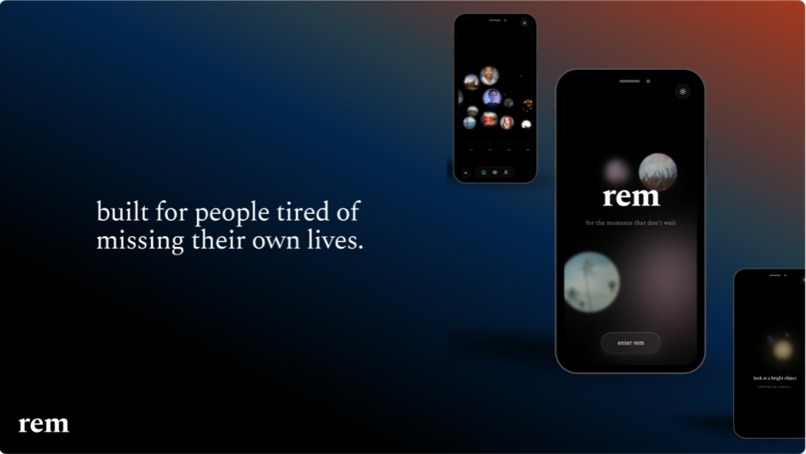
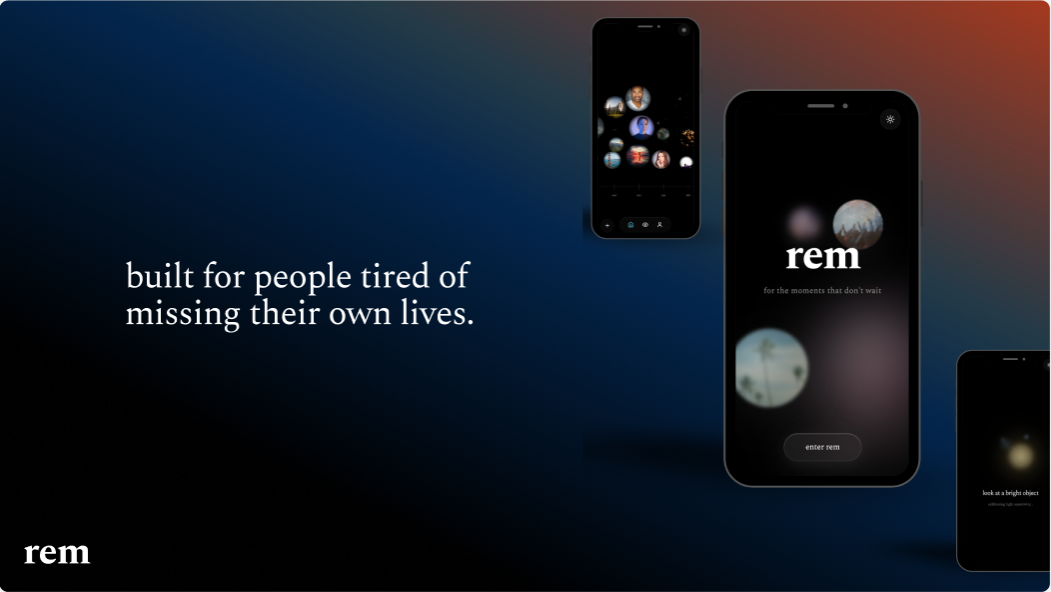
rem: built for people tired of missing their own lives
-
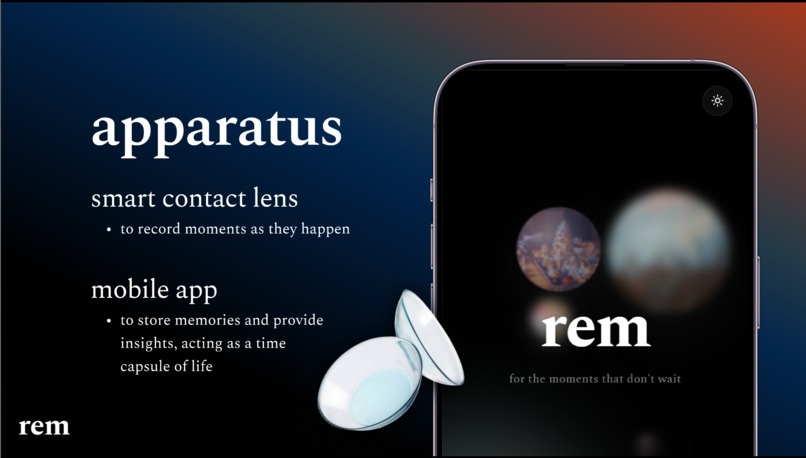
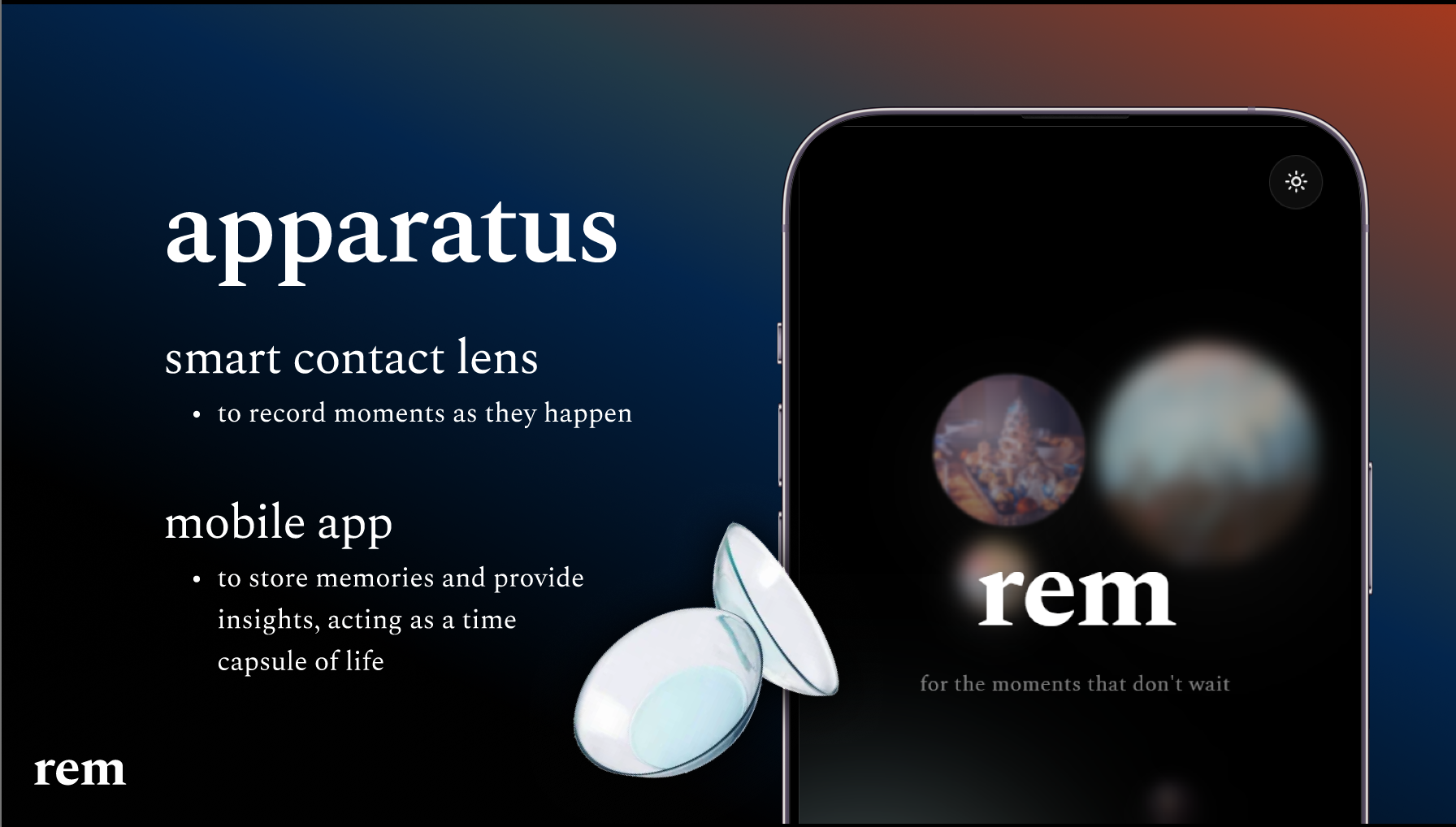
apparatus
Inspiration
Observations
There's a well-documented phenomenon where the act of taking a photo actually impairs your memory of the thing you photographed. Your brain outsources the remembering on technology and stops encoding the experience itself. We started there — if the camera is making memory worse, what would a camera that didn't ask anything of you actually look like? Moreover, how might we reclaim our memories without compromising living in the present?
Visual Style: Apple Liquid Glass (iOS 26)
Translucent, multi-layered "living glass" panels that refract and reflect background content. Neomorphic depth meets fluid minimalism.
All surfaces behave like light-reactive glass — frosted, semi-transparent, with soft inner shadows and specular highlights. UI adapts dynamically between light/dark contexts.
Widgets, icons, and cards feel organic and touch-responsive, as if filled with light liquid. Consistent across mobile, tablet, and watch viewports. See-through layers, adaptive blur, no hard opaque backgrounds.
| Property | Detail |
|---|---|
| Surfaces | Frosted, semi-transparent, light-reactive glass |
| Depth | Neomorphic with soft inner shadows & specular highlights |
| Contexts | Adapts dynamically between light/dark |
| Components | Widgets, icons, cards — organic & touch-responsive |
| Viewports | Mobile, tablet, watch |
| Backgrounds | See-through layers, adaptive blur, no hard opaque |
Reference: spill-verify-25039844.figma.site
What it does
rem is a speculative tool built for people who are tired of missing their own lives and consists of two key devices: an app and a pair of lens. The lens are a touchpoint which automatically record the moments your body recognizes as meaningful based on physical cues like pupil dilation or gaze duration — before your brain has time to reach for a phone. Following a gentle and personalized onboarding phase based on biometric data, it pairs seamlessly with an app that organizes and replays those memories for you based on identified patterns. You live, and rem keeps up.
IMPORTANT NOTE:
Our app has NO backend connected to it. Therefore, any sequence of letters and numbers will be allowed when typing your email, name, and password into the “sign up” page or “login page.” The email typed in does not have to be a real email for it to go through: our software only requires there to be an “@gmail.com” at the end. Our goal for the signup page is just to simulate the experience of signing into the app if it were a real product. No information that you type will be stored or saved, since again, there is no backend connected.
How we built it
We used Figma Design to ideate and create moodboards to craft a cohesive brand identity, Figma Make to build a prototype, and Figma Slides to compile our work into one coherent presentation.
Challenges we ran into
Privacy was the hardest wall we kept running into. A device that records passively is admittedly uncomfortable at face value, and we were afraid of breaching privacy for the sake of novelty. We had to think carefully about thoughtful tradeoffs, where the product's responsibility ends and the user's begins, and how to account for these risks. With a thoughtful interaction model as our top priority, we made sure that rem implemented many layers of preferences and customization based on each individual user’s boundaries and comfort.
Accomplishments that we're proud of
We are most proud that our product's entire philosophy stayed intact from the first idea to the final version. We were really deliberate about making sure rem never asks anything of you in the moment, and still captures the feeling of time passing (chronoception, as we denote in our presentation) most people have but don't have language for.
We are proud of creating something deeply relevant to our own experiences, and tackling all the privacy considerations that came with this concept head-on. Situated in the current sociocultural climate, rem is forward-facing and seeks to coexist with a growing generation of “digital natives” raised in an uncertain environment built on social media and emerging AI tools that are overwhelming at times.
What we learned
From a technical standpoint, we learned how to leverage Figma Make and other front end skills to create a viable prototype, as well as key user-based considerations that are the foundation of a human-centered product. From a more intimate and personal standpoint, we learned that building from an emotional truth that resonates with the human experience is what makes every design decision clearer.
What's next for rem: for the moments that don't wait
The most immediate next steps for rem would include a more in-depth examination of biometric features as well as how to construct the memory "capsules" themselves based on user behavioral patterns. Further down the road, we would be interested in thinking about how to examine usage of rem over a longer period of time -- perhaps decades or even a lifetime -- and what it would look like for the application to essentially grow alongside a user.
Built With
- claude
- figma
- figmadesign
- figmamake
- figmaslides





Log in or sign up for Devpost to join the conversation.