-
-
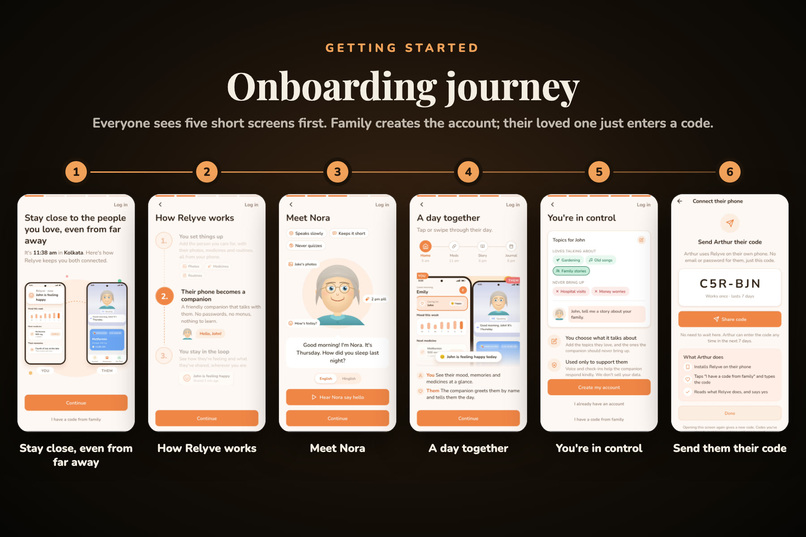
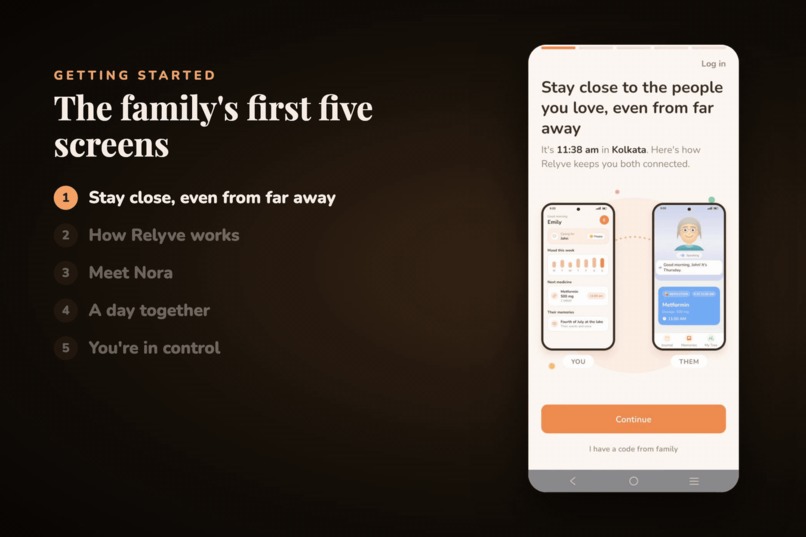
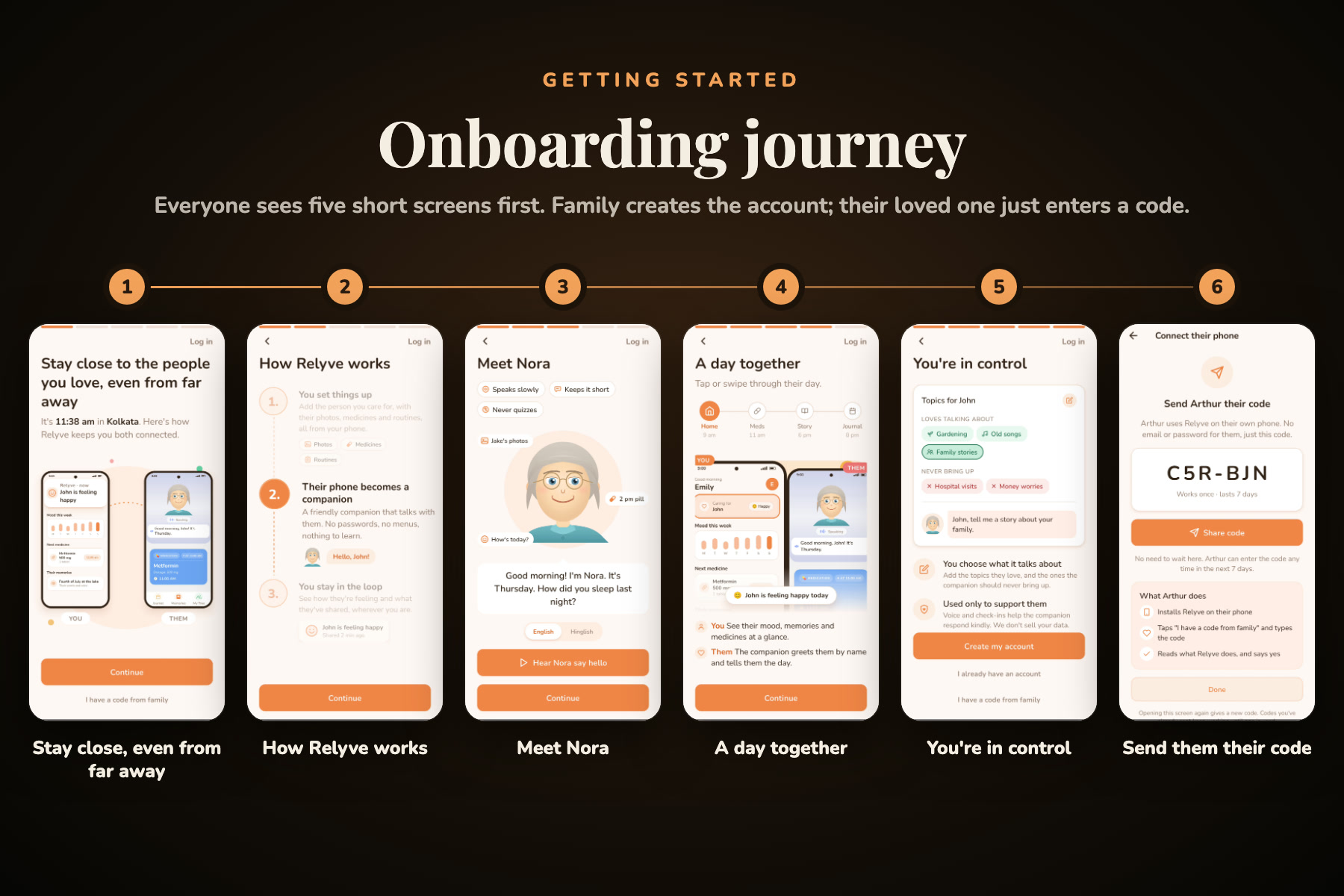
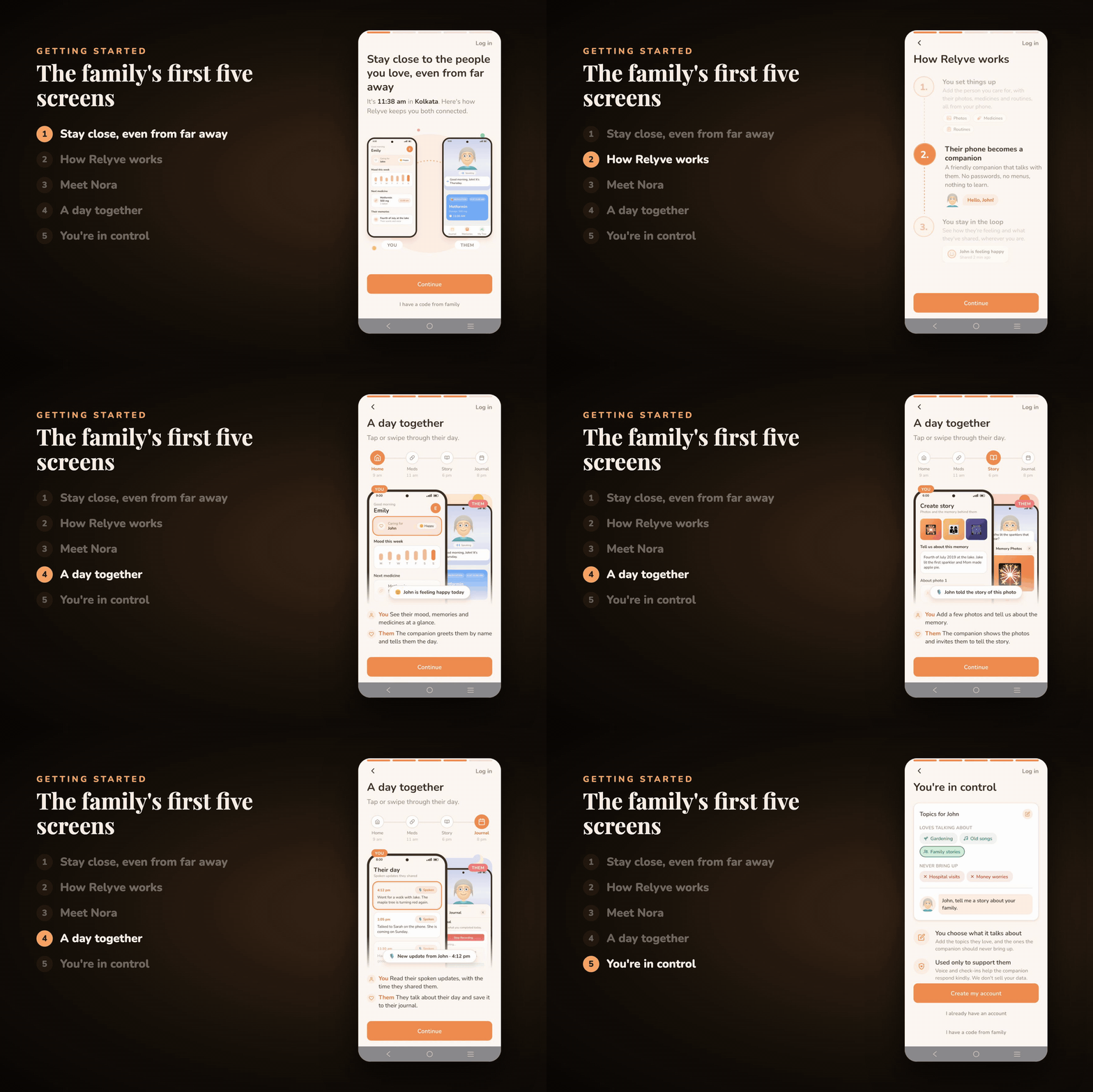
Everyone starts with five short screens. Family creates the account and sends a code; their loved one never needs a password.
-
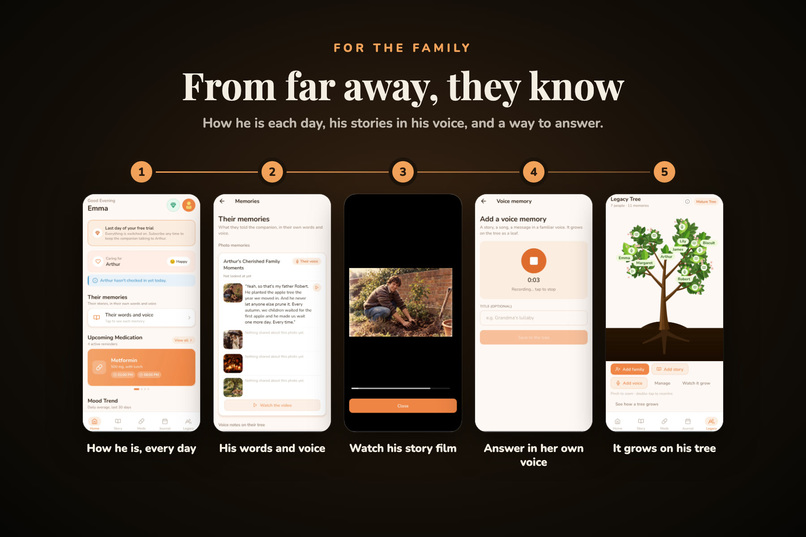
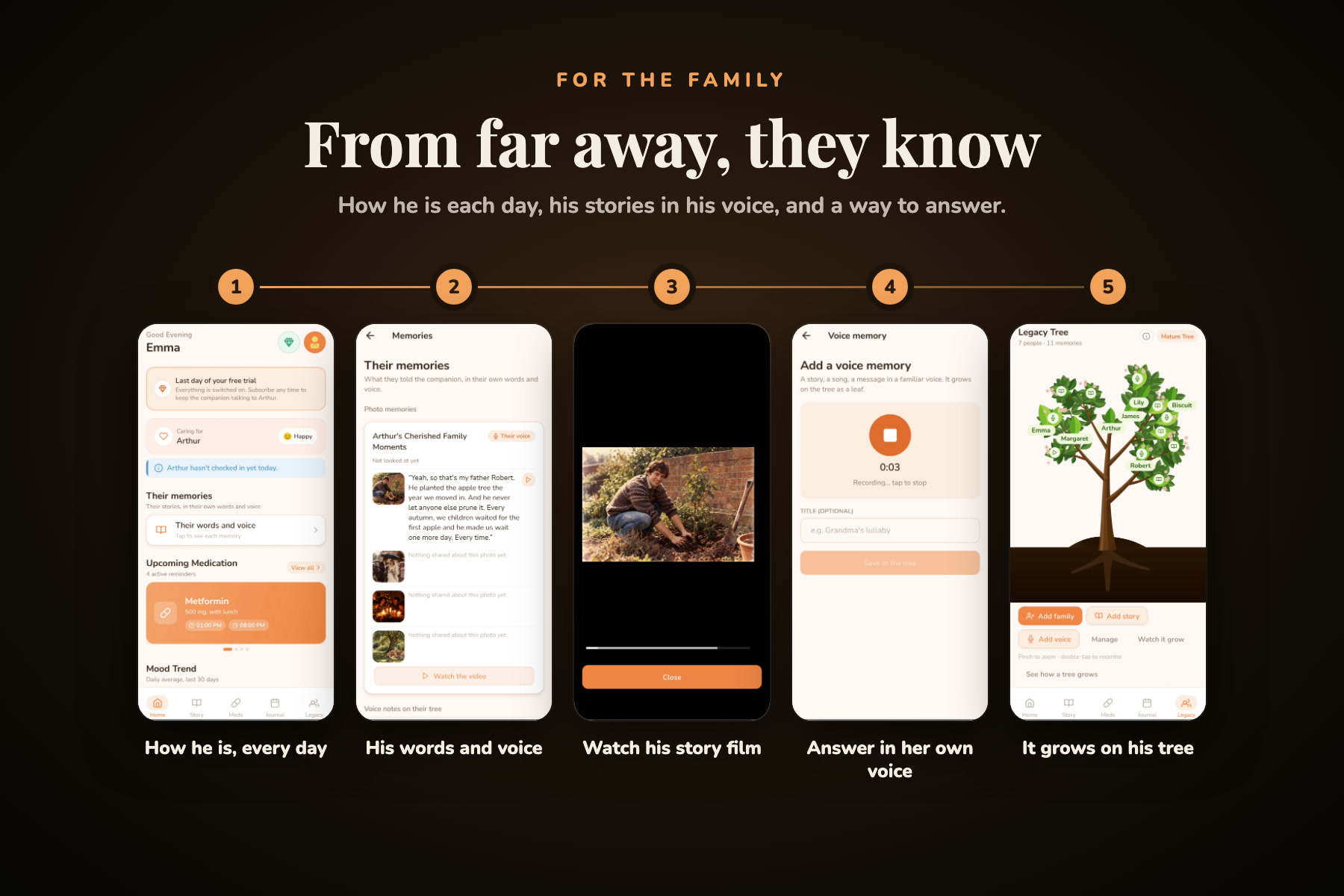
The family side: how he is each day, his stories in his own words and voice, his story film, and a reply in a voice he knows.
-
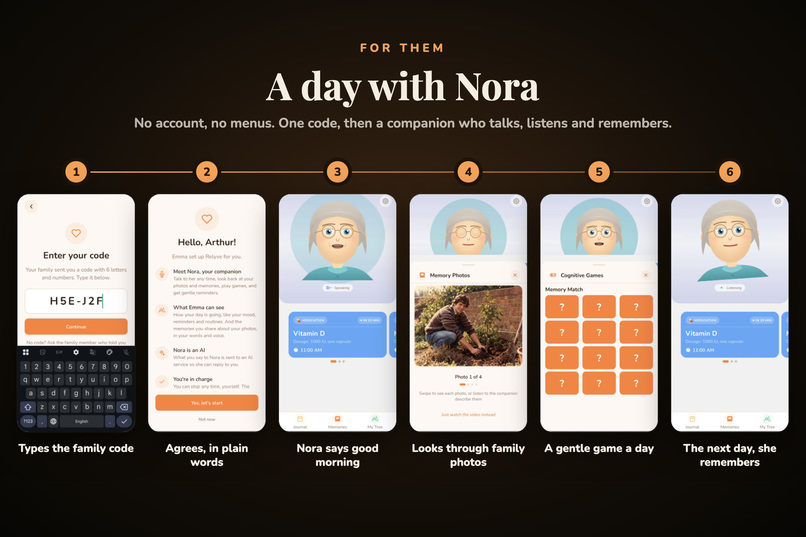
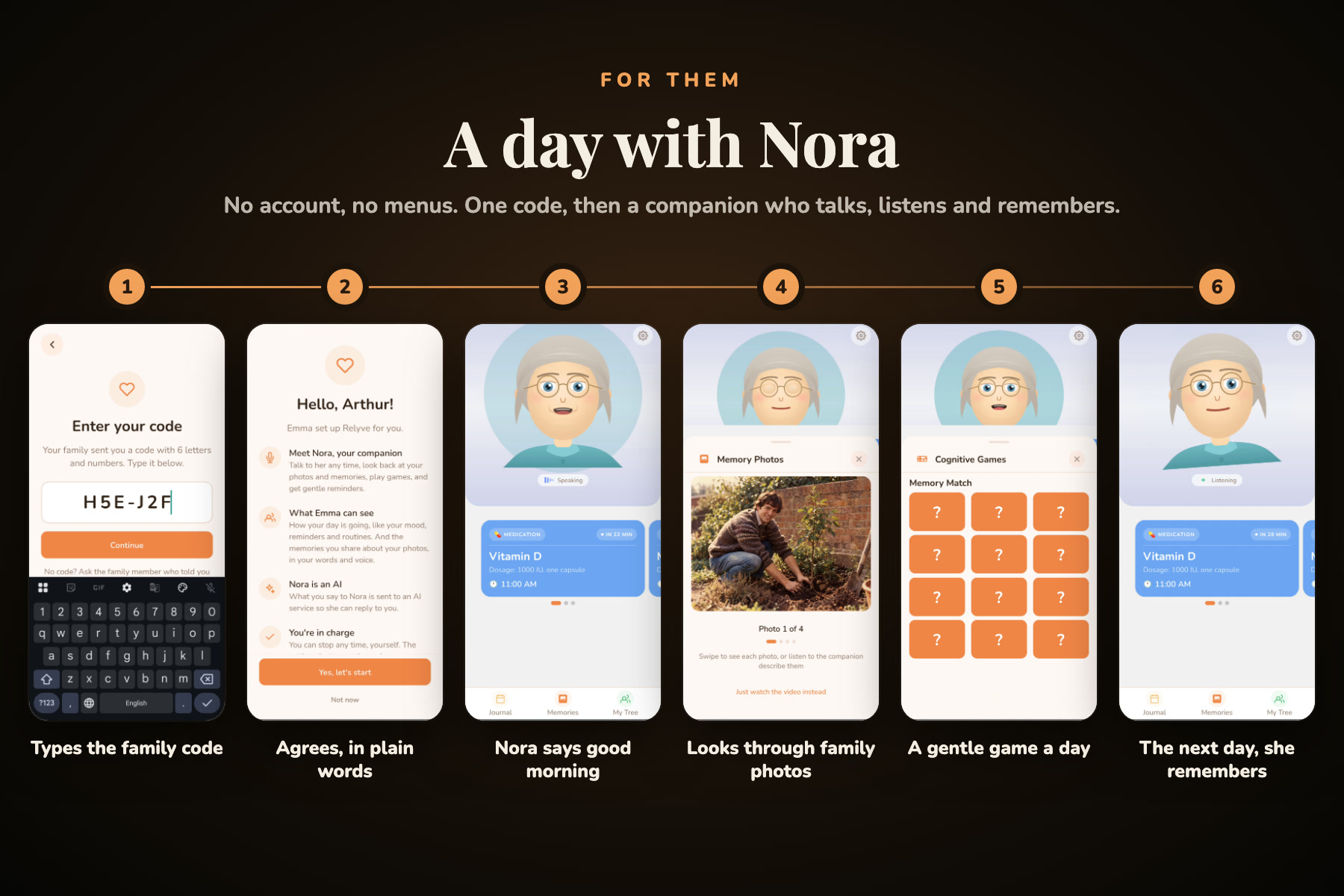
His side: one code, plain-word consent, then Nora greets him, looks at family photos, offers a gentle game, and remembers the next day.
-
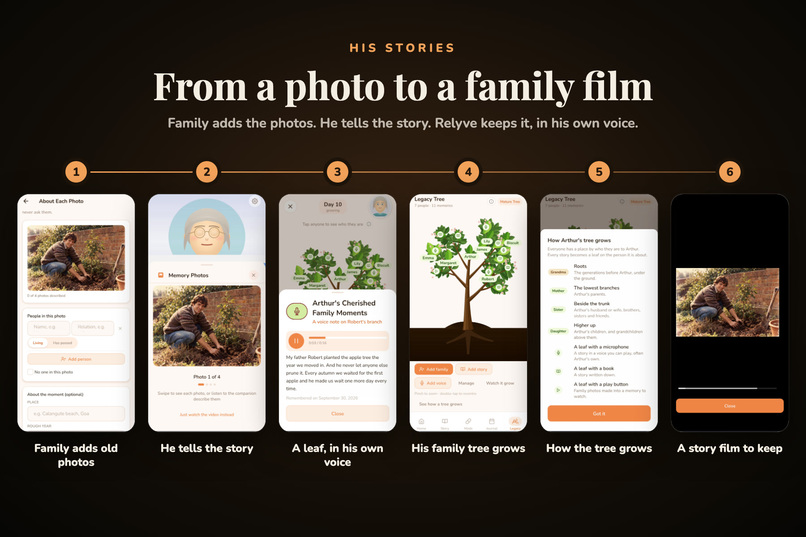
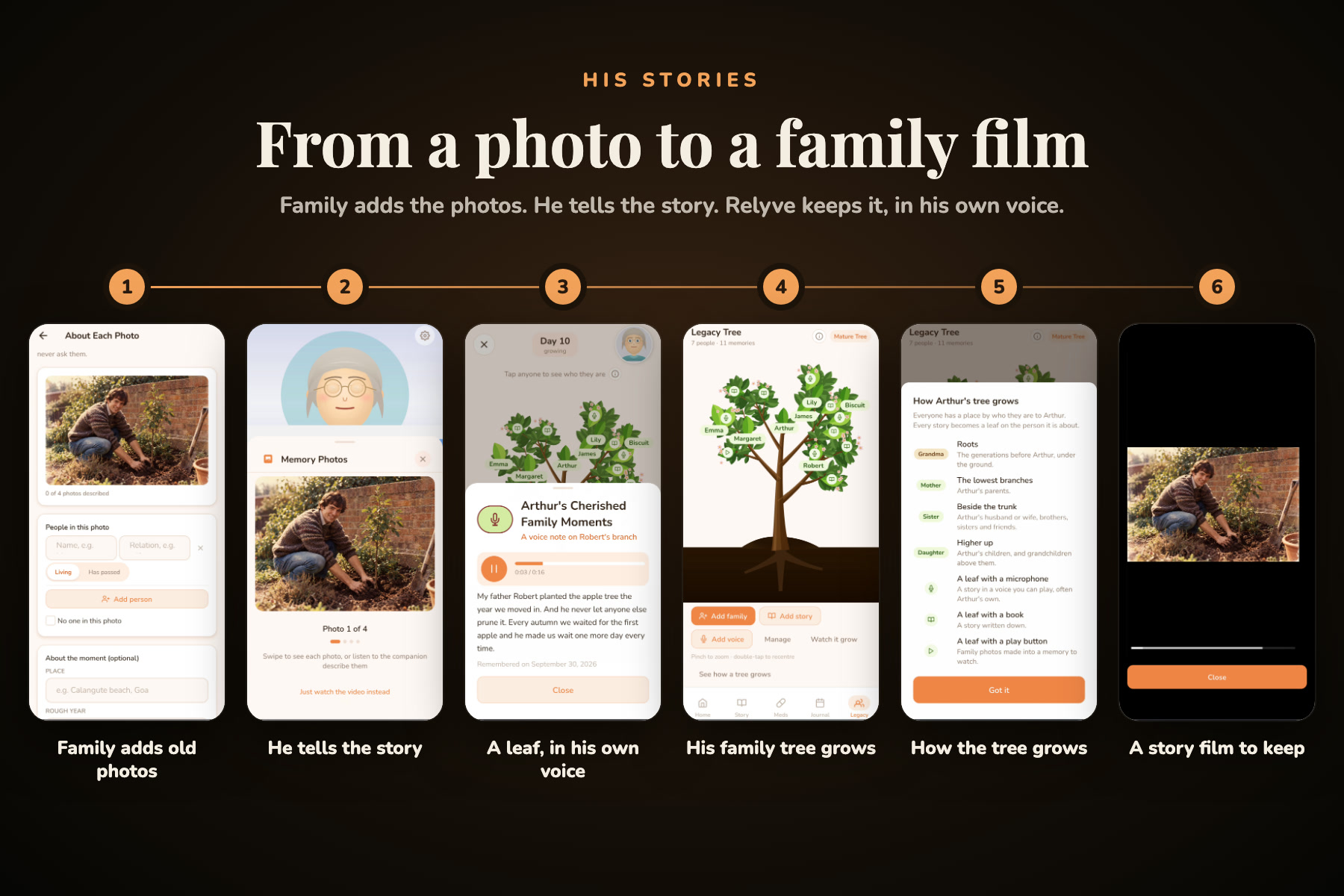
Family adds old photos. He tells the story to Nora. It becomes a leaf in his own voice, and Relyve makes a story film the family keeps.
-
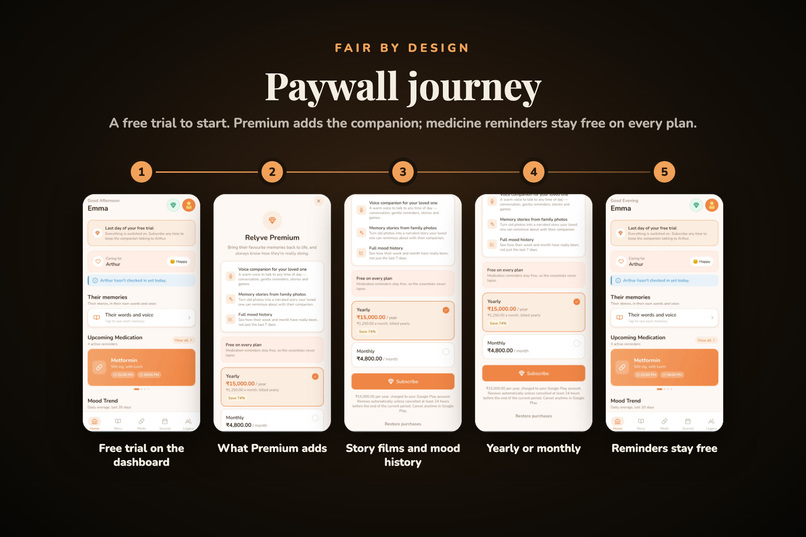
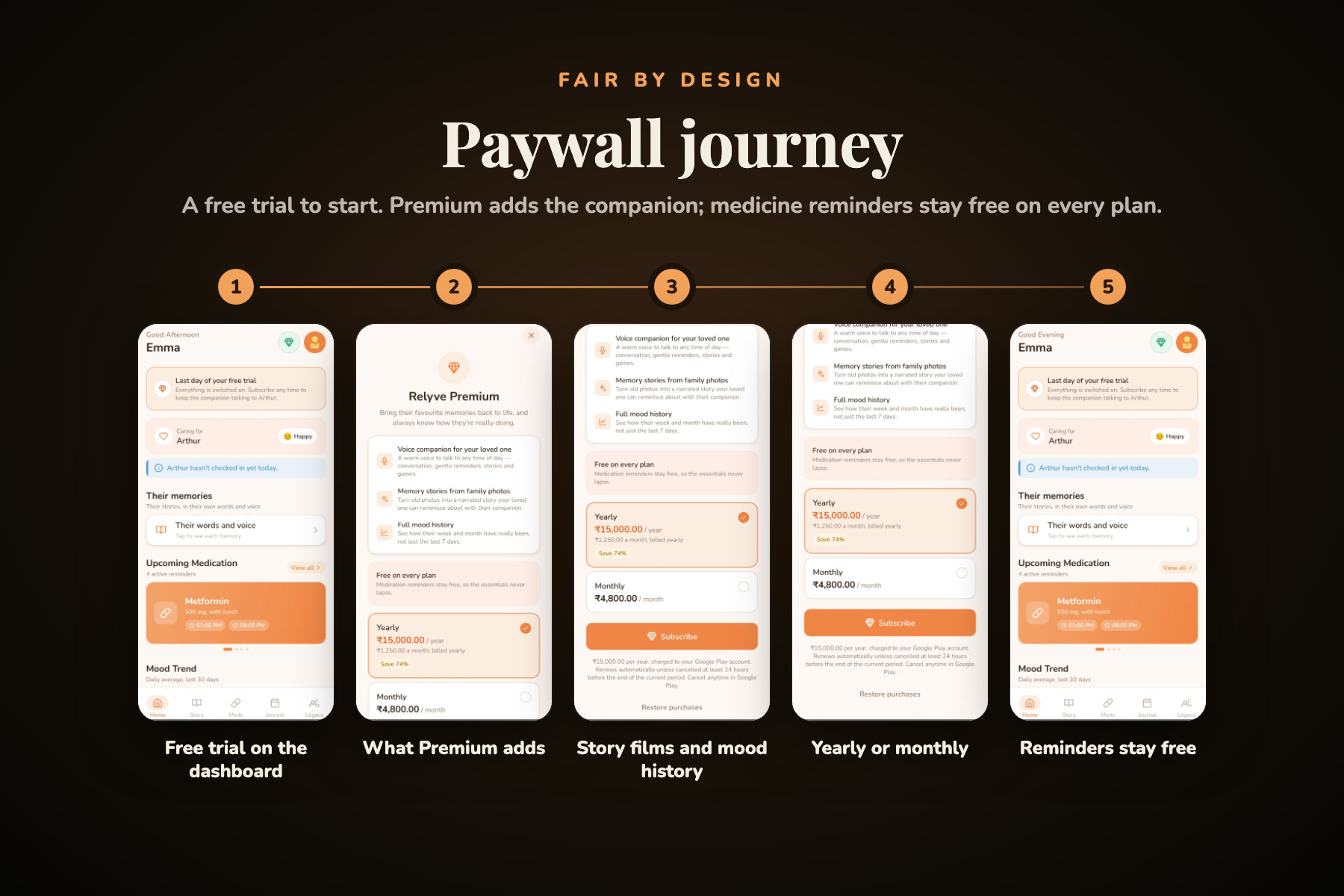
A free trial to start. Premium adds the voice companion and story films. Medicine reminders stay free on every plan, so safety never lapses.
-
 GIF
-
-
-


Inspiration
Relyve began with my parents.
My parents live in Nashik. I work as a software developer in Hinjewadi, Pune, about 200 km away, and I'm their only child. Lately I've started to notice the little things on our calls: a name that takes a moment to come, a question asked twice.
Being an only child means there's no brother or sister down the road to drop in. When I'm not there, the house is quiet. And every time I visit, I hear stories I've never heard before: how they met, the first house, people I only know from photographs. I realised nobody was keeping those stories, and that one day I'd want to hear them again in their own voices.
I'm not the only one. Families everywhere have scattered for work, and a lot of parents are growing old in quiet houses. About a third of adults over 60 are socially isolated (WHO, 2025). More than 1 in 7 people over 50 live with mild cognitive impairment (Age and Ageing, 2022), which is the stage where names and appointments start to slip but the stories are still there.
I didn't want to build another app that watches and measures older people. I wanted one they'd actually want to open, where they're the storyteller and not the patient. Today my own parents use it.
What it does
Relyve helps people in early cognitive decline (mild cognitive impairment and early dementia) relive their life through their memories, in their own voice, and keeps their family close while they do it.
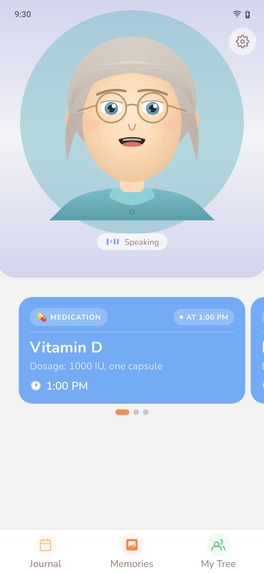
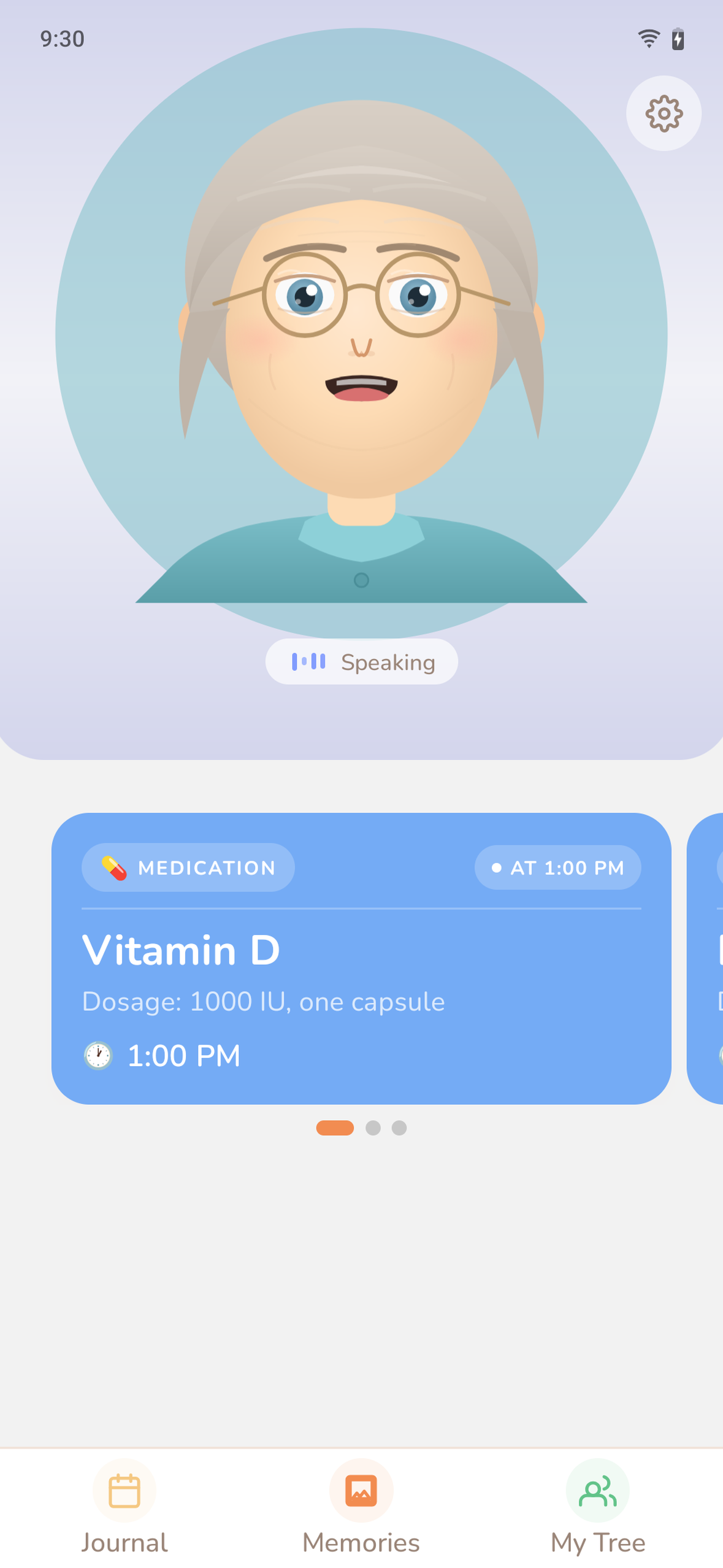
A companion who feels like a person. Nora is a real-time voice companion on the person's own phone. You can interrupt her mid-sentence, just as you would a friend. If the person sounds low, confused or agitated, she slows down, keeps it simple and stays gentle; late at night she speaks softly and calmly.
Never a patient. People in early decline don't want to be told they're declining, so Relyve never says it. Nora never tests, quizzes or corrects, and never asks "do you remember".
No menus to learn. The person just asks. Nora opens the photos, starts a game or shows someone on the family tree herself, from the conversation.
Photos from family, stories from them. Family members add old photographs from wherever they live. Nora looks through them with the person, one at a time, and asks about them. This is reminiscence, an approach used in memory care and studied for decades for its effect on mood and wellbeing (Cochrane review, Reminiscence therapy for dementia, 2018).
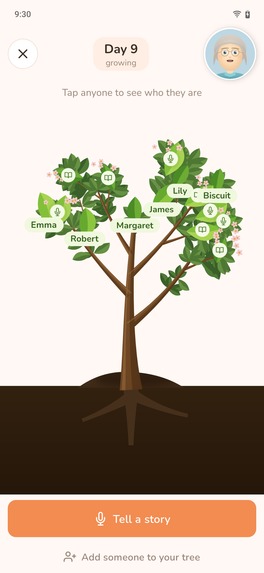
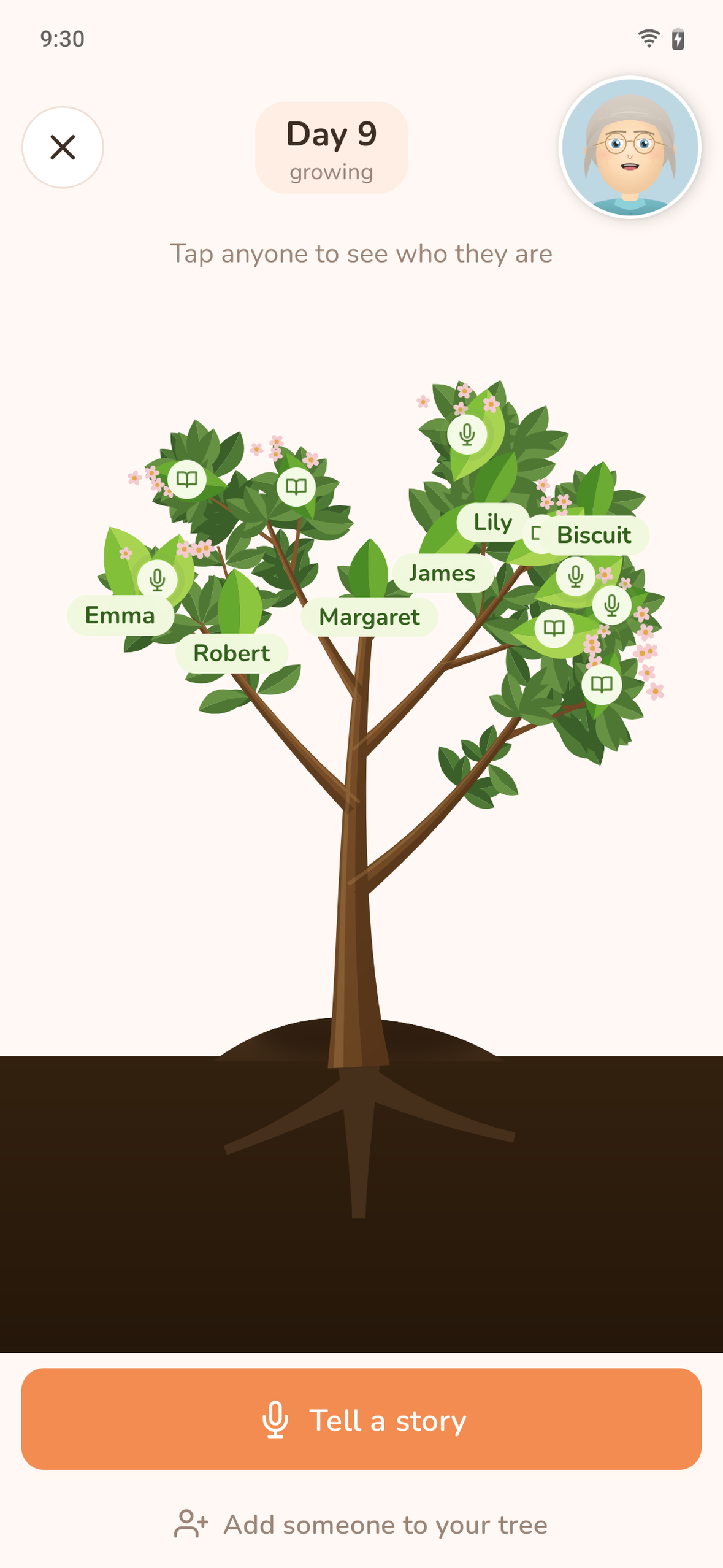
A family tree that grows as they tell it. Whatever they say about a photo becomes a leaf on that person's branch, kept as a recording of their own voice. The family are the branches and the stories are the leaves, and the family can watch the whole tree grow from a single seed.
Their story, kept as a film. After they talk, Relyve turns the photos, the family's notes and the person's own voice into a short film: a narrator tells each photo, then hands over to the person telling it themselves. It rebuilds itself as they tell more, and lives on the tree as a video leaf.
Family watches it, and answers. On their own phone, a son or daughter watches the film, hears the story in their parent's voice, and records a reply, which grows as a leaf on the tree.
Nora remembers. The next morning Nora brings the story back as something the person told her, and can open their family tree to the person it was about.
Medicines, on time. A gentle reminder for each medicine arrives at the right time.
The family knows how they are, every day. Mood from their conversations, medicines taken, and new stories reach the family's phone: only what the person agreed to on their consent screen, and they can switch it off themselves at any time.
Seven gentle games. Memory recall, picture recall, object recognition, odd one out, emotion recognition, a memory grid and rapid sort. Nora offers one a day at a natural moment in conversation, a different one each time: a little everyday mental exercise, and fun. Never scored at them, never set.
Gentle by design. If they can't remember, Nora lets it go and moves on. If they get upset, the questions stop and the family is told privately.
Fair by design. Setup is a six-character code, with no account and no password for the older person. They agree to a consent screen written in plain words, which says exactly what the family can see and that Nora is an AI. Medication reminders are free on every plan, so if a subscription lapses, nothing that keeps them safe switches off.
How we built it
I build software for a living, but a real-time voice app for older people was new ground for me. I built Relyve with Claude Code as my pair programmer.
- App: React Native (TypeScript), Android first.
- Voice: Gemini Live over WebSockets, for natural conversation where you can interrupt. Nora uses tool calls to open the photos, save a story as a leaf, add someone to the tree and start a game, all from conversation.
- Voice leaves: while the person talks about a photo, their part of the live audio is clipped and saved as the leaf's recording.
- Story films: Gemini writes a short narration for each photo from the family's notes, Gemini text-to-speech reads it, and ffmpeg builds the film with the person's own clips placed after each narration. It is rebuilt after every conversation, so new stories join the film.
- Backend: Node.js and Express with MySQL on AWS, Firebase Cloud Messaging for reminders and family notifications, and signed URLs for private family media.
- Subscriptions: RevenueCat for the voice companion, with entitlements checked on the server. The companion has a real per-minute cost, so it's the paid part. Reminders stay free.
- Tree: drawn with React Native Skia, so new leaves grow in with animation.
Challenges we ran into
Making conversation feel like conversation. An older person won't wait through a long silence. It is the difference between "talking to someone" and "using an app". The first version took 5 to 10 seconds to reply. After moving to a newer live model and adding local barge-in and earlier end-of-speech detection, replies now come in about 2.4 seconds.
Choosing who it's for. I first designed Relyve for dementia in general. Watching my own parents changed that. In the early stage of memory decline, a person can still tell their own story, and that's the window Relyve is built for: mild cognitive impairment and early dementia.
Not over-claiming. It would be easy to say an app like this "strengthens memory". The evidence doesn't support that. Reviews of reminiscence therapy find small and inconsistent benefits, and only in dementia. So Relyve doesn't claim to slow anything. It supports what reminiscence is known for: mood, connection and a sense of self.
Dignity in every word. The app never says "patient" or "dementia" to the person using it. No camera is ever pointed at them, and the family doesn't get a transcript feed. The person can stop sharing from a visible setting, without having to ask anyone.
Accomplishments that we're proud of
- A voice companion that replies fast enough to feel like a person.
- A family tree that fills with a parent's stories, recorded in their own voice, which their children and grandchildren can keep.
- Story films that weave a family's photos with the parent telling them, made automatically from a conversation.
- A setup an older person can do with one code and no password.
- A subscription model that never takes safety features away from someone whose card has lapsed.
What we learned
I learned that for this audience, the technology only works when you can't see it. The hardest decisions weren't about code. They were about what to leave out: no quizzes, no scores, no clinical words, and no claims I can't back up.
I also learned that building for your own family makes every decision clearer. When I wasn't sure about a feature, I asked myself whether my parents would feel respected by it.
What's next for Relyve: relive your life through memories
- A companion they choose. Today Nora is an illustrated face that reacts as she listens and speaks; next come 3D companions in different characters, so each person picks the face they would most like to talk to.
- Their voice on every story. Today Relyve keeps the person's voice whenever they talk about a photo; next, stories told in ordinary conversation will keep their voice too, not just a written summary.
- Smarter story films that choose the person's clearest moments on their own, so a stray "hmm" never makes the cut.
- Release on iOS
- A keepsake book of the tree, with its stories and voices, for the family to keep.
Built With
- amazon-web-services
- android
- express.js
- firebase
- gemini
- gemini-live-api
- mysql
- node.js
- react-native
- revenuecat
- skia
- typescript

Log in or sign up for Devpost to join the conversation.