-
-

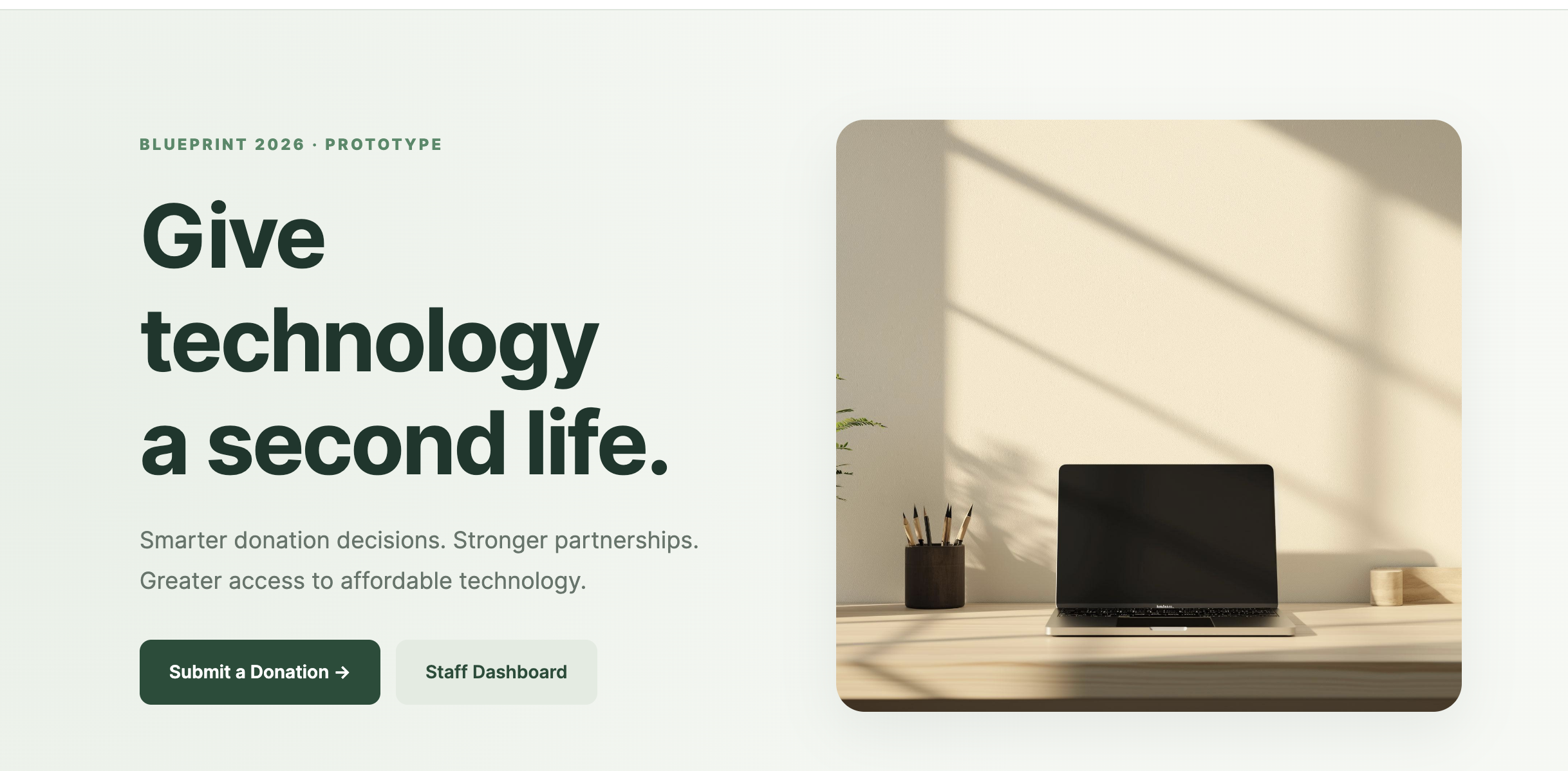
ReLoop Intelligence homepage — a digital platform helping Free Geek Toronto make smarter technology donation decisions.
-
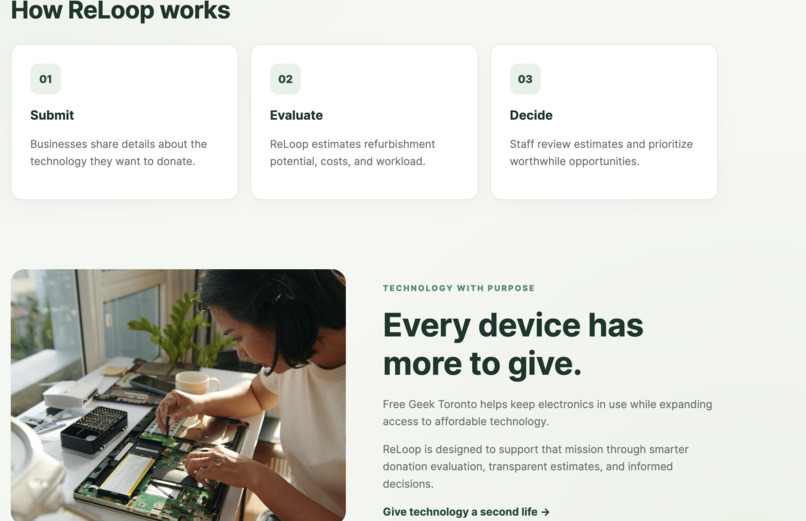
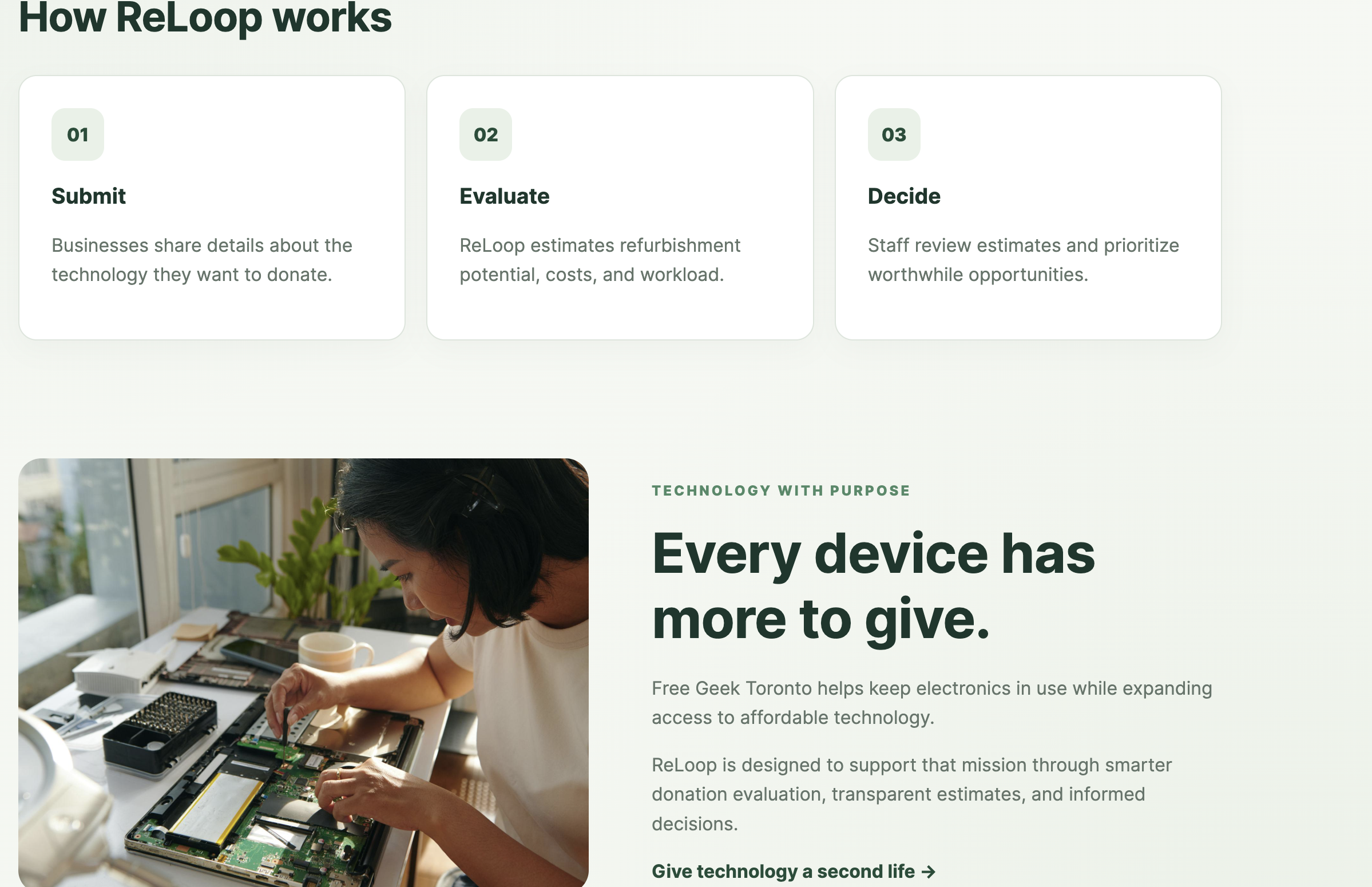
How ReLoop works — businesses submit device details, receive preliminary evaluations, and support informed staff decisions.
-
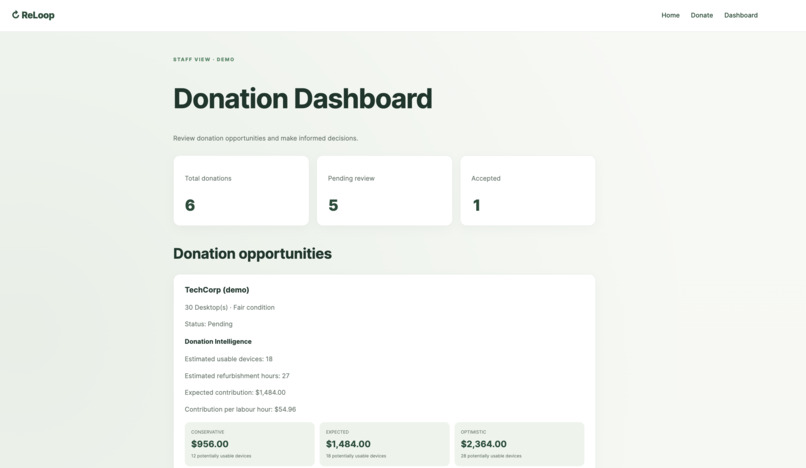
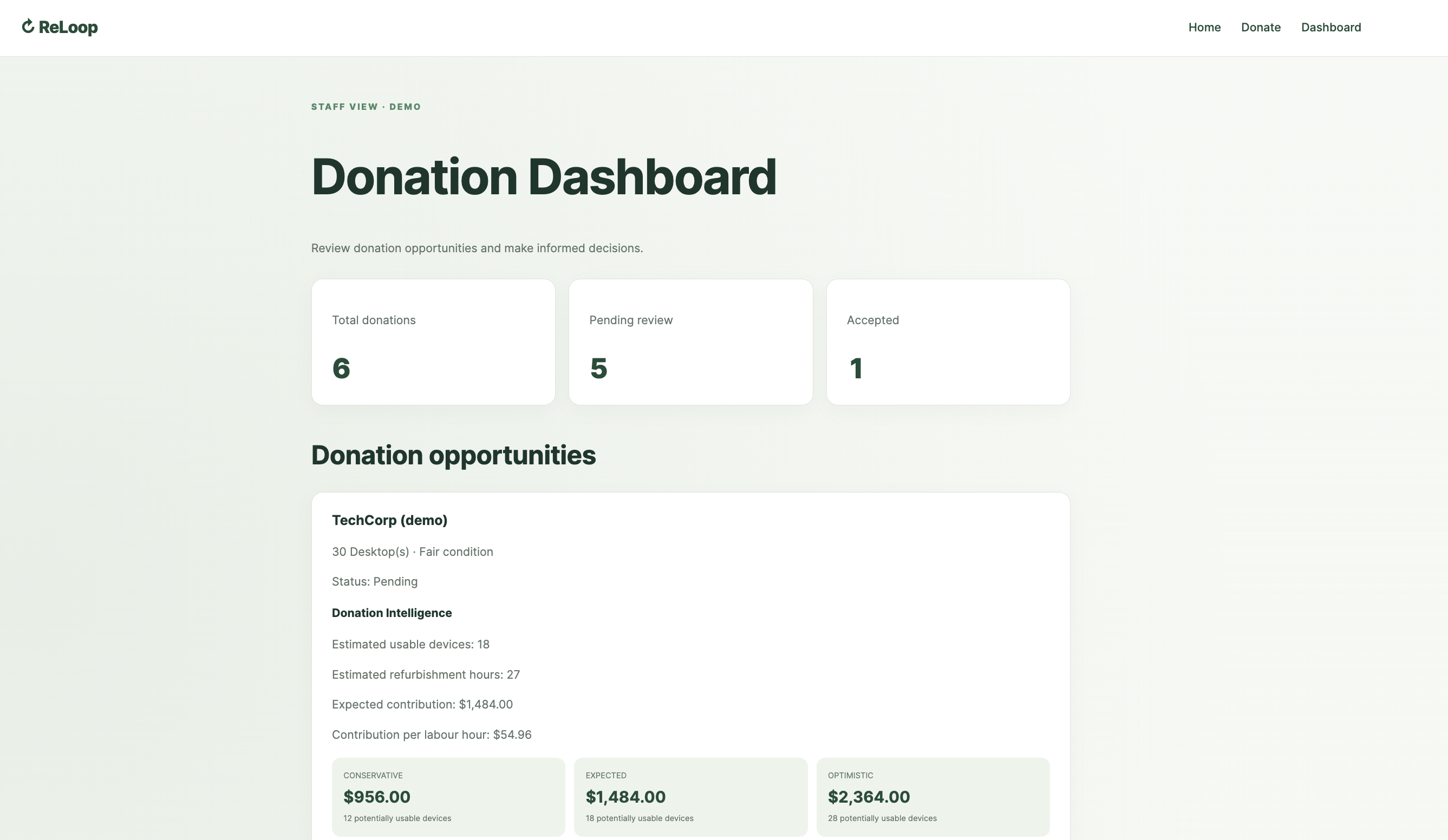
Staff dashboard — track donation submissions, pending reviews, and accepted donations in one centralized interface.
-
Donation evaluation — estimated reusable devices, refurbishment hours, financial scenarios, and warnings for staff review.
-
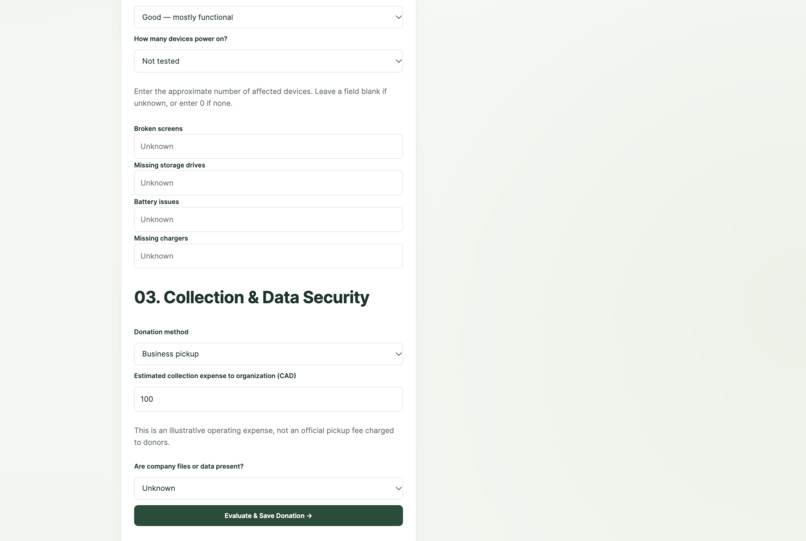
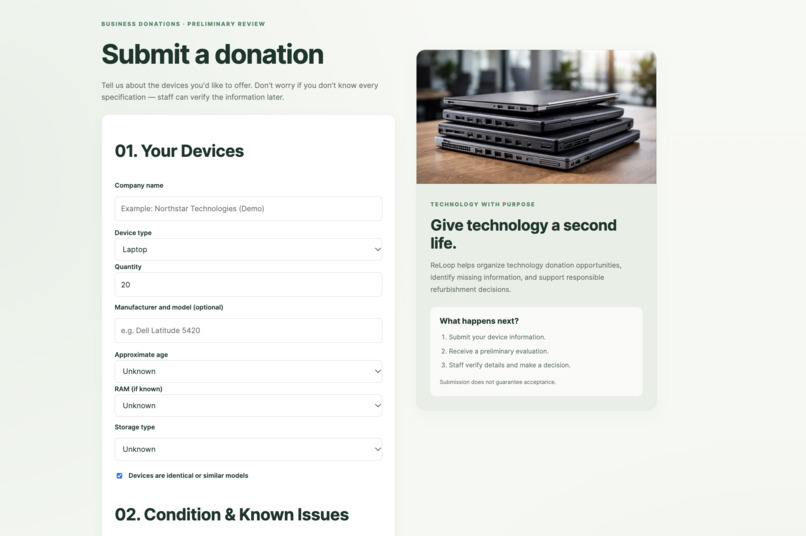
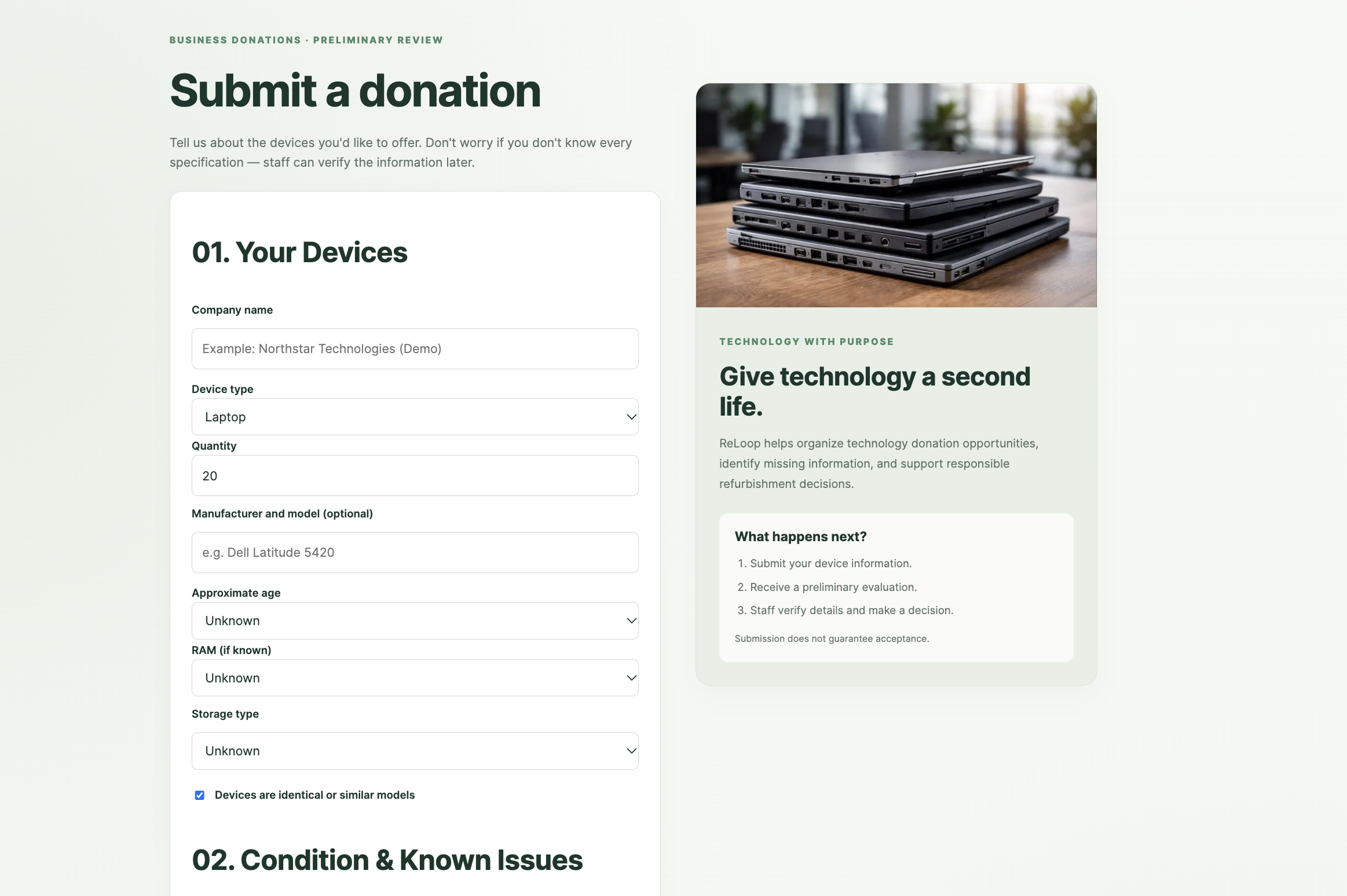
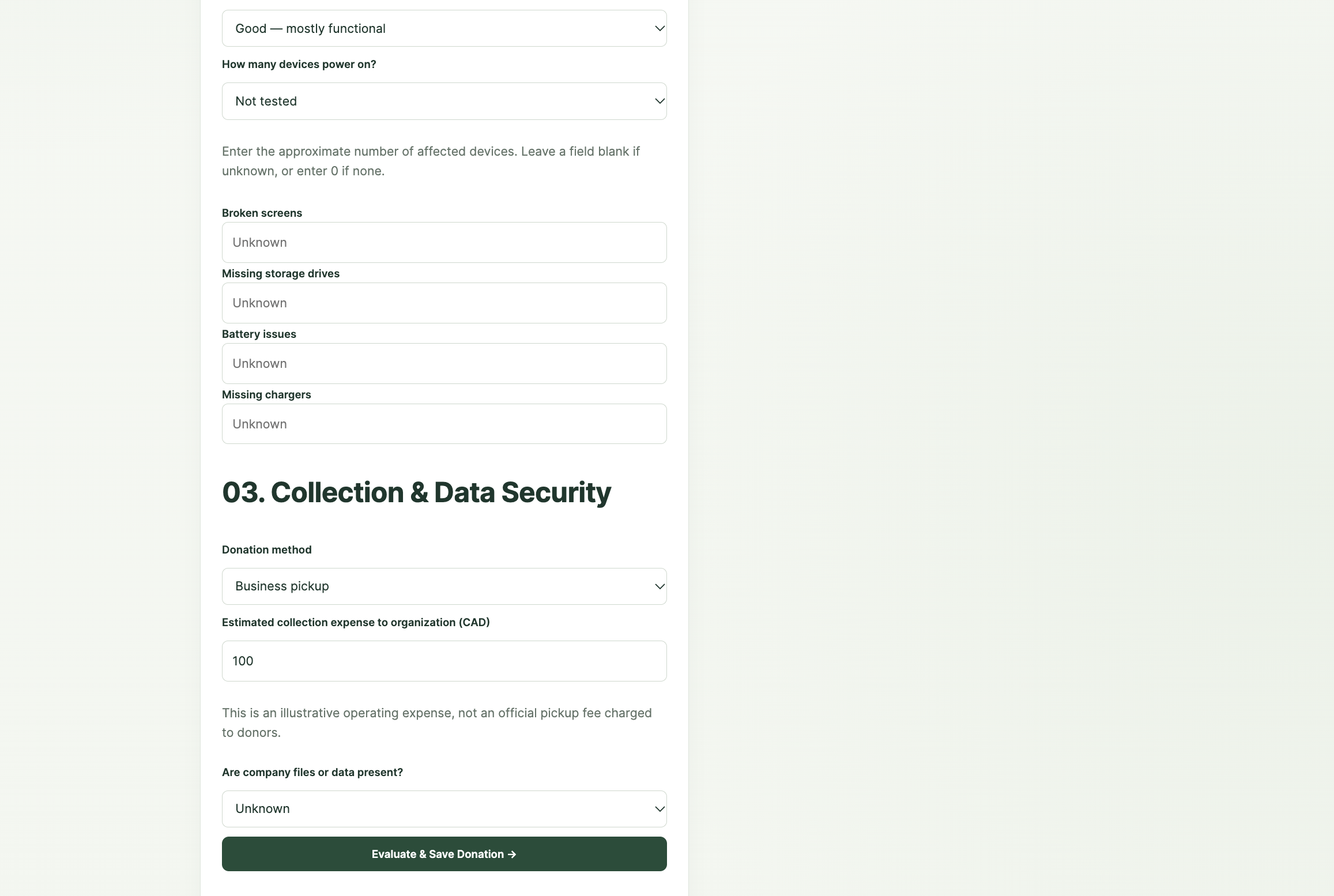
Business donation portal — collect device specifications, condition, known hardware issues, and collection details.
Inspiration
What if the biggest challenge in technology recycling isn't collecting more devices, but making better decisions about the devices we already have?
That question inspired ReLoop Intelligence.
For many people, access to reliable technology is essential for education, employment, and everyday life. Yet countless electronic devices are replaced or discarded despite potentially having years of useful life remaining.
Free Geek Toronto (FGT) helps address this challenge by collecting unwanted electronics, refurbishing reusable technology, and making computers more affordable and accessible to the community.
However, through the FUSE Society Blueprint 2026 case study, we discovered several interconnected operational challenges:
- Inconsistent donations: Devices arrive in different conditions, models, and quantities, making refurbishment planning difficult.
- Limited corporate partnerships: Without established corporate partners, securing a recurring supply of suitable technology remains a challenge.
- Resource constraints: FGT operates with one full-time employee, five part-time employees, and approximately 30–40 active volunteers.
- Revenue dependence: According to the case, approximately 77% of FGT's 2025 revenue came from sales, making suitable refurbished products essential to its financial sustainability.
We realized that simply encouraging more businesses to donate wouldn't necessarily solve the underlying problem.
A large donation of outdated computers with missing components could require significantly more resources than a smaller donation of relatively modern, functional devices.
The real opportunity was to make donation evaluation more informed, transparent, and efficient.
This led us to develop ReLoop Intelligence, a full-stack donation evaluation and management platform that helps organizations assess the potential value, refurbishment needs, and operational suitability of technology donations before committing limited resources.
What it does
ReLoop Intelligence is a functioning web-based prototype that helps organizations assess technology donations, compare hypothetical financial scenarios, identify operational concerns, and manage donation decisions through a centralized dashboard.
Our application follows four stages:
Submit → Evaluate → Review → Decide
1. Submit — Detailed Donation Intake
Businesses begin by completing an accessible donation form that collects information about their available technology.
Our upgraded donation process goes beyond basic device quantity and condition.
Hardware information:
- Device type and quantity
- Manufacturer and model
- Approximate device age
- Installed RAM
- Storage type (SSD, HDD, or missing)
- Whether devices are identical or similar models
Condition assessment:
- Overall reported condition
- Number of devices that power on
- Number of broken screens
- Missing storage drives
- Battery problems
- Missing chargers
Collection and security:
- Pickup or drop-off method
- Estimated collection expense
- Whether company data may still be present
Unknown information is permitted because business donors may not know every technical specification.
Rather than treating missing information as verified, ReLoop can identify uncertainty and prompt further review.
The purpose is to collect enough information for a meaningful preliminary assessment without requiring donors to perform professional hardware inspections.
2. Evaluate — Donation Intelligence Engine
Once a donation is submitted, our Python-based evaluation engine processes the reported information using a transparent, rules-based algorithm.
The upgraded model considers more than quantity and general condition. It incorporates additional information such as device age, memory, storage, power-on status, and known hardware issues into its assumptions.
The system estimates:
- Potentially reusable devices
- Expected refurbishment workload
- Potential sales revenue
- Modeled parts, labour, and collection costs
- Estimated financial contribution
- Contribution per refurbishment hour
ReLoop also generates three possible financial outcomes:
Conservative: A less favourable refurbishment outcome.
Expected: The central estimate based on the model's assumptions.
Optimistic: A more favourable refurbishment outcome.
These scenarios help demonstrate how uncertainty can affect the value of an incoming donation.
The evaluator also generates review notes for potential operational problems, such as excessive labour requirements, missing hardware, storage concerns, or data-security considerations.
ReLoop is not a trained artificial intelligence model. It uses an explainable, rules-based approach so that assumptions can be examined and updated.
All financial outputs remain hypothetical until calibrated with verified refurbishment and financial data.
3. Review — Centralized Donation Dashboard
Submitted donations are stored in a SQLite database and displayed through an interactive staff dashboard.
The dashboard includes:
- Total donations received
- Pending donation opportunities
- Accepted donations
- Donor-reported device details
- Preliminary financial evaluations
- Conservative, expected, and optimistic scenarios
- Estimated refurbishment workload
- Operational warnings and review notes
We designed the interface to make complex information approachable, with forest-green branding, soft nature-inspired backgrounds, rounded cards, and animated statistics.
This provides a central location for reviewing donation opportunities instead of relying exclusively on disconnected forms and manual records.
4. Decide — Staff-Controlled Donation Management
After reviewing an assessment, staff can change the donation's status to:
- Pending
- Accepted
- Declined
- Needs Information
Status changes are saved in the database and remain available after refreshing the application.
Importantly, ReLoop does not automatically approve donations.
A donor's report cannot establish the true condition of a device. Physical inspection, verification, and appropriate data handling remain essential.
ReLoop is designed to support staff decisions, not replace professional judgment.
How we built it
We developed ReLoop Intelligence using a modular full-stack architecture that prioritizes explainability, usability, and practical operation for a resource-constrained nonprofit.
Frontend — HTML, CSS, and JavaScript
We built a responsive website using HTML5, CSS3, and vanilla JavaScript.
The website includes three primary interfaces.
Homepage: Introduces ReLoop's mission, explains the donation workflow, and connects users to the application.
Donation Portal: Collects detailed hardware information, reported defects, collection requirements, and data-security information.
Staff Dashboard: Displays stored donations, preliminary assessments, financial scenarios, and staff review controls.
JavaScript collects and validates user inputs, communicates with our FastAPI backend through HTTP requests, and dynamically displays results.
We also implemented animated dashboard statistics, responsive layouts, and accessible form labels.
Backend — Python and FastAPI
Our backend uses Python and FastAPI to handle requests, process submitted information, and communicate with the database.
Pydantic provides structured data models and validation.
We organized the backend into four modules:
main.py— API endpoints and application configurationmodels.py— Donation models and input validationevaluator.py— Refurbishment and financial estimation logicdatabase.py— SQLite storage and donation status management
Separating these responsibilities makes the application easier to understand, maintain, and expand.
Donation Evaluation Algorithm
The core of ReLoop is its rules-based donation evaluation engine.
The model begins by estimating the number of devices that may be suitable for refurbishment.
$$ \text{Usable Devices} = \lfloor \text{Quantity} \times \text{Estimated Refurbishment Rate} \rfloor $$
The refurbishment estimate is based on illustrative assumptions informed by donor-reported details.
ReLoop then estimates potential financial contribution:
$$ \text{Contribution} = \text{Estimated Revenue} - \text{Modeled Costs} $$
The program also considers the amount of refurbishment labour required:
$$ \text{Contribution per Hour} = \frac{\text{Estimated Contribution}}{\text{Estimated Labour Hours}} $$
These calculations allow donation opportunities to be examined from both financial and operational perspectives.
For example, a donation with a high estimated resale value may still require substantial repair time or expensive replacement components.
The upgraded model considers additional reported hardware details to make its assumptions more specific, while continuing to distinguish preliminary estimates from verified inspection results.
The model is not trained on Free Geek Toronto's historical donation data. Its outputs are illustrative planning estimates, not verified revenue forecasts or guaranteed profits.
Database — SQLite
We integrated SQLite to store incoming donation information and staff decisions.
This includes the expanded device specifications, condition details, and collection information required by the upgraded assessment process.
Using a lightweight relational database allows the application to maintain donation records without requiring a complex external database service.
Testing and Debugging
We tested the application locally using Uvicorn and FastAPI's interactive API interface.
During development, we submitted fictional donation scenarios, reviewed estimated outcomes, and verified dashboard functionality.
We also worked through issues involving Python imports, virtual environments, frontend-backend communication, database changes, and browser caching.
These challenges helped us better understand how all parts of a full-stack application work together.
Challenges we ran into
1. Identifying the Right Business Problem
One of our earliest challenges was finding a problem where software could provide meaningful value.
Simply creating another donation website would not necessarily address Free Geek's operational limitations.
We therefore focused on evaluating donation suitability, refurbishment workload, and potential contribution before staff commit resources.
2. Improving the Accuracy of Our Model
Our original prototype collected only a few pieces of information: device type, quantity, condition, model consistency, and collection expense.
During testing, we identified a major limitation.
Two donations containing the same number of laptops could produce similar estimates even when their hardware specifications and repair requirements were completely different.
For example, older laptops with failing batteries and missing storage drives should not necessarily receive the same assessment as newer business laptops with functioning hardware.
To address this, we expanded the donation form to collect device age, manufacturer and model, RAM, storage type, power-on status, and known hardware problems.
We then developed a more detailed preliminary evaluation process.
However, additional information alone does not guarantee accuracy. A real deployment would require verified refurbishment outcomes and historical cost data.
3. Working Without Internal Financial Data
Although the case study provided valuable information about Free Geek Toronto, we did not have access to its complete refurbishment costs, resale records, or repair success rates.
We therefore avoided claiming that our system could predict actual profits.
Instead, we built a transparent model using hypothetical assumptions and multiple possible scenarios.
This provides a framework that could eventually be calibrated using real operational information.
4. Integrating the Full-Stack Application
Connecting HTML and JavaScript to Python required us to understand API requests, JSON, validation, and asynchronous programming.
We encountered problems with server configuration, imports, database persistence, and file paths.
As the application grew, maintaining compatibility across the frontend, backend, and database became increasingly important.
Through debugging and iterative testing, we improved the integration between these components.
5. Maintaining a Simple User Experience
We wanted to collect more accurate information without making the donation process intimidating.
Business donors may not know exact processor specifications, storage configurations, or the condition of every device.
We therefore designed the expanded form with organized sections, optional technical fields, and clear instructions.
The goal was to balance detailed information gathering with accessibility and ease of use.
Accomplishments that we're proud of
Our biggest accomplishment is transforming a real nonprofit challenge into a working full-stack prototype.
We are particularly proud of:
- Building an end-to-end donation workflow connecting the website, evaluation engine, and database.
- Developing an expanded hardware intake form that collects meaningful device specifications and known defects.
- Improving our rules-based evaluator to consider additional factors influencing refurbishment potential and cost.
- Implementing scenario-based analysis with conservative, expected, and optimistic outcomes.
- Incorporating operational warnings to identify potential limitations and concerns.
- Building persistent staff decision tracking with saved donation statuses.
- Designing a cohesive, sustainability-inspired interface that makes technical information approachable.
- Recognizing the limitations of our financial model and making transparency a central design principle.
What makes us most proud is that we did not stop after getting our first prototype to work.
We identified shortcomings in its assessment process and improved the program to collect more relevant information.
This iterative process helped us build a more thoughtful solution.
What we learned
Software Development Is Iterative
Our first working version was not necessarily our best version.
By testing the system and questioning its assumptions, we discovered ways to improve both functionality and usability.
More Data Does Not Automatically Mean Greater Accuracy
Adding hardware specifications makes an assessment more detailed, but reliable predictions still require verified data.
We learned the importance of distinguishing assumptions from evidence.
Technology Must Fit Its Users
A technically impressive system is only valuable if people can realistically use it.
We learned to balance detailed information gathering with an approachable interface and an understandable workflow.
Full-Stack Applications Require Careful Integration
Building with Python, FastAPI, Pydantic, SQLite, HTML, CSS, and JavaScript helped us understand how data flows between interfaces, APIs, evaluation algorithms, and persistent storage.
Human Judgment Is Essential
A financial model cannot fully determine whether an electronics donation is appropriate.
Physical inspection, data security, actual repair costs, and an organization's mission must remain part of the decision.
Ultimately, Blueprint taught us that meaningful innovation requires balancing technical development, business understanding, operational feasibility, and social impact.
What's next for ReLoop Intelligence
Although our upgraded prototype demonstrates an expanded donation evaluation process, several improvements would be necessary before real-world deployment.
Phase 1 — Validate Financial and Refurbishment Assumptions
Collaborate with Free Geek Toronto to obtain verified refurbishment success rates, repair costs, resale values, labour requirements, and historical donation outcomes.
Use these records to calibrate and test the accuracy of ReLoop's estimates.
Phase 2 — Introduce Verified Inspection Records
Allow trained staff to record actual hardware specifications, repair requirements, refurbishment outcomes, and final costs.
Compare preliminary donor-reported assessments with verified inspection results to improve future estimates.
Phase 3 — Expand Corporate Partnership Management
Introduce company profiles, recurring donation schedules, donation histories, and follow-up reminders.
These features could support Free Geek's efforts to develop more consistent corporate donation relationships.
Phase 4 — Conduct a Small Pilot
Evaluate ReLoop with a limited number of donation opportunities.
Compare its workflow against existing processes to determine whether it reduces administrative workload or improves operational decisions.
Phase 5 — Improve Security and Deployment
Implement staff authentication, role-based access controls, secure data management, audit logging, backups, and an ongoing maintenance plan.
A real-world system would also need appropriate procedures for handling donor information.
Phase 6 — Measure Real-World Impact
Measure outcomes such as:
- Donation review time
- Preliminary estimate accuracy
- Actual refurbishment success rate
- Contribution per batch
- Refurbishment hours required
- Number of suitable devices received
- Recurring business donation relationships
Our long-term vision is to help organizations make better use of donated technology while supporting environmental sustainability and affordable digital access.
ReLoop Intelligence is built around one simple idea:
The goal isn't just to collect more electronics. It's to turn more electronics into opportunity.

