-
-
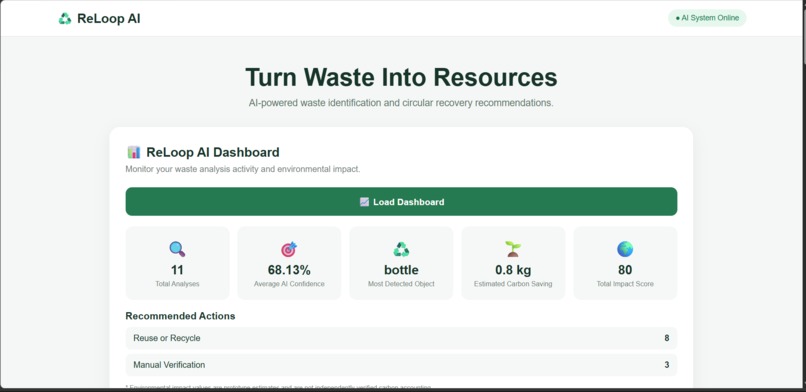
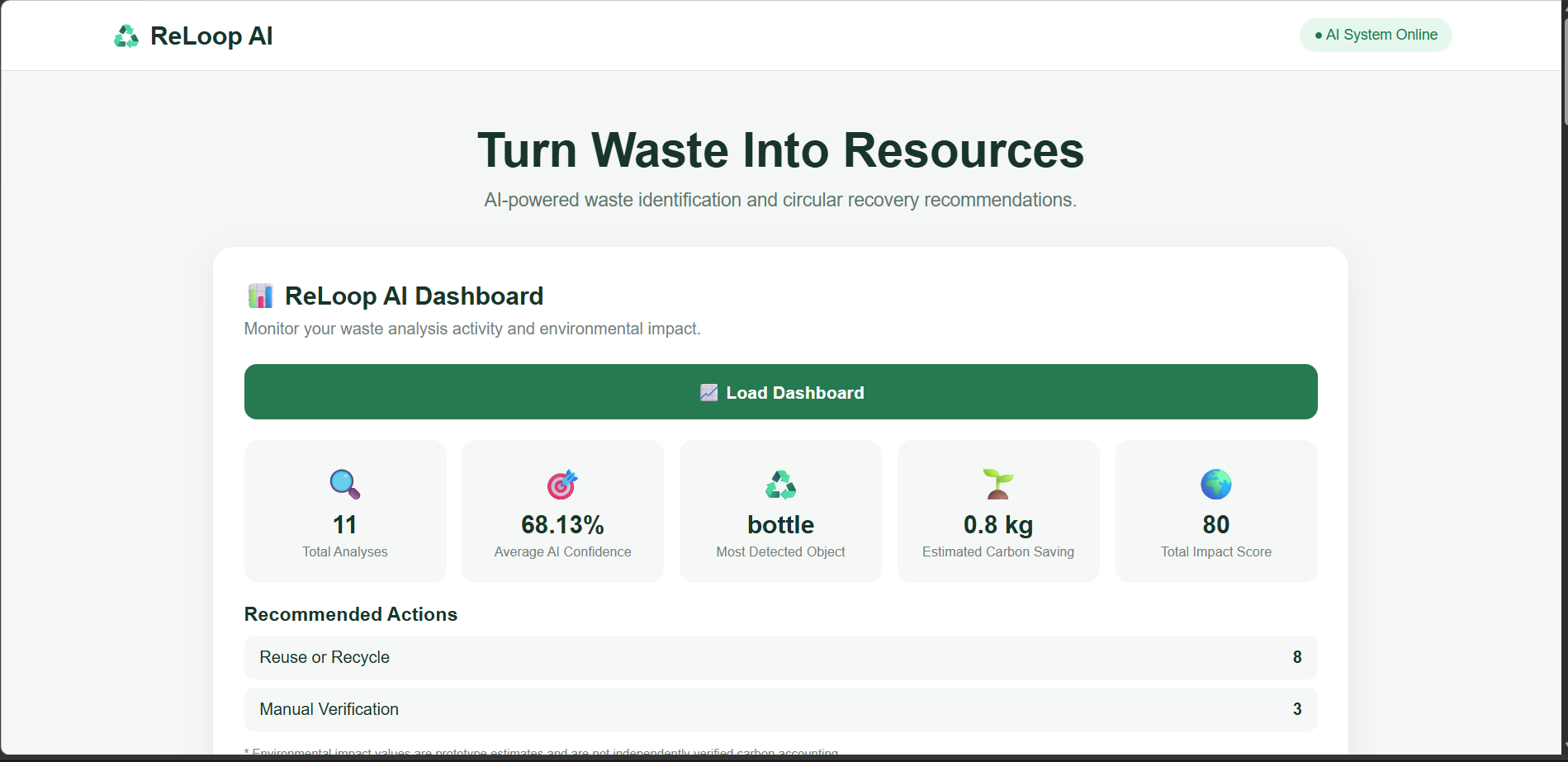
So this the User interface of the Reloop Ai
ReLoop AI
Identify. Recover. Reuse. Repeat. ♻️🌍
ReLoop AI is an AI-powered circular waste intelligence platform that helps people make better decisions at the moment they are about to dispose of an item.
Instead of simply asking “Where should this waste go?”, ReLoop AI asks a more important question:
“How can we keep this material in circulation?”
Users upload an image of a waste item, and ReLoop AI analyzes it, identifies the object and material, recommends a circular recovery action, explains the recommendation, and estimates the potential environmental impact. The resulting activity is stored and visualized through a sustainability dashboard.
Inspiration
Waste management has a problem that happens before waste even reaches a recycling facility: people often don't know what to do with the item in front of them.
A plastic bottle, food container, paper product, or metal can may have a recovery pathway, but consumers frequently have to make that decision without enough information. A small decision at the point of disposal can determine whether a material remains in circulation or becomes waste.
Our inspiration came from a simple observation:
What if AI could help people make the right waste decision before they throw something away?
We wanted to move beyond the traditional “trash vs. recycle” mindset and create a system that thinks in terms of circular recovery.
That led us to ReLoop AI.
The idea is simple: use computer vision to understand an everyday waste item, combine that understanding with a decision engine, and turn the result into an actionable recommendation.
We also wanted the system to make the environmental consequence visible. Instead of telling users only “Recycle this,” ReLoop AI connects the recommendation to an estimated environmental impact.
Our goal is to make sustainable decisions easier, faster, and more understandable for ordinary users.
What it does
ReLoop AI is a web-based AI waste analysis platform.
The primary workflow is:
Upload → Identify → Understand → Recommend → Measure → Learn
A user uploads an image of a waste item.
ReLoop AI then:
- Detects the object using computer vision
- Identifies the associated material
- Calculates/returns an AI confidence score
- Recommends a circular recovery action
- Explains why that action is recommended
- Provides a prototype environmental-impact estimate
- Stores the analysis for future reference
- Aggregates results in a sustainability dashboard
Example
A user uploads a picture of a plastic bottle.
The system can produce an output such as:
- Object: Bottle
- Material: Plastic
- AI Confidence: 82%
- Recommended Action: Reuse or Recycle
- Reason: The material may be recoverable instead of being sent directly to disposal.
- Estimated Carbon Saving: Prototype estimate
- Impact Score: Prototype environmental-impact score
The user can then view the analysis in the history section and see aggregated statistics through the dashboard.
Target users
ReLoop AI is designed initially for:
- Individuals who want simple waste-disposal guidance
- Students and educational institutions
- Sustainability-conscious communities
- Recycling initiatives
- Organizations tracking waste behavior
The longer-term vision is to support municipalities, smart-bin systems, recycling organizations, and enterprises.
How we built it
ReLoop AI was built as a lightweight full-stack AI application designed to demonstrate the complete journey from image recognition to sustainability insight.
Architecture
User
  │
  ▼
Web Frontend
  │
  ▼
FastAPI Backend
  │
  ├── AI Waste Detection
  │
  ├── Material Classification
  │
  ├── Circular Decision Engine
  │
  ├── Environmental Impact Estimation
  │
  └── Database
       │
       ▼
   Sustainability Dashboard
Frontend
The frontend was built using:
- HTML
- CSS
- JavaScript
The interface provides:
- Waste-image upload
- AI analysis results
- Recommendation explanations
- Environmental-impact information
- Analysis history
- Sustainability dashboard
We intentionally kept the interaction simple so that a user can go from an image to an actionable recommendation with minimal friction.
Backend
The backend uses:
- Python
- FastAPI
- Uvicorn
FastAPI provides the API layer connecting the frontend to the AI and database components.
Key endpoints include functionality for:
- Waste analysis
- Analysis history
- Dashboard statistics
- Application health monitoring
AI / ML
The AI layer uses computer vision to identify waste objects from uploaded images.
The detected object is then passed through our material and circular-recovery logic to determine an appropriate next action.
The system is designed around the principle that object recognition alone is not enough. The useful output is the decision that follows recognition.
Database
We use:
- SQLite
- SQLAlchemy
The database stores analysis results such as:
- Detected object
- Confidence
- Material
- Recommended action
- Reason
- Timestamp
- Environmental-impact information
This allows individual analyses to become aggregated sustainability insights.
Environmental impact layer
We added a prototype impact layer that translates recovery actions into estimated sustainability indicators such as:
- Impact score
- Estimated carbon saving
These values are currently prototype estimates rather than independently verified carbon accounting, and we deliberately communicate that limitation to users.
Development approach
We developed ReLoop AI incrementally, moving from a minimum viable AI analysis workflow toward a complete product experience.
We first established the backend and AI workflow, then connected the frontend, added persistent analysis history, built the sustainability dashboard, added environmental-impact metrics, and finally prepared the application for deployment and public demonstration.
Git and GitHub were used for version control and milestone tracking.
Challenges we ran into
1. Connecting AI predictions to meaningful actions
Identifying an object is only the first step.
The harder question was:
“What should the user actually do with it?”
We addressed this by building a decision layer that maps detected materials and objects to circular recovery actions.
This helped transform the project from a simple computer-vision demo into a decision-support platform.
2. Making environmental impact understandable
We wanted to communicate environmental value without pretending that a hackathon prototype could provide scientifically verified lifecycle assessments.
The challenge was balancing usefulness with honesty.
We therefore introduced impact scores and estimated carbon-saving values while clearly labeling them as prototype estimates.
A future production version would replace these estimates with validated lifecycle and material-specific datasets.
3. Building a complete product instead of an isolated AI model
It was relatively easy to demonstrate an AI prediction.
It was much harder to build the surrounding product:
Image
→ AI
→ Recommendation
→ Explanation
→ Database
→ History
→ Dashboard
Integrating these components into a single working application required iterative debugging across the frontend, backend, database, and AI layers.
4. Working within hackathon time constraints
We had to prioritize features that demonstrated the core value of ReLoop AI rather than attempting to build an entire commercial waste-management ecosystem.
We focused on the strongest end-to-end experience:
recognition + decision + explanation + environmental impact + analytics.
This allowed us to deliver a functional MVP while leaving advanced infrastructure for future development.
5. Balancing ambition with prototype limitations
A real-world deployment would require:
- Larger and more diverse datasets
- Better material-level classification
- Location-specific recycling rules
- Verified environmental-impact data
- More robust model evaluation
- Production-scale infrastructure
We chose to be transparent about these limitations rather than overstate what the prototype can currently guarantee.
Accomplishments that we're proud of
Our biggest accomplishment is that ReLoop AI became more than an AI model demo.
We built a complete working workflow:
Waste Image
     ↓
AI Detection
     ↓
Material Understanding
     ↓
Circular Recommendation
     ↓
Explanation
     ↓
Environmental Impact
     ↓
Persistent History
     ↓
Sustainability Dashboard
We are especially proud of:
A complete end-to-end MVP
The application connects the AI layer, backend APIs, frontend interface, database, and dashboard into one working system.
Explainable recommendations
The system doesn't simply output an action. It also provides a reason, making the recommendation easier for users to understand.
Environmental-impact visibility
We incorporated carbon-saving estimates and impact scores into the user experience instead of treating sustainability as an afterthought.
Persistent analytics
Individual waste analyses are stored and transformed into aggregate dashboard insights.
Hackathon-ready architecture
The project is structured so that the prototype can evolve toward a larger platform rather than being a one-off demonstration.
Most importantly, we achieved the original goal: turning an everyday waste decision into an AI-assisted circular-economy decision.
What we learned
AI is most useful when it leads to an action
One of our biggest lessons was that an accurate prediction alone does not necessarily solve a user problem.
The valuable part of ReLoop AI is the chain:
Detection → Understanding → Recommendation → Action.
This changed how we thought about AI product design.
Product integration is harder than model integration
Connecting an AI model to a real application requires much more than inference.
We learned about:
- API design
- FastAPI
- frontend/backend integration
- database persistence
- error handling
- dashboard aggregation
- Git-based development
- deployment preparation
Transparency matters
Environmental claims need to be handled carefully.
We learned that it is better to clearly identify prototype estimates than to present uncertain numbers as scientific facts.
That principle will remain important as we move toward validated environmental datasets.
Start with the user decision
We also learned to work backward from the user's problem.
Instead of starting with:
“What AI model can we build?”
we started asking:
“What decision are we trying to improve?”
That shift helped us design ReLoop AI around a real-world outcome rather than technology for its own sake.
What's next for ReLoop AI
The hackathon MVP is only the beginning.
1. Improve AI accuracy
We want to expand the range of detectable waste categories and improve recognition at the material level, not just the object level.
Future versions will use larger, more diverse datasets covering different lighting conditions, product designs, contamination levels, and real-world disposal environments.
2. Location-aware recycling guidance
Recycling rules vary significantly by location.
A future version will use the user's location to answer:
“What can I actually do with this item where I live?”
This could connect users with:
- Local recycling facilities
- Collection programs
- Composting facilities
- Reuse centers
- Special waste drop-off locations
3. Verified environmental-impact data
Our current impact metrics are prototype estimates.
The next generation will integrate validated lifecycle-assessment and material-impact datasets to provide more scientifically defensible environmental estimates.
4. Smart-bin integration
ReLoop AI could eventually become the intelligence layer behind smart waste bins.
A camera-equipped bin could automatically identify materials and provide real-time sorting guidance.
5. Community and municipal dashboards
At scale, aggregated anonymous data could help organizations understand:
- What types of waste are being generated
- Which materials are frequently misclassified
- Where recycling education is needed
- How recovery behavior changes over time
This could turn ReLoop AI from an individual assistant into a circular-economy intelligence platform.
6. Business and sustainability model
We see several potential paths:
B2C: A free consumer waste assistant with premium sustainability insights.
B2B: Subscription-based waste analytics for companies, campuses, and organizations.
B2G: Municipal dashboards and waste-management intelligence for local governments.
Infrastructure: AI capabilities integrated into smart-bin and recycling systems.
7. Partnerships
We would like to explore partnerships with:
- Recycling organizations
- Municipal waste departments
- Sustainability-focused companies
- Educational institutions
- Smart-bin manufacturers
- Environmental technology programs
We also plan to continue developing ReLoop AI through sustainability and AI-focused competitions, accelerator programs, and grant opportunities.
Our long-term vision
We believe the future of waste management should not begin at the landfill.
It should begin at the moment a person holds an item and decides what to do with it.
ReLoop AI aims to make that decision intelligent, explainable, and environmentally conscious.
ReLoop AI
Identify. Recover. Reuse. Repeat. ♻️🌍
Built With
- artificial-intelligence
- computer-vision
- css
- fastapi
- git
- html
- javascript
- machine-learning
- python
- rest-api
- sqlalchemy
- sqlite
- uvicorn

Log in or sign up for Devpost to join the conversation.