-
-
relocate-ai
Inspiration
Inspiration
Relocating to a new country is often treated as a simple travel problem, but in reality it is a high-risk, high-stress life event. Missing one document, misunderstanding one rule, or making one wrong decision at the airport can lead to being stranded, denied entry, or losing money.
The inspiration for this project came from observing how people—especially first-time travelers, students, and migrants—rely on scattered blog posts, outdated advice, and word-of-mouth information when planning international travel. There is no single, trustworthy guide that walks someone from the moment they decide to travel to the moment they successfully settle.
We wanted to build something that feels less like a chatbot and more like a personal relocation guide—one that is practical, exhaustive, and grounded in real information.
What it does
What the Project Does
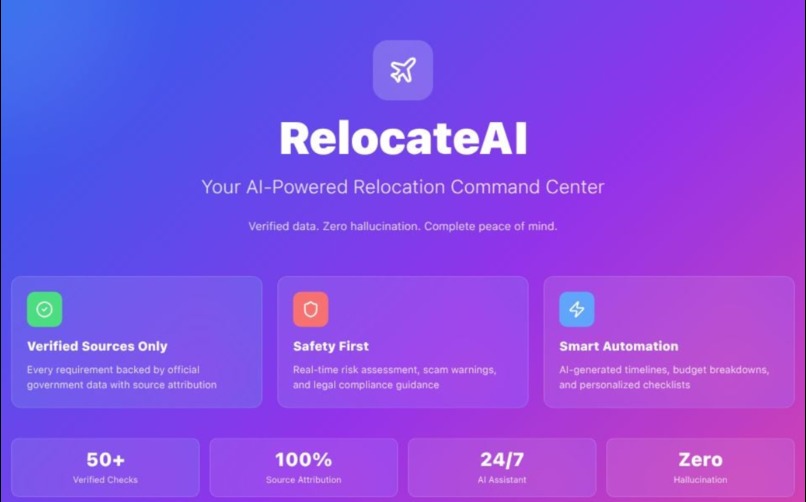
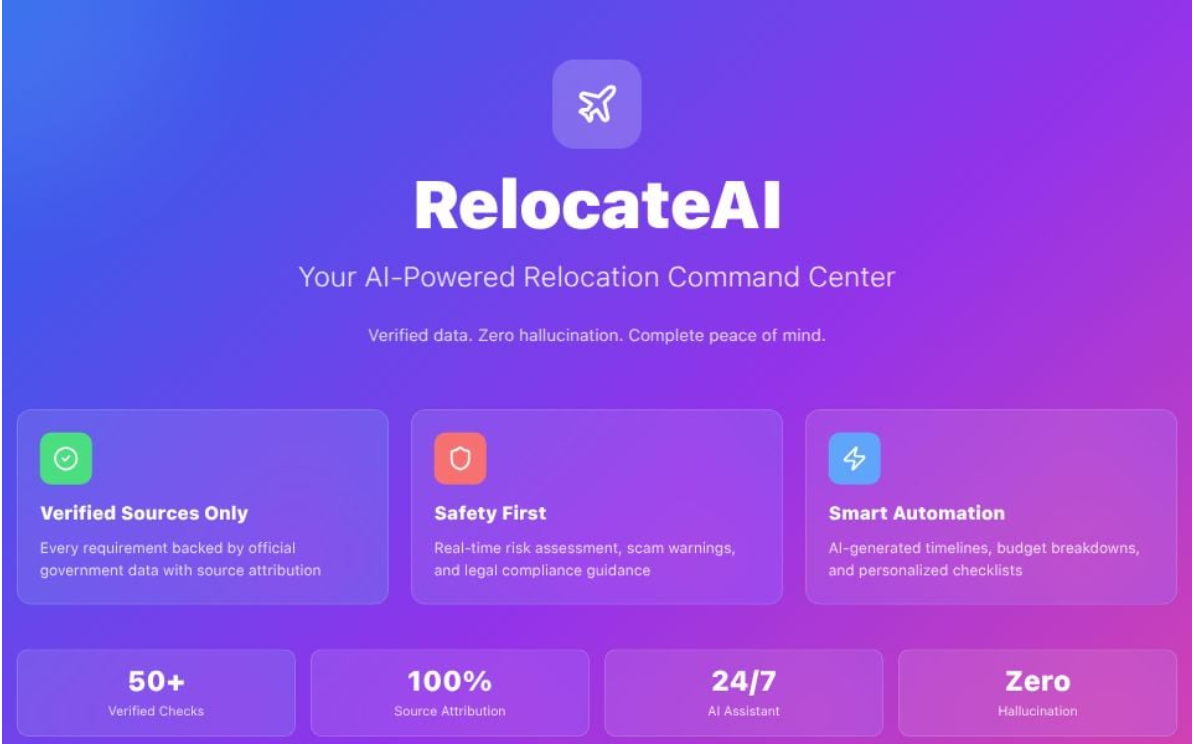
RelocateAI is a web-based, AI-powered relocation guide that helps users plan international travel and relocation step by step.
A user:
Clicks “I want to travel”
Selects a destination (e.g., United States or Dubai)
Receives a comprehensive checklist covering:
Travel documents and visas
Weather and clothing
Food and cultural considerations
Flight ticket cost ranges
Living and daily expenses
Health, insurance, and safety
Local laws and risks
Each requirement can be expanded for deeper explanation. If something is confusing, the user can ask the context-aware AI assistant, which continues guidance from the exact step the user is on.
The app then adapts further based on travel intent (holiday, work, education, health), generating additional, purpose-specific requirements such as tuition costs, work permissions, or student living expenses.
Finally, RelocateAI provides a personalized journey-to-airport timeline, helping users plan their departure day conservatively to avoid delays, traffic issues, or missed flights.
How we built it
How We Built It
The project is implemented as a web prototype with a strong focus on AI behavior control and reliability.
Instead of allowing the AI to freely generate answers, we designed the system using Retrieval-Augmented Generation (RAG). Official and authoritative sources (government portals, immigration guidance, airport authorities) are retrieved and injected into the AI’s prompt. The AI is explicitly instructed not to guess or hallucinate.
This ensures that guidance is grounded, conservative, and explainable.
The UI is checklist-driven, which constrains the AI’s output and keeps the user in control of their progress.
Challenges we ran into
One of the biggest challenges was hallucination risk. Relocation is a domain where incorrect advice can have serious consequences. Designing prompts, system rules, and UI constraints that prevent speculation required careful iteration.
Another challenge was balancing exhaustiveness with clarity. The goal was to show everything a user needs to know without overwhelming them. This led to the checklist + expandable detail approach, supported by a focused AI assistant instead of long unstructured text.
Finally, we had to scope the project realistically for a hackathon, focusing on a small number of destinations while clearly demonstrating scalability.
Accomplishments that we're proud of
Designed RelocateAI as a guided system, not just a chatbot, ensuring users always know what step they are on and what comes next
Built a checklist-driven relocation flow that covers everything a traveler needs — from documents and costs to culture, safety, and arrival logistics
Implemented a context-aware AI assistant that follows the user’s progress and explains only the requirement they are currently struggling with
Addressed AI hallucination risk by designing the system around Retrieval-Augmented Generation (RAG) using official and authoritative sources
Created a realistic journey-to-airport timeline feature that helps users plan conservatively and avoid missing flights or getting stranded
Delivered a fully functional web-based prototype that demonstrates real-world usability and scalability
What we learned
AI systems are most reliable when they are constrained, grounded, and guided by structure rather than free-form responses
In high-stakes domains like travel and migration, trust and accuracy matter more than creativity
Checklist-based UX dramatically improves user confidence and reduces cognitive overload
Context awareness is critical — users don’t want to repeat themselves or restart conversations
Preventing hallucination requires both prompt design and UI design, not just better models
What's next for RelocateAI
Expand destination coverage beyond the prototype to include more countries and regions
Add live data ingestion from government and airport APIs where available
Introduce document upload and validation (passports, visas, tickets)
Enable offline access for critical airport-day guidance
Incorporate community-verified insights while maintaining official data as the source of truth
Develop a mobile version to support travelers on the move

Log in or sign up for Devpost to join the conversation.