-
-
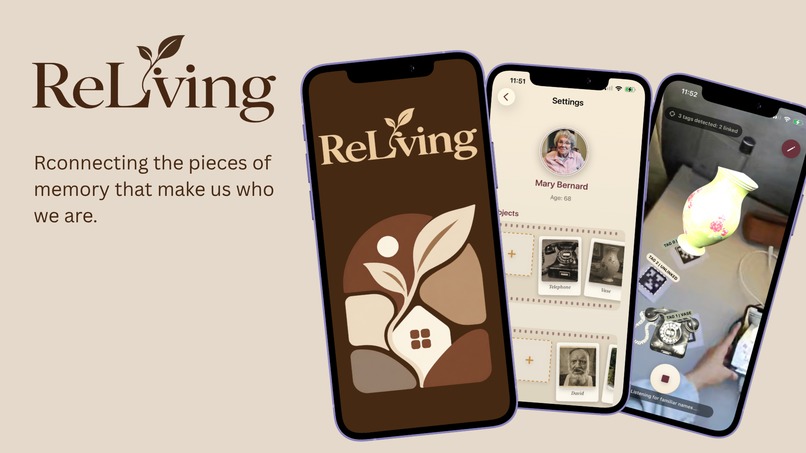
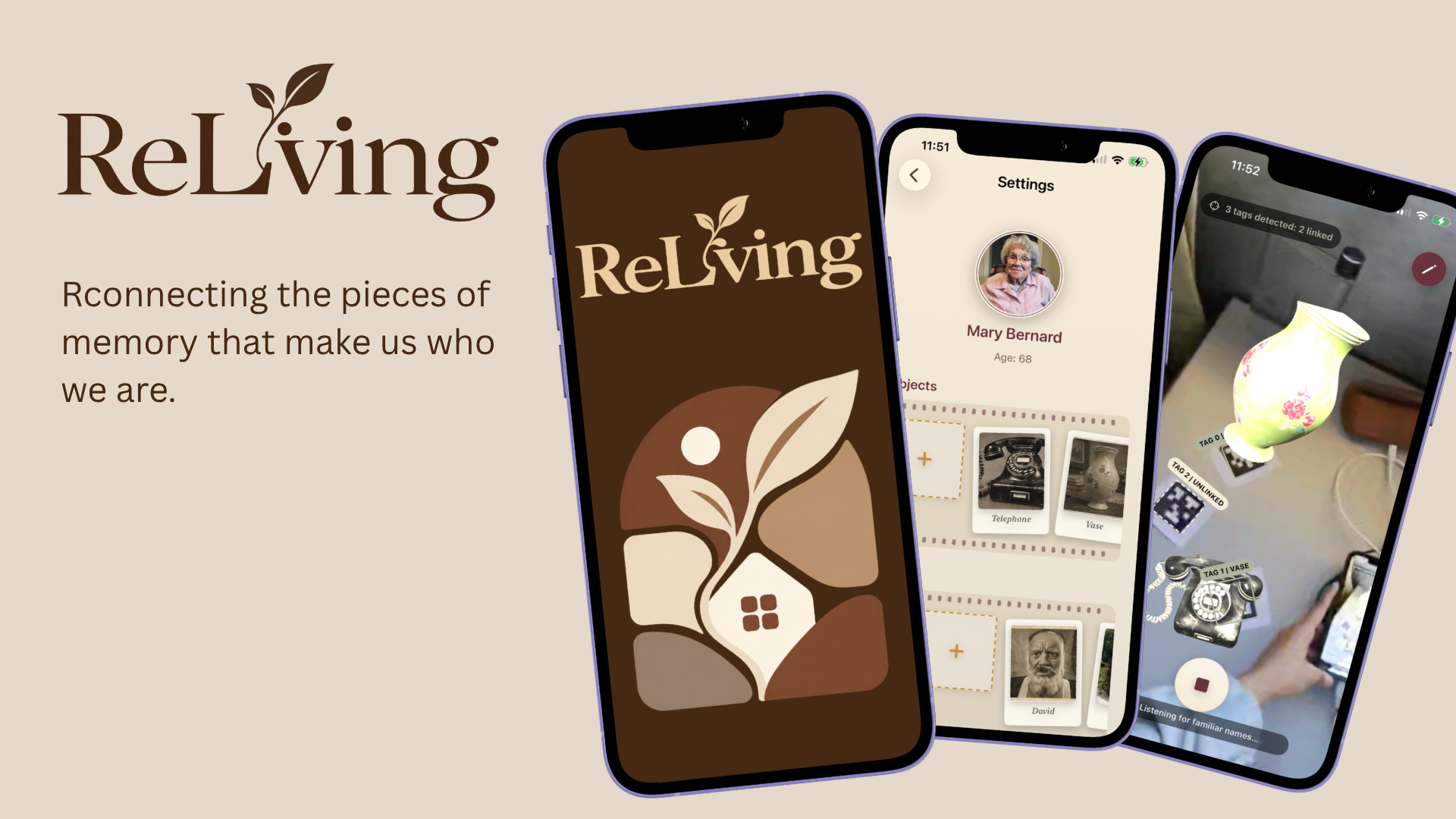
App Screens
Inspiration
Our world is made up of familiar people, places, objects, voices and memories.
For people living with dementia, those pieces can become harder to recognise as the world around them changes, creating confusion and disconnection from the present.
I was inspired by reminiscence therapy, which uses familiar photos, objects, music and stories to help people reconnect with meaningful experiences from their past.
That led me to ask:
How might we use technology to bring people living with dementia closer to their past, while helping them feel genuinely connected to the people and world around them?
That became ReLiving.
What it does
ReLiving is a smart-glasses augmented reality memory-support experience for people living with dementia.
Families can upload old photos, treasured objects, voice recordings and photos of family members to create personalised spatial memories.
Old black-and-white object photos can be restored in colour and transformed into 3D models, allowing familiar objects to be placed back into the person’s environment.
Families can also attach authentic voice recordings to memories. When the wearer says something related to a saved memory, ReLiving can surface the most relevant recording.
ReLiving also helps bridge the space between visits. Family members can create a 3D presence and attach real voice messages, allowing familiar people and voices to appear within the wearer’s environment.
If no relevant recording is found with enough confidence, ReLiving stays silent.
It never invents what a loved one would have said.
How I built it
I built ReLiving as an iOS prototype using Swift and SwiftUI.
The intended experience is designed for lightweight spatial glasses such as XREAL AURA, with native spatial tracking and hand interaction.
Because AURA is not publicly available yet, my prototype uses:
- Meta smart glasses for first-person POV
- an iPhone for interaction and placement
- AprilTags for visual spatial anchoring
I also integrated image restoration, 3D generation, speech recognition, audio playback and local semantic retrieval.
Key technologies included:
- Swift / SwiftUI
- Meta Wearables Device Access Toolkit
- AprilTag tracking
- OpenAI
- Meshy
- Apple Speech Recognition
- AVFoundation
- a local semantic matching model
Challenges I faced
One of the biggest challenges was spatial tracking.
Meta glasses provide a live first-person camera stream, but not the full positional data needed for native world anchoring. I explored markerless tracking before using AprilTags as a more reliable approach for the hackathon prototype.
Another challenge was designing responsibly.
An early concept explored interactive representations of deceased loved ones. I moved away from this after considering the potential for confusion or distress for people living with dementia.
ReLiving instead focuses on preserving memories of the past while using interactive spatial presences for people who are still part of the user’s current life.
I also chose to use authentic recordings rather than generate new dialogue.
What I learned
Building ReLiving taught me that immersive technology is not only about what is technically possible, but also what is appropriate.
During the hackathon I learned how to combine wearable camera streams, visual tracking, 3D generation, speech recognition and semantic retrieval into one experience.
Most importantly, I learned that technology for dementia support should strengthen real human connection rather than try to replace it.
What’s next
Future versions of ReLiving could support:
- markerless 6DoF spatial anchoring
- hand-based placement and interaction
- automatic room and furniture recognition
- richer shared family memory libraries
- improved on-device semantic models
- co-design and testing with dementia-care professionals, families and users
As spatial-computing hardware becomes lighter and more accessible, I imagine ReLiving becoming less like an app and more like a familiar layer over the world around you.
ReLiving
Reconnecting the pieces that make us who we are.



Log in or sign up for Devpost to join the conversation.