-
-
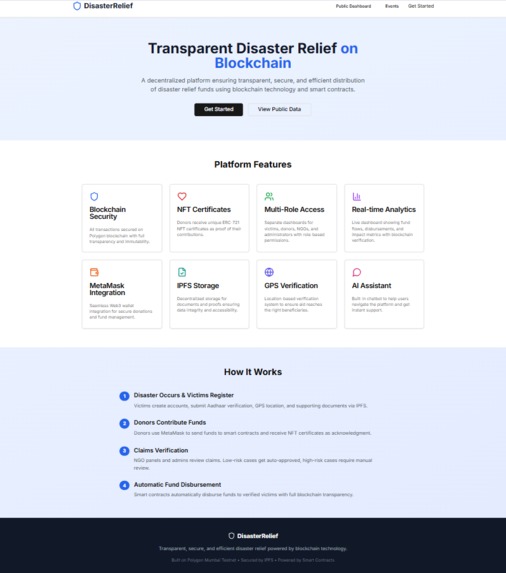
Relivault Dashboard
-
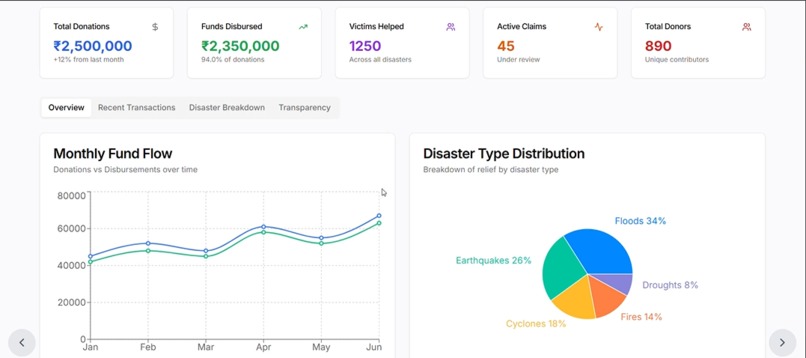
Public Dashboard
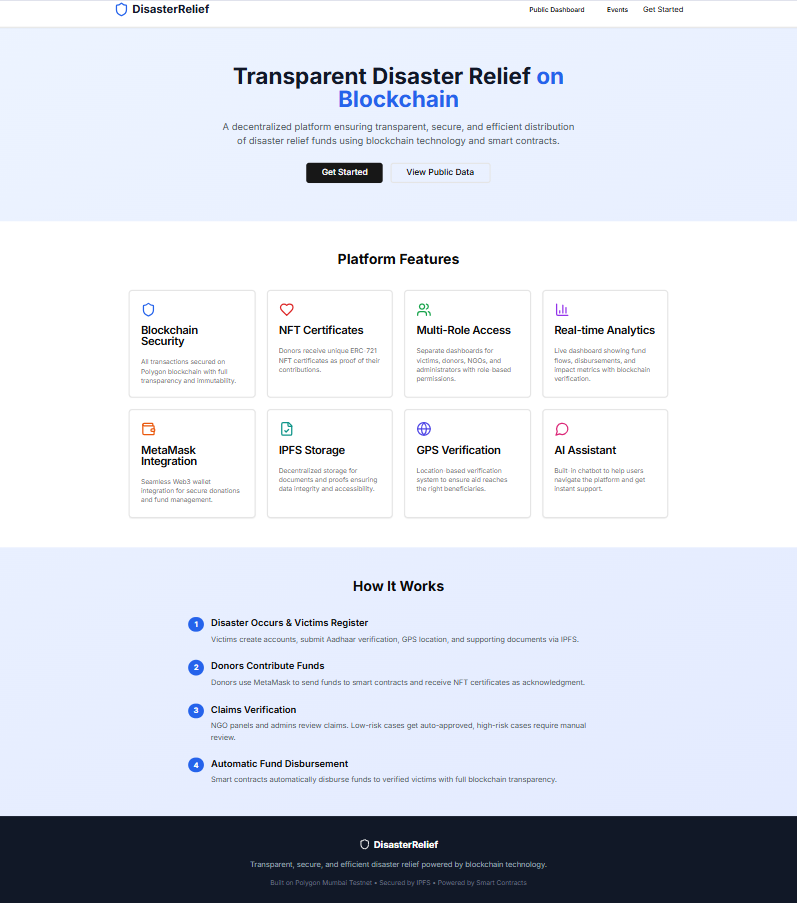
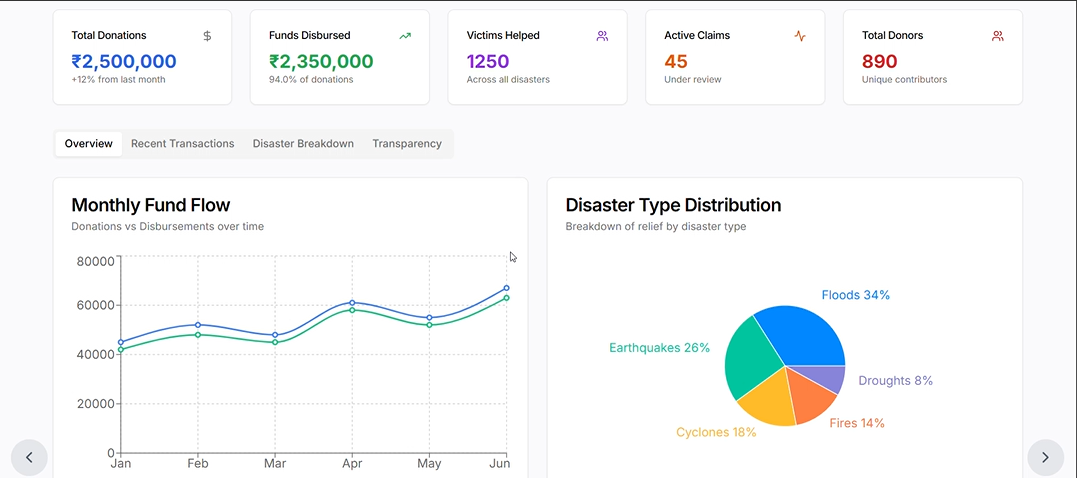
About the Project: Relivault
Inspiration
The project was inspired by the recurring challenges faced during urban disasters where victims struggle to access timely aid, and donors lack trust in how their funds are utilized. I wanted to create a decentralized system that ensures transparency, accountability, and fairness in relief fund distribution. Blockchain technology gave me the foundation to achieve this trustless, tamper-proof environment.
What It Does
Relivault provides a blockchain-powered platform for secure and transparent disaster relief fund distribution.
- Donors contribute via MetaMask and receive NFT certificates as proof of impact.
- Victims submit claims with Aadhaar and geolocation verification.
- Smart contracts automate disbursements and log all transactions on Polygon.
- A public dashboard provides real-time visibility into fund flows and statistics.
How I Built It
- Frontend: React + Next.js + Tailwind CSS, designed as a Progressive Web App (PWA).
- Authentication: Firebase Authentication with role-based access (Victims, Donors, NGOs, Admins).
- Blockchain: Solidity smart contracts deployed on Polygon Mumbai Testnet, connected via Ethers.js.
- Storage: MongoDB for metadata, IPFS for documents.
- Dashboards: Real-time analytics built using Recharts for transparency.
System pipeline:
- Admin registers disaster.
- Donors contribute via MetaMask.
- Victims apply using Aadhaar + geolocation.
- Backend verifies and interacts with smart contract.
- Funds are auto-disbursed or manually approved.
- All activity is visible on the public dashboard.
Challenges
- Ensuring trust and transparency across multiple stakeholders.
- Securely handling Aadhaar and geolocation verification at scale.
- Designing a user-friendly PWA that integrates blockchain seamlessly.
- Balancing transaction costs with speed on the Polygon network.
- Managing document storage via IPFS without bloating the blockchain.
Accomplishments
- Built a decentralized fund tracking system tailored to disaster scenarios.
- Integrated NFTs for donor recognition to boost engagement.
- Achieved a seamless Web2 + Web3 hybrid system combining React, Firebase, and Polygon.
- Delivered a public dashboard that makes every rupee traceable.
Learnings
Through this project, i learned the importance of decentralization in public welfare, how smart contracts automate financial processes securely, and the challenges of integrating Aadhaar and geolocation verification. I also gained practical experience in combining IPFS for immutable document storage with modern frontend and backend frameworks.
What's Next for Relivault: Decentralized Disaster Relief Fund System
- Expanding to multi-chain support for scalability (Polygon + Ethereum mainnet).
- AI-powered claim scoring and fraud detection.
- Mobile app version for better accessibility during disasters.
- Partnerships with NGOs and government bodies for real-world deployment.
Key Takeaway
This project showed me that blockchain is not just a financial tool but a mathematical guarantee of fairness and trust. In simple terms, every transaction is an immutable element ( T_i ) in the chain, and the global ledger is a secure sequence:
$$ Ledger = { T_1, T_2, T_3, ..., T_n } $$
where each ( T_i ) is cryptographically linked, ensuring tamper-proof relief distribution.

Log in or sign up for Devpost to join the conversation.