-
-
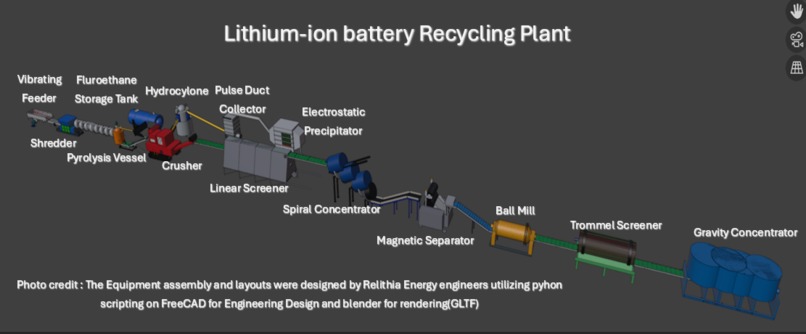
Lithium battery manufacturing plant
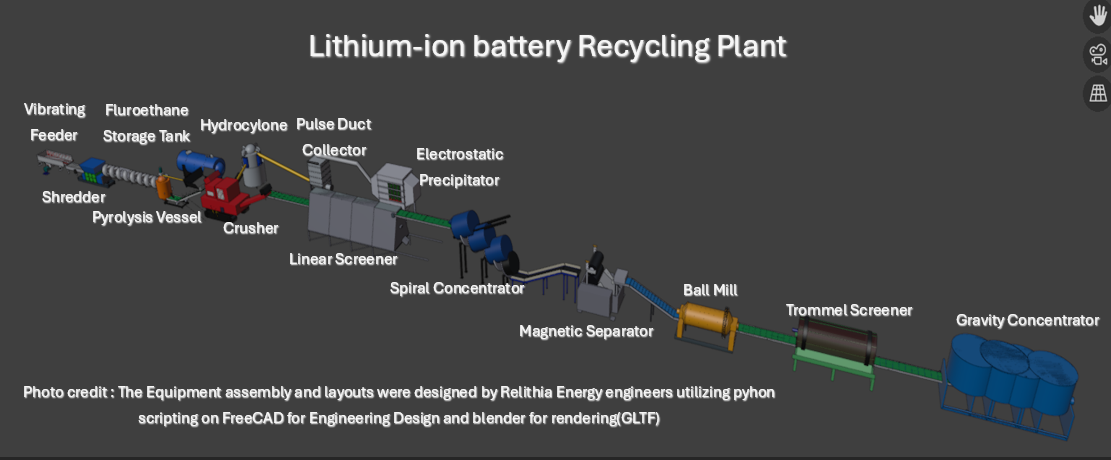
Inspiration As the world shifts toward a green economy, the demand for lithium-ion batteries and rare earth metals is skyrocketing. However, e-waste and dead batteries are piling up. The processes required to recycle these materials—and manufacture new, high-capacity battery cells—are incredibly complex, making it difficult for engineers and stakeholders to visualize, optimize, and scale these industrial plants. I was inspired to bridge the gap between software and heavy industry by building a highly accurate, programmatic "Digital Twin." I wanted to create a simulation that doesn't just look good, but is mathematically driven by real-world thermodynamics, material densities, and mechanical engineering principles. What it does Relithia-Energy-Process-Simulation is a parametric 3D Digital Twin that models and simulates two state-of-the-art industrial recycling and manufacturing lines: The RE300 Electronic Recycling Line: A 143 kW system that processes 300 kg/hr of complex PCB and e-waste. The simulation visually and programmatically tracks the material flow—from a 6.3mm low-speed shredder and hammer crushers down to a 260-micron grinding mill. It simulates airflow separation, electrostatic precipitation, and specific gravity concentration to purify copper, silver, gold, and tin. The RTEN200/600 Battery Recycling & Manufacturing Line: Simulates the mechanical and thermal extraction of e-waste batteries. It visualizes the 343.15 K pyrolysis process that converts electrolytes into fluorides and gases, followed by dense-medium separation to isolate 91% pure lithium cobalt oxide. Finally, it simulates the precision manufacturing of new 1.58 kg NCA prismatic cells, complete with 10-micron slurry engineering, calendaring, and ultrasonic laser copper fusion. How I built it I built this project at the intersection of parametric modeling, data-driven scripting, and 3D rendering: Python (The Brains): I used Python to define the heavy mathematical logic, material properties, and industrial parameters (e.g., particle sizes, kilowatt usage, magnetic gauss strengths, and percentage yields). FreeCAD (The Skeleton): I utilized FreeCAD to programmatically generate the precise geometric models of the industrial machinery—including shredders, trommel screens, pyrolysis chambers, and hydrostatic separators. Blender (The Visual Engine): I imported the CAD models into Blender and heavily utilized the Blender Python API (bpy). I wrote scripts to automate the simulation, animate the material flow on the anti-static PVC belts, and dynamically render the text data overlays based on the simulation state. Challenges I ran into The biggest challenge was translating raw, complex industrial data into a coherent 3D visual space. Bridging FreeCAD and Blender via Python meant I had to strictly manage coordinate systems, mesh data, and animation keyframes programmatically. Additionally, keeping track of the sheer volume of variables—such as the 4,383 kg/m ³ density for the positive plate calendaring, or the 3,500 to 5,000 gauss field strength for the magnetic separators—required highly organized object-oriented Python code to prevent the simulation from breaking. Accomplishments that I'm proud of I am incredibly proud of achieving a "true" digital twin rather than just a generic 3D animation. Every machine in the simulation corresponds to specific wattage, throughput, and micron-level accuracy. Successfully writing Python scripts that can manipulate Blender's environment to automatically animate thousands of data points—yielding a realistic 73 prismatic cells per hour in the simulation—was a massive technical milestone for me. What I learned This project pushed my skills across multiple disciplines. I deeply expanded my knowledge of battery chemistry (NCA cells, pyrolysis, electrolyte conversion) and industrial metallurgy. On the software side, I mastered the Blender Python API (bpy), learning how to automate complex animations, manage rendering pipelines, and interface CAD geometry from FreeCAD into an animation software without losing mathematical fidelity. What's next for Relithia-Energy-Process-Simulation The ultimate goal is to turn this from an offline simulation into a Live Digital Twin. IoT Integration: I plan to connect the Python backend to live MQTT data streams from actual factory PLCs, allowing the 3D Blender model to update in real-time based on actual machine performance. Machine Learning: Implementing predictive maintenance algorithms in Python to simulate and predict when a shredder blade or hammer crusher might fail. AR/VR: Exporting the simulated environment into a game engine (like Unity or Unreal) for immersive, VR-based training for factory operators.

Log in or sign up for Devpost to join the conversation.