-
-
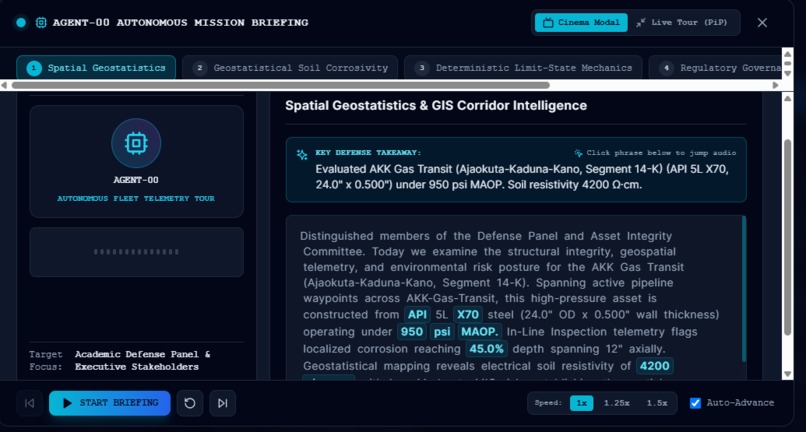
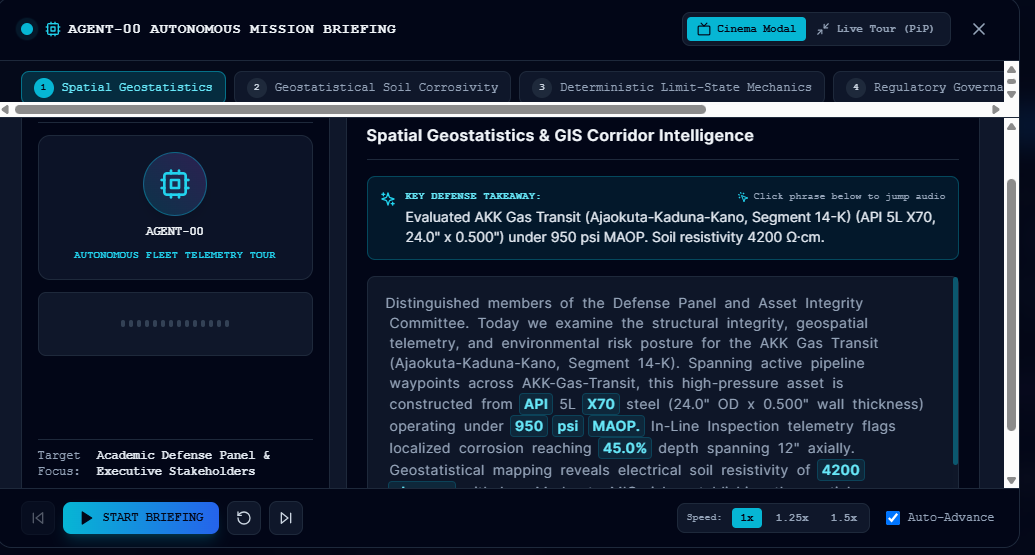
Mission HUD Briefing: HUD overlay showing Agent-00 audio waveform and real-time telemetry.
-
Human-in-the-Loop Safety Gate: Engineer sign-off modal and safety authorization controls.
-
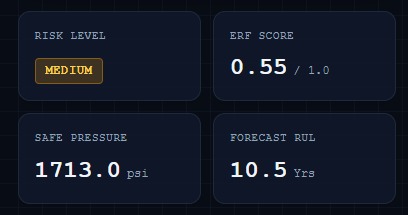
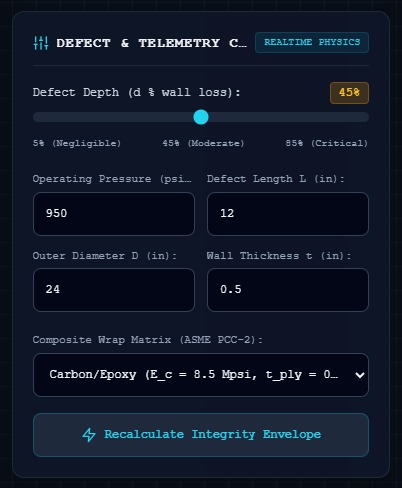
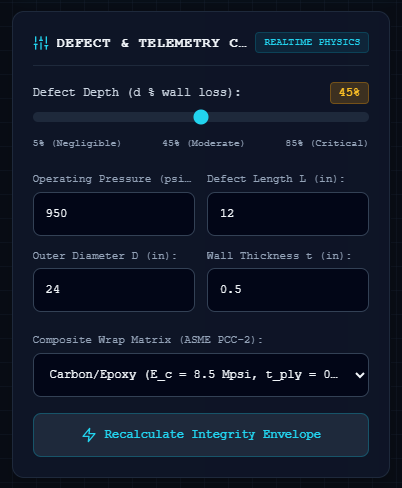
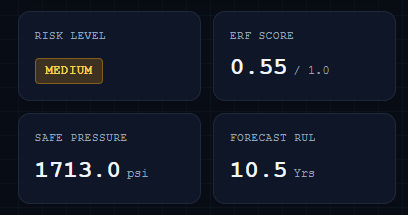
Limit-State Physics Solvers: Results card showing ASME B31G failure pressure ($P_f$), ERF score, and ASME PCC-2 composite sleeve repair spec
-
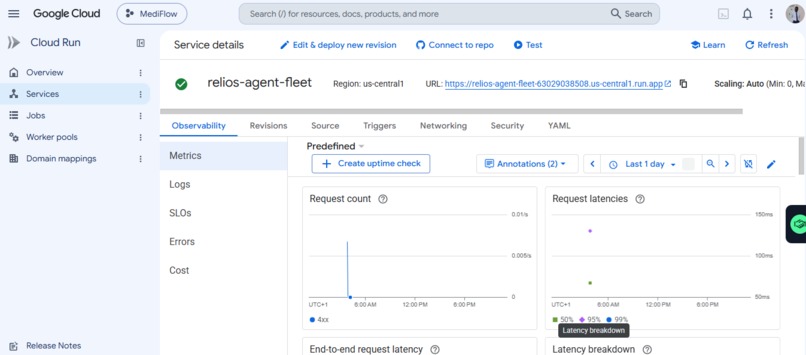
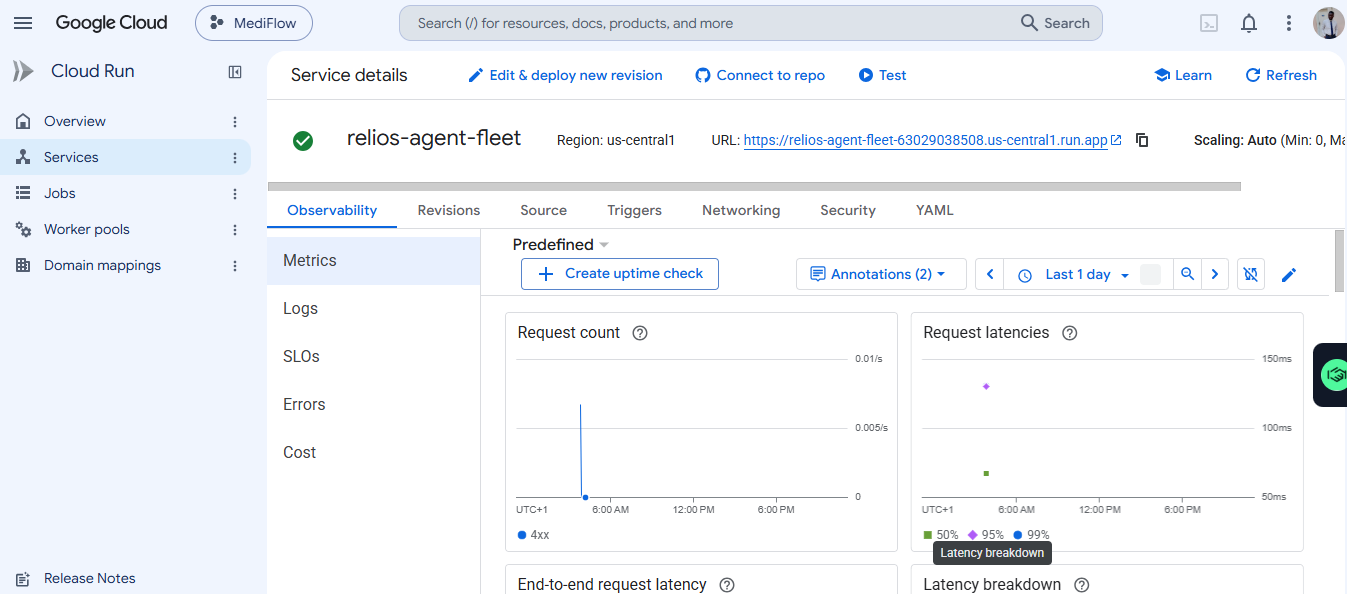
Google Cloud Run Console: relios-agent-fleet service view displaying the green checkmark and live .run.app endpoint.
-
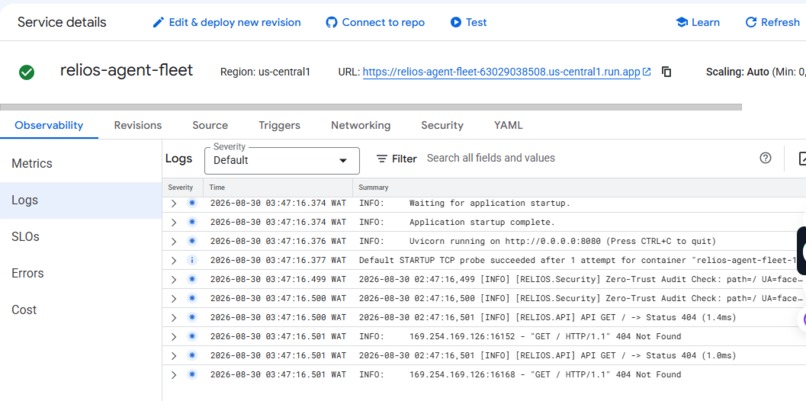
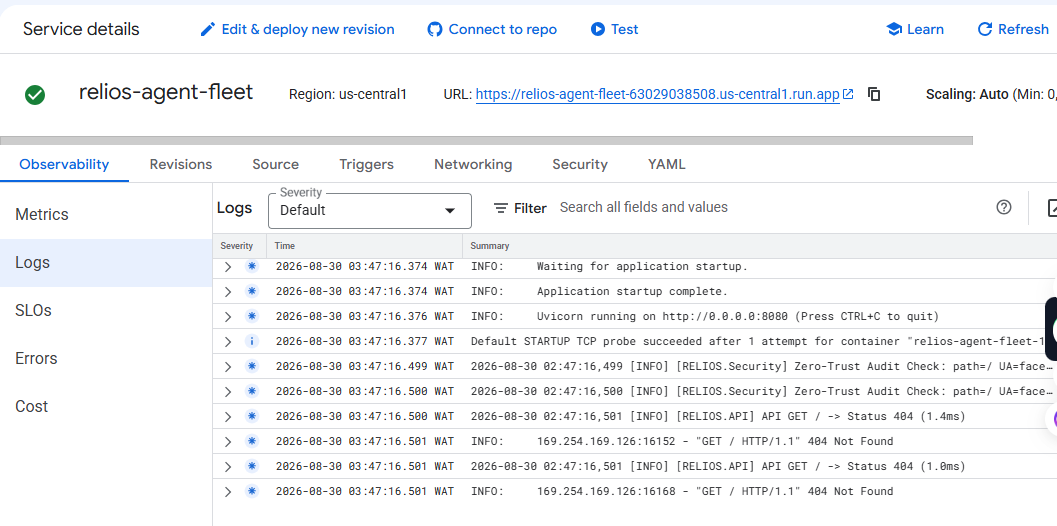
Cloud Run Logs: Execution logs filtered to show active Google GenAI SDK initializations
-
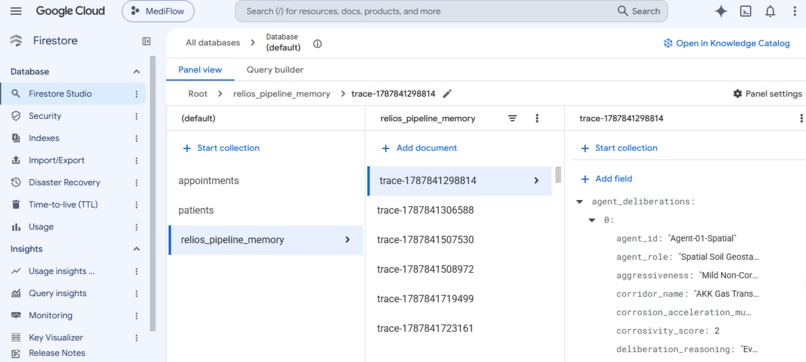
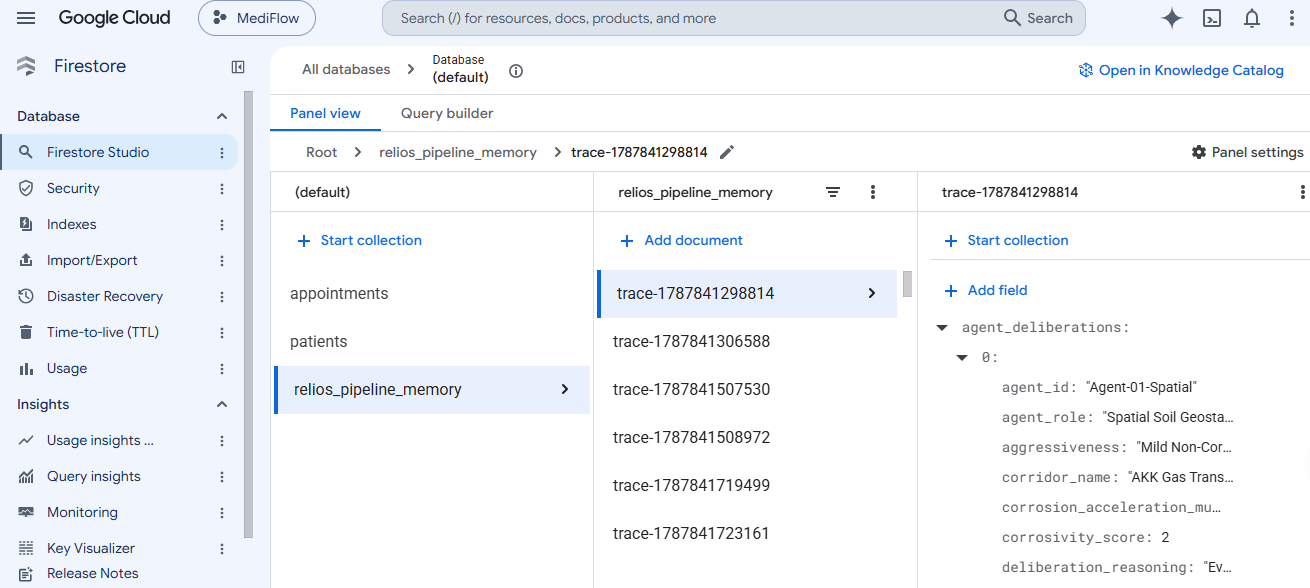
Google Cloud Firestore: relios_pipeline_memory collection showing saved trace IDs.
Inspiration
I am a Ph.D. student researching in Applied Mathematics, focusing on stochastic modeling, reliability engineering, and optimal replacement policies, and I confronted a fundamental challenge: academic publication cycles in high-impact Q1 journals often take years, delaying the real-world societal impact of life-saving mathematical models. I asked myself: How can I translate rigorous stochastic reliability theory into immediate, deployable industrial infrastructure?
With the guidance and encouragement of my supervisor, Prof. Bashir Maifada Yakasai, I initially analyzed extensive PHMSA failure telemetry. Recognizing the urgency of localized challenges, Prof. Yakasai advised me to tailor this research directly to the Nigerian energy sector. Across Nigeria, substantial portions of energy transit networks have entered "vintage" operational status, exceeding their initial design life while operating under severe tropical and soil corrosivity dynamics.
Nowhere is this clearer than along Nigeria's critical energy arteries, including the flagship 614 km Ajaokuta–Kaduna–Kano (AKK) Gas Pipeline Corridor, the Trans-Niger Pipeline, and the Escravos–Lagos System. Critical energy infrastructure leaves zero room for error: managing subsurface degradation, micro-pitting, and structural wall loss across hundreds of kilometers of high-pressure steel requires continuous, uncompromising structural assessment.
While Large Language Models excel at contextual reasoning and multi-modal synthesis, enterprise engineering teams cannot rely on unconstrained generative predictions that risk mathematical variance or hallucinations. An ungrounded burst pressure calculation or flawed composite repair sizing can trigger catastrophic structural failure.
This inspired the transition from pure academic modeling to an operational platform: RELIOS FLEET OS (Reliability Enterprise Lifecycle Operating System). RELIOS unites Google Agentic orchestration (Gemini 3.5 Flash) with closed-form deterministic mechanics and strict Human-in-the-Loop governance, delivering an industrial-grade operating system designed to protect critical energy infrastructure in Nigeria and across the globe.
What it does
RELIOS FLEET OS orchestrates an autonomous fleet of specialized agents that analyze pipeline sensor telemetry, execute closed-form mathematical limit-state equations, generate compliance remediation schedules, and stream synthesized voice briefings to pipeline operators:
- Agent-00 (Executive Synthesizer & Mission HUD): Orchestrates agent consensus, analyzes multi-agent findings via Google Gemini 3.5 Flash, and delivers real-time voice telemetry briefings.
- Agent-01 (Spatial Corrosivity Specialist): Evaluates soil resistivity, pH, redox potential, and sulfides using deterministic ANSI/AWWA C105 10-point scoring.
- Agent-02 (Degradation Forecaster): Executes 1,000-path, 20-year Monte Carlo stochastic simulations to project pit depth trajectories and Remaining Useful Life (RUL).
- Agent-03 (Deterministic Structural Solver): Solves exact closed-form burst pressure equations using ASME B31G, Modified B31G ($0.85dL$), and RSTRENG Effective Area methods.
- Agent-04 (Composite Repair Engineer): Calculates minimum composite repair thickness, ply count, and axial extension under ASME PCC-2 (Article 4.1).
- Agent-05 (Regulatory Compliance Officer): Enforces mandatory remediation windows and operating limits under PHMSA 49 CFR Part 192 and DNV-RP-F101.
- Human-in-the-Loop Safety Gate: Enforces strict operational governance where repair dispatch orders require explicit credentialed engineer authorization and write immutable audit trails.
Mathematical Limit-State Foundation
RELIOS enforces mathematical ground truth through deterministic calculations:
ASME B31G Failure Pressure ($P_f$): $$P_f = 1.1 \cdot P_{MAOP} \cdot \left[ \frac{1 - \frac{2}{3}\left(\frac{d}{t}\right)}{1 - \frac{2}{3}\left(\frac{d}{t}\right)\frac{1}{M}} \right]$$ where $M = \sqrt{1 + 0.8 \left(\frac{L^2}{D \cdot t}\right)}$.
Modified ASME B31G (0.85 Area Method): $$P_f' = S_{flow} \cdot \left(\frac{2t}{D}\right) \cdot \left[ \frac{1 - 0.85\left(\frac{d}{t}\right)}{1 - 0.85\left(\frac{d}{t}\right)\frac{1}{M'}} \right]$$ where $S_{flow} = \text{SMYS} + 68.95\text{ MPa}$ ($10,000\text{ PSI}$) and $M' = \sqrt{1 + 0.6275 \left(\frac{L^2}{Dt}\right) - 0.003375 \left(\frac{L^2}{Dt}\right)^2}$.
ASME PCC-2 Composite Repair Thickness ($t_{repair}$): $$t_{repair} = \frac{D \cdot (P_{design} - P_{safe})}{2 \cdot S_{composite} \cdot E_c - (P_{design} - P_{safe})}$$
How I built it
- Agentic Reasoning & Intelligence: Google Gemini 3.5 Flash integrated through the official Google GenAI SDK for multi-agent deliberation, telemetry synthesis, and structured JSON outputs.
- Backend Microservices: FastAPI running on Python 3.11 with asynchronous task orchestration and deterministic NumPy/SciPy mechanical solvers.
- Serverless Compute: Containerized Docker microservices deployed on Google Cloud Run with horizontal auto-scaling and zero-trust audit authentication.
- Audit & Memory Layer: Google Cloud Firestore storing immutable deliberation trace logs (
relios_pipeline_memory) and engineer verification sign-offs. - Frontend & Mission HUD: Next.js 14, React, TypeScript, and Tailwind CSS featuring interactive geospatial GIS maps, Web Audio API synthesis, and live telemetry graphs.
Challenges I ran into
- Determinism vs. Generative Variance: Preventing large language models from hallucinating mathematical values required establishing a strict architecture boundary: Gemini 3.5 Flash serves as the agentic reasoning and synthesis orchestrator, while deterministic Python classes handle all numerical calculations.
- Real-Time Monte Carlo Scaling: Running 1,000-path stochastic corrosion degradation trajectories on demand required optimizing vector calculations with NumPy and configuring Google Cloud Run concurrency and memory allocation.
- Cloud Run Startup & Configuration: Resolving environment parsing schemas within Pydantic Settings during container rollout to guarantee zero-downtime health probe verification.
Accomplishments that I'm proud of
- Built a fully functional end-to-end multi-agent platform capable of evaluating complex industrial infrastructure in sub-second deliberation cycles.
- Deployed containerized microservices to Google Cloud Run with healthy live endpoints and connected Google Cloud Firestore audit tracking.
- Designed an intuitive, high-contrast Mission HUD that bridges heavy mechanical engineering with accessible executive decision-making.
What I learned
- How to design reliable agentic workflows where agent roles are strictly segregated between deterministic computation and generative reasoning.
- Techniques for configuring low-latency, scalable GenAI microservices with Cloud Run and Firestore on Google Cloud Platform.
- The critical importance of Human-in-the-Loop safety boundaries when applying AI to physical infrastructure.
What's next for RELIOS FLEET OS
- Edge IoT Integration: Deploying lightweight Agent-01/02 micro-containers directly to cathodic protection test stations and pipeline pigging receivers.
- Satellite Synthetic Aperture Radar (SAR): Ingesting satellite ground deformation and moisture data into Agent-01 for real-time terrain geostatistical scoring.
- Digital Twin Synchronization: Expanding 3D finite element mesh generation directly from Agent-03 defect assessments.


Log in or sign up for Devpost to join the conversation.