-
-
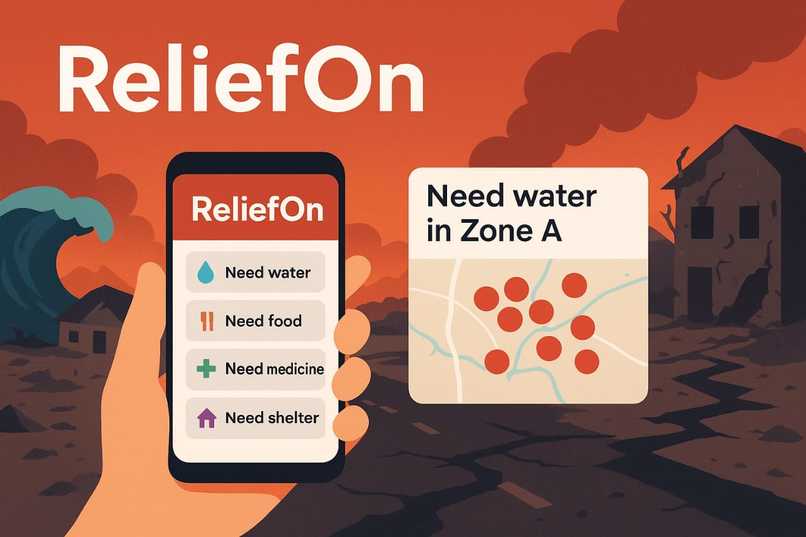
ReliefOn: AI-Powered Platform For Instant Disaster Relief.
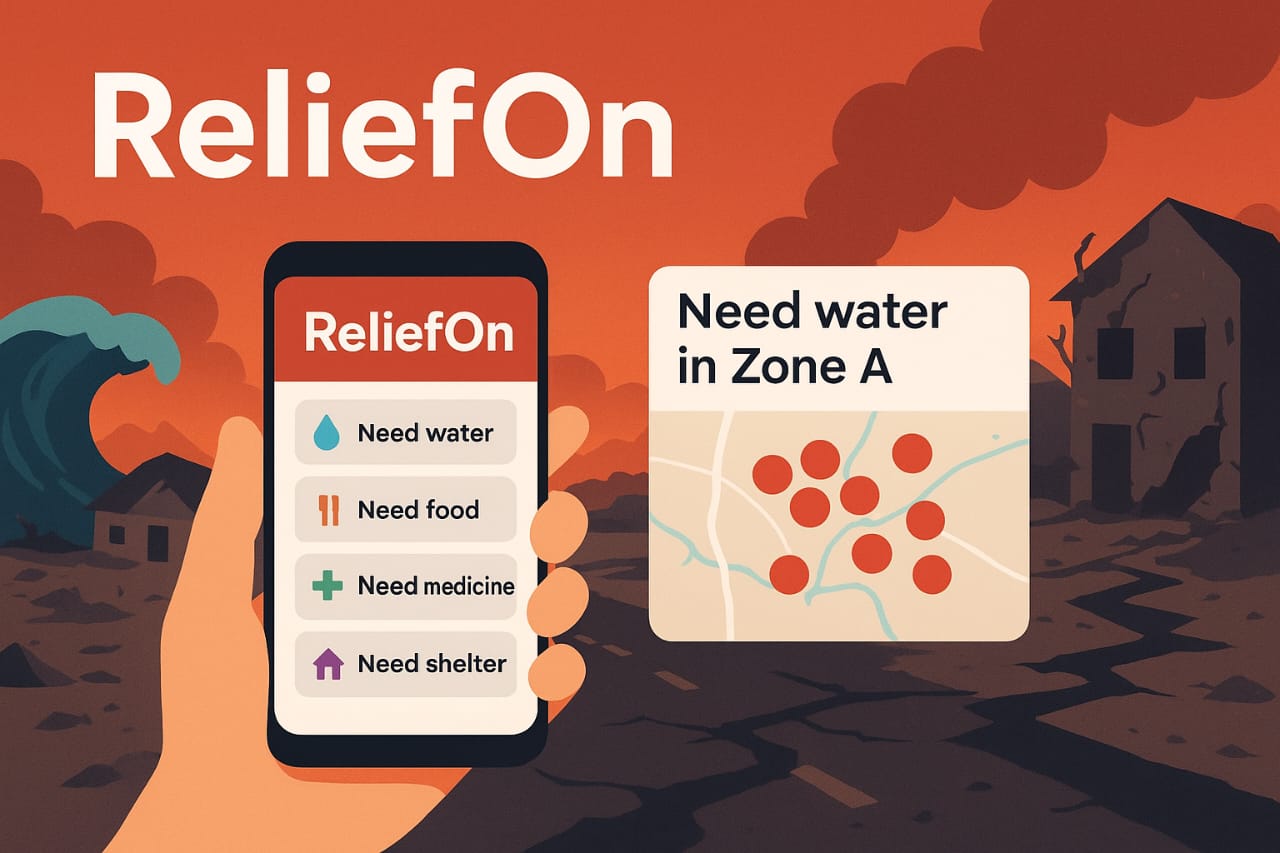
🌍 ReliefOn: AI-Powered Platform for Instant Disaster Relief
✨ Inspiration
🌪️ The Human Reality of Disasters
Disasters are not rare events. They are constant, recurring, and in many parts of the world, almost seasonal. Floods ravage South Asia every year. Hurricanes batter the Caribbean and North America. Wildfires consume thousands of acres of land in Australia and California. Earthquakes devastate Asia and South America.
The World Bank reports that disasters push 26 million people into poverty every year. The UNDRR estimates that 200–300 million people are affected annually, with damages crossing hundreds of billions of dollars.
But beyond statistics are the faces and voices of those affected:
- A mother trapped with her children on a flooded rooftop, unable to call for help.
- An elderly man waiting for medicine in an earthquake-ravaged town.
- Volunteers desperately searching Twitter and WhatsApp, not knowing which request is real, which is duplicate, and which is most urgent.
This gap between desperate need and scattered communication is heartbreaking.
📉 The Problem Behind the Problem
When we dug deeper, one insight stood out:
👉 Most lives lost are not because of lack of resources, but because of delayed or mismanaged response.
- In the 2010 Haiti Earthquake, aid poured in from around the world, but logistics bottlenecks delayed distribution for weeks.
- During the 2020 Indian Floods, boats were available, but volunteers lacked clear directions of which areas needed them first.
- In the California Wildfires, evacuation alerts were delayed or inconsistent, leaving people confused.
We realized the true bottleneck is coordination.
Social media platforms like Twitter, Facebook, and WhatsApp flood with help requests during disasters. But NGOs, governments, and volunteers struggle to filter through noise. Duplicate requests, vague descriptions, and scattered channels create chaos.
Relief often arrives late not because of what is available but because of who knows what is needed, where, and when.
💡 The Spark of ReliefOn
We asked ourselves:
“What if there was a single platform where every cry for help could be instantly heard, categorized, and visualized in real time?”
- Victims could raise their voices effortlessly.
- AI could cut through the noise, grouping duplicates and prioritizing urgent needs.
- Volunteers and NGOs could see a clear map of action, instead of drowning in messages.
This was the seed for ReliefOn.
The name itself carries meaning:
- Relief → Symbol of hope, aid, and survival.
- On → Always active, always available, always ready.
Together: ReliefOn = Relief is Always On.
🚀 What It Does
ReliefOn is more than an app. It is an ecosystem that connects victims, volunteers, NGOs, and governments into a single, real-time loop of disaster relief.
🧭 Core Features
1. Victim Request Submission
- Victims can send requests through:
- Mobile web app (lightweight, intuitive, multi-language).
- SMS/WhatsApp integration for low-connectivity areas.
- Mobile web app (lightweight, intuitive, multi-language).
- Example: “Need urgent water and shelter in Zone B.”
2. AI Categorization & Urgency Scoring
- Requests processed by Natural Language Processing (NLP).
- Extracts categories: Food, Water, Medicine, Shelter, Rescue.
- Urgency scored by:
- Keywords (urgent, dying, trapped, need asap).
- Time decay (older requests get higher weight).
- Keywords (urgent, dying, trapped, need asap).
Formula:
$$ Priority = \alpha U + \beta \frac{1}{T} $$
where:
- $U$ = urgency score,
- $T$ = time since posted,
- $\alpha, \beta$ = tunable weights.
3. Real-Time Relief Map
- Requests appear as geo-pins on a live map.
- Color-coded:
- 🔴 Red = Critical.
- 🟡 Yellow = Moderate.
- 🟢 Green = Resolved/In-progress.
- 🔴 Red = Critical.
4. Clustering & De-Duplication
- Multiple requests from same location get clustered.
- 50 people asking for water in Zone B → One urgent cluster.
- Reduces noise, maximizes clarity.
5. Volunteer & NGO Dashboard
- Relief workers see a taskboard view:
- Filter by type (medical, food, rescue).
- Sort by urgency.
- Claim tasks and mark them completed.
- Filter by type (medical, food, rescue).
6. Status Tracking
- Victims notified when request is picked up.
- NGOs see analytics of how many people helped.
📊 Additional Features
- Multi-language support → Hindi, Spanish, French, etc.
- Accessibility design → Large buttons, offline caching, voice-enabled.
- Data insights → Heatmaps of disaster impact.
- Cross-submission → Data can be shared with UN/Red Cross dashboards.
🌟 In One Sentence
ReliefOn transforms scattered cries for help into organized, actionable insights for disaster responders—saving lives when every second counts.
🛠️ How We Built It
Our biggest design principle: Resilience in chaos.
We built ReliefOn like a disaster survivor would use it—fast, simple, reliable under pressure.
🔹 Frontend (Victim App & Volunteer Dashboard)
- Framework: React.js with TailwindCSS.
- Maps: Leaflet.js + Mapbox API.
- Design: Mobile-first, one-click request flow.
- Accessibility:
- Simple forms (3 taps max).
- Large icons.
- Local language support.
- Simple forms (3 taps max).
🔹 Backend
- Server: Node.js + Express.
- Database: MongoDB Atlas with geospatial indexing.
- APIs: REST for simplicity; GraphQL planned.
- Caching: Redis for high traffic.
🔹 AI & Machine Learning
- NLP (spaCy + HuggingFace Transformers):
- Keyword extraction.
- Urgency detection.
- Keyword extraction.
- Clustering:
- K-means and DBSCAN for request grouping.
- K-means and DBSCAN for request grouping.
- Sentiment Analysis:
- Emotional weight of text.
- Emotional weight of text.
- Urgency Model:
- Blend of keywords + time decay + sentiment.
- Blend of keywords + time decay + sentiment.
🔹 Communication Layer
- Twilio API for SMS/WhatsApp fallback.
- Victims without internet still included.
🔹 Deployment
- Cloud: Google Cloud Platform (GCP).
- Containerization: Docker + Kubernetes.
- Scaling: Auto-scaling under traffic spikes.
🔹 Security & Privacy
- Data anonymization.
- Location masking for sensitive zones.
- Data expiry after disaster cycle.
⚡ Challenges We Faced
Messy Data Input
- People use slang, abbreviations, multiple languages.
- Example: “plz hlp need watr” → NLP must recognize = “Please help, need water.”
- People use slang, abbreviations, multiple languages.
Connectivity Gaps
- No internet = no app.
- Solved with SMS/WhatsApp channel.
- No internet = no app.
Stress-Based Design
- Victims under trauma won’t fill long forms.
- Designed “3-click flow” + voice input.
- Victims under trauma won’t fill long forms.
Real-Time Scaling
- Simulated 100,000 requests.
- Backend optimized with caching + indexing.
- Simulated 100,000 requests.
Team Pressure
- Building full-stack + AI in hackathon timeline.
- Required extreme focus and role clarity.
- Building full-stack + AI in hackathon timeline.
🏆 Accomplishments We’re Proud Of
- End-to-end AI + real-time map + SMS fallback prototype in hackathon time.
- Real-time clustering with low latency.
- Designed for real people under trauma (human-centered).
- Scalable backend capable of thousands of requests per second.
- Developed a system that NGOs said they could actually use.
📚 What We Learned
- Tech for social good requires empathy.
- Simplicity beats sophistication in disasters.
- Inclusion matters: offline, SMS, multi-language.
- Building such systems means balancing AI accuracy vs. human usability.
- Hackathons are about impact, not just code.
🔮 What’s Next for ReliefOn
- Offline-first native app with local caching.
- Voice request input for illiterate users.
- Blockchain for transparency in aid tracking.
- Predictive AI: anticipate needs based on weather/disaster data.
- NGO partnerships: Red Cross, UNICEF, UNHCR.
- Global pilots in flood-prone South Asia, wildfire zones in California, cyclone regions in the Philippines.
🌟 Closing Vision
Disasters are inevitable. Chaos doesn’t have to be.
ReliefOn transforms scattered, desperate voices into a coordinated, intelligent relief network.
It ensures that aid doesn’t just exist, but reaches exactly where it’s needed, exactly when it’s needed.
Because when the world shakes, burns, or floods—Relief should always be ON.
Built With
- docker
- express.js
- figma
- github
- google-cloud-platform-(gcp)
- huggingface-transformers
- kubernetes
- leaflet.js
- mapbox-api
- mongodb-atlas
- node.js
- python-(for-ai/nlp)
- react.js
- redis
- rest-apis
- spacy
- tailwindcss
- tensorflow-lite
- twilio
- websockets


Log in or sign up for Devpost to join the conversation.