-
-
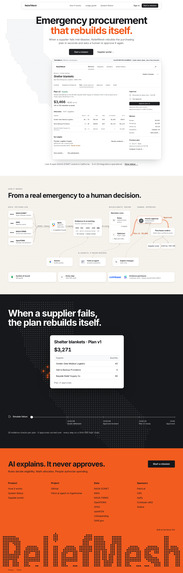
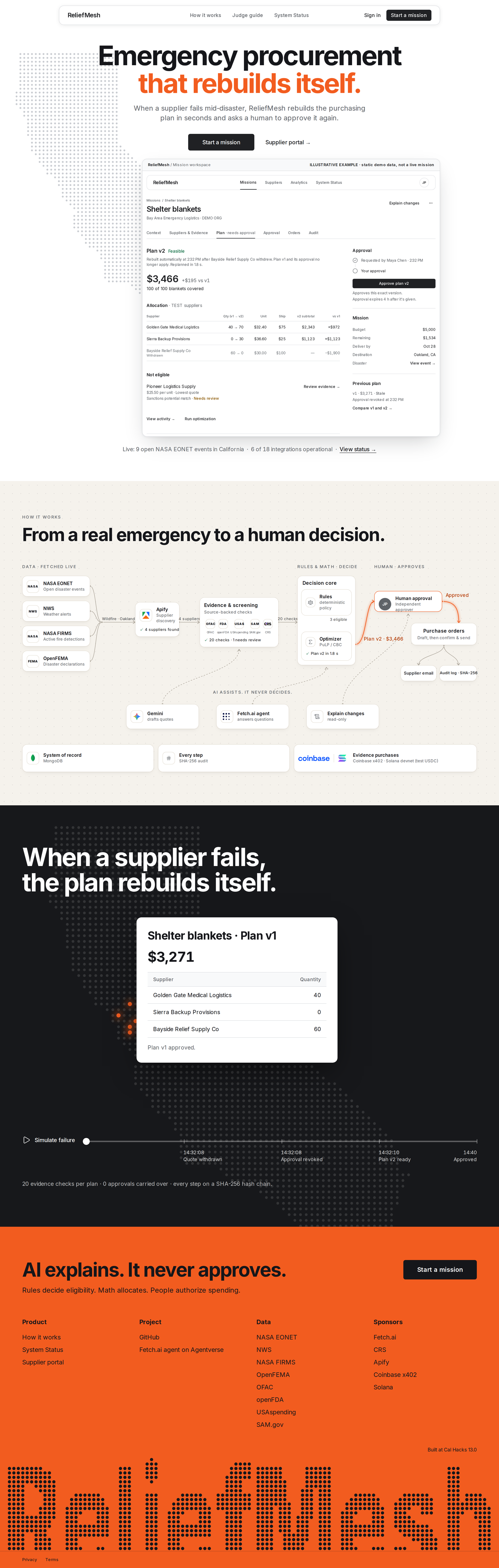
Landing page: evidence-backed emergency procurement that rebuilds itself when the supply chain changes.
-
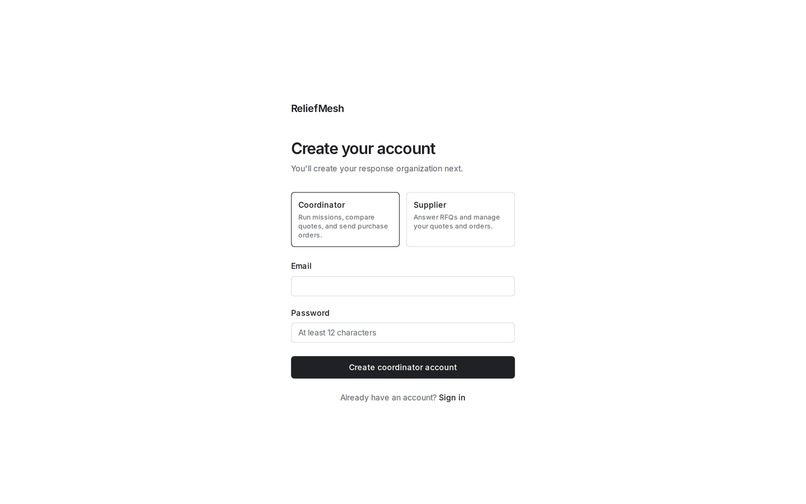
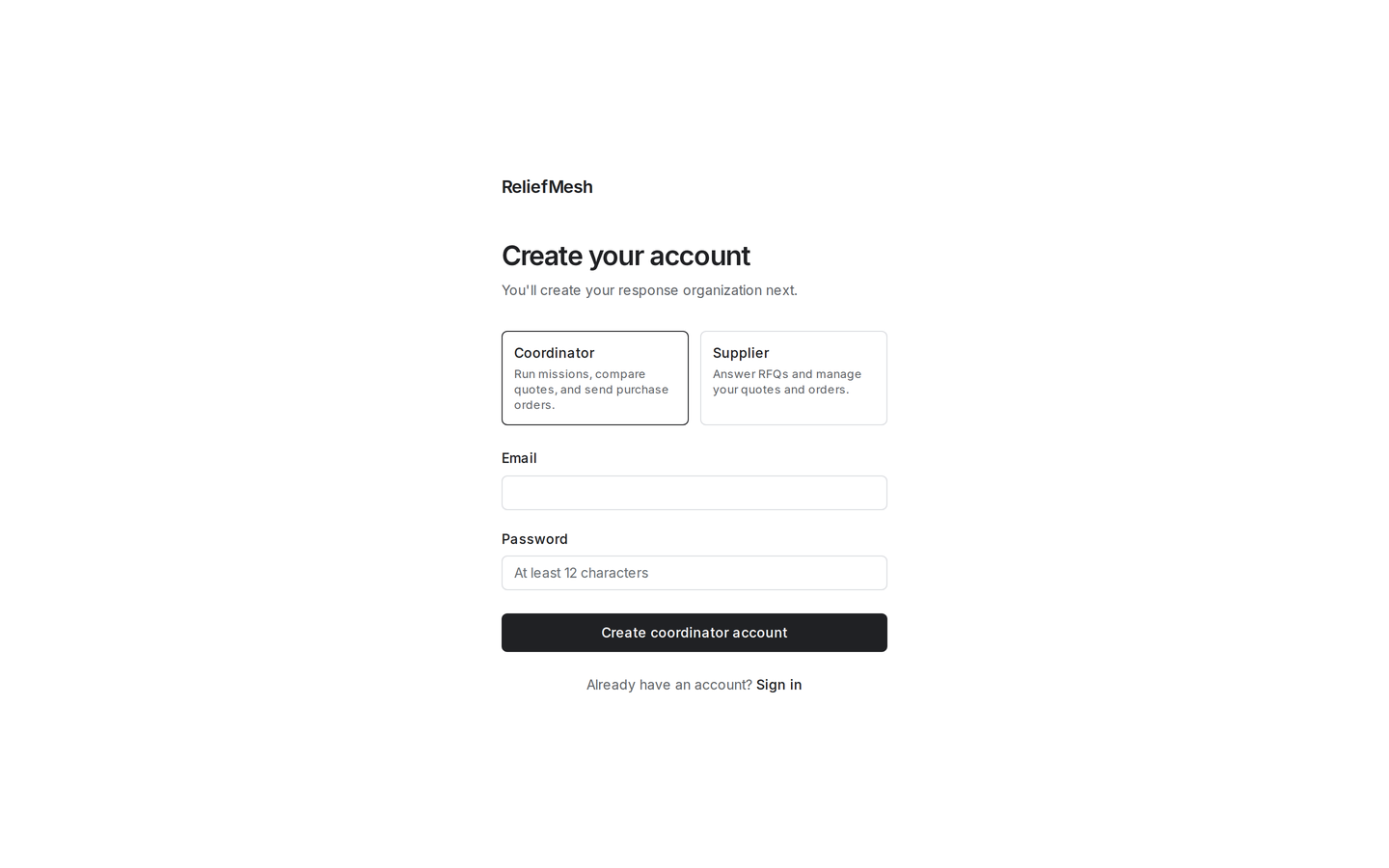
Coordinator sign-up — starts a mission in seconds, no credentials or setup required.
-
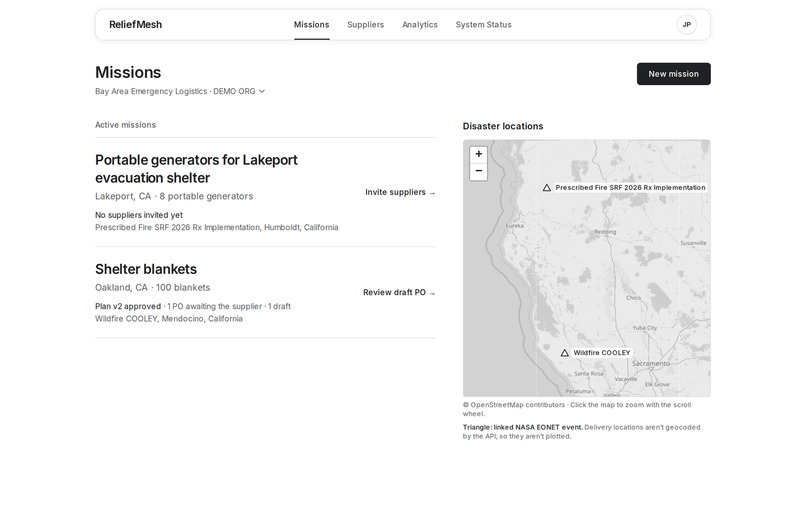
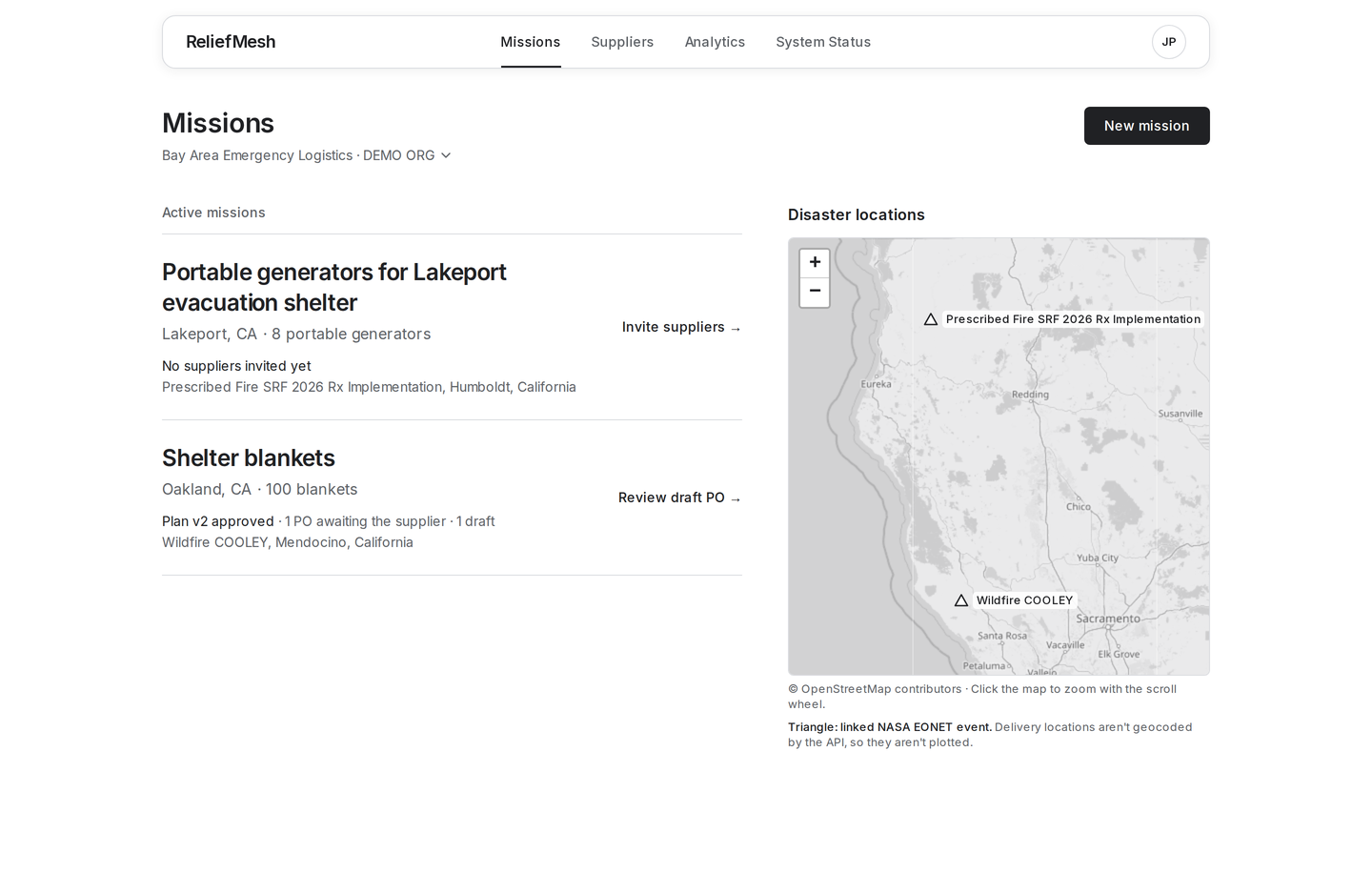
Coordinator dashboard: create an organization and launch a new procurement mission.
-
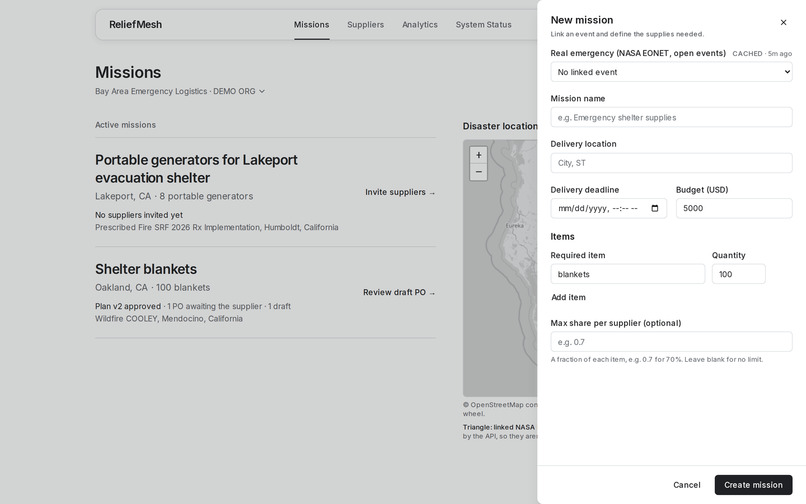
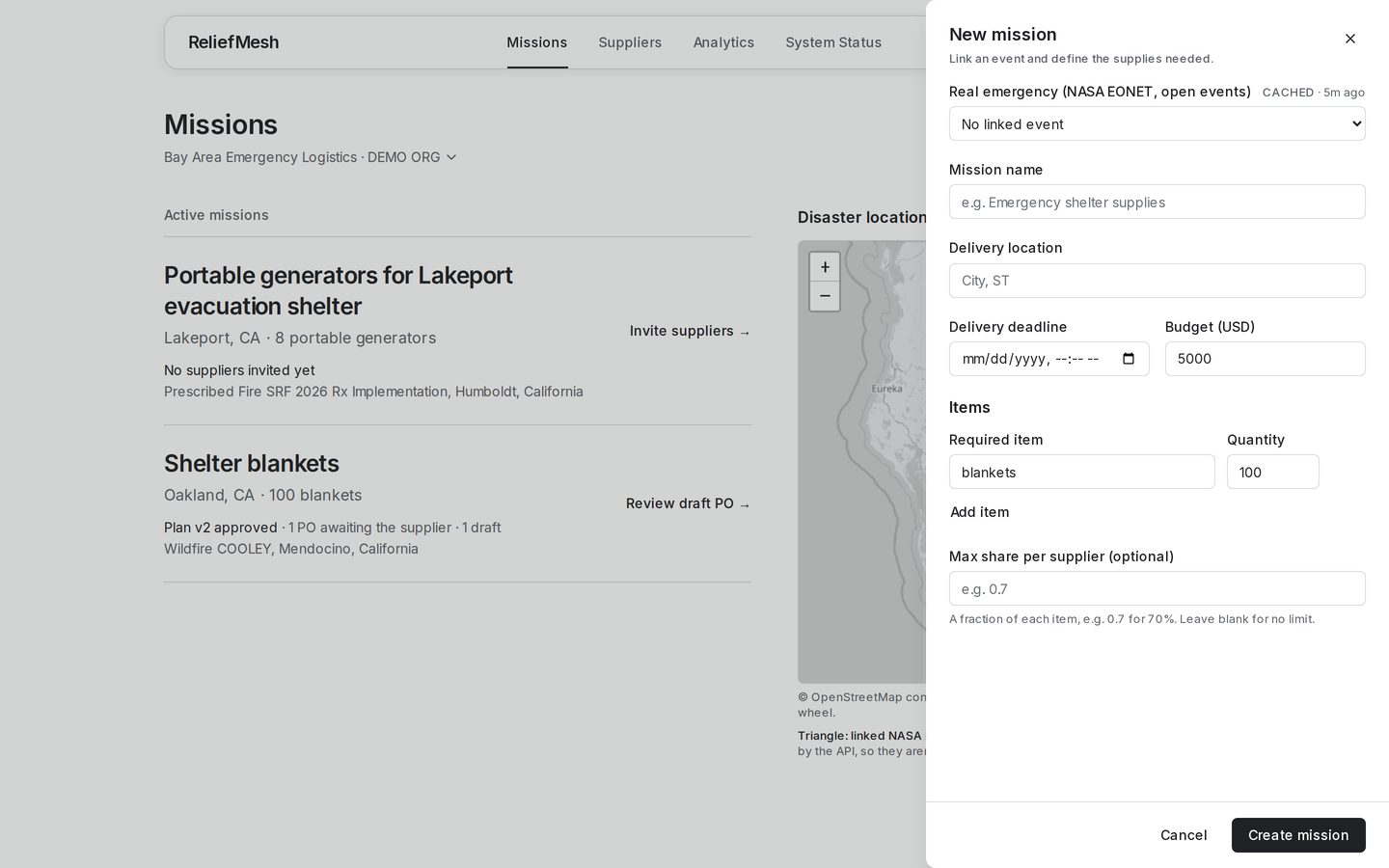
New mission: link a real NASA EONET disaster event and define exactly what's needed.
-
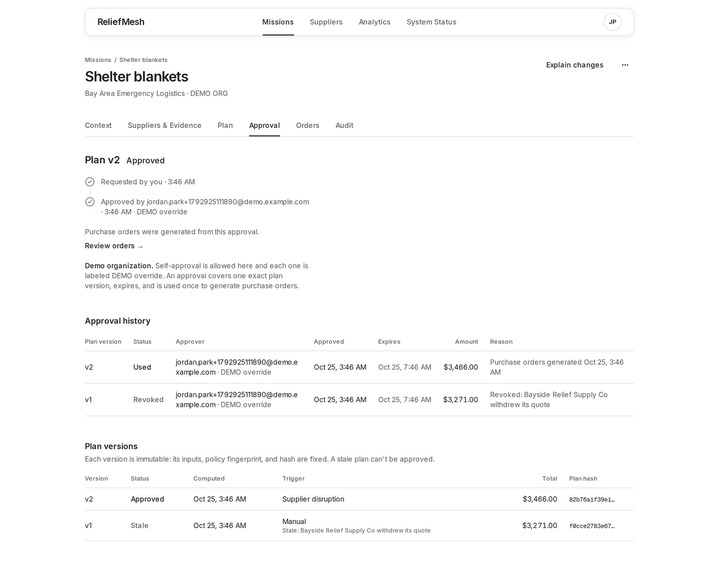
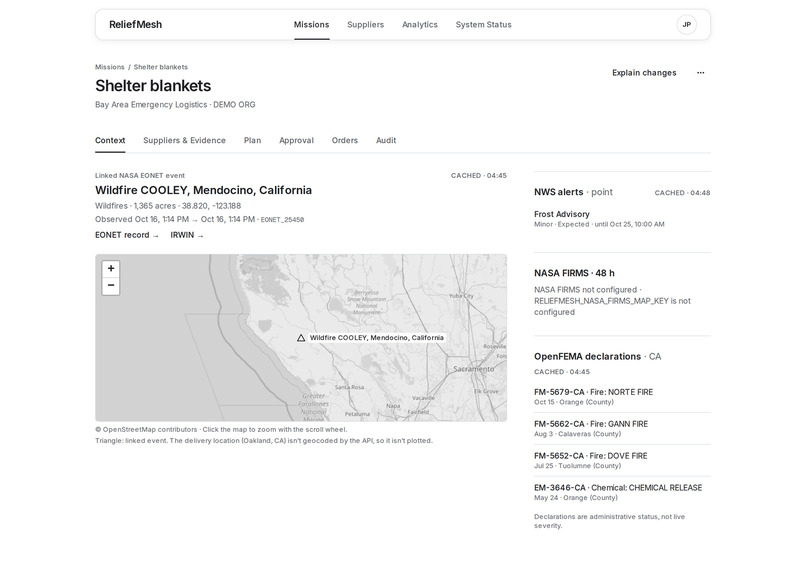
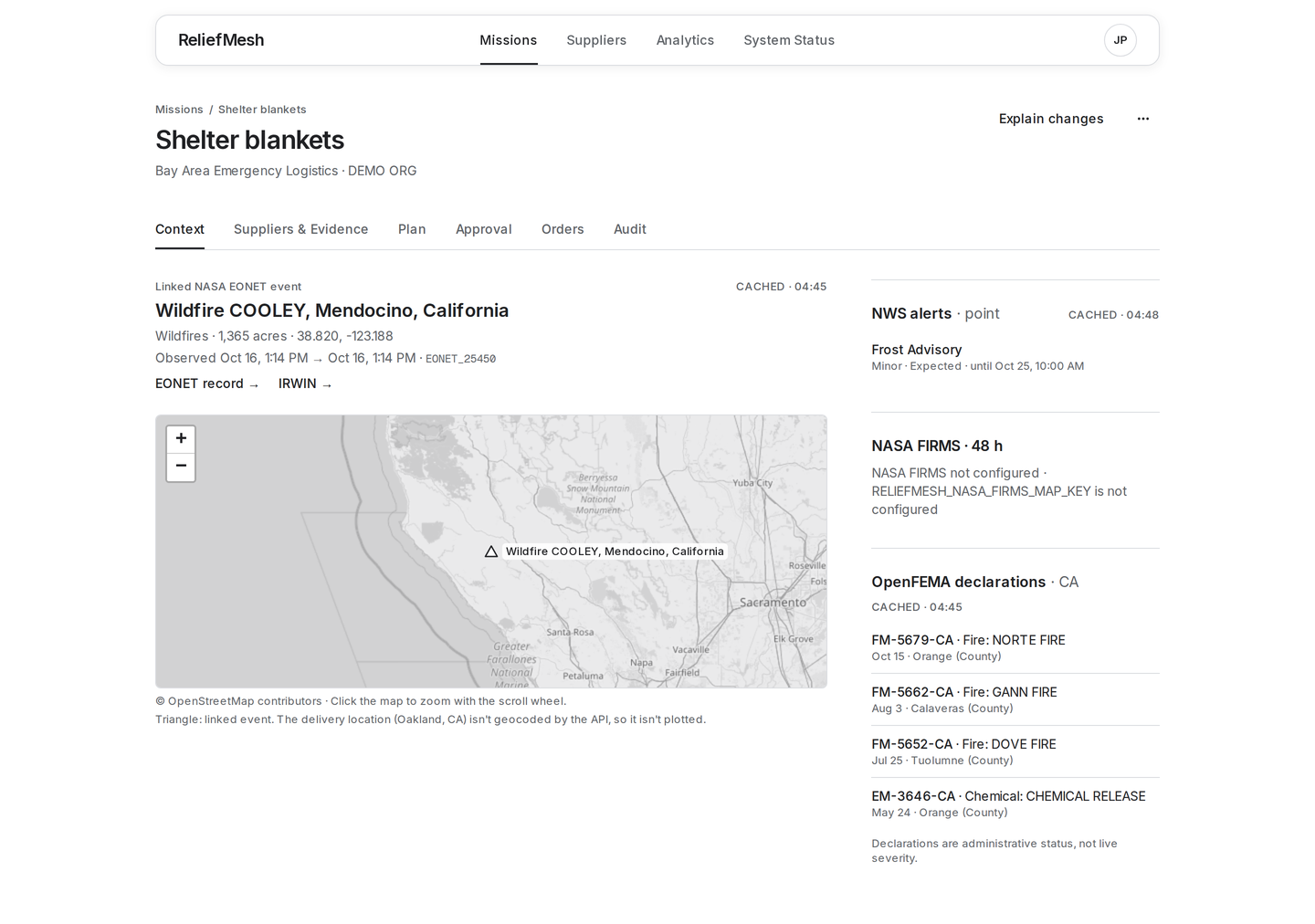
Mission context: live NWS alerts, FEMA declarations, and NASA fire data for the affected area.
-
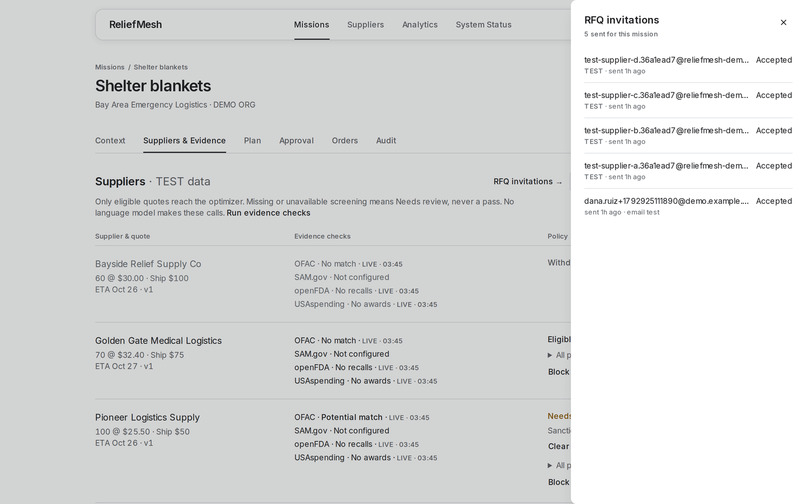
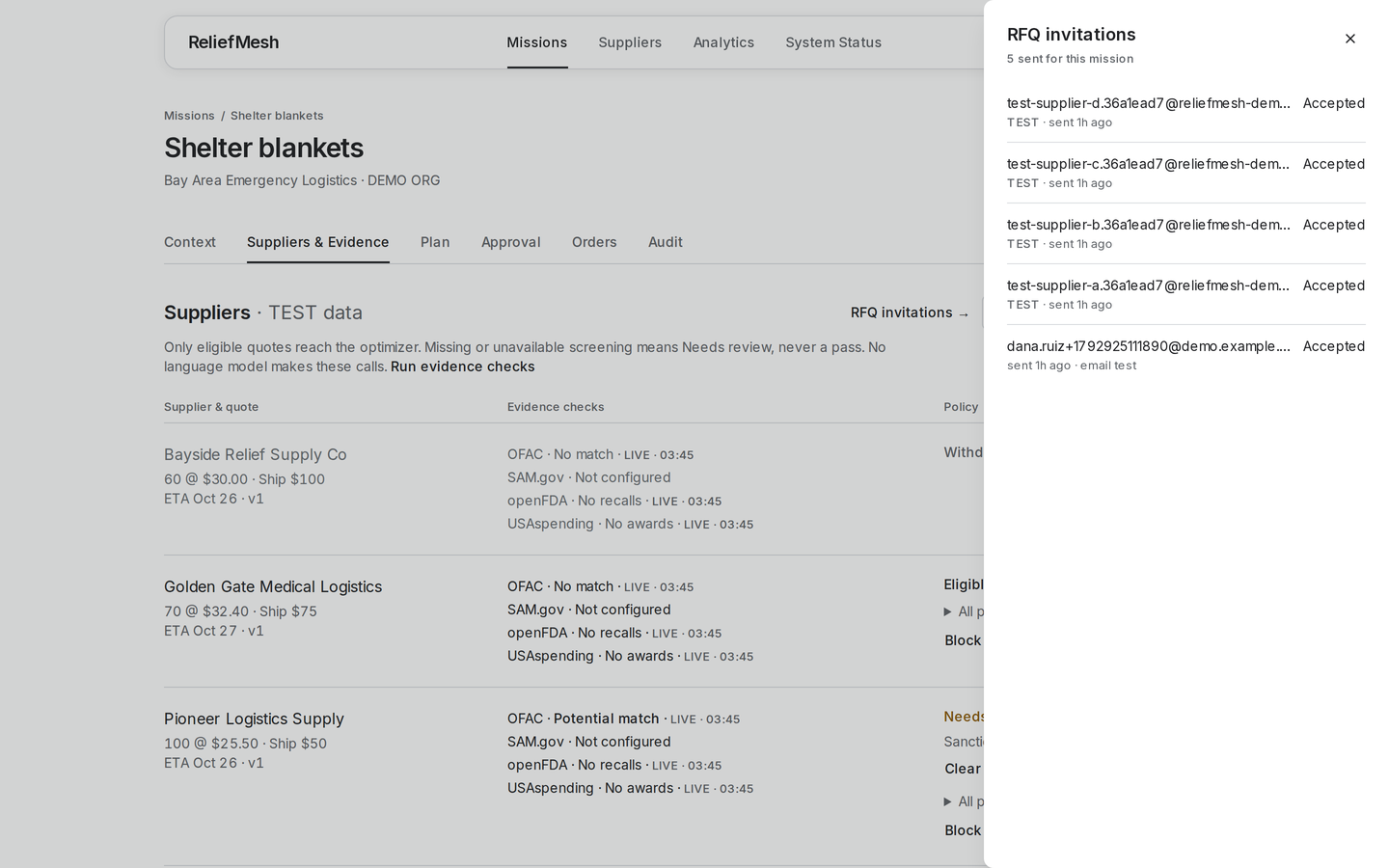
Real RFQ invitations sent to suppliers by email with a single-use secure quote link.
-
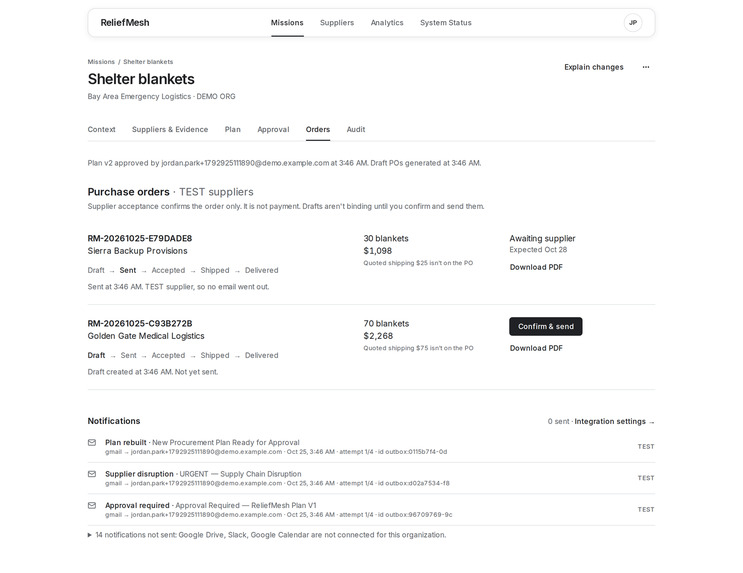
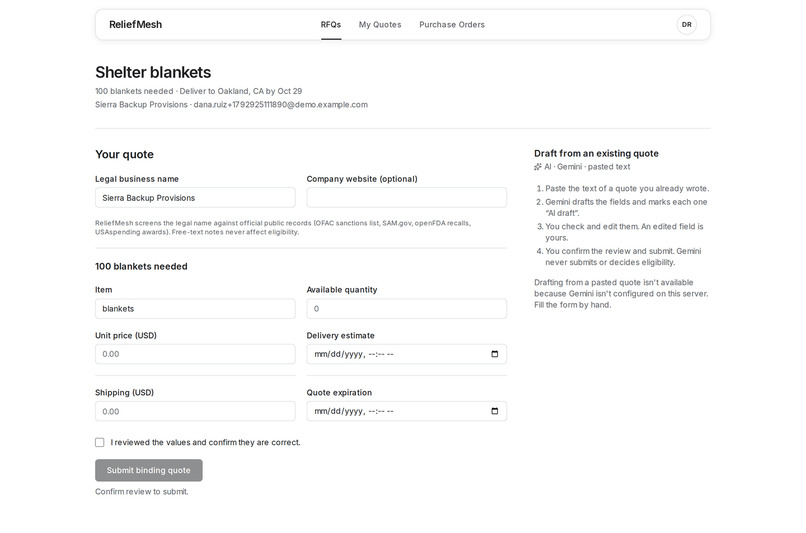
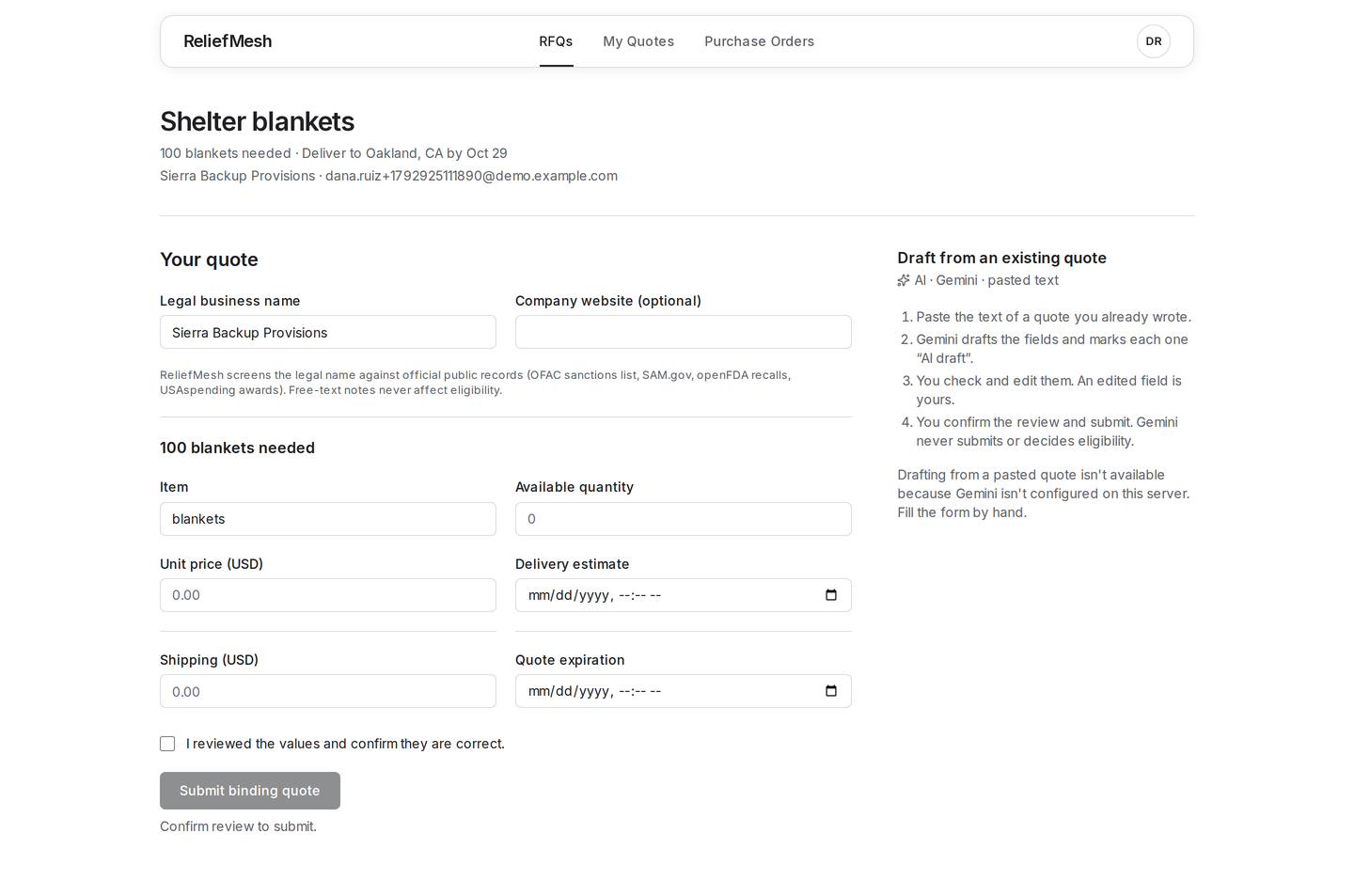
Supplier quote form — binding, line-itemized, optionally Gemini-assisted, always human-reviewed.
-
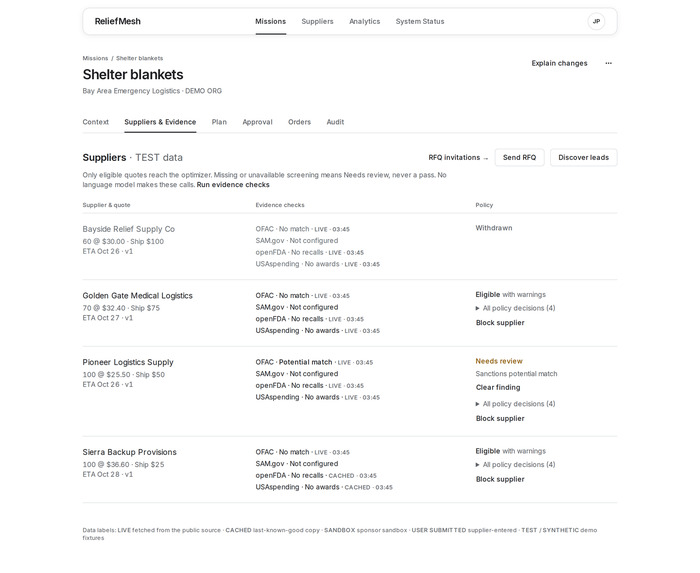
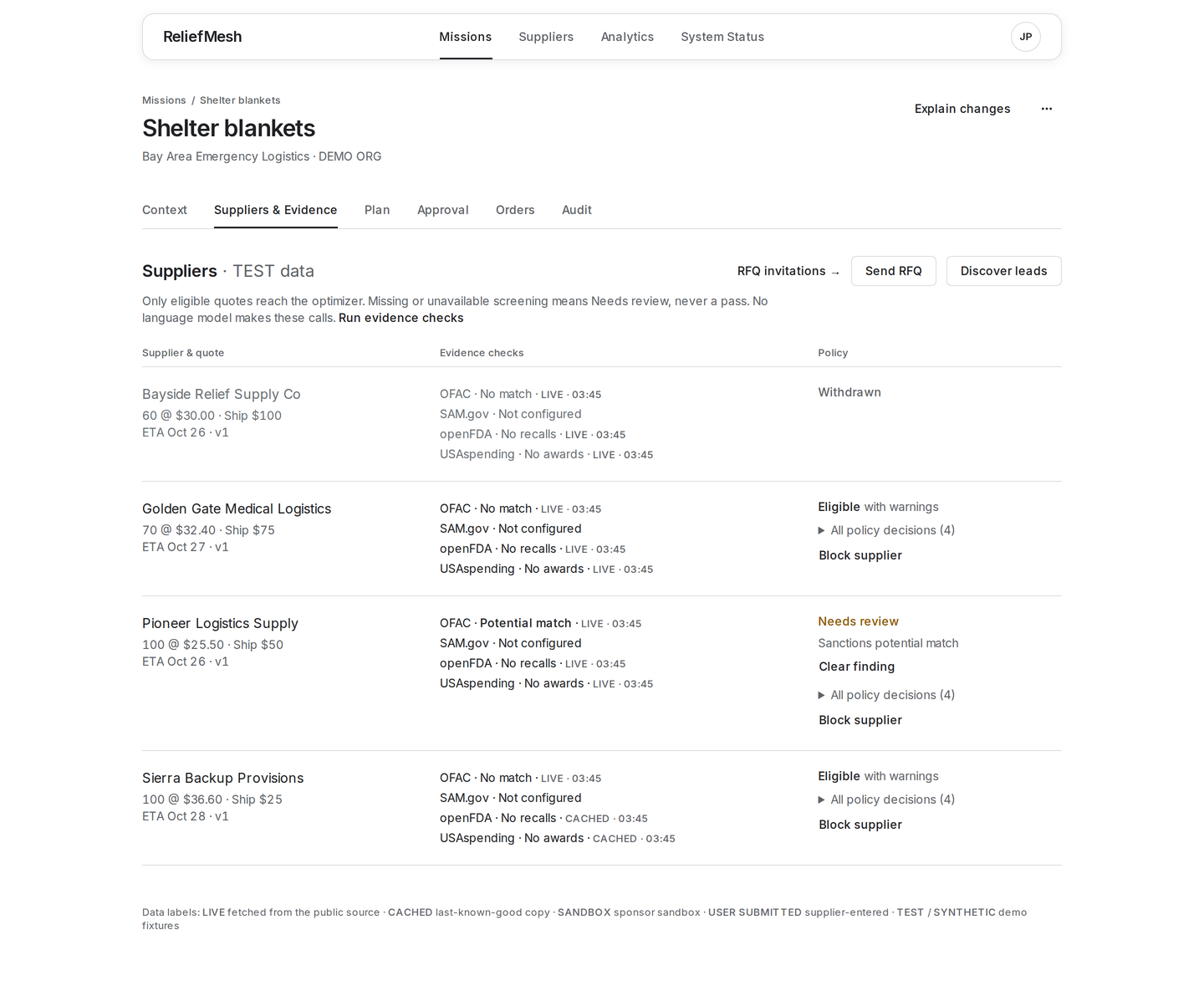
Deterministic eligibility: every supplier screened live against OFAC, openFDA, and USAspending.
-
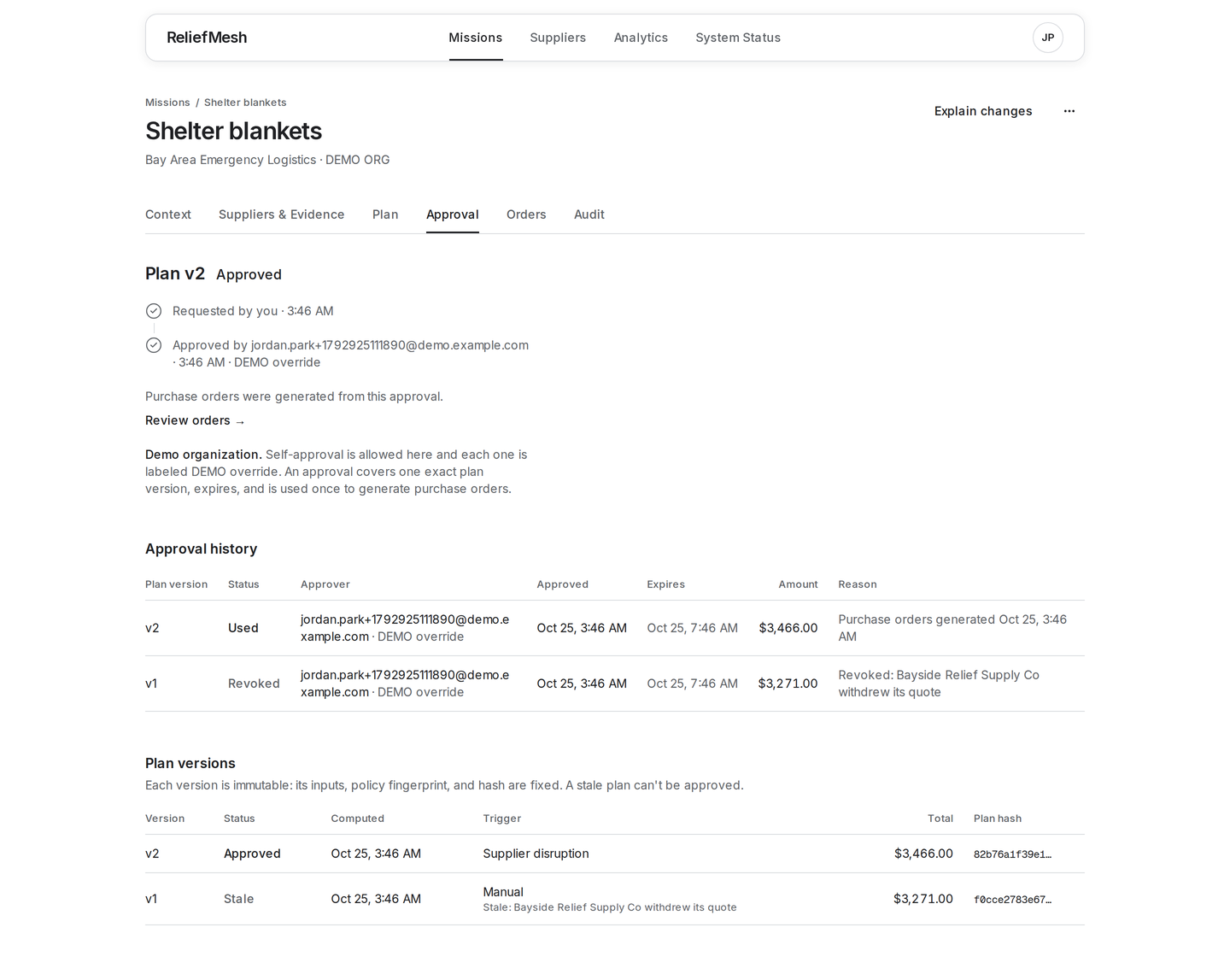
Independent approval: the requester can never approve their own plan — segregation of duties enforced.
-
Mixed-integer optimizer output: the cheapest valid plan across real supplier quotes and constraints.
-
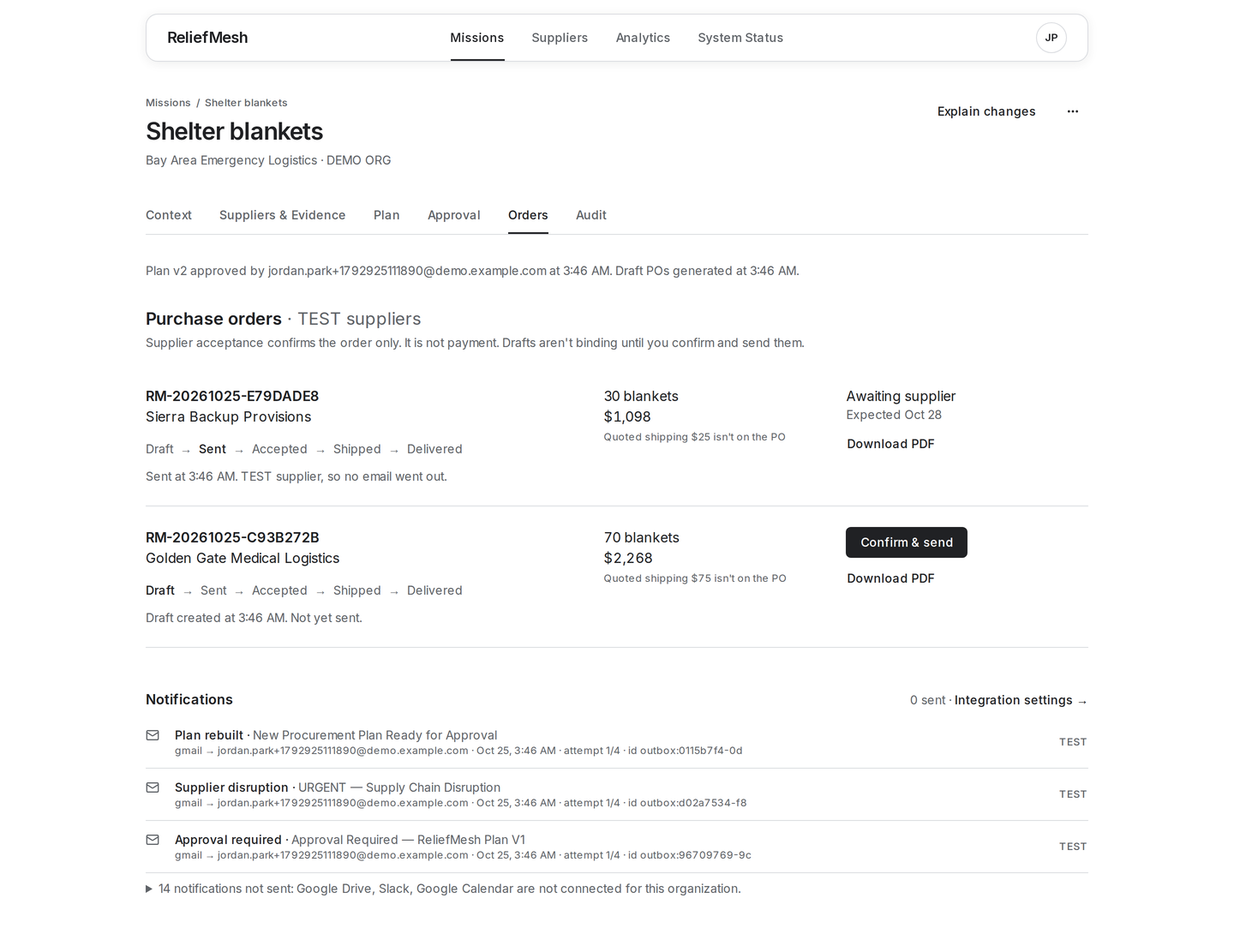
Purchase orders issued only after explicit confirmation — drafting and sending stay separate.
-
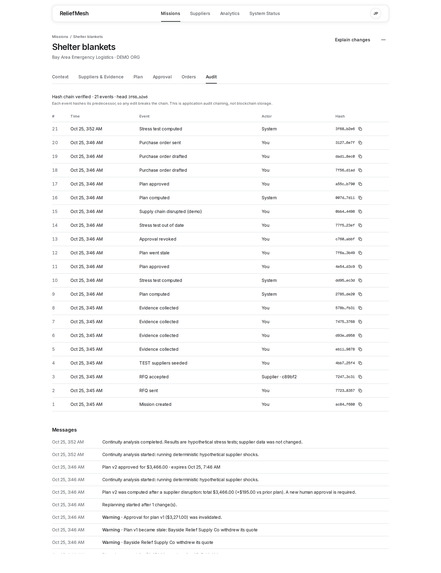
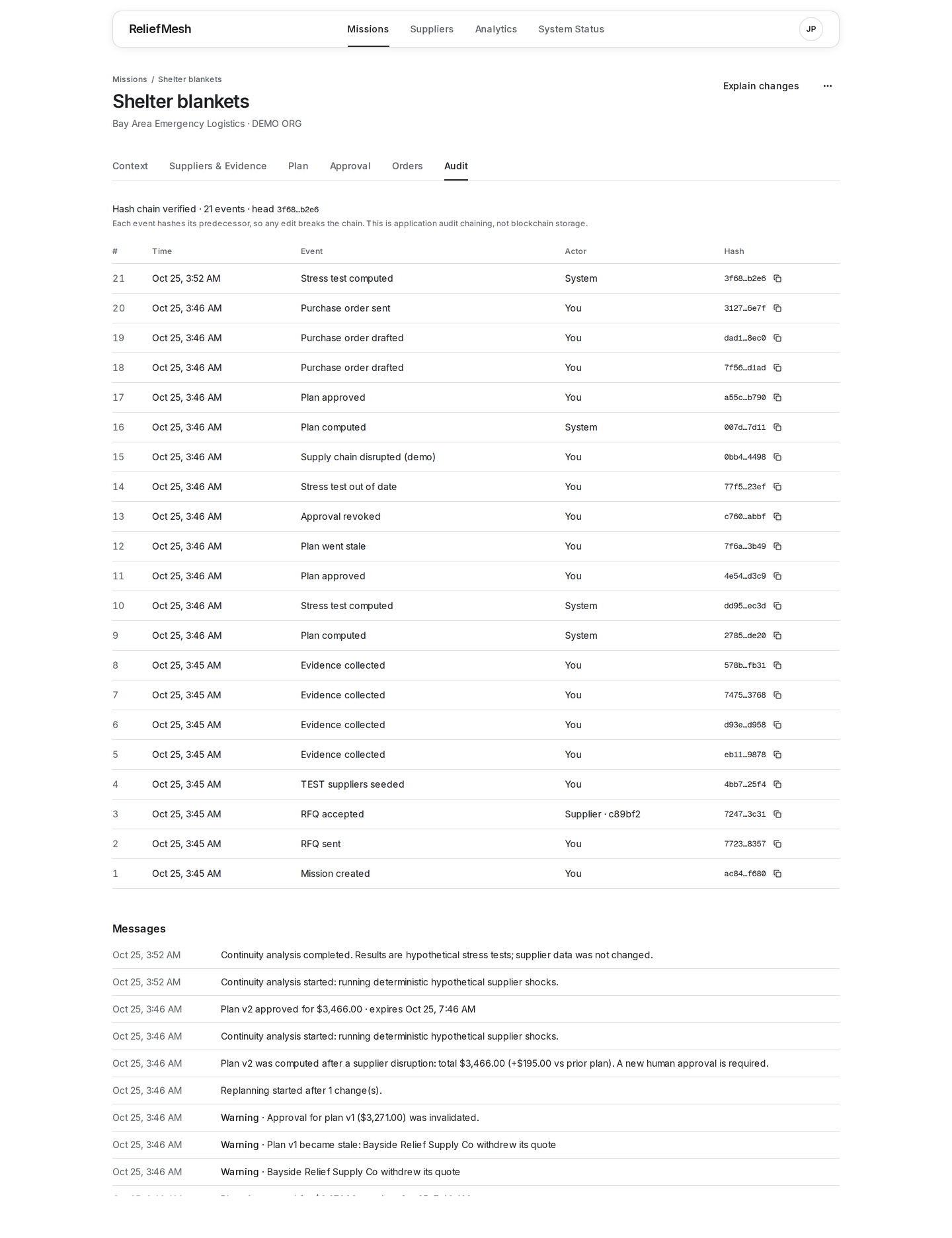
SHA-256 hash-chained audit log — every action is tamper-evident and independently verifiable.
-
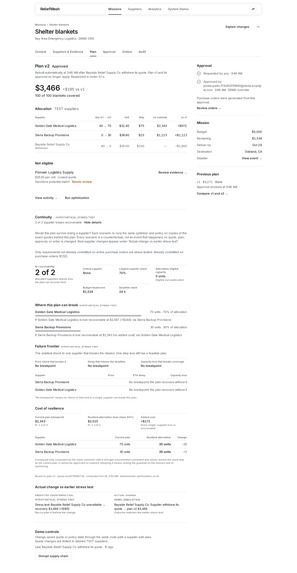
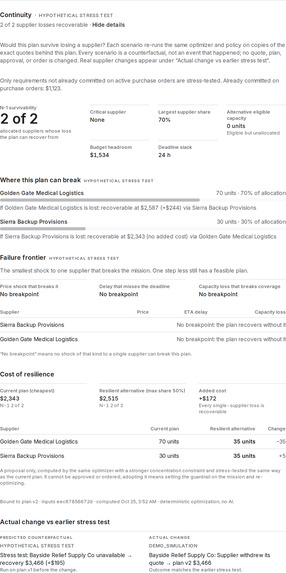
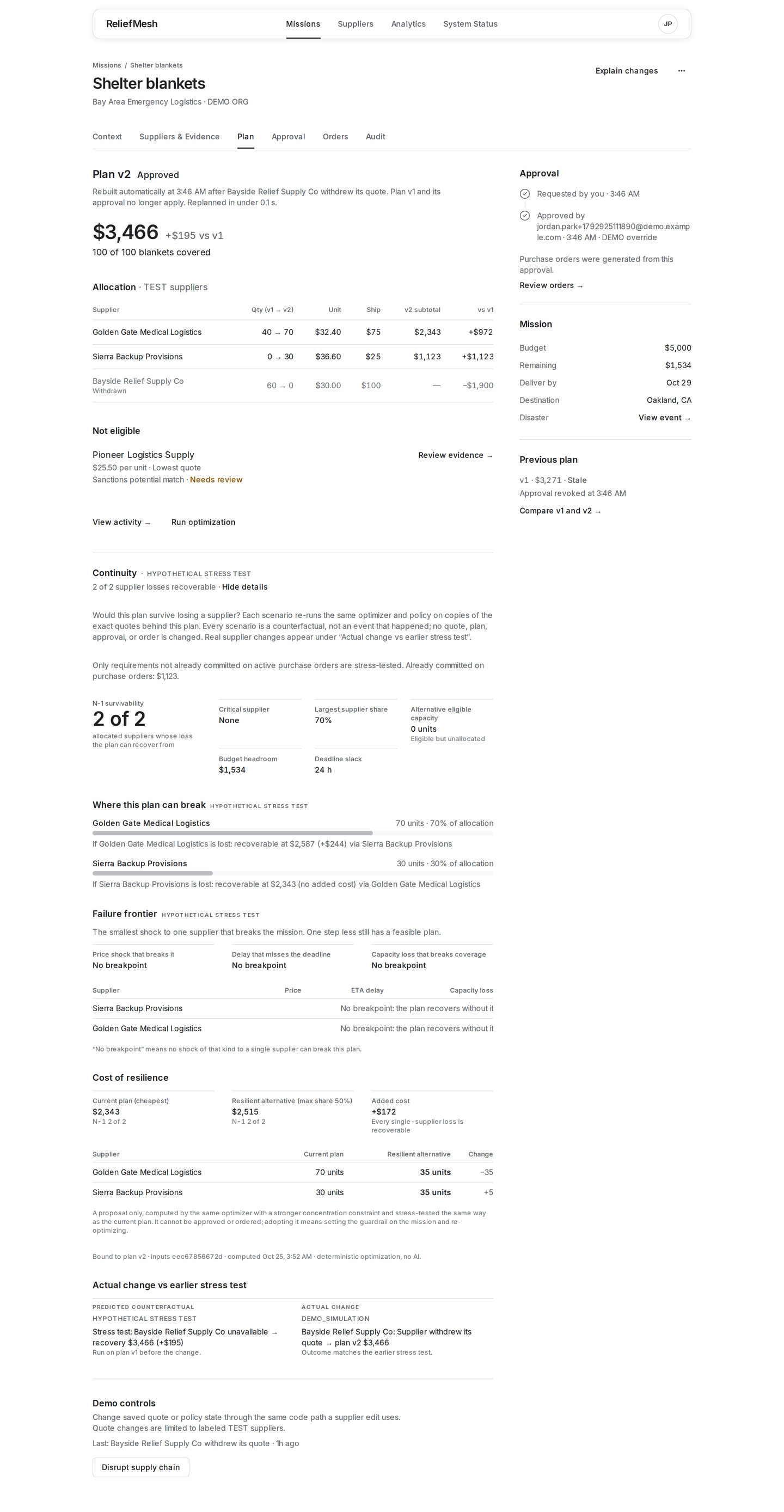
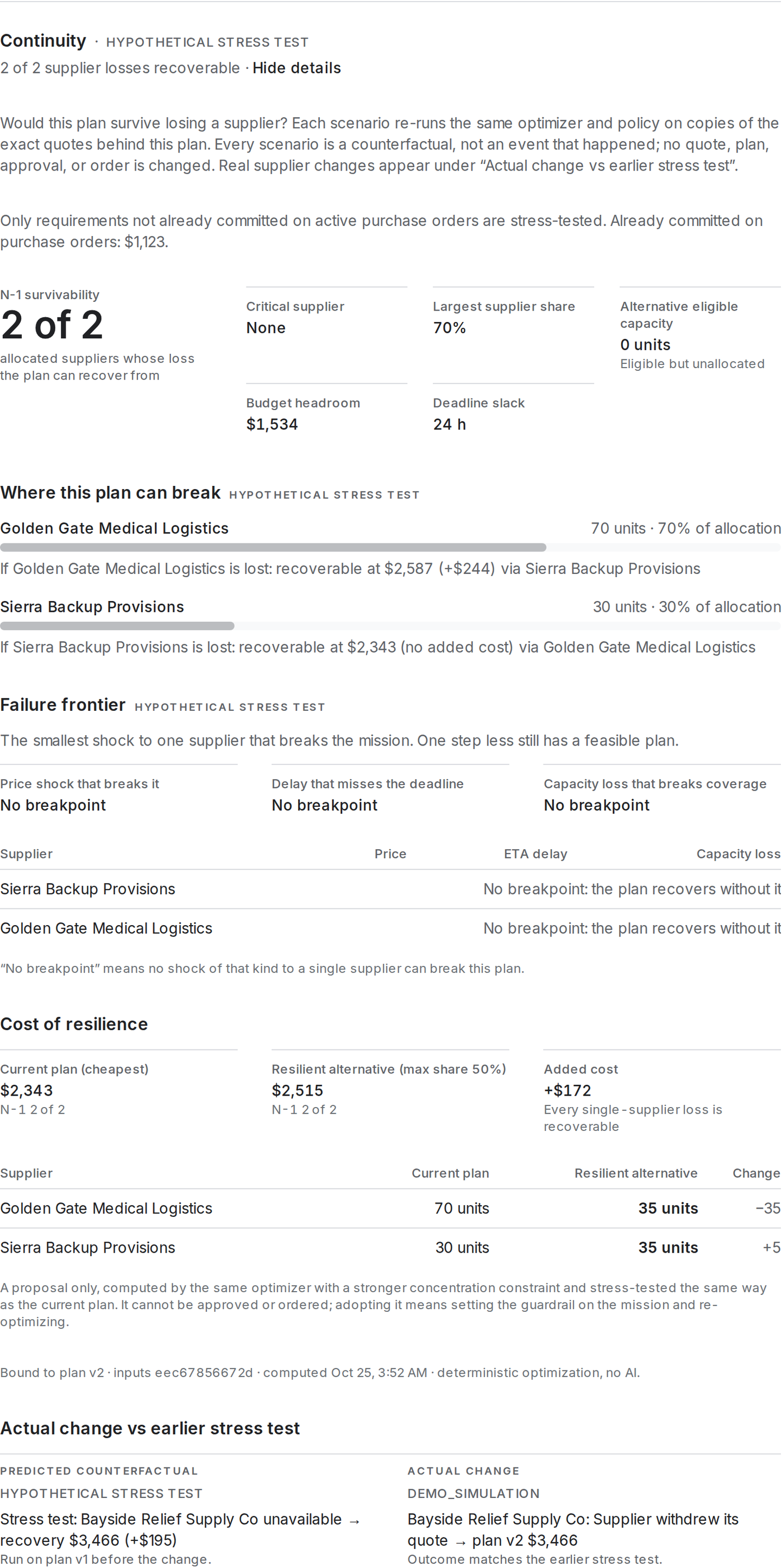
Continuity Engine: stress-tests the approved plan against supplier loss, price, and delay shocks.
-
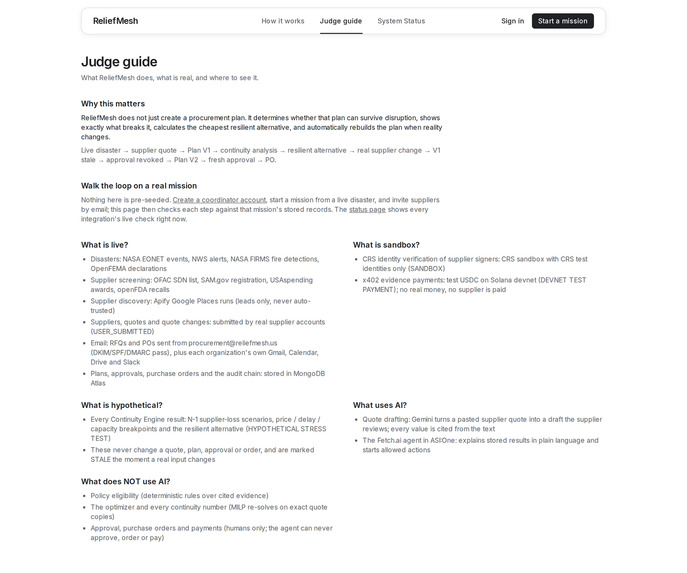
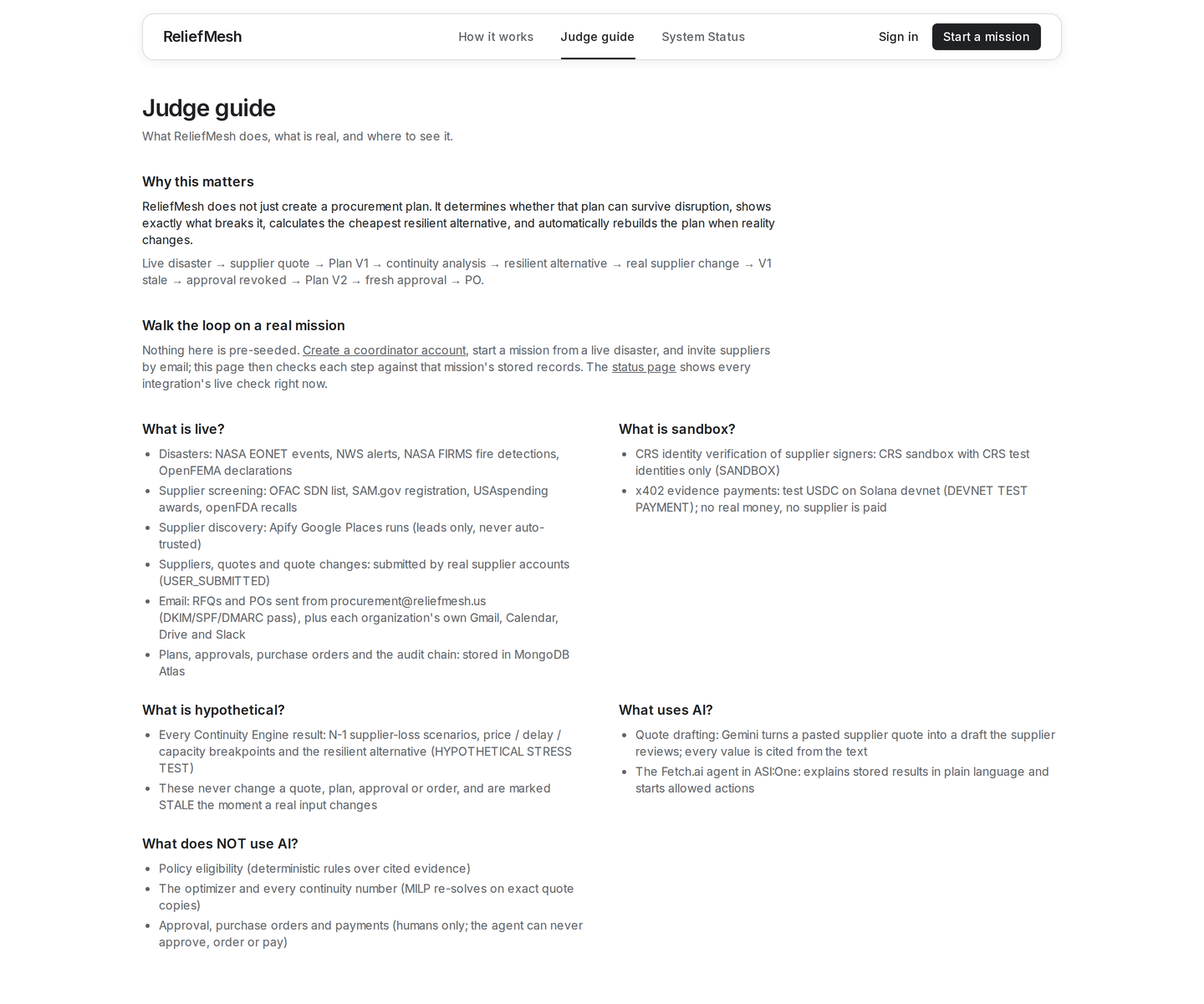
Judge view: a guided walkthrough of the full procurement recovery loop for evaluators.
-
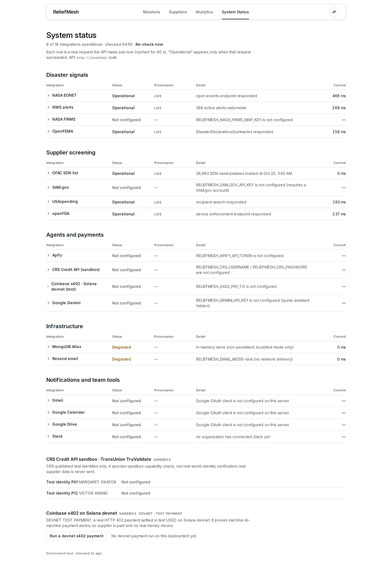
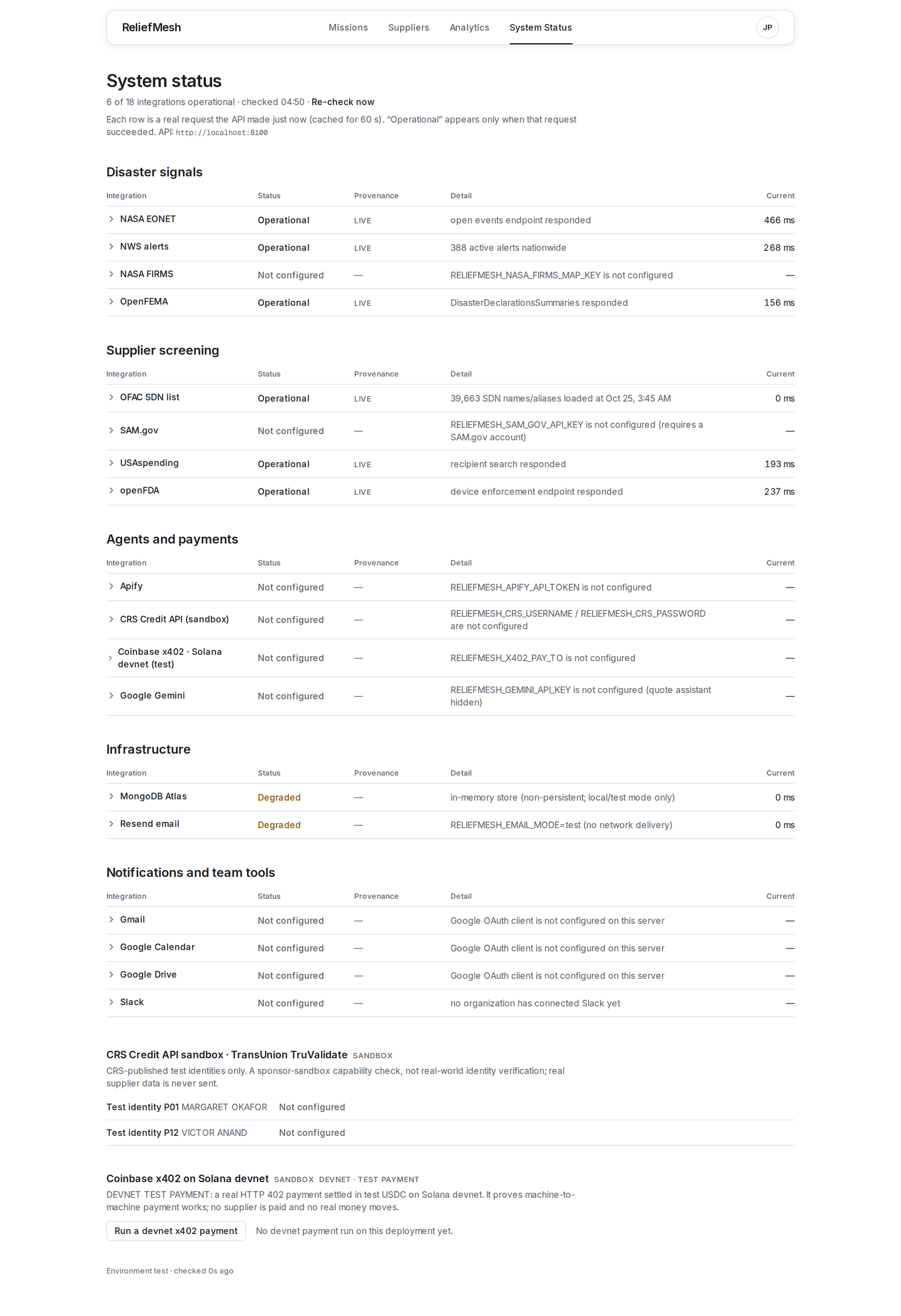
Live system status: real-time health of every integration, labeled LIVE, CACHED, or SANDBOX.
Inspiration
Emergency procurement plans are written against facts that can change in minutes: a supplier sells out, raises a price, misses a delivery window, or becomes ineligible. Most tools help make a plan; they do not prove whether that plan survives the first failure or revoke an approval when its inputs are no longer true.
We built ReliefMesh to make emergency purchasing resilient. It finds the best valid plan from supplier-submitted quotes, tells a coordinator how that plan can fail, and rebuilds it when the real world changes-without letting an agent or requester authorize spending.
What it does
- A coordinator enters the need, destination, deadline, budget, and disaster context.
- ReliefMesh discovers public supplier leads, sends RFQs, and accepts supplier-submitted binding quotes.
- It evaluates public evidence and applies a deterministic eligibility policy.
- PuLP/CBC solves the constrained procurement problem: coverage, inventory, deadline, budget, and concentration.
- The Continuity Engine re-runs that same deterministic model under supplier loss, price, delay, and capacity shocks. Its output is always labeled HYPOTHETICAL STRESS TEST.
- An authorized human approves the exact plan version. The requester and agent cannot self-approve.
- A real supplier quote change makes the plan stale, revokes its approval, and queues an automatic replan.
- A new plan requires a new human approval before purchase orders are issued.
How we built it
Web: Next.js, React, TypeScript, Tailwind, TanStack Query, React Hook Form, and Zod. API: FastAPI, Python, Pydantic, MongoDB Atlas, ReportLab, and durable background jobs. Decision system: a deterministic policy engine plus PuLP/CBC mixed-integer optimization. Continuity: snapshot-bound N-1, price, delay, and capacity stress tests plus a constrained resilient alternative. Evidence and disaster context: NASA EONET, NASA FIRMS, NWS, OpenFEMA, OFAC, SAM.gov, openFDA, and USAspending. Operations: Gmail, Google Calendar, Google Drive, Slack, and Resend. Agent and AI: Fetch.ai / uAgents / Agentverse / ASI:One for operational questions; Gemini for supplier-reviewable quote drafting. Payments: Coinbase x402 with Solana devnet test USDC for machine-paid evidence only; no supplier is paid. Deploy: Vercel, Render, MongoDB Atlas, and reliefmesh.us.
Challenges we ran into
We had to separate useful autonomy from financial authority. The system can invalidate, explain, and replan, but only a human can approve a plan or commit a purchase order. A continuity result is only useful if it is bound to the same quotes, policy, evidence, and plan version that a human sees, so we added explicit input bindings and stale-state handling instead of presenting a plausible but old answer. Real integrations need truthful failure behavior, so we use provenance, caching, retries, and fail-closed policy rather than replacing unavailable data with mock success.
Accomplishments that we're proud of
A procurement plan can be stress-tested before an emergency supplier fails. A real input change automatically invalidates the old financial authorization. The complete recovery loop is auditable: V1, change, stale, V2, new approval, POs. Replayed operational delivery jobs produce no duplicate notifications, files, orders, or receipts. AI assistance stays on the assistive side of a firm human and deterministic boundary.
What we learned
Trust is a product feature. Showing whether data is live, cached, user-submitted, sandboxed, or hypothetical is as important as computing a recommendation. We also learned that a resilient plan is not necessarily the cheapest plan, and a correct answer must include the cost of that resilience.
What's next
Continue validating the workflow with emergency-response partners and policy owners. Expand supplier participation while preserving the same evidence, approval, and audit boundaries.


Log in or sign up for Devpost to join the conversation.