-
-
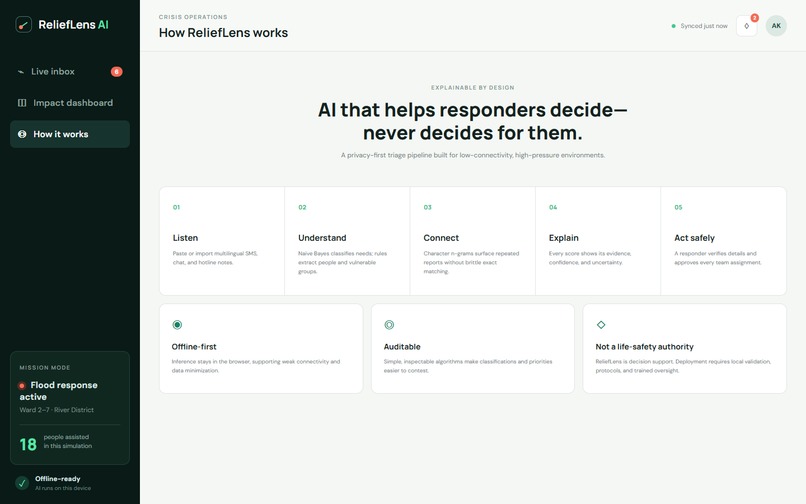
Responsive mobile experience for responders working in the field.
-
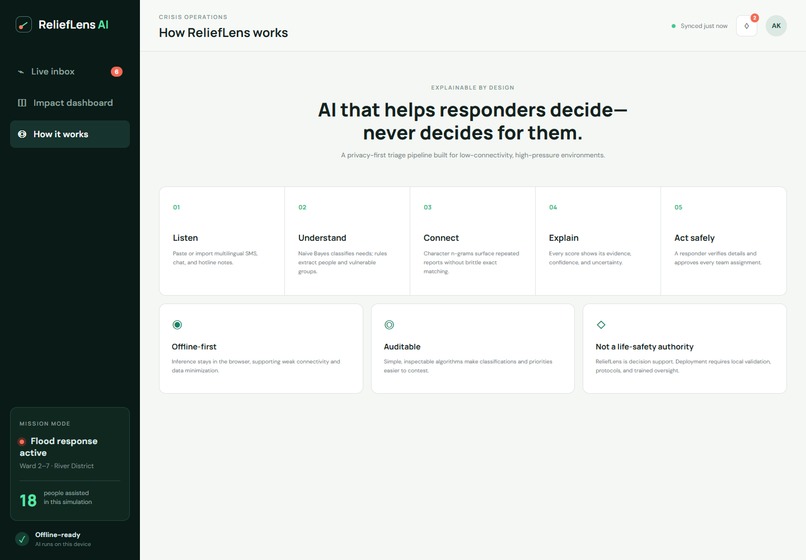
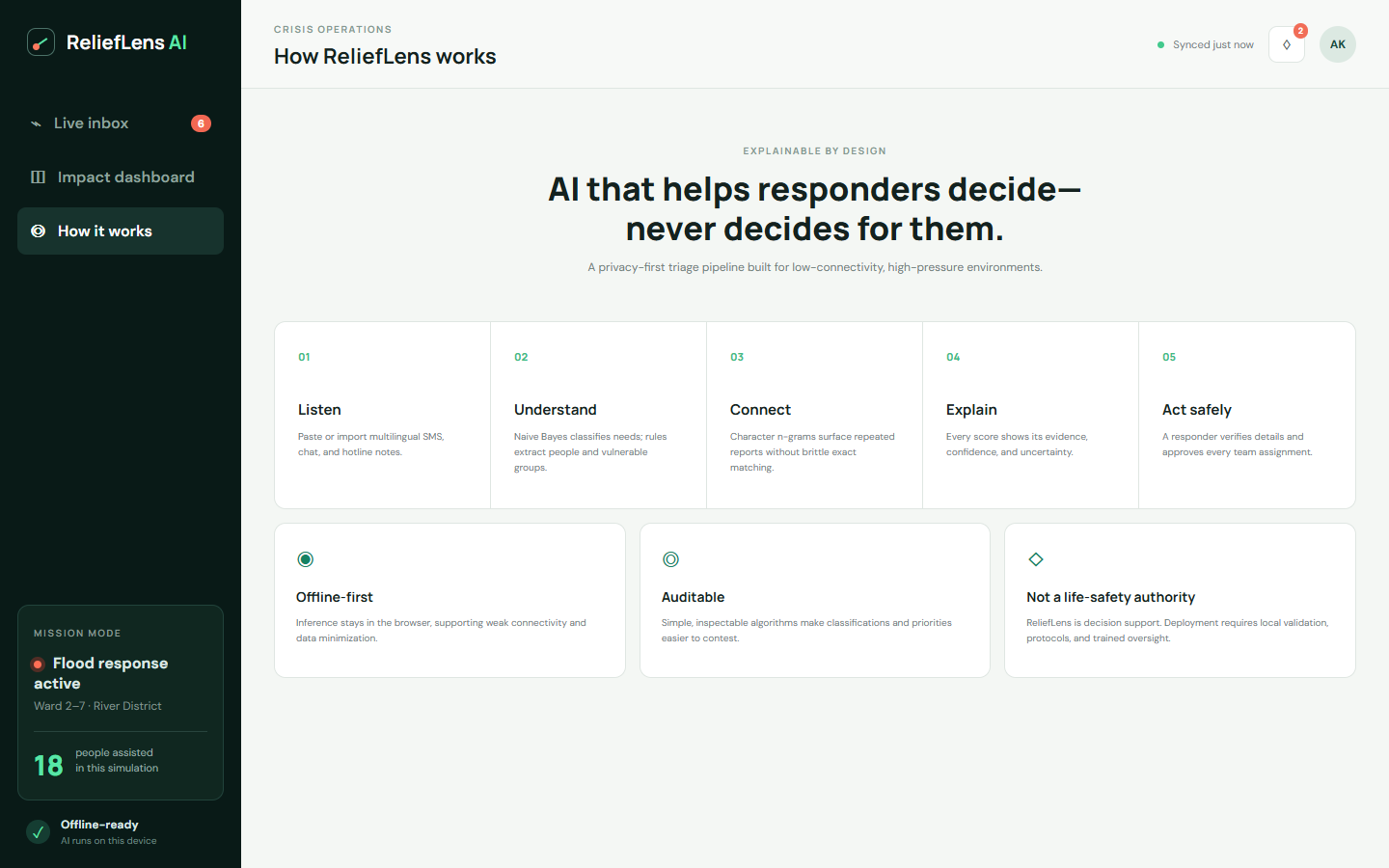
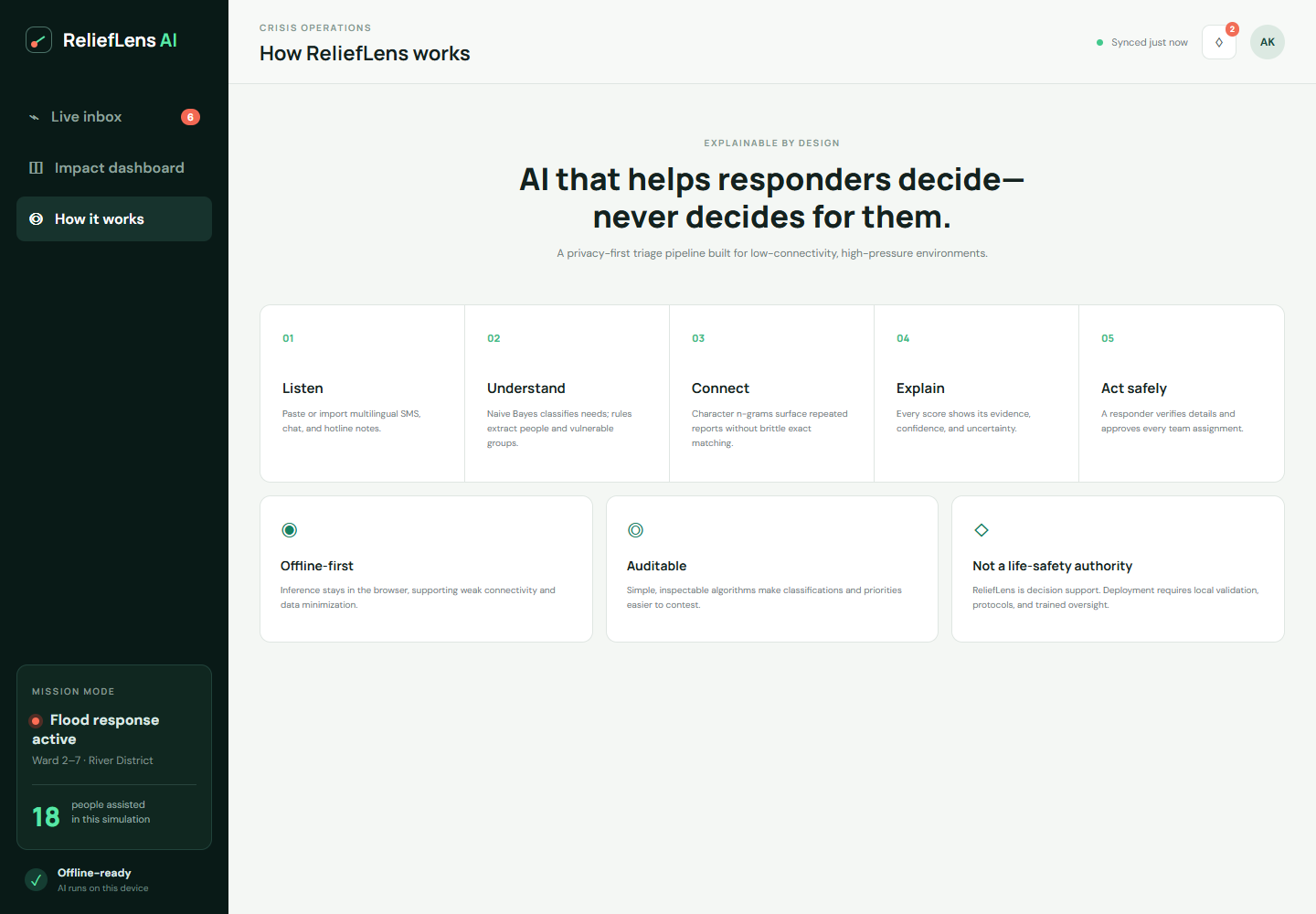
Transparent five-stage ML pipeline: listen, understand, connect, explain, and act safely.
-
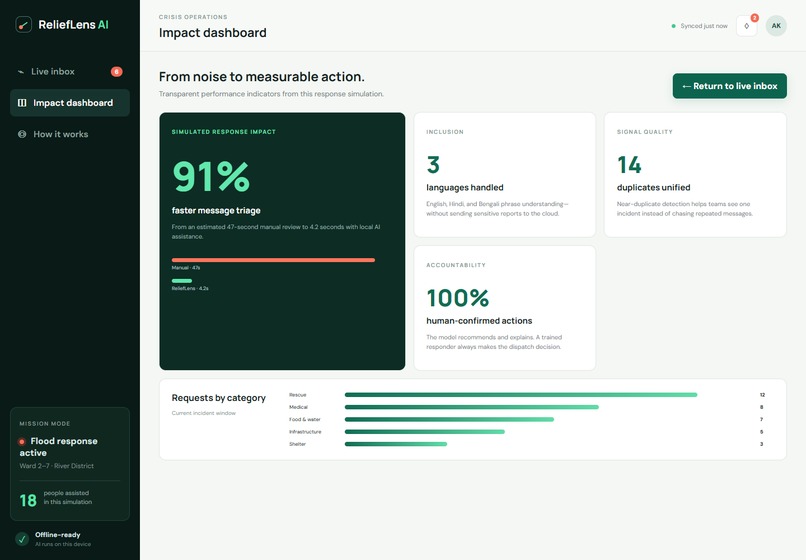
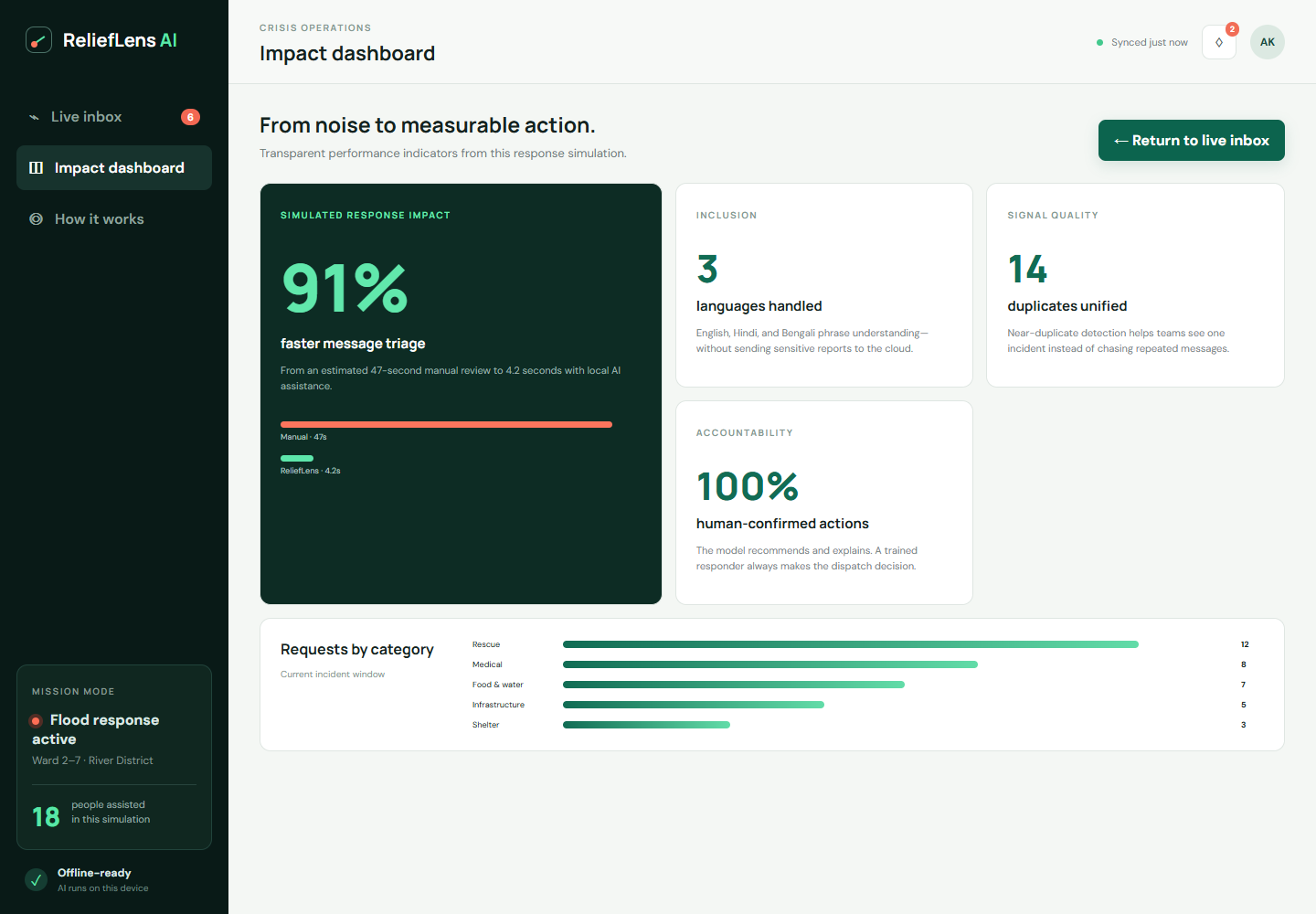
Impact dashboard displaying simulated triage speed, multilingual inclusion, and human oversight.
-

Responsive mobile experience for responders working in the field.
-
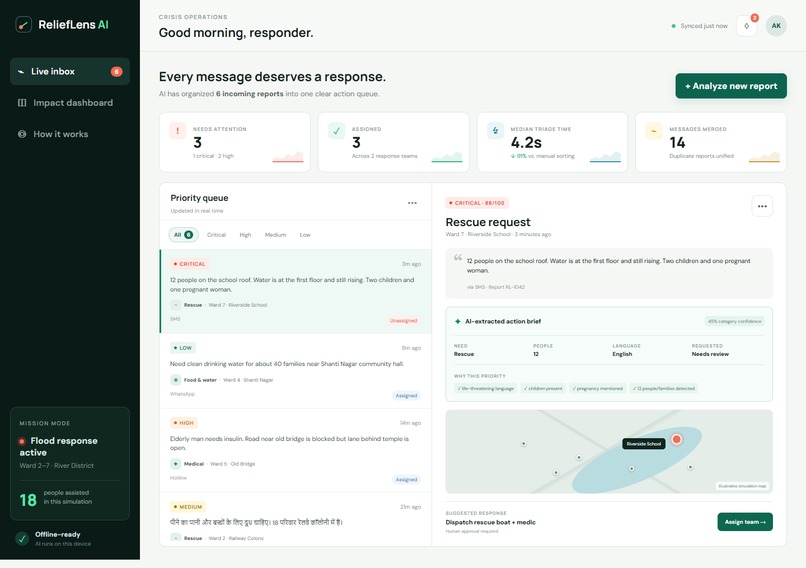
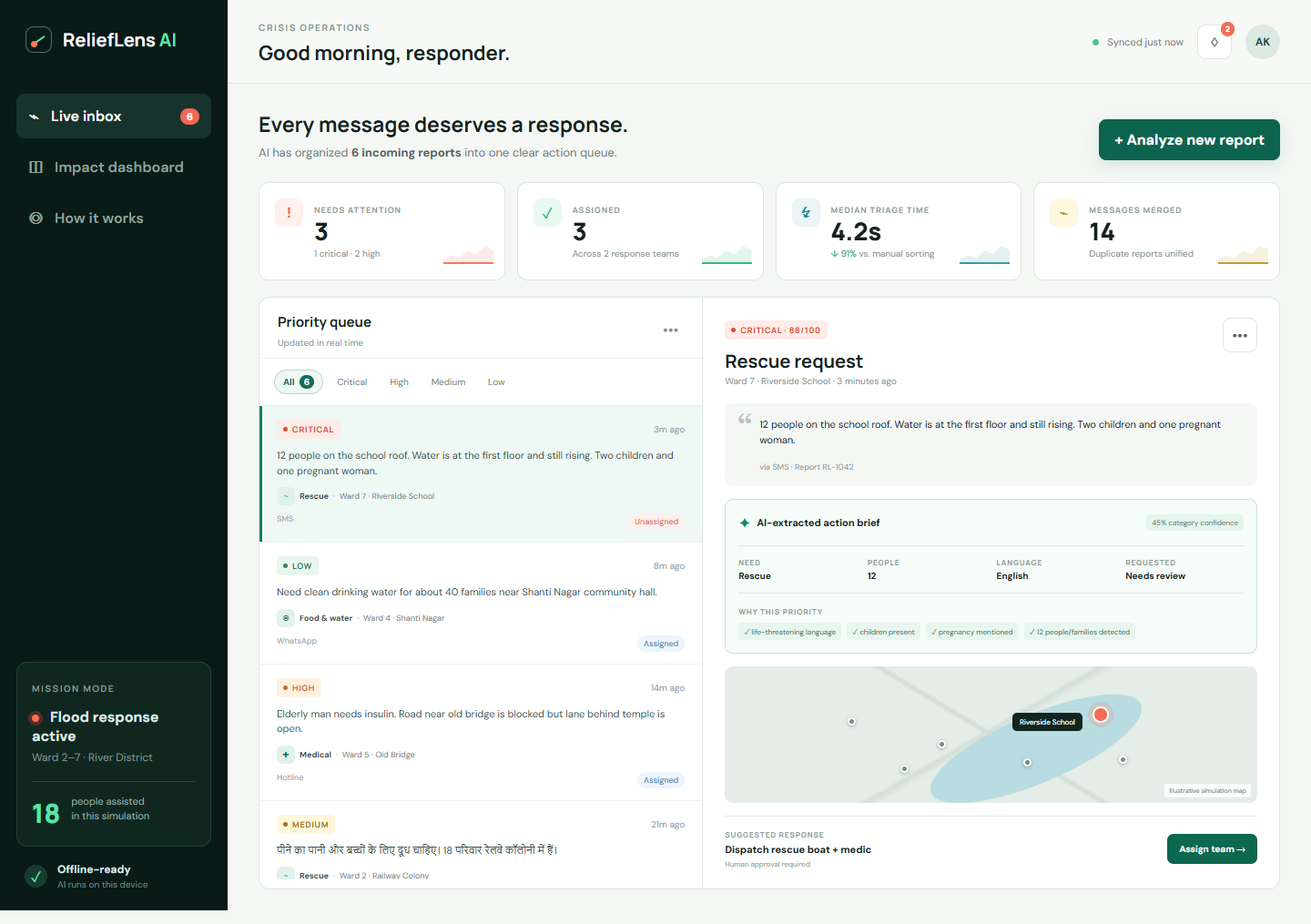
Live crisis-response dashboard organizing multilingual reports into a prioritized action queue.
-
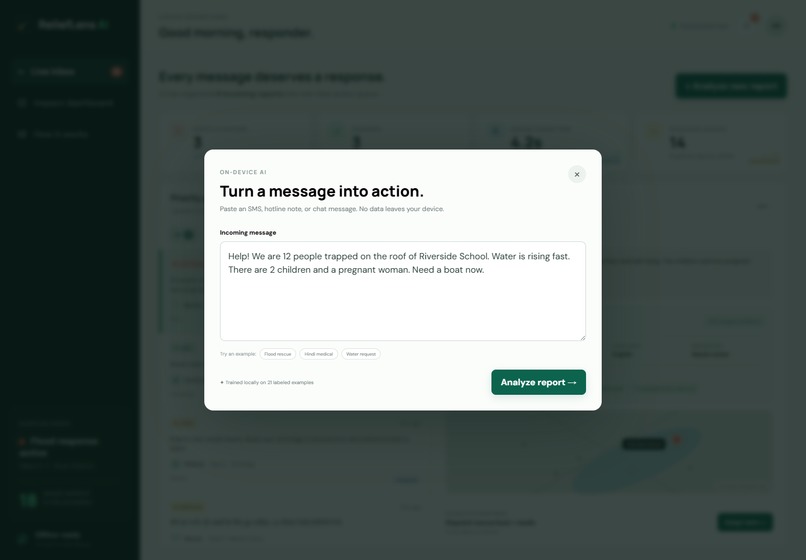
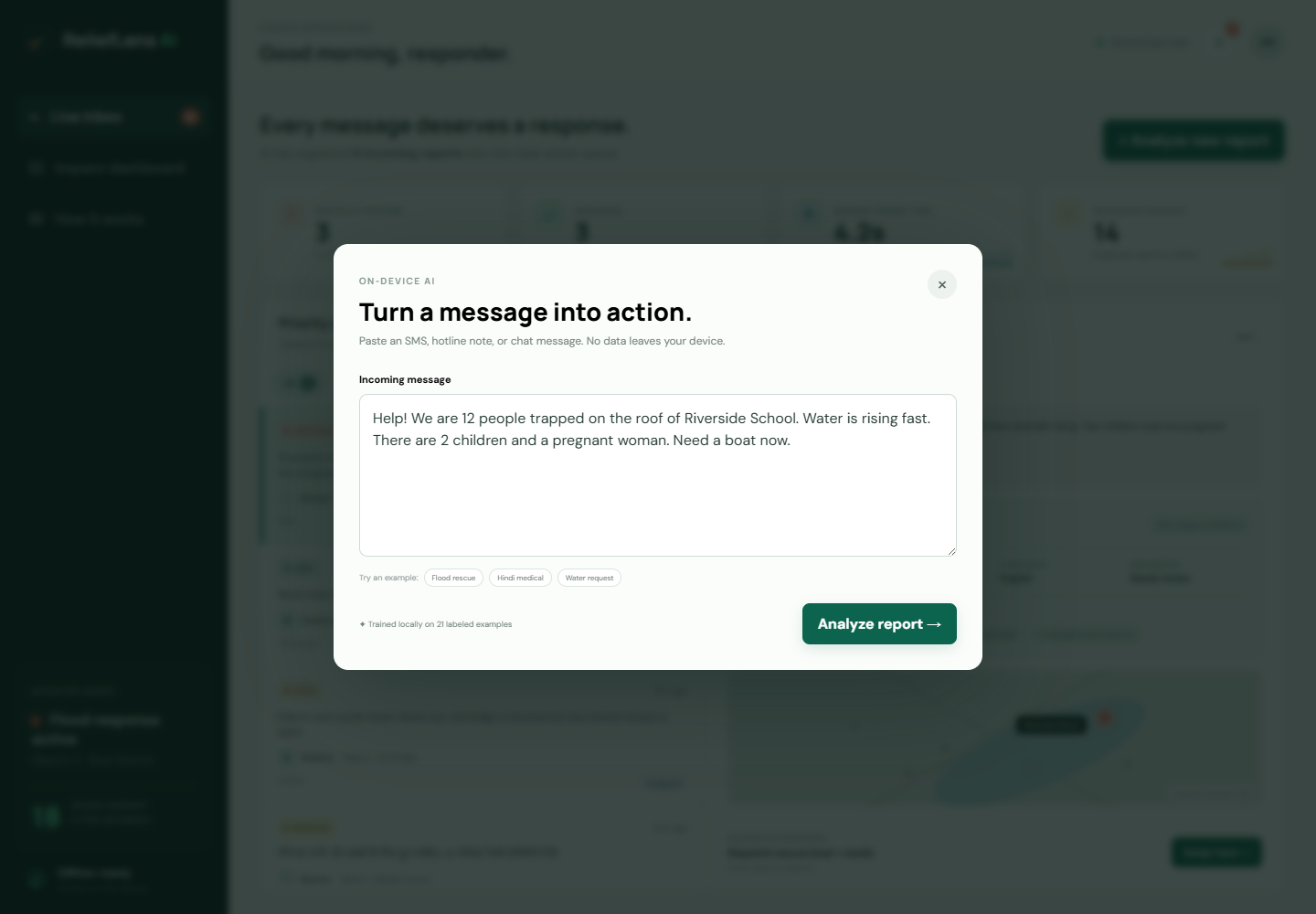
Offline message analyzer accepts emergency reports without sending sensitive information to the cloud.
-
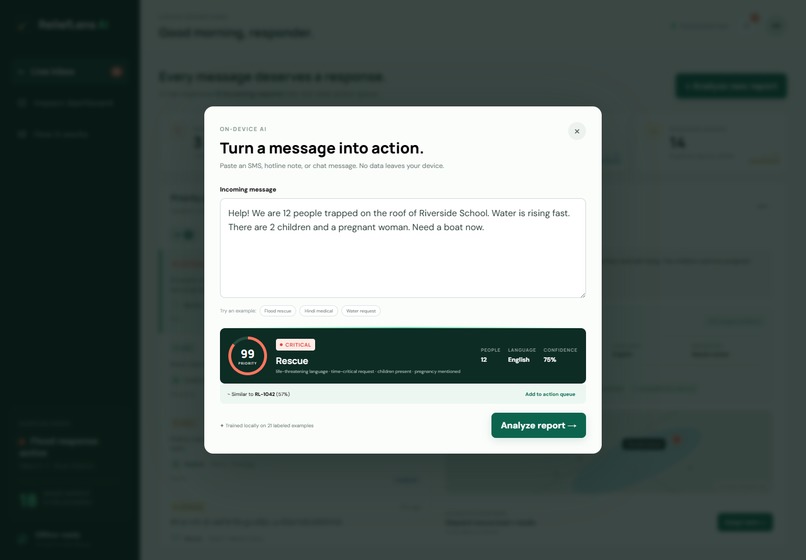
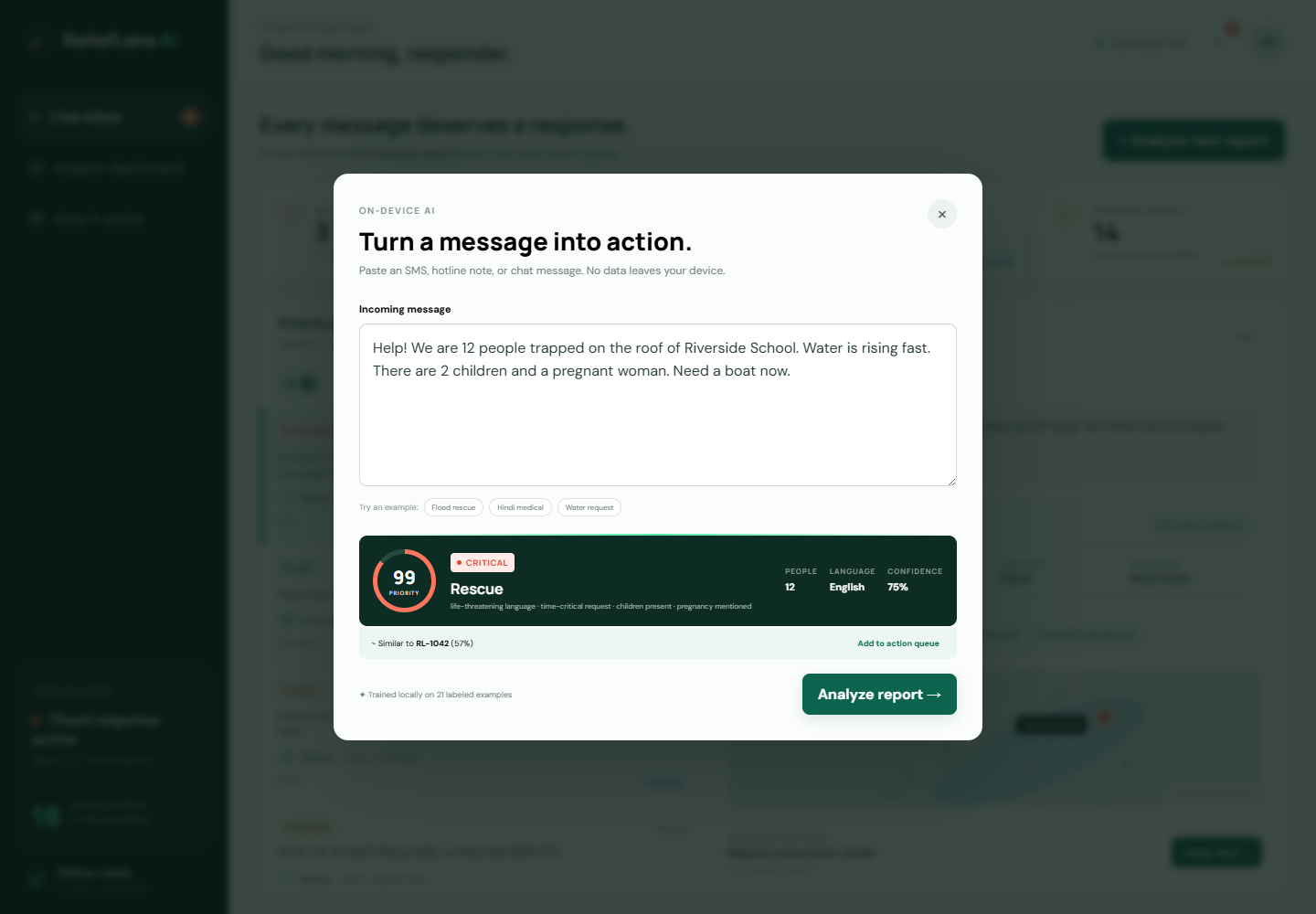
Explainable AI result showing urgency, need category, confidence, evidence, and duplicate detection.

Inspiration
During floods and other emergencies, small response teams receive large numbers of calls, SMS messages, hotline notes, and community chats. Manually reviewing every report is slow, duplicate messages can waste limited resources, and language barriers may cause urgent requests to be overlooked.
ReliefLens AI was inspired by a simple question: can practical machine learning help responders understand community needs faster without allowing AI to make life-safety decisions?
What it does
ReliefLens AI is an offline-first crisis-message triage workspace. It converts multilingual emergency reports into a clear, prioritized action queue.
For every incoming message, ReliefLens:
- Predicts the type of need, such as rescue, medical assistance, food and water, shelter, or infrastructure support
- Extracts people counts, requested resources, language, and vulnerable groups
- Calculates an urgency score using visible risk evidence
- Identifies possible duplicate reports
- Suggests an appropriate response
- Requires human verification before any team assignment
The current prototype supports English, Hindi, and Bengali examples and runs entirely inside the browser. Sensitive reports are not uploaded to an external AI service.
How we built it
ReliefLens was built using TypeScript, Vite, HTML, CSS, and browser-based machine learning.
The application uses:
- A multinomial Naive Bayes classifier trained on labeled multilingual examples
- Rule-based entity extraction for people, resources, and vulnerability indicators
- A transparent urgency model using risk language, time pressure, scale, and vulnerable groups
- Character trigram vectors and cosine similarity for near-duplicate detection
- A service worker for offline support
- Vitest for automated ML-engine testing
- Playwright for desktop, mobile, and production verification
Unlike a basic chatbot or prompt wrapper, the complete ML pipeline runs locally and exposes its confidence, evidence, and uncertainty.
Challenges we ran into
The hardest challenge was balancing speed with safety. An AI system that appears overly confident can be dangerous during an emergency. We therefore designed ReliefLens as decision support rather than an autonomous dispatcher.
The interface distinguishes missing information from zero, explains why each report received its priority, labels all impact figures as simulation metrics, and requires human approval before assigning a response team.
Multilingual duplicate detection was another challenge because exact word matching performs poorly across spelling and phrasing variations. Character n-grams provided a lightweight and language-tolerant alternative.
Accomplishments that we're proud of
- Built a working on-device ML pipeline rather than a single prompt wrapper
- Created an end-to-end prototype that requires no API key
- Added multilingual crisis-message analysis
- Made every priority score explainable and contestable
- Implemented duplicate detection and human-confirmed dispatch
- Designed responsive command-center and mobile experiences
- Added automated tests and responsible-use safeguards
- Deployed a publicly accessible working demonstration
What we learned
Responsible AI is not merely a disclaimer—it changes the product architecture. Keeping reports local, exposing confidence, representing uncertainty honestly, and retaining human oversight made ReliefLens safer and more useful.
We also learned that small and transparent ML models can create meaningful impact when they are placed inside a carefully designed real-world workflow.
Real-world impact
ReliefLens is intended for community relief organizations, campus emergency teams, local nonprofits, and municipal response groups that must review more unstructured reports than they can process quickly.
The dashboard demonstrates a simulated reduction from 47 seconds of manual sorting to 4.2 seconds of AI-assisted triage. This is a prototype hypothesis, not a field-validated claim.
Before real deployment, ReliefLens would require representative local data, evaluation of precision and recall by language, security review, responder training, data-retention policies, and field validation with relief partners.
What's next
Future development will include:
- Co-designing the workflow with relief organizations
- Building a consented local-language dataset
- Measuring accuracy, calibration, and false-negative rates by language
- Adding encrypted store-and-forward synchronization
- Integrating approved SMS gateways and humanitarian data standards
- Testing the system through tabletop emergency exercises
ReliefLens AI demonstrates how practical, privacy-conscious, and human-centered machine learning can help every emergency message become action.
Built With
- cosine-similarity
- css3
- html5
- machine-learning
- naive-bayes
- natural-language-processing
- playwright
- progressive-web-app
- service-worker
- typescript
- vercel
- vite
- vitest

Log in or sign up for Devpost to join the conversation.