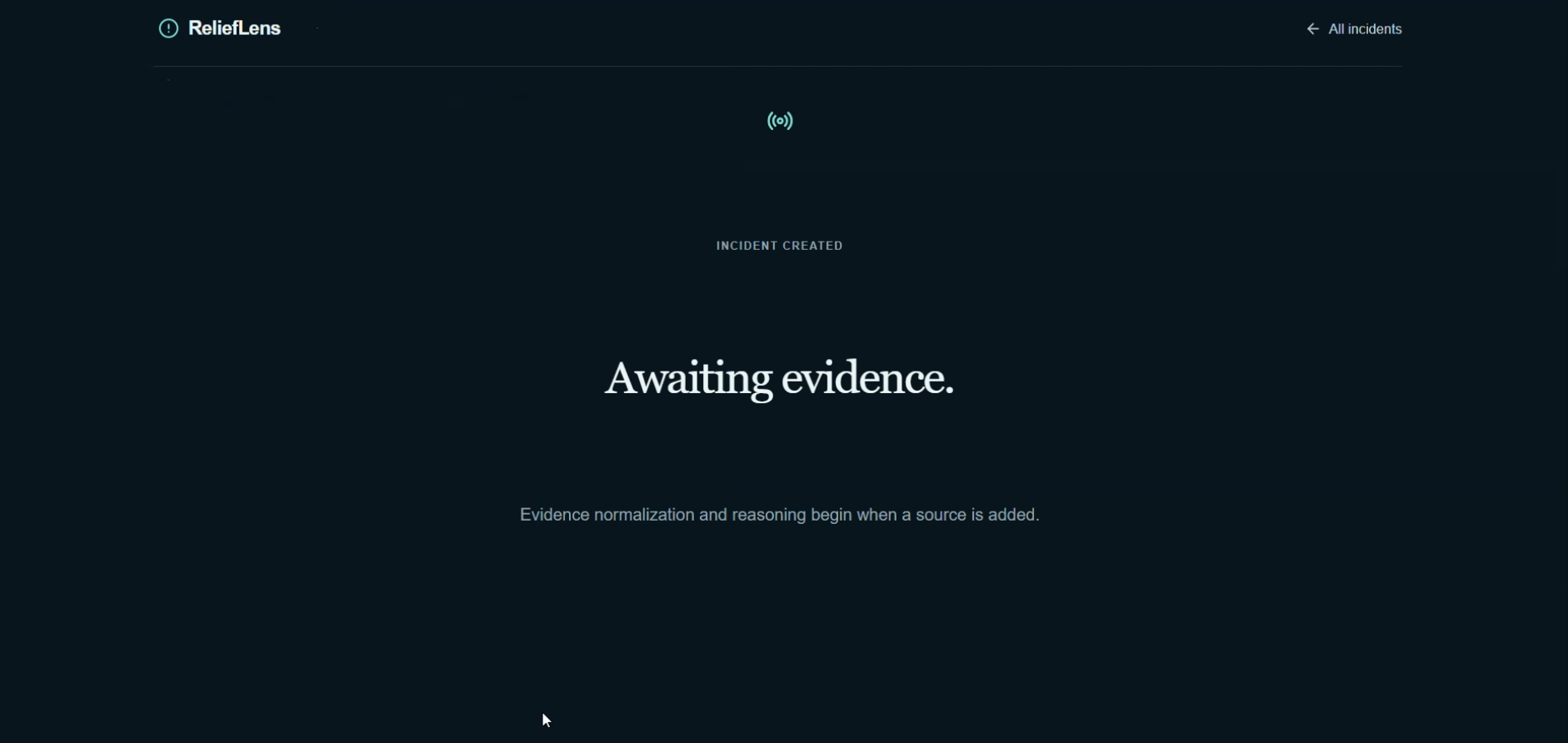

ReliefLens
Inspiration
During disasters, emergency coordinators receive photos, videos, and voice reports from multiple sources. These reports are often incomplete, contradictory, or difficult to verify in real time. Most AI systems summarize information, but they rarely communicate uncertainty or explain why a recommendation should or should not be trusted.
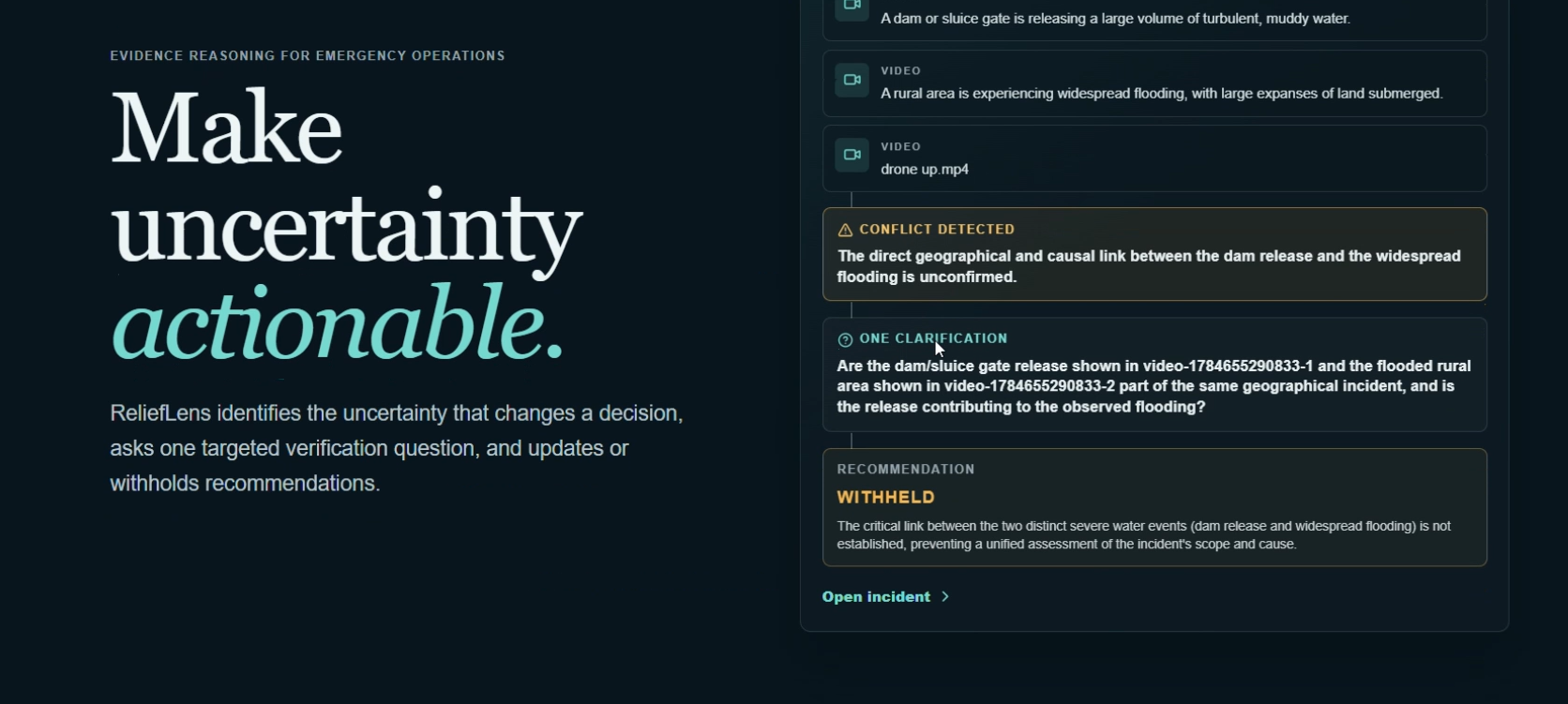
We wanted to build an AI assistant that behaves more like an experienced emergency coordinator—one that analyzes multimodal evidence, identifies conflicting information, asks the single most valuable clarification question, and only makes recommendations after critical uncertainty has been resolved.
That idea became ReliefLens.
What it does
ReliefLens is a multimodal AI-powered emergency reasoning assistant designed to support disaster response teams.
Users can upload:
- 📷 Photos
- 🎥 Videos
- 🎙️ Voice reports
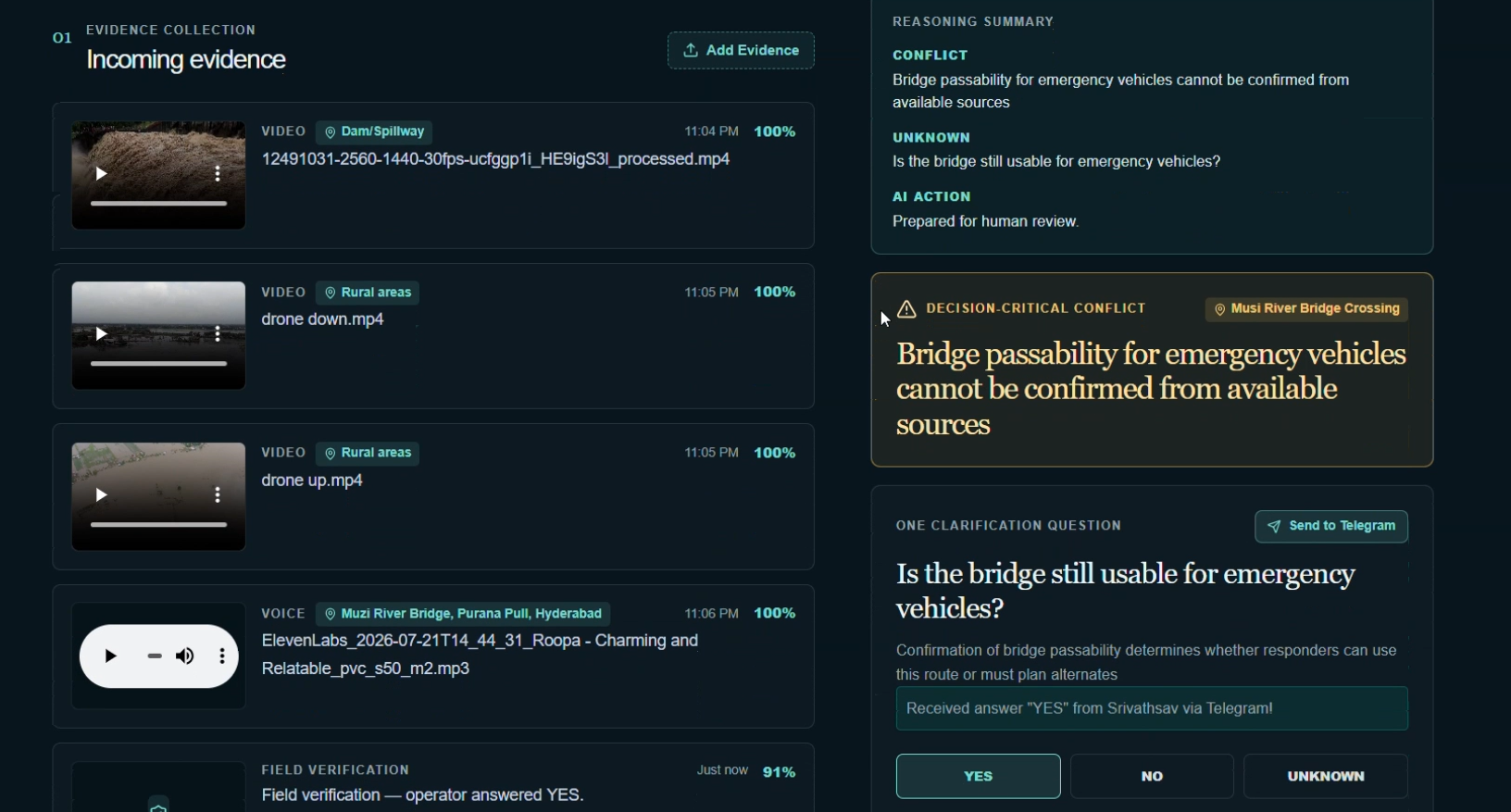
ReliefLens analyzes every piece of evidence and produces:
- Structured evidence extraction
- Claim identification
- Evidence strength scoring
- Conflict detection
- AI-generated clarification questions
- Transparent reasoning summaries
- Human verification workflow
- Final recommendations backed by evidence
Unlike traditional AI assistants, ReliefLens intentionally withholds recommendations when critical uncertainty exists instead of making potentially unsafe assumptions.
How we built it
ReliefLens combines modern web technologies with multimodal AI.
Frontend
- React
- TypeScript
- Tailwind CSS
Backend
- Node.js
- Express
AI
- Google Gemini Multimodal API
Processing Pipeline
Photo
Video
Audio
      │
      ▼
Preprocessing
      │
      ▼
Gemini Analysis
      │
      ▼
Structured JSON
      │
      ▼
Schema Validation
      │
      ▼
Reasoning Engine
      │
      ▼
Conflict Detection
      │
      ▼
Clarification Question
      │
      ▼
Human Verification
      │
      ▼
Recommendation
To improve reliability, we implemented deterministic schema validation and fallback logic so the application continues functioning even when AI output is incomplete or uncertain.
Challenges we ran into
One of the biggest challenges was designing an AI system that doesn't simply generate an answer but reasons about uncertainty.
Some of the challenges included:
- Handling multimodal inputs with different formats and sizes
- Producing consistent structured outputs from AI responses
- Detecting conflicting evidence across photos, videos, and audio
- Preventing hallucinated recommendations
- Building a transparent reasoning workflow that users can trust
- Designing a deterministic fallback pipeline when AI confidence is low
Balancing flexibility with reliability required multiple iterations of both the prompting strategy and the validation pipeline.
Accomplishments that we're proud of
We're especially proud that ReliefLens doesn't just summarize evidence—it reasons about it.
Some highlights include:
- Built a complete multimodal reasoning workflow
- Developed transparent AI reasoning summaries
- Implemented evidence conflict detection
- Created an uncertainty-aware recommendation engine
- Added human verification before final recommendations
- Built deterministic fallback logic for improved robustness
- Delivered a clean, intuitive interface suitable for emergency response scenarios
Most importantly, we built an AI system that knows when it needs more information before making important decisions.
What we learned
Building ReliefLens reinforced that trustworthy AI is not about generating answers as quickly as possible.
We learned:
- Explainability is just as important as accuracy.
- Human-in-the-loop workflows significantly improve trust.
- Structured outputs make AI systems more reliable.
- Validation layers are essential when working with generative AI.
- Multimodal reasoning becomes much more valuable when evidence is transparent and traceable.
Perhaps our biggest takeaway was that uncertainty itself is useful information, and AI should communicate it rather than hide it.
What's next for ReliefLens
We see ReliefLens evolving into a comprehensive emergency intelligence platform.
Future plans include:
- Live drone video analysis
- GIS and interactive map integration
- Satellite imagery support
- Multi-language voice translation
- Real-time collaboration for emergency operations centers
- Edge deployment for low-connectivity environments
- Integration with public emergency management systems
- Retrieval-Augmented Generation (RAG) using official disaster protocols
- Predictive risk assessment using historical incident data
- Support for multiple AI models with confidence comparison
Our long-term vision is to help emergency teams make faster, safer, and more transparent decisions when every second matters.
Built With
- api
- css
- css3
- express.js
- gemini
- git
- github
- html5
- javascript
- node.js
- react
- rest
- tailwind
- typescript
- vercel


Log in or sign up for Devpost to join the conversation.