
Inspiration
Natural disasters are chaotic, but one of the biggest challenges isn't the lack of data—it's the loss of context. Emergency responders, humanitarian organizations, and government agencies often work across multiple teams, shifts, and systems. Critical information becomes fragmented, previous decisions are difficult to retrieve, and valuable operational knowledge is lost when it is needed most.
While recent advances in AI have made autonomous agents capable of reasoning and generating recommendations, we realized that reasoning alone is not enough. An AI agent that cannot remember previous incidents, understand historical context, or collaborate with other agents will repeatedly solve the same problems from scratch.
That observation became the foundation of ReliefGrid.
We wanted to build more than another disaster management platform. We wanted to demonstrate what happens when AI agents are given production-grade, persistent memory. By combining CockroachDB's distributed transactional database and vector indexing capabilities with Amazon Bedrock's foundation models, we built a system where specialized AI agents can remember, retrieve, and build upon operational knowledge instead of treating every emergency as a brand-new conversation.
Our goal was to show that in mission-critical environments, AI that remembers is far more valuable than AI that simply responds.
What it does
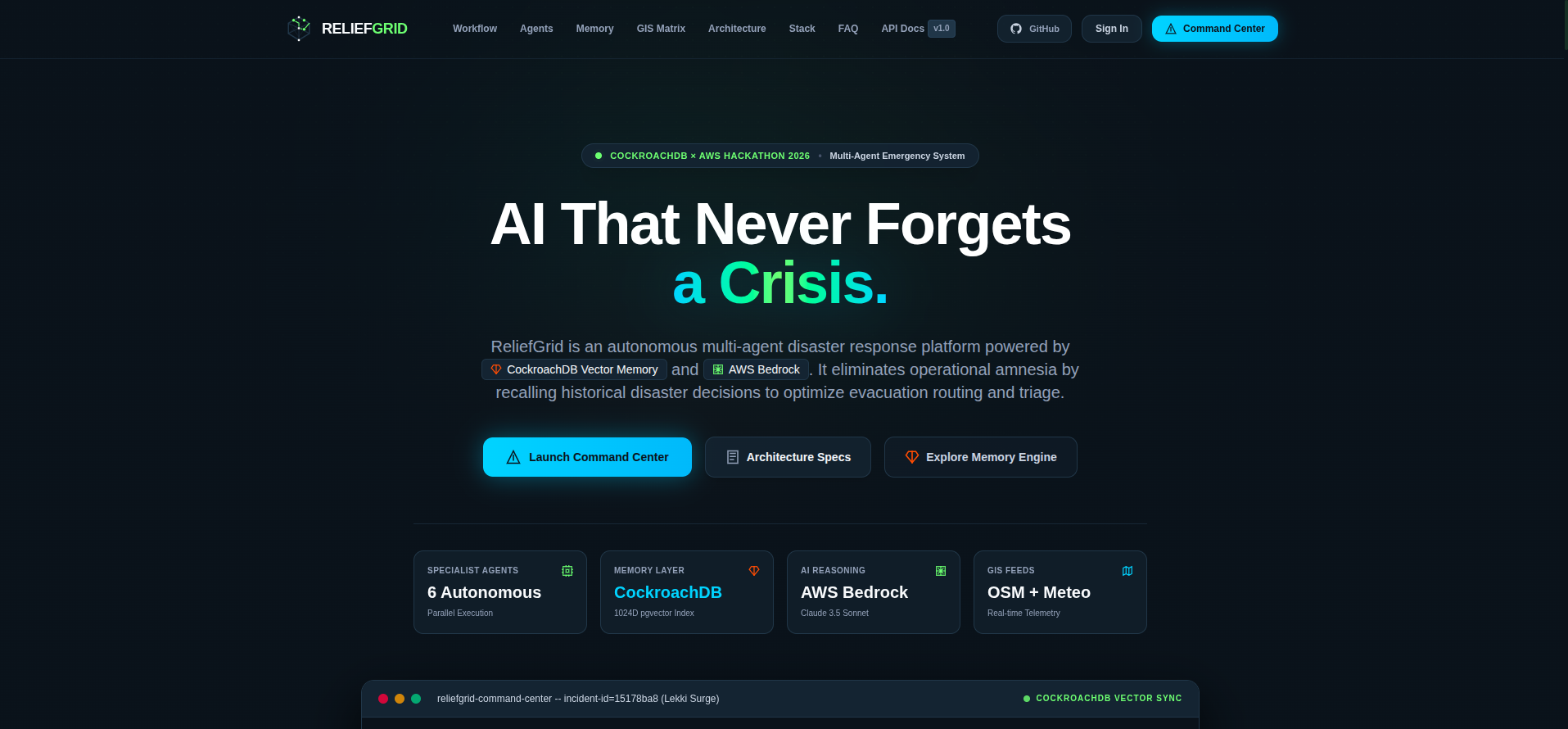
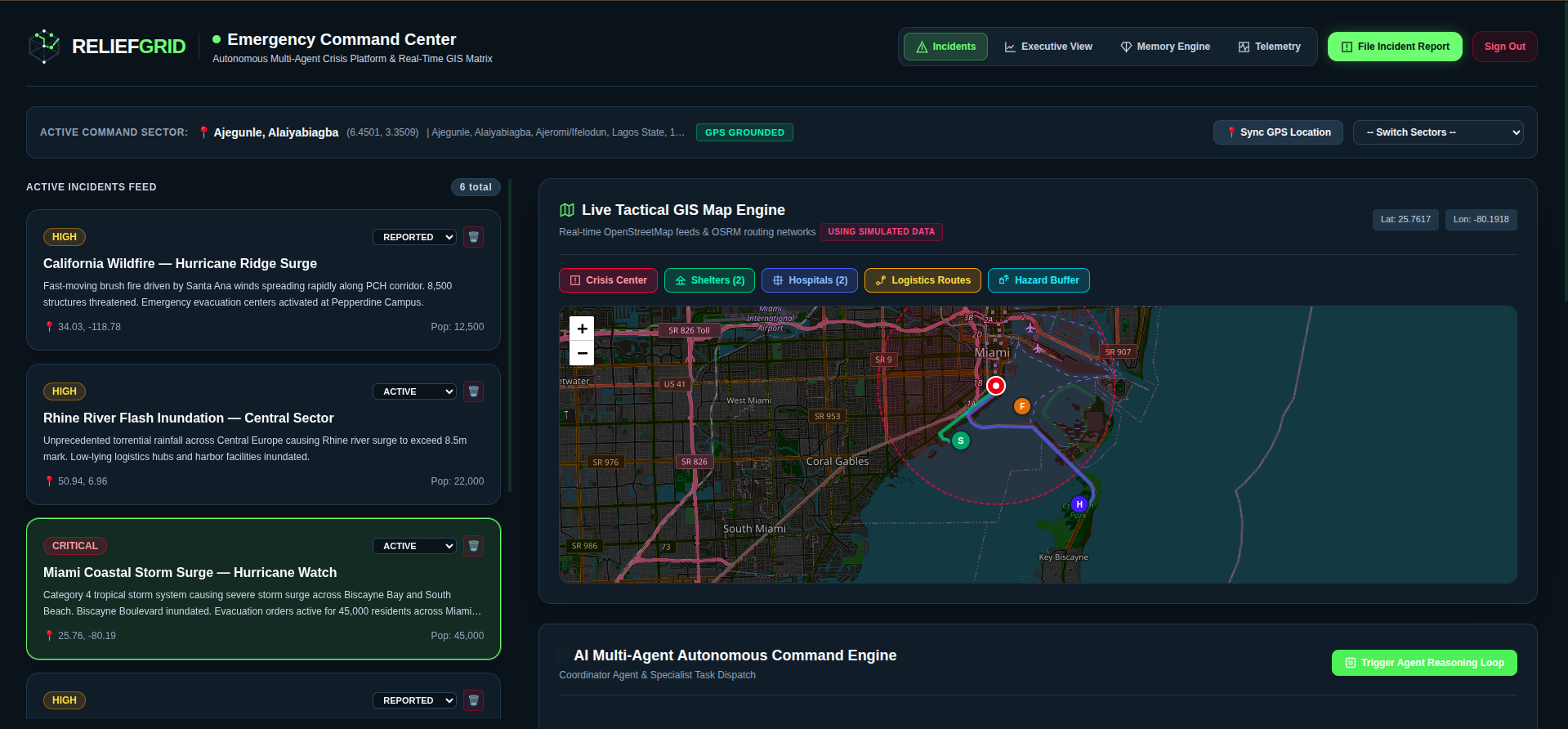
ReliefGrid is an AI-powered emergency command platform that enables autonomous specialist agents to coordinate disaster response through a shared, persistent memory layer.
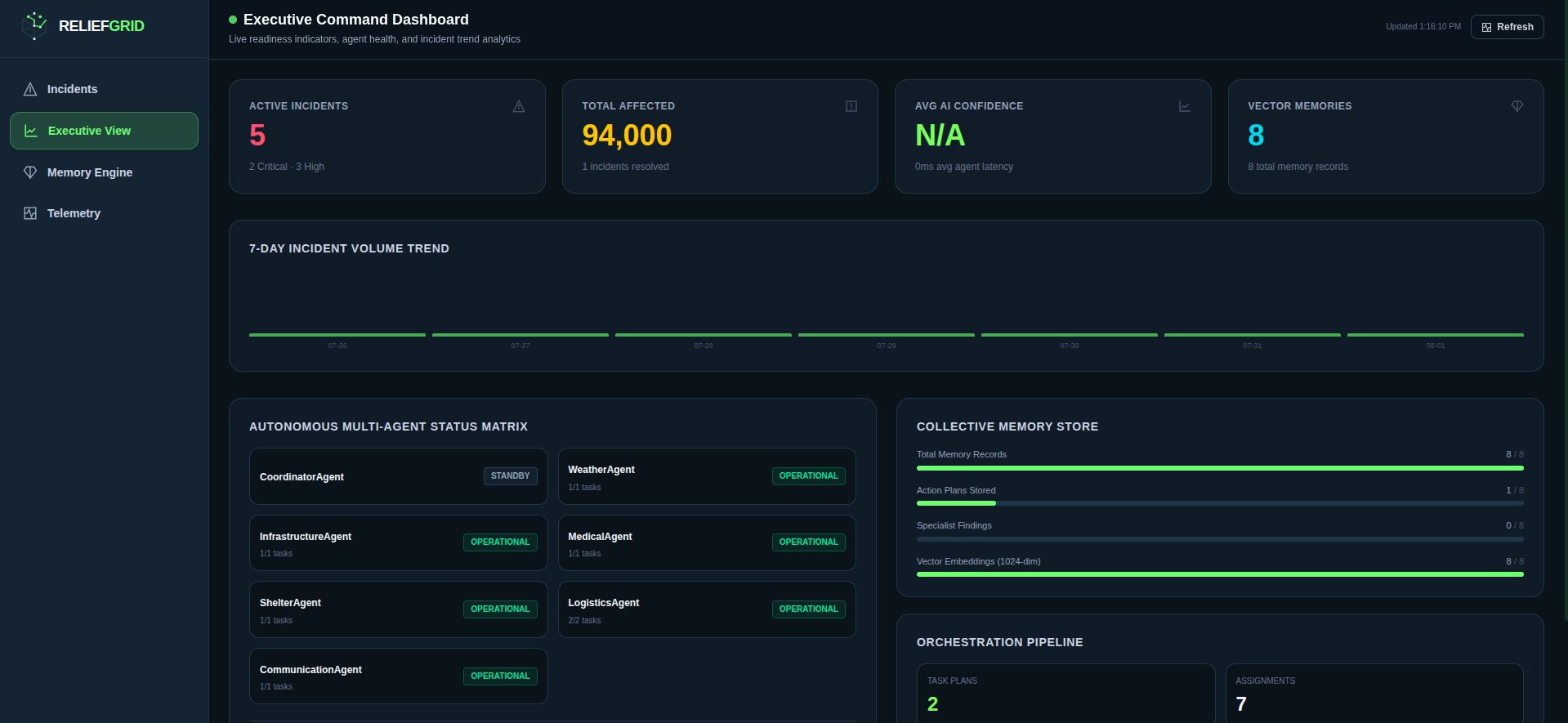
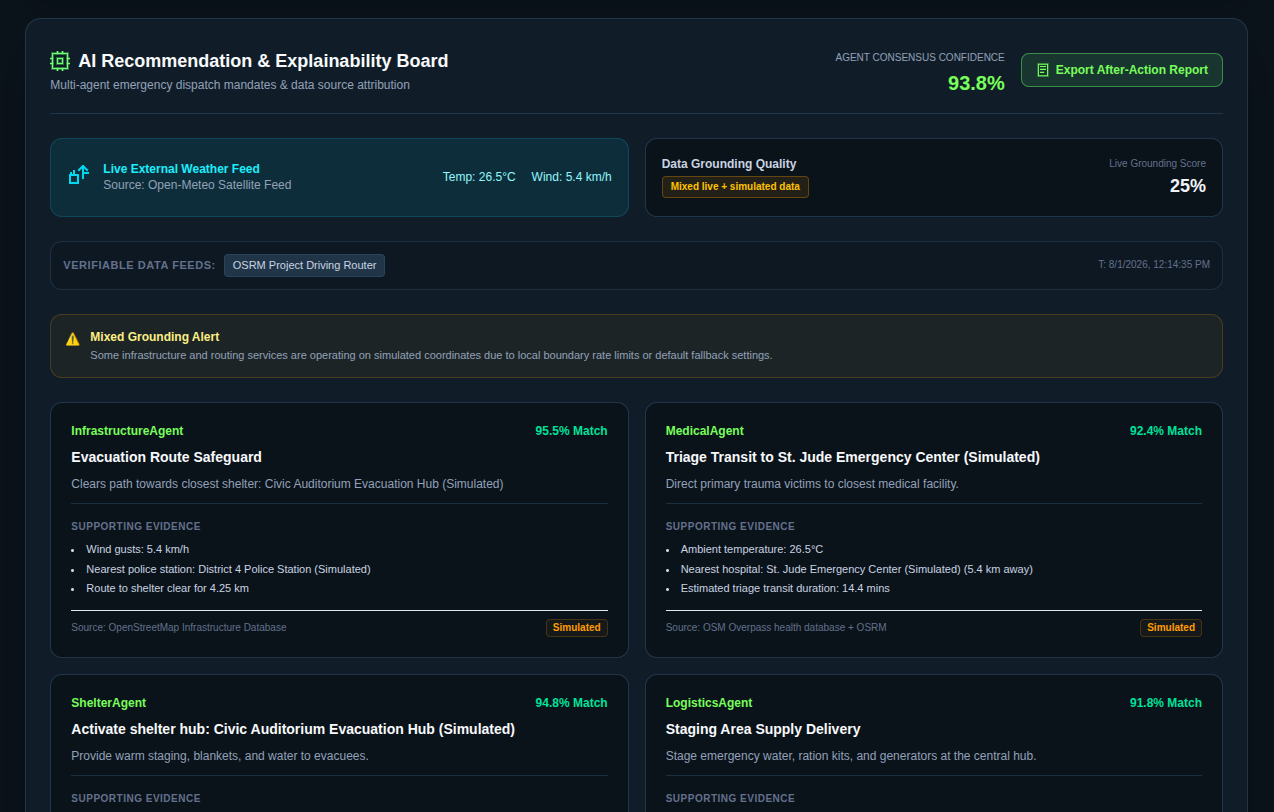
When an incident is reported, the Coordinator Agent analyzes the situation and delegates tasks to specialized agents responsible for weather intelligence, logistics, medical response, shelter management, infrastructure assessment, and public communication. Instead of operating independently, every agent contributes to and retrieves information from a shared memory powered by CockroachDB.
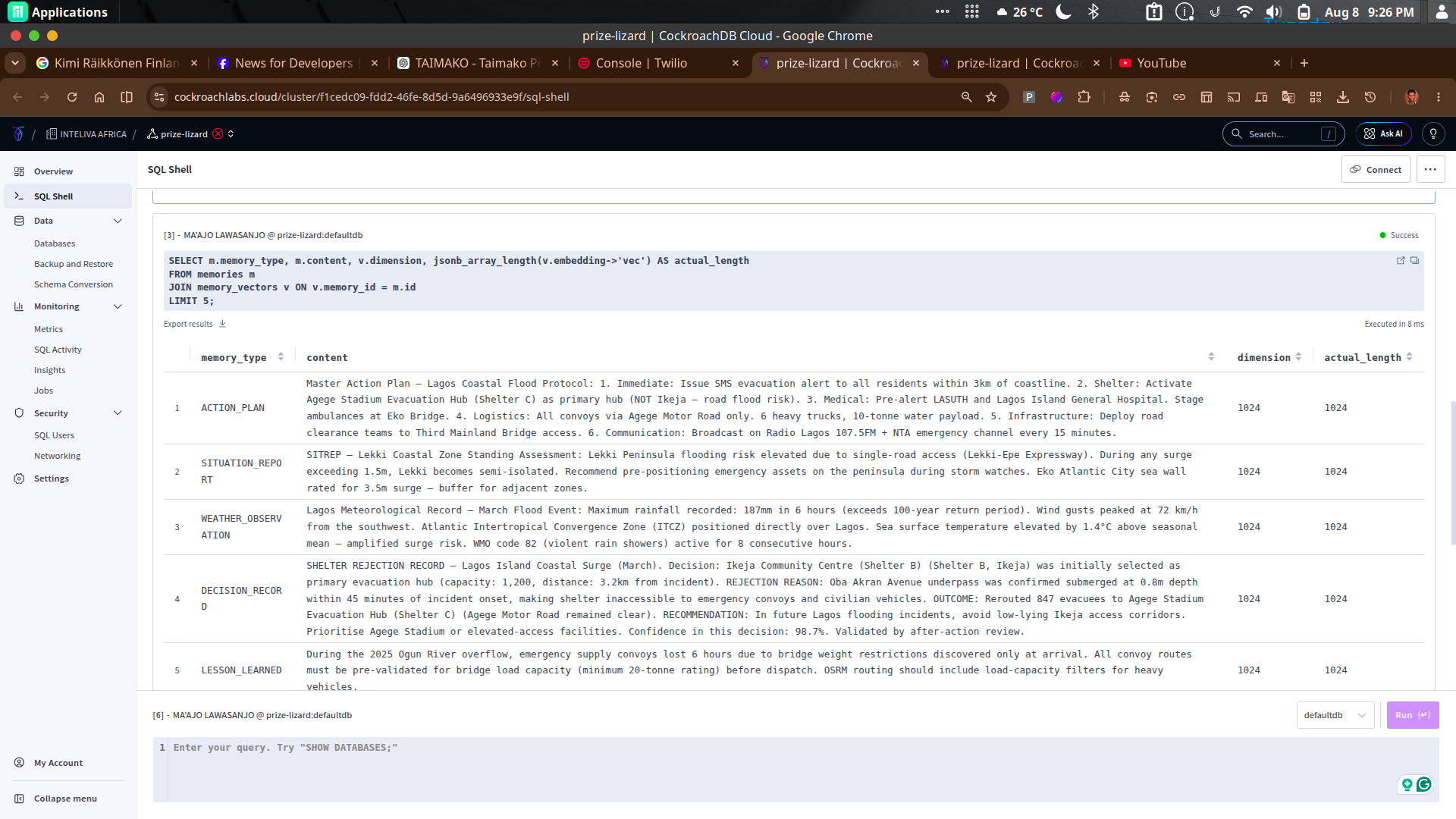
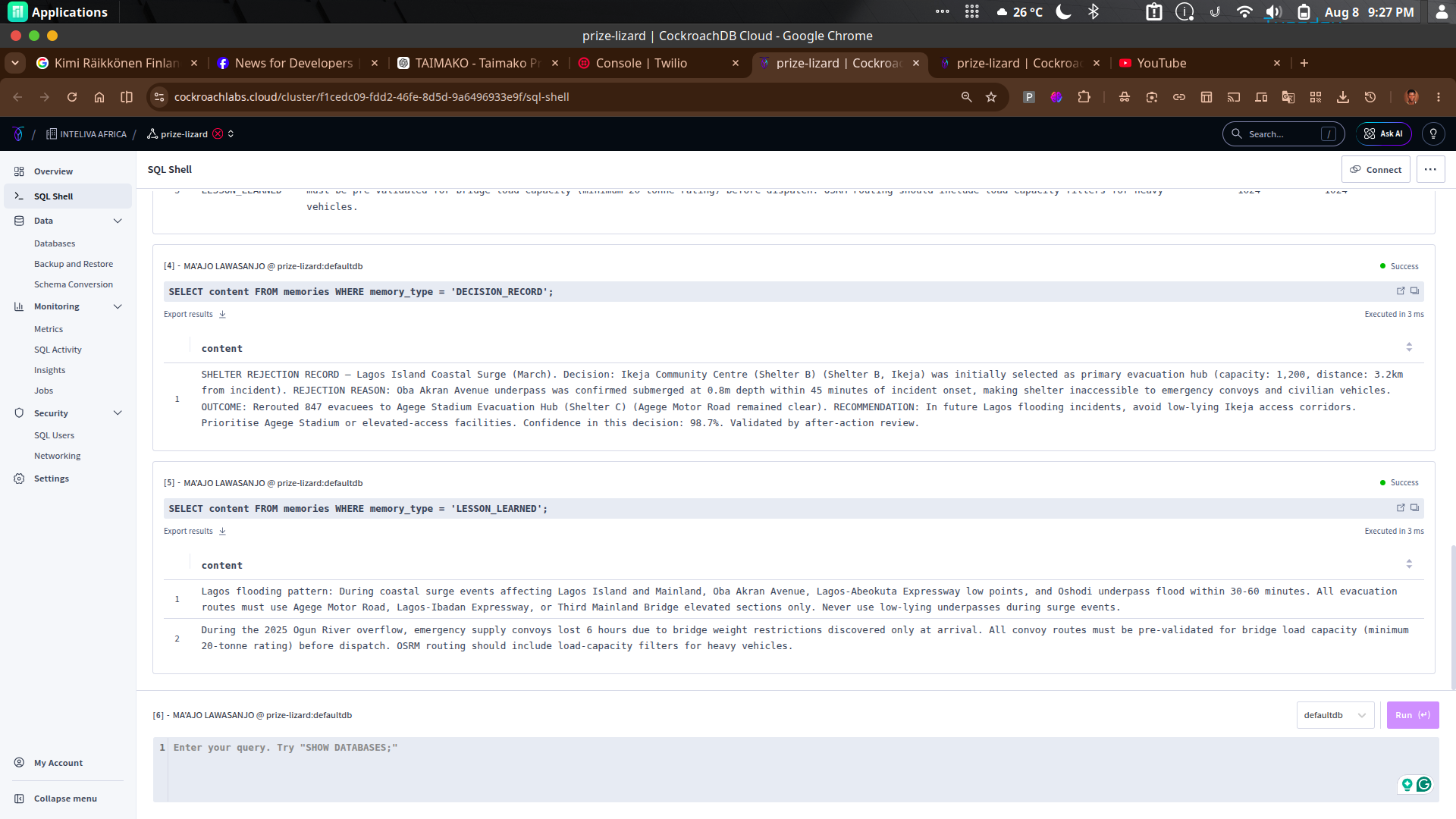
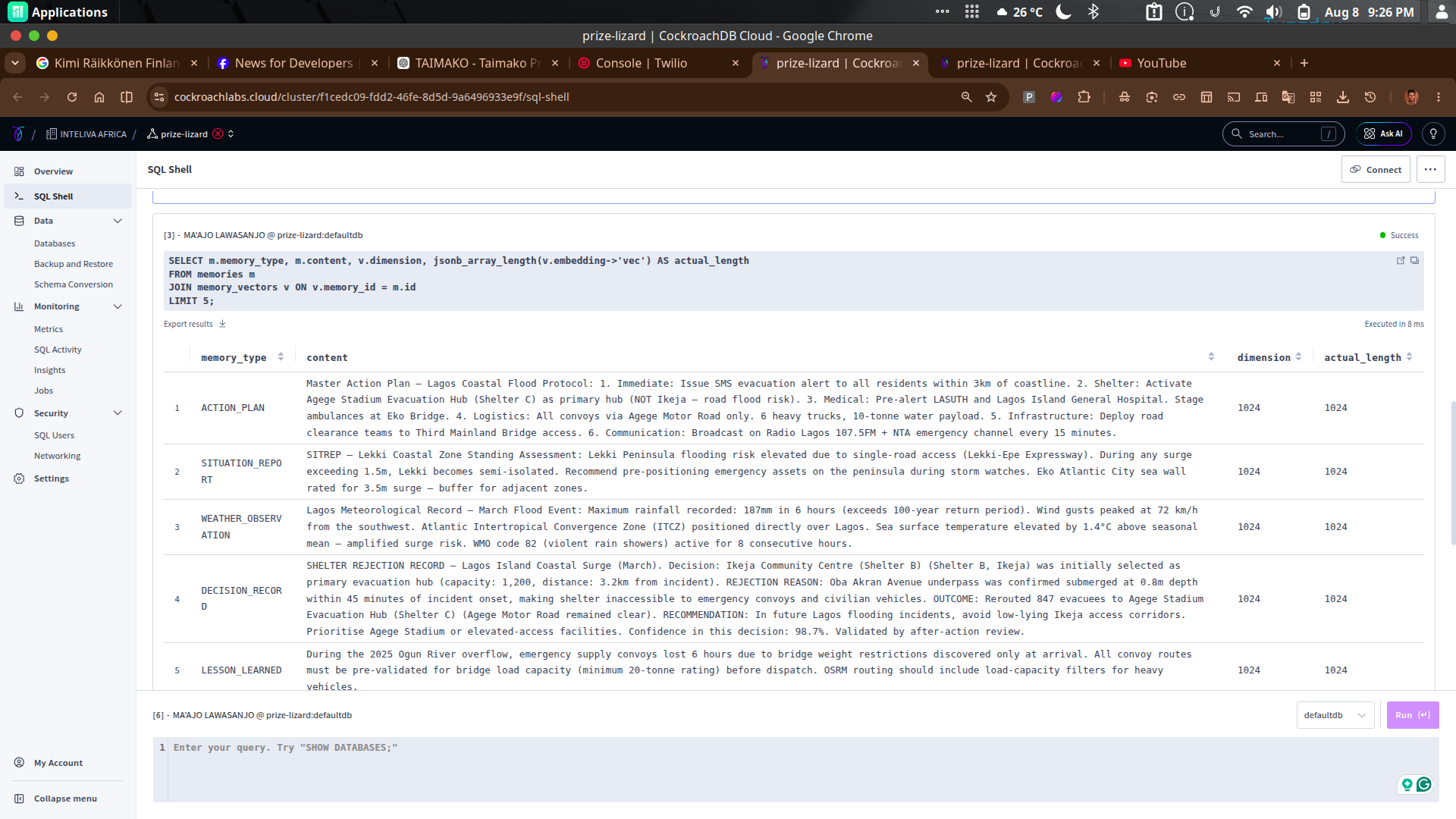
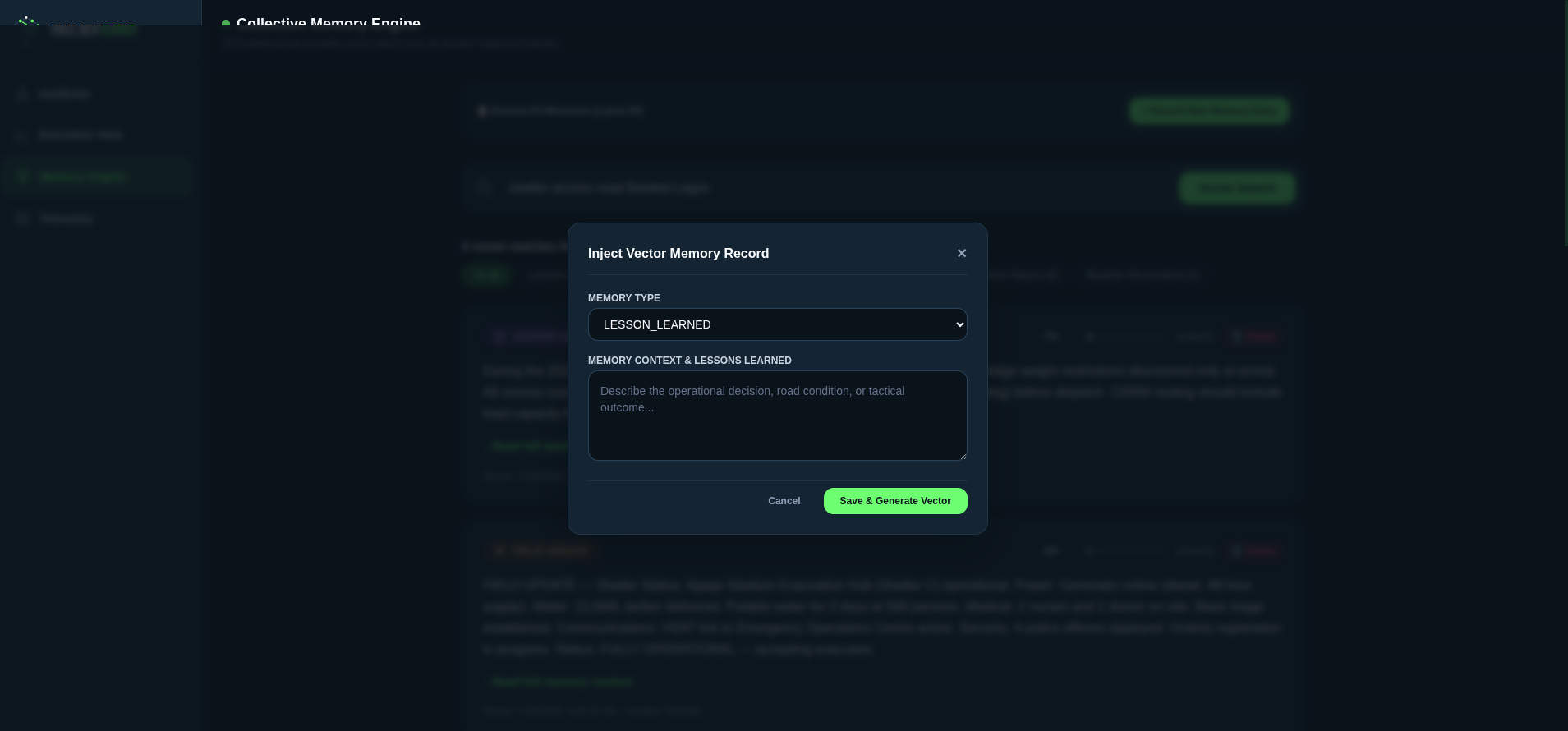
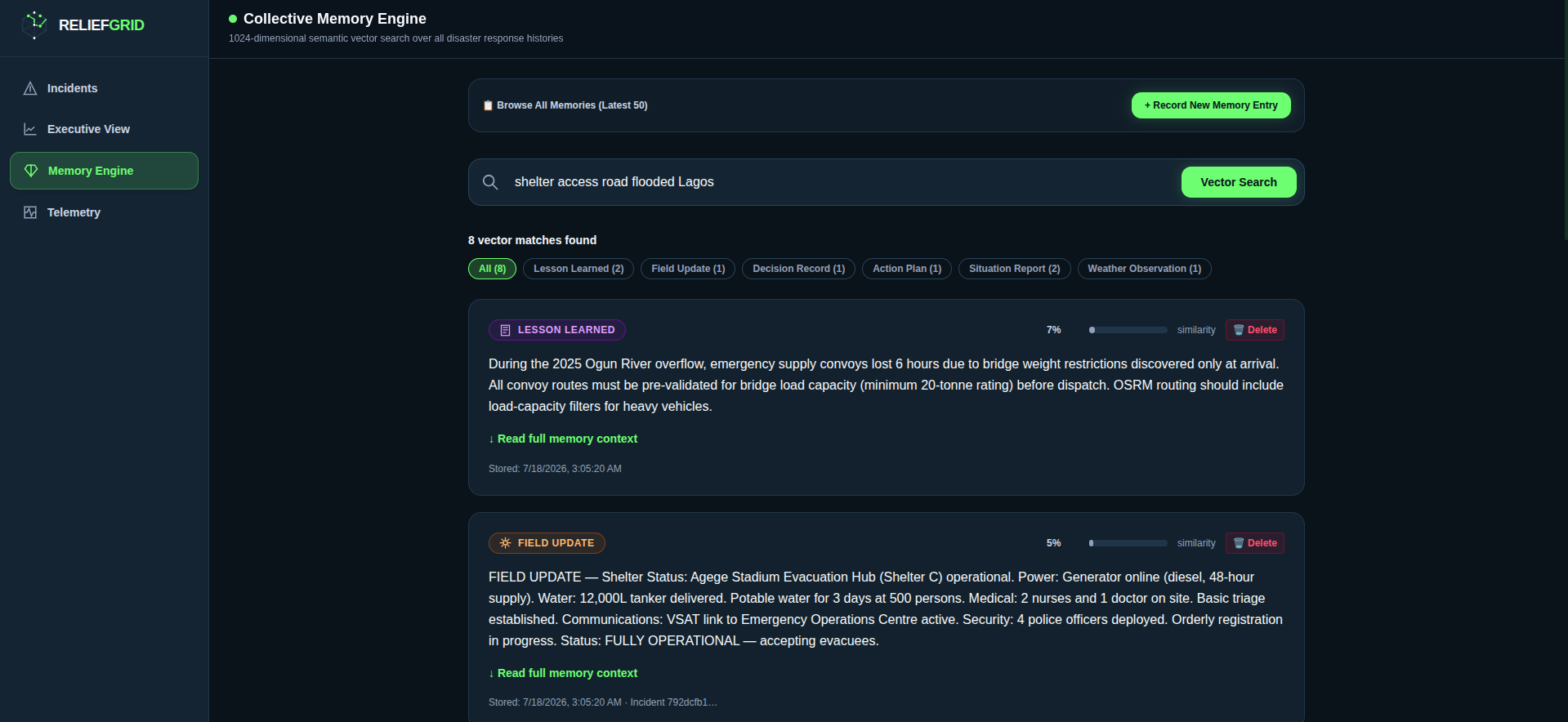
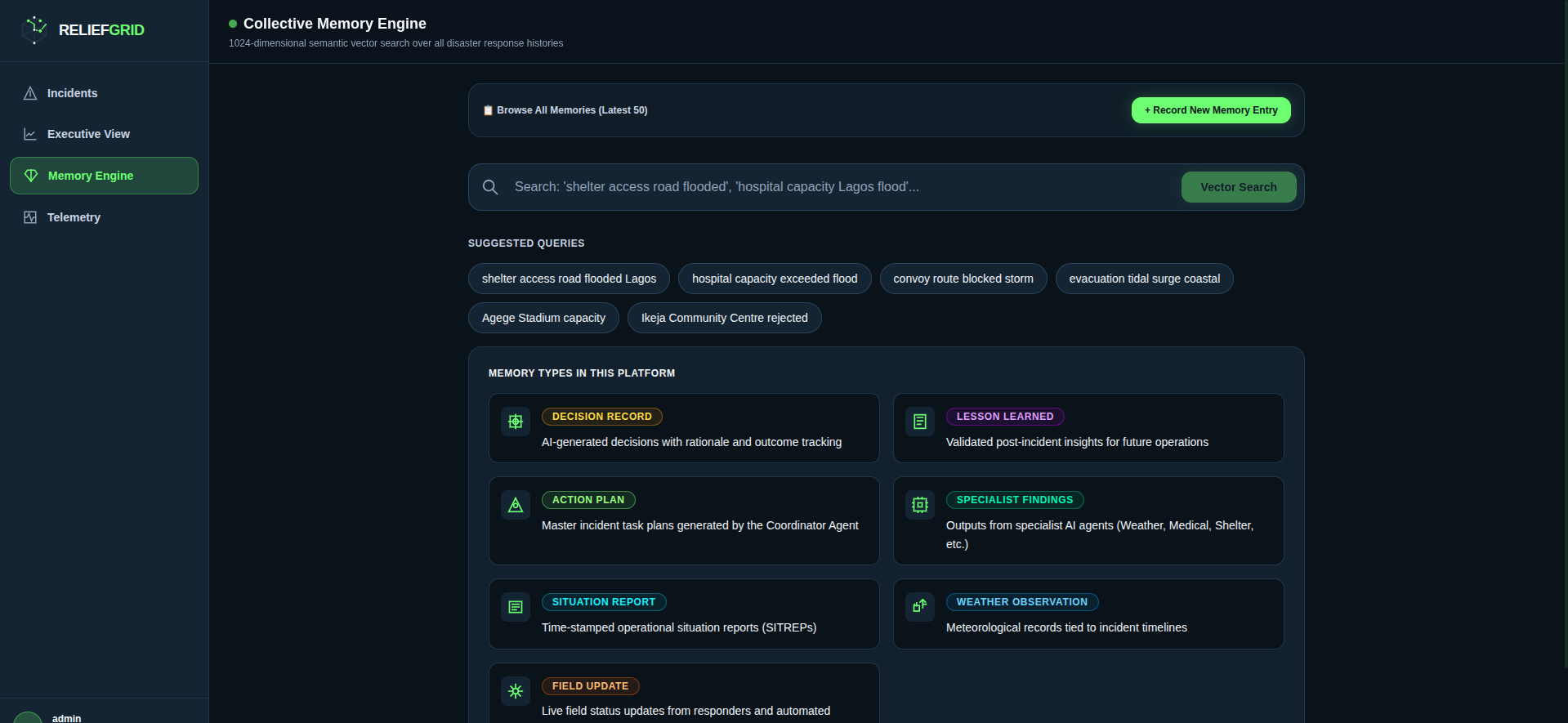
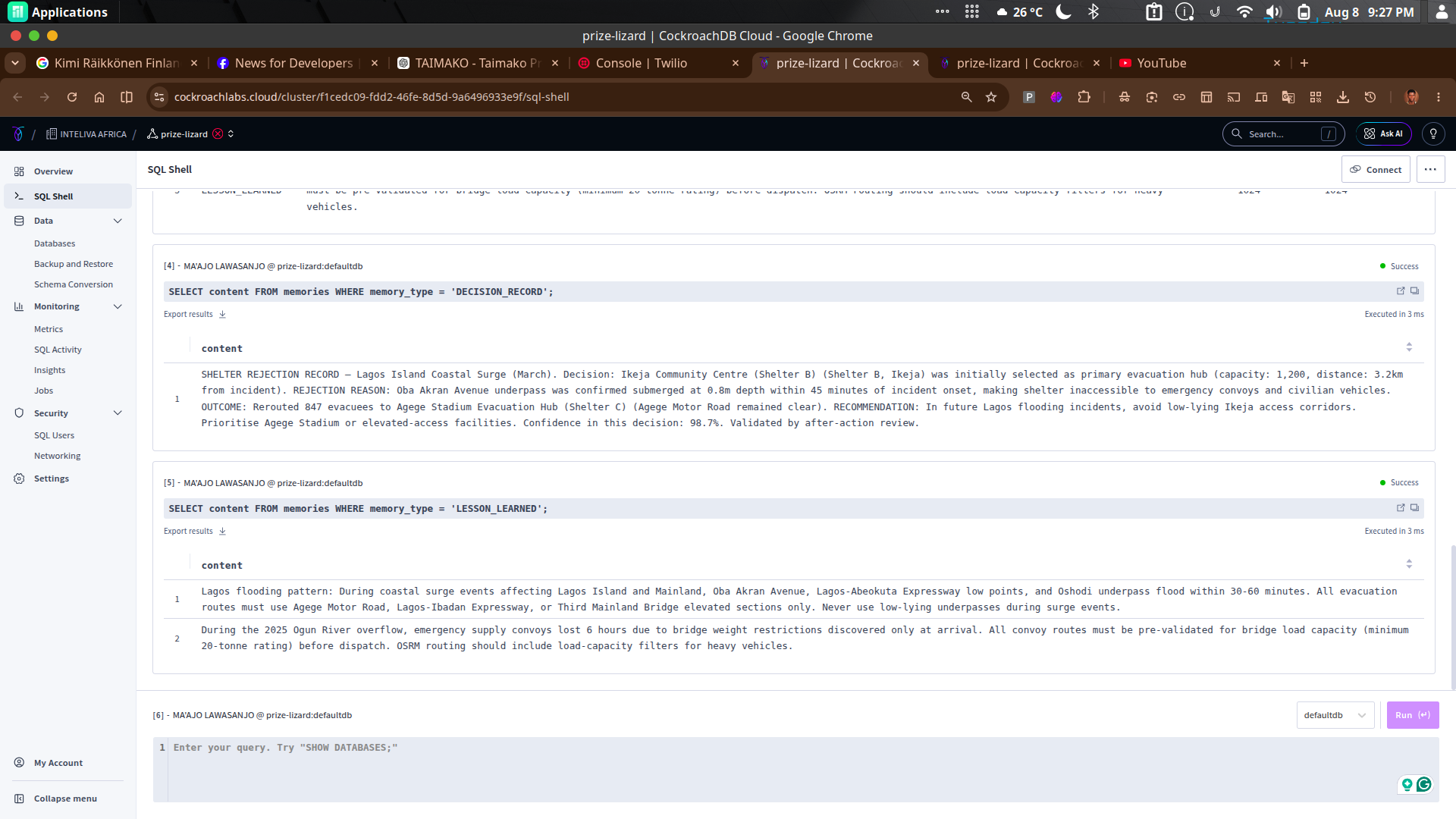
Using Distributed Vector Indexing, the platform performs semantic searches across previous incidents, operational decisions, responder knowledge, and contextual information. This allows agents to retrieve relevant historical experience, maintain continuity across sessions, and generate recommendations based on both real-time conditions and accumulated operational memory.
Amazon Bedrock provides the reasoning capabilities behind each specialist agent, while CockroachDB serves as the durable system of record for transactional state, semantic memory, embeddings, and historical context.
The result is a collaborative AI system capable of producing faster, more consistent, and context-aware decisions for disaster response.
How we built it
ReliefGrid was designed as a modern, production-oriented multi-agent platform built around persistent memory.
The frontend was developed using Next.js, TypeScript, and Tailwind CSS to provide an intuitive command center for emergency operations. The backend was implemented with FastAPI, exposing secure REST APIs that orchestrate authentication, incident management, memory retrieval, and AI workflows.
Amazon Bedrock powers the reasoning capabilities of the Coordinator Agent and the specialist agents, enabling natural language understanding, incident analysis, and recommendation generation.
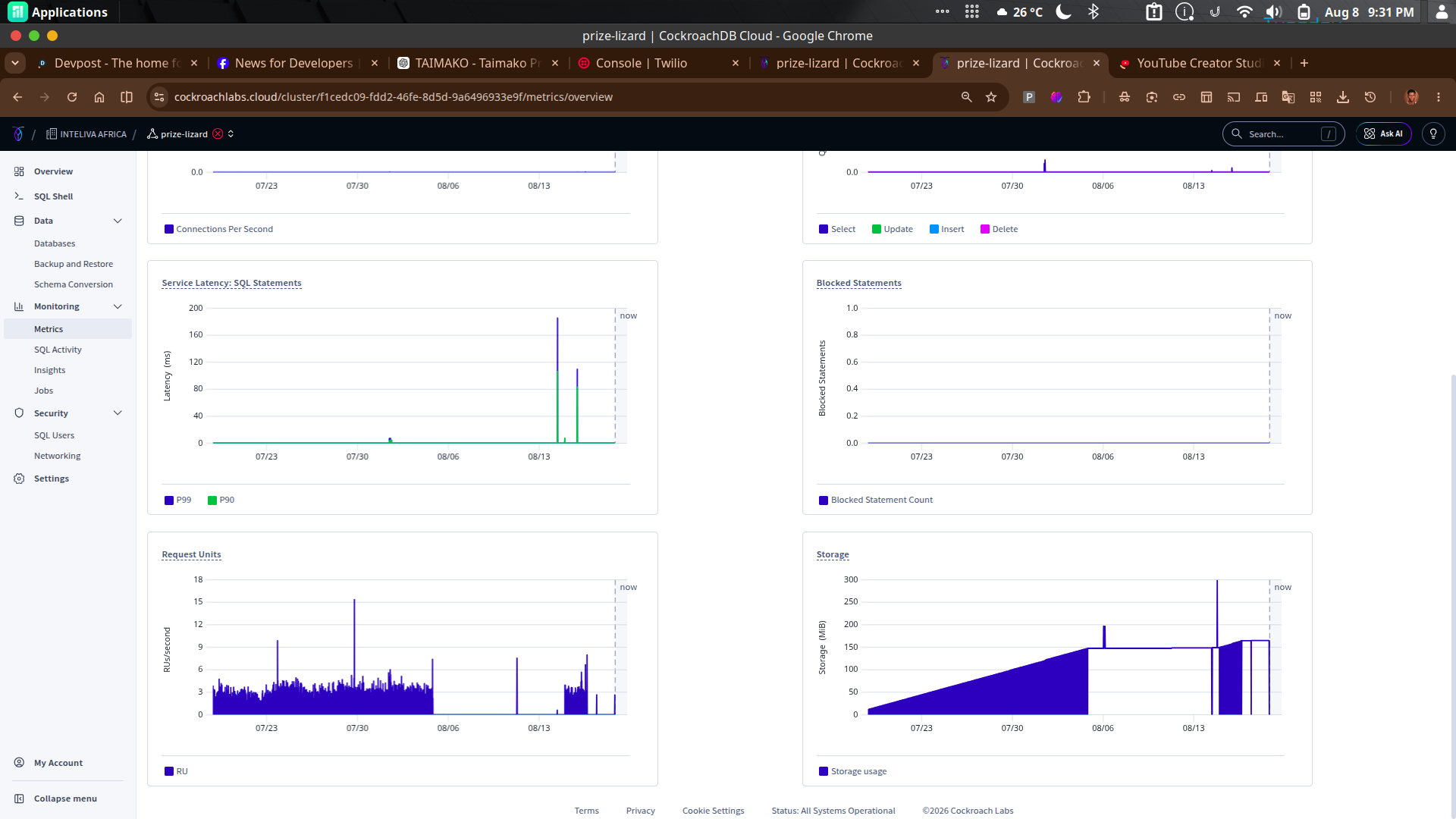
CockroachDB serves as the platform's persistent memory layer. We used its PostgreSQL compatibility for transactional storage while leveraging Distributed Vector Indexing to store embeddings and perform semantic similarity searches. Rather than maintaining a separate vector database, operational data and semantic memory remain unified within the same distributed system, ensuring transactional consistency between structured records and vector representations.
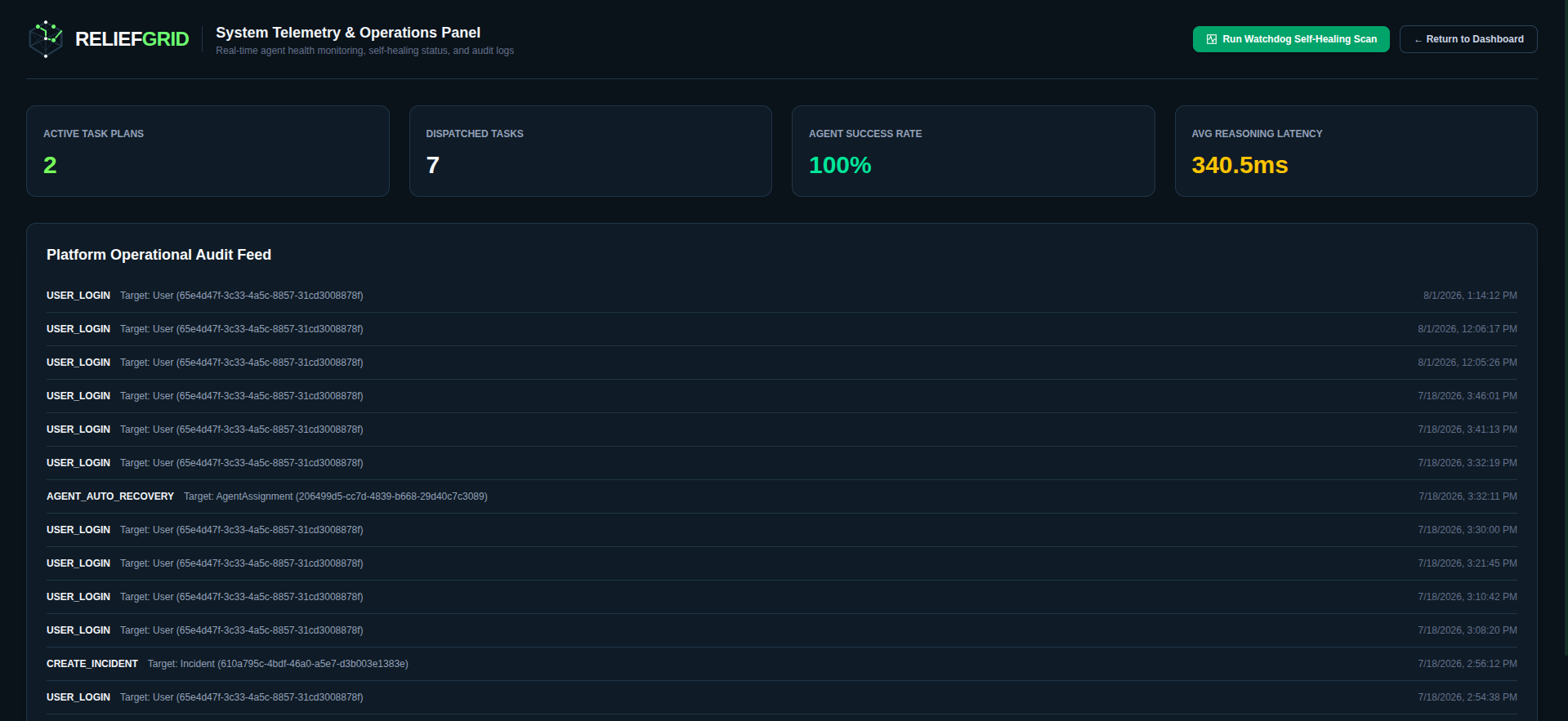
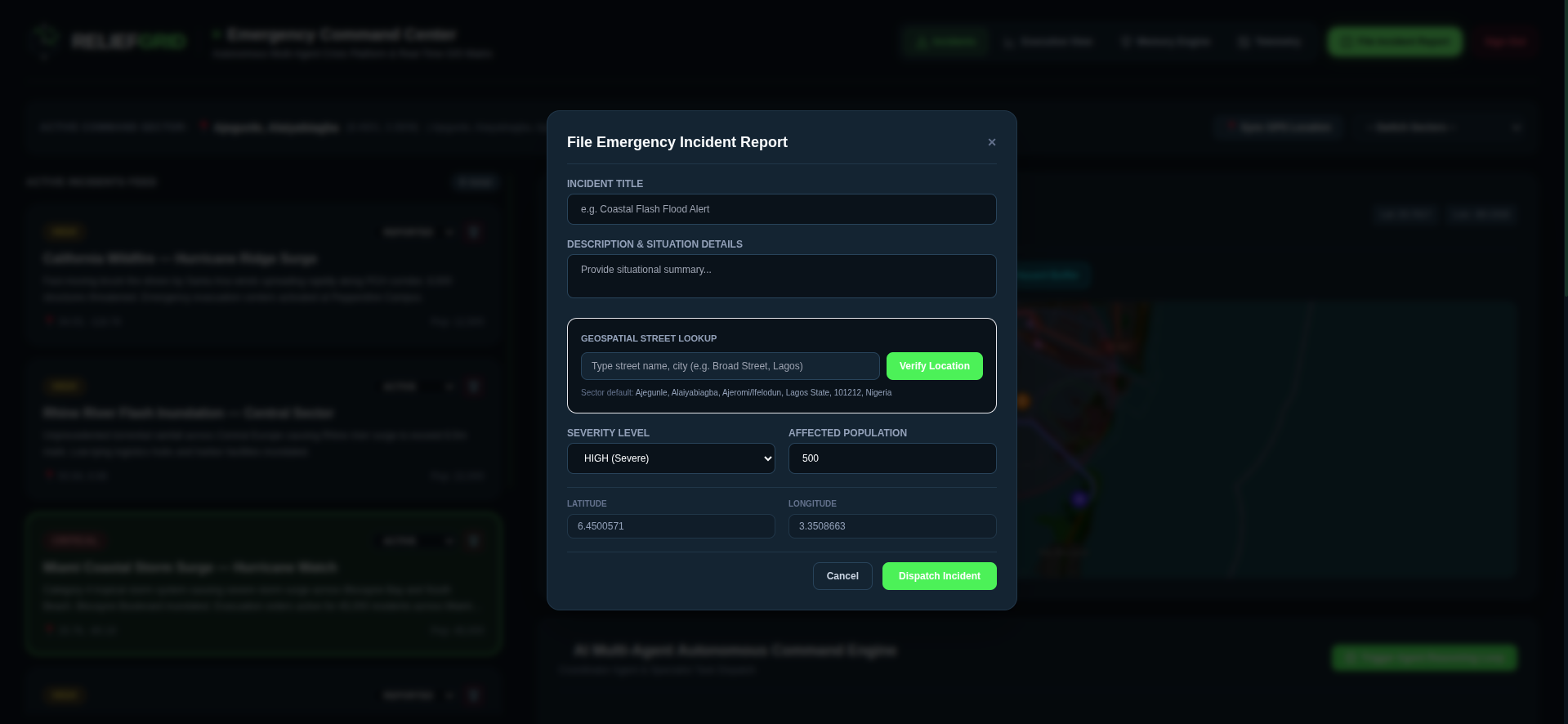
The platform integrates GIS intelligence, routing services, telemetry, authentication, and role-based access control to support production-style workflows. Every incident contributes to the platform's evolving knowledge base, allowing future recommendations to benefit from historical operational experience.
Challenges we ran into
One of the biggest challenges was designing a system where multiple autonomous agents could collaborate without creating conflicting or inconsistent decisions. We needed every agent to operate independently while still contributing to a shared understanding of an evolving emergency.
Another major challenge was designing a memory architecture that treated semantic knowledge and transactional data as a single source of truth. We wanted historical incidents, operational decisions, embeddings, and structured records to remain synchronized without introducing consistency problems that often arise when combining separate relational and vector databases.
Balancing real-time reasoning with persistent memory also required careful orchestration. Each recommendation needed to combine live incident data with relevant historical knowledge while maintaining low latency and reliable retrieval.
Finally, designing documentation, architecture diagrams, and workflows that accurately communicated a complex distributed system in a way that judges and developers could quickly understand became an engineering challenge in its own right.
Accomplishments that we're proud of
We're proud that ReliefGrid goes beyond demonstrating AI reasoning and instead focuses on what makes agentic systems practical in production: persistent memory.
Some accomplishments include:
- Building a collaborative multi-agent architecture where specialist agents share operational knowledge instead of working in isolation.
- Successfully integrating CockroachDB as the persistent memory layer for transactional state, embeddings, and semantic retrieval.
- Leveraging Amazon Bedrock to power intelligent reasoning across multiple autonomous agents.
- Creating a production-oriented architecture with authentication, role-based access control, telemetry, GIS integration, and scalable APIs.
- Designing comprehensive technical documentation, architecture diagrams, workflow visualizations, and deployment guides that make the project easy to understand and reproduce.
- Demonstrating how persistent memory can transform AI from isolated assistants into coordinated decision-making systems.
What we learned
This project fundamentally changed the way we think about AI systems.
We learned that reasoning is only one component of intelligence. Long-term usefulness comes from memory, continuity, and collaboration. The ability for agents to retrieve historical knowledge, preserve operational context, and build upon previous decisions is what enables AI to move from experimentation into production.
We also gained a deeper appreciation for the importance of designing data architectures where transactional consistency and semantic retrieval coexist rather than compete. CockroachDB's distributed architecture demonstrated how operational data and vector memory can be unified without sacrificing reliability.
Perhaps most importantly, we learned that building production-ready AI requires thinking beyond models. Infrastructure, resilience, documentation, security, observability, and developer experience all contribute to whether an intelligent system can succeed in real-world environments.
What's next for ReliefGrid
ReliefGrid was designed with disaster response as its first application, but the underlying architecture extends far beyond emergency management.
Our next steps include expanding the platform with real-time satellite imagery, IoT sensor integration, live emergency communication channels, and predictive analytics for proactive disaster mitigation. We also plan to enhance the memory engine with richer long-term knowledge management, continuous learning from operational outcomes, and more advanced retrieval strategies.
From an infrastructure perspective, we intend to strengthen deployment automation, observability, and multi-region resilience while exploring additional CockroachDB capabilities and AWS services to further improve scalability and reliability.
Beyond disaster response, we believe the same persistent collaborative memory architecture can support healthcare operations, cybersecurity incident response, critical infrastructure management, and other mission-critical domains where autonomous AI agents must remember, coordinate, and make reliable decisions over time.
At its core, ReliefGrid represents our vision of the future of agentic AI: systems that don't just think—they remember, collaborate, and continuously improve.
Built With
- amazon-web-services
- cockroachdb
- github
- next
- railway
- react
- tailwindcss
- typescript
- vector
- vercel


Log in or sign up for Devpost to join the conversation.