Inspiration
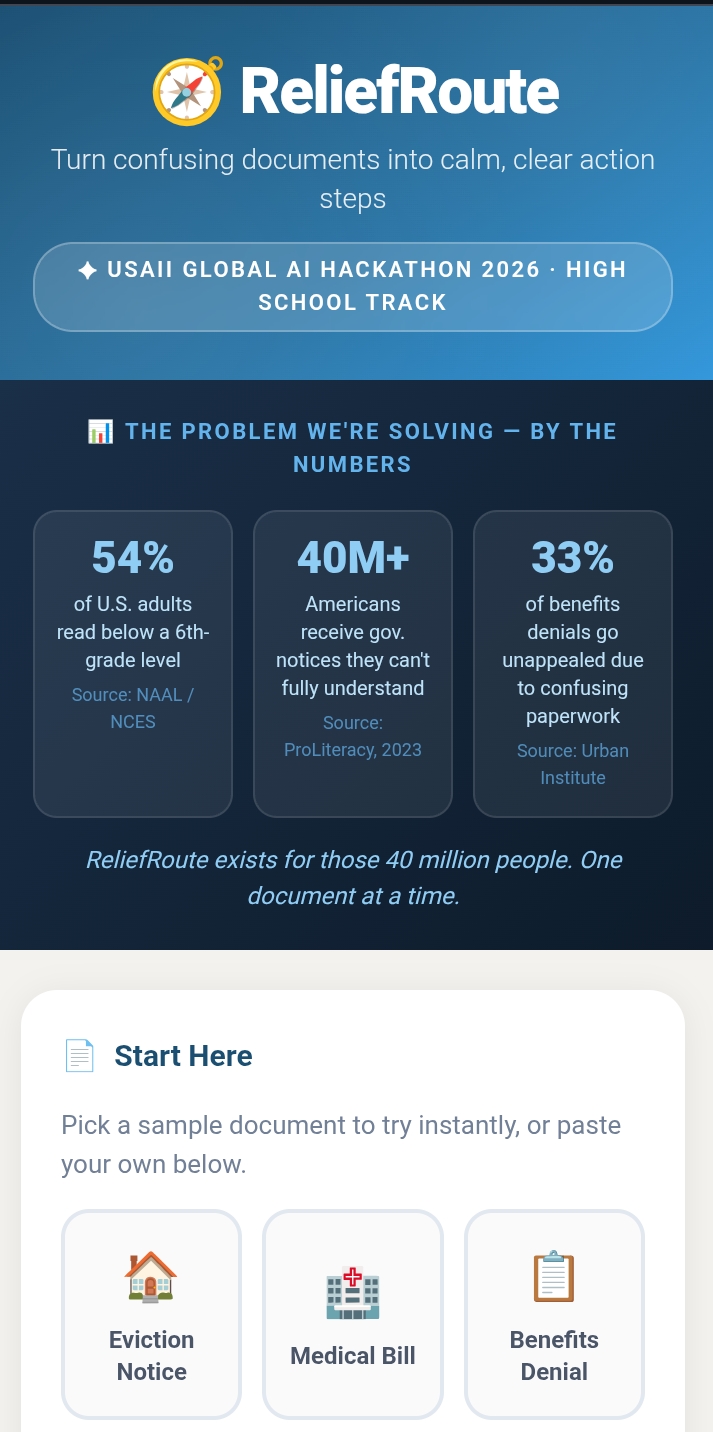
It started with a real moment that changed everything for us. A family member received an eviction notice in the mail. Three pages of dense legal language filled with citations like "pursuant to Section 1161(2) of the California Code of Civil Procedure" and phrases like "unlawful detainer proceedings" and "forfeiture of lease agreement." She is a hard-working parent — not a lawyer. She had absolutely no idea what any of it meant. She only knew one thing: it felt absolutely terrifying. She missed the 3-day response deadline because she did not understand it was a 3-day deadline. A situation that could have been resolved with one phone call became a crisis — simply because confusing paperwork on a piece of paper defeated her. We watched someone we love struggle with something that should have been solvable, and we asked ourselves: Why does getting help have to feel this hard? We researched the problem and discovered it is not rare. It is a massive, systemic crisis affecting tens of millions of families in the United States: 54% of U.S. adults read below a 6th-grade level (NAAL/NCES) 40,000,000+ Americans receive government notices they cannot fully understand every year (ProLiteracy, 2023) 33% of benefits denials go unappealed — not because families give up fighting, but because the paperwork defeats them (Urban Institute) That is 40 million families. Every year. Receiving documents they cannot decode. Losing housing, food assistance, healthcare — not because they are ineligible, but because they cannot navigate the language. ReliefRoute was born to serve those families. One document at a time.
What We Built
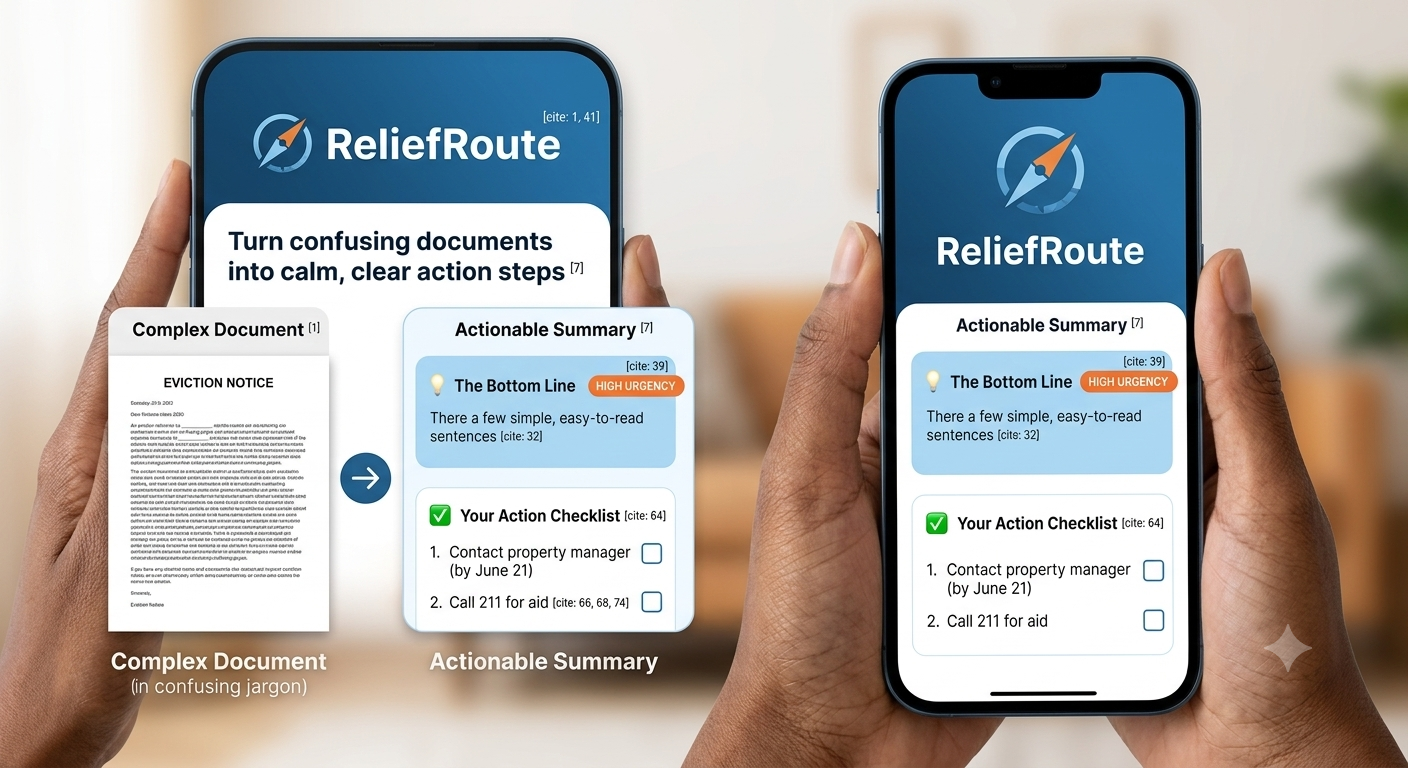
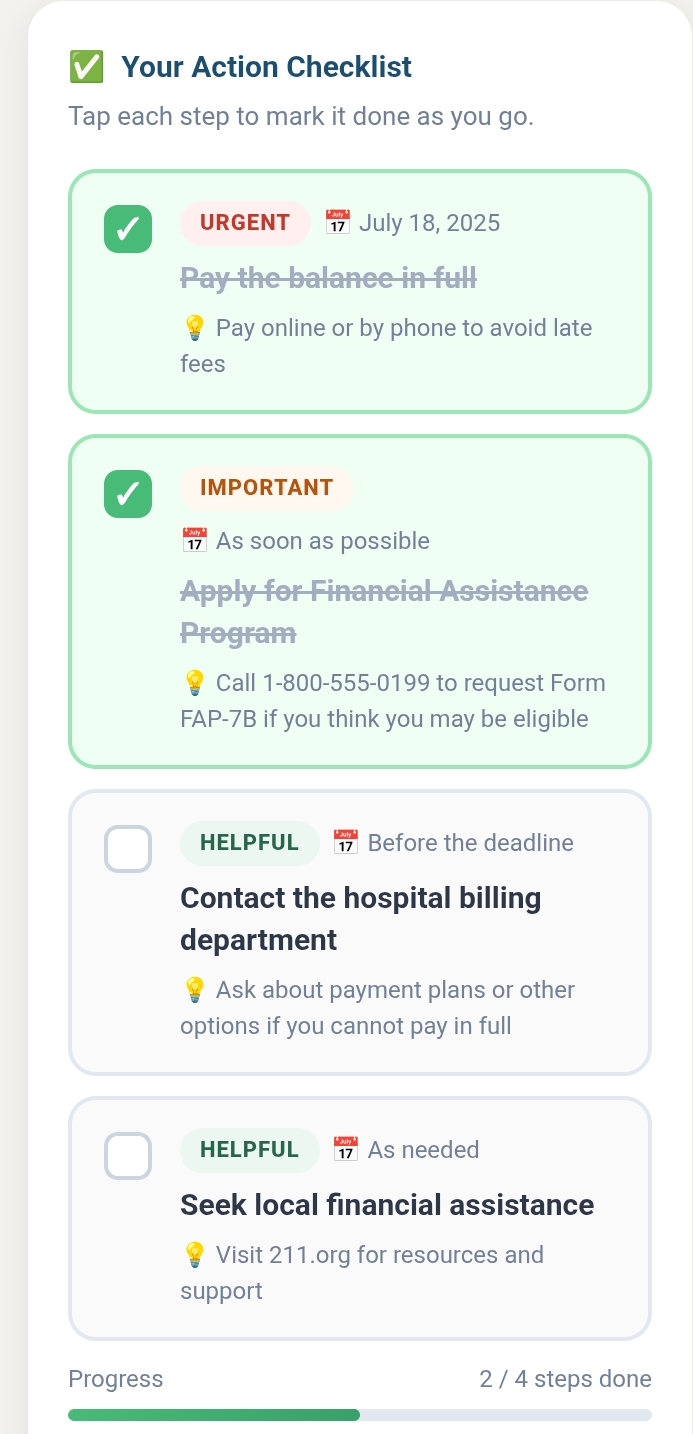
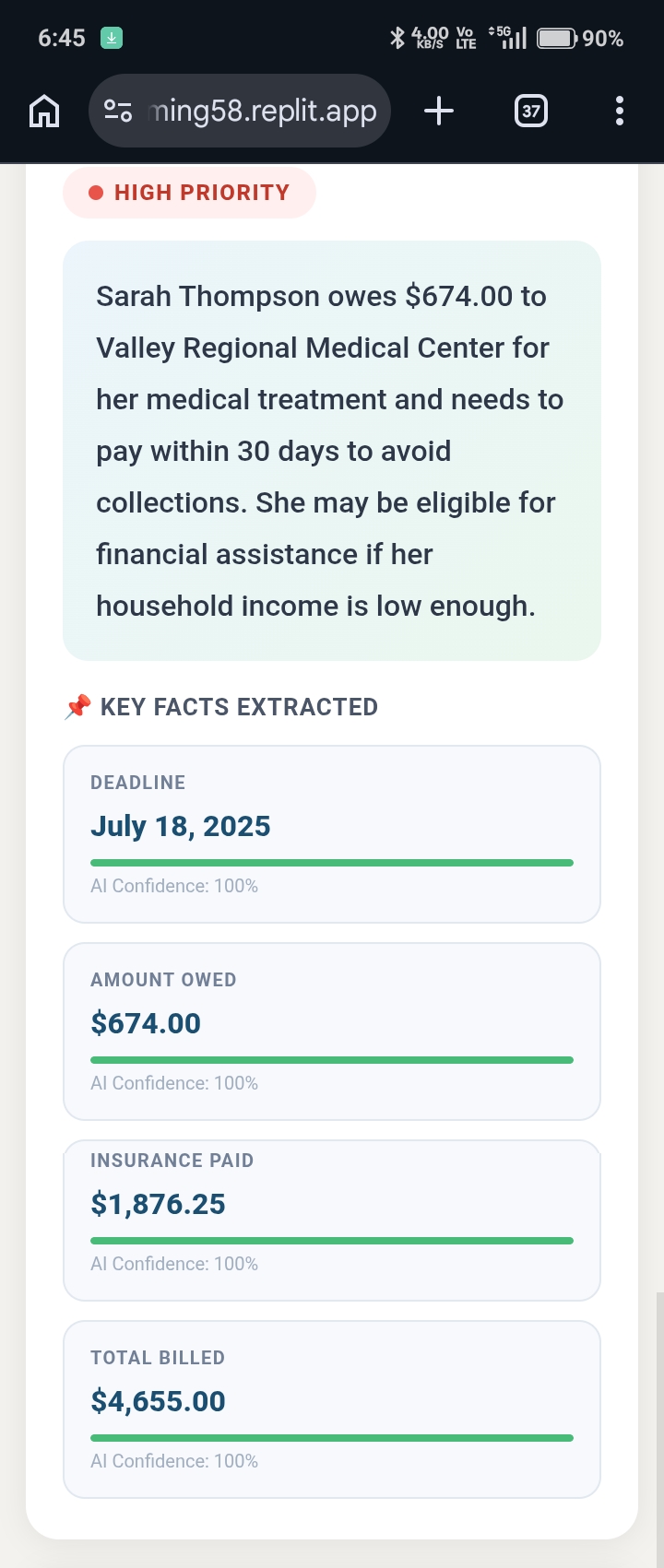
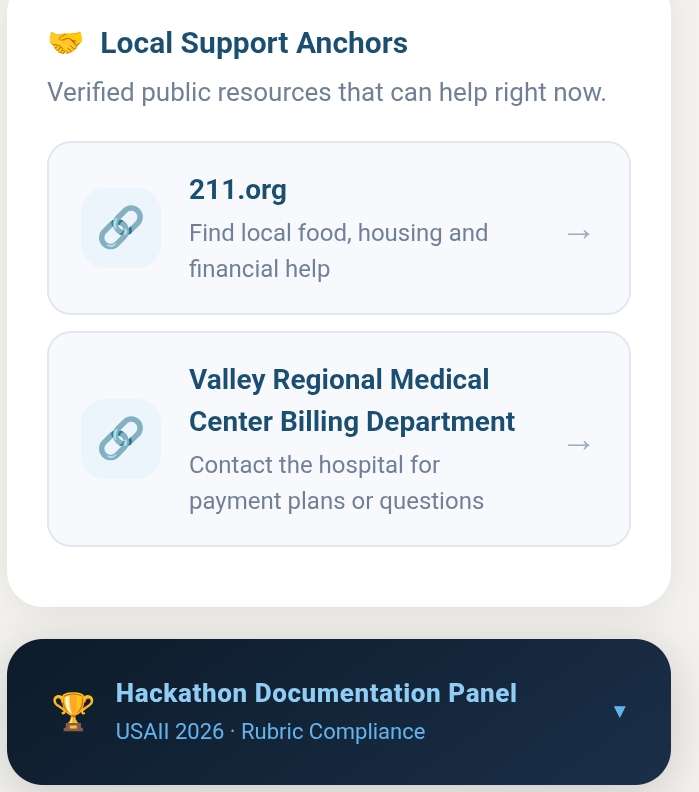
ReliefRoute is an AI-powered Crisis-to-Action Translator. Here is exactly what it does: A user pastes or selects any confusing legal, medical, or government document — an eviction notice, a medical bill, a SNAP denial letter, a hospital discharge summary, anything — and within seconds the app gives them four things: The Bottom Line — A 2-sentence plain-English summary of what the document actually means, written at a 5th-grade reading level Key Facts — Critical information extracted automatically (deadlines, dollar amounts, penalties, required actions) with a Confidence Score on each one so the user knows how certain the AI is Your Action Checklist — 3 to 5 prioritized, interactive steps the user must take, with specific deadlines and practical tips they can check off as they go Local Support Anchors — Verified links to real public services (211.org, LawHelp.org) relevant to their exact situation What becomes easier: Instead of choosing between "hire a lawyer I cannot afford" or "ignore this terrifying document," users now have a clear, free, immediate third option — understand it themselves and act on it with confidence.
How We Built It
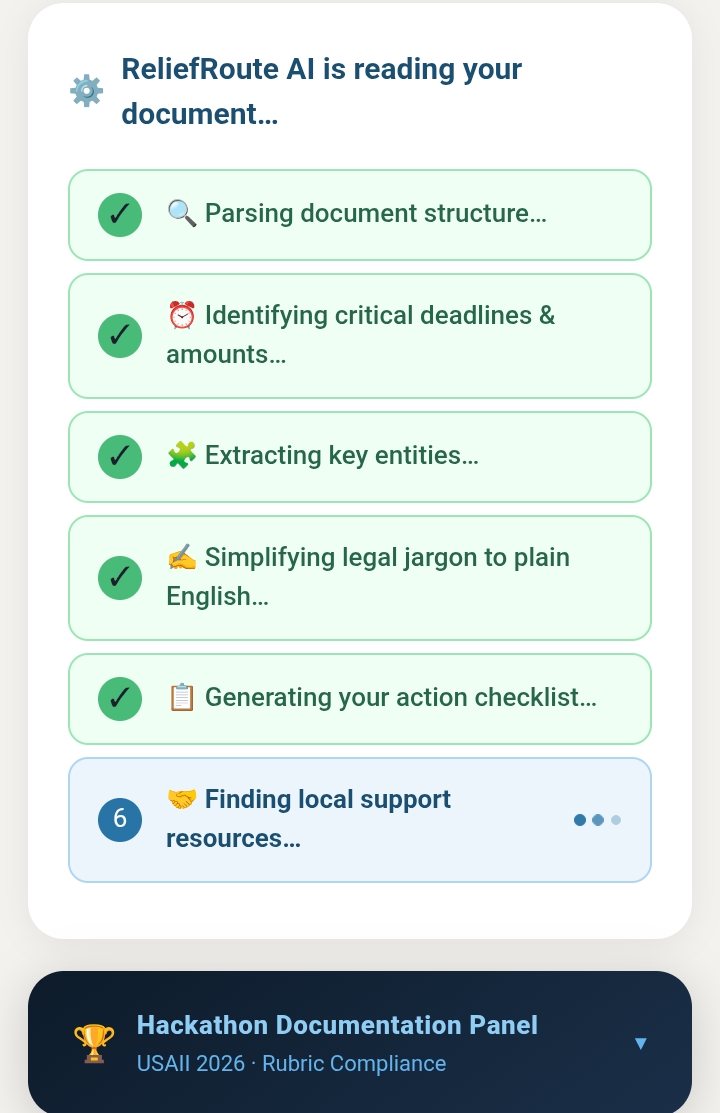
This entire project was built from scratch during this hackathon — on a tablet, with no laptop or PC available. THE ARCHITECTURE ReliefRoute follows a clear, understandable data flow: Document Text Input → Groq LLM → JSON Extraction → React → Interactive UI Output
THE AI REASONING PIPELINE
The AI does not just summarize — it follows a three-stage reasoning pipeline that produces structured output: Stage 1 — Extract The LLM reads the document and identifies all critical metadata: deadlines, dollar amounts, penalties, required actions, involved parties. Each extracted fact gets a Confidence Score (0–100%) based on how certain the model is. Stage 2 — Translate The LLM rewrites every sentence into plain English at a 5th-grade reading level. Passive voice becomes active. Legal warnings become actionable instructions. Before: "Failure to respond within 14 days may result in lease termination." After: "Call your landlord or housing office before June 30th." Stage 3 — Act The LLM generates 3–5 prioritized action steps (Urgent / Important / Helpful), each with a specific deadline and a practical tip. The app renders these as an interactive checklist the user can check off. WHY AI IS THE RIGHT TOOL This problem requires AI — not a simple rule-based system — because: Language is infinite. The same legal concept appears in hundreds of different phrasings across documents, jurisdictions, and agencies Context matters. Understanding what a deadline means requires reading comprehension, not pattern matching Translation is creative. Converting legal language to plain English requires understanding nuance, not just keyword extraction Scale. 40 million families need this, and rule-based systems cannot scale to handle the variation Challenges We Faced
CHALLENGE 1
— Building on a Tablet (No PC or Laptop) Every single line of code was written, debugged, and deployed from a mobile tablet using Replit's browser IDE. There is no external keyboard, no large screen, no typical development environment. We worked in landscape mode to maximize screen space, handled accidental touch taps, managed copy-paste failures, and debugged JavaScript errors on a 7-inch screen. This constraint forced us to be disciplined: every coding session was focused, every change was tested immediately, and we could not afford to waste time on distractions. In the end, building on a tablet taught us more about efficient, intentional development than a comfortable setup ever would have. CHALLENGE 2 — Three API Failures Before Finding One That Works We attempted to deploy with four different AI APIs, and three of them failed: Anthropic Claude: Built entire integration using Claude API → Requires paid API key outside of Claude.ai — no free tier available Google Gemini: Implemented full flow with Gemini 1.5 Flash → Free quota = 0 in our region due to restrictions Groq llama3-70b-8192: Deployed and tested successfully → Model decommissioned mid-hackathon, API returned 500 error Groq llama-3.3-70b-versatile: Final implementation → Free, globally accessible, fast, reliable Each failure meant rewriting the entire API integration — on a tablet. By the final iteration, we had built error handling and fallback logic that makes the app more resilient than if we had gotten it right the first time. CHALLENGE 3 — Designing for Emotional State, Not Just Usability Standard UX design assumes a calm, focused, rational user. Our users are in crisis. They are scared, confused, angry, exhausted. Every design decision had to account for emotional state: We removed all bright red colors (associated with panic and danger) We eliminated all technical jargon from the interface We avoided walls of text and overwhelming visual clutter We chose soft blues and muted greens (calming colors) We made buttons large and easy to tap We added reassuring language ("You can do this") Every design decision asked one question: "Does this make a stressed parent feel calmer or more anxious?" CHALLENGE 4 — Keeping AI Responsible When Shipping Fast In a hackathon, there is pressure to ship features fast. The tempting features were the ones that would have been technically impressive but ethically wrong: auto-filling forms, submitting applications on behalf of the user, making final legal or medical decisions. We deliberately said no to all of those. We built a hard boundary into the system: The AI reads. The human decides. Always. This meant: Adding a permanent disclaimer on every output screen Including Confidence Scores so users can verify uncertain extractions Only using verified, hardcoded resource links (never AI-generated suggestions) Making the app read-only — it explains documents but never takes action This constraint made the product harder to build but infinitely more trustworthy.
What We Learned EMPATHY IS NOT SOFT — IT IS AN ENGINEERING REQUIREMENT You cannot design for people in crisis without deeply understanding what crisis feels like. We did not just design for function — we designed for emotion. Every color, font size, button label, error message, and animation was chosen to reduce anxiety rather than add to it. This made the product better for every user, not just the most vulnerable. PROMPT ENGINEERING IS A REAL, DIFFICULT SKILL Getting an LLM to return consistent, structured JSON across dozens of different document types required dozens of iterations. Small wording changes in the system prompt produced wildly different outputs. We learned to think like the model — to understand what phrasings would produce reliable results. Precision in prompting matters as much as precision in code. CONSTRAINTS BREED CREATIVITY AND RESILIENCE A tablet-only build with free APIs and zero budget forced us to be resourceful in ways we never would have been with a comfortable setup. We had to think critically about every line of code, every API choice, every design decision. Constraints made us better engineers. RESPONSIBLE AI IS NOT A FEATURE YOU ADD AT THE END — IT IS A FOUNDATION YOU BUILD ON The confidence indicators, the human-in-the-loop disclaimer, and the verified resource links are not afterthoughts. They shaped every architectural decision from the very beginning. An AI that helps vulnerable families has a higher ethical obligation than most. We took that seriously. REAL PROBLEMS DESERVE REAL SOLUTIONS The 40 million Americans who struggle with confusing government documents are not an edge case or a niche market. They are the majority of people in crisis. Building for them — not for a demo, not for a grade, but for real people facing real consequences — made every difficult hour of this hackathon feel meaningful.
PLAIN LANGUAGE IS A FORM OF RESPECT
Every single word in ReliefRoute — including all AI outputs — was written to be understood by someone reading at a 5th to 6th-grade level under stress. This was not a limitation. It was the entire point. Accessibility is not a feature. It is the core mission.


Log in or sign up for Devpost to join the conversation.