-
-
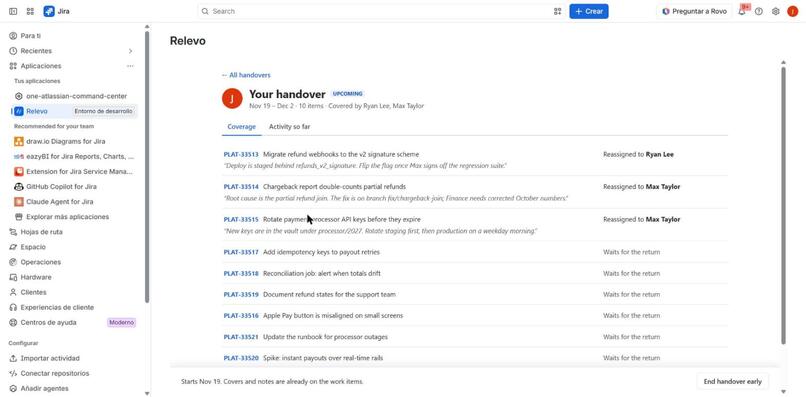
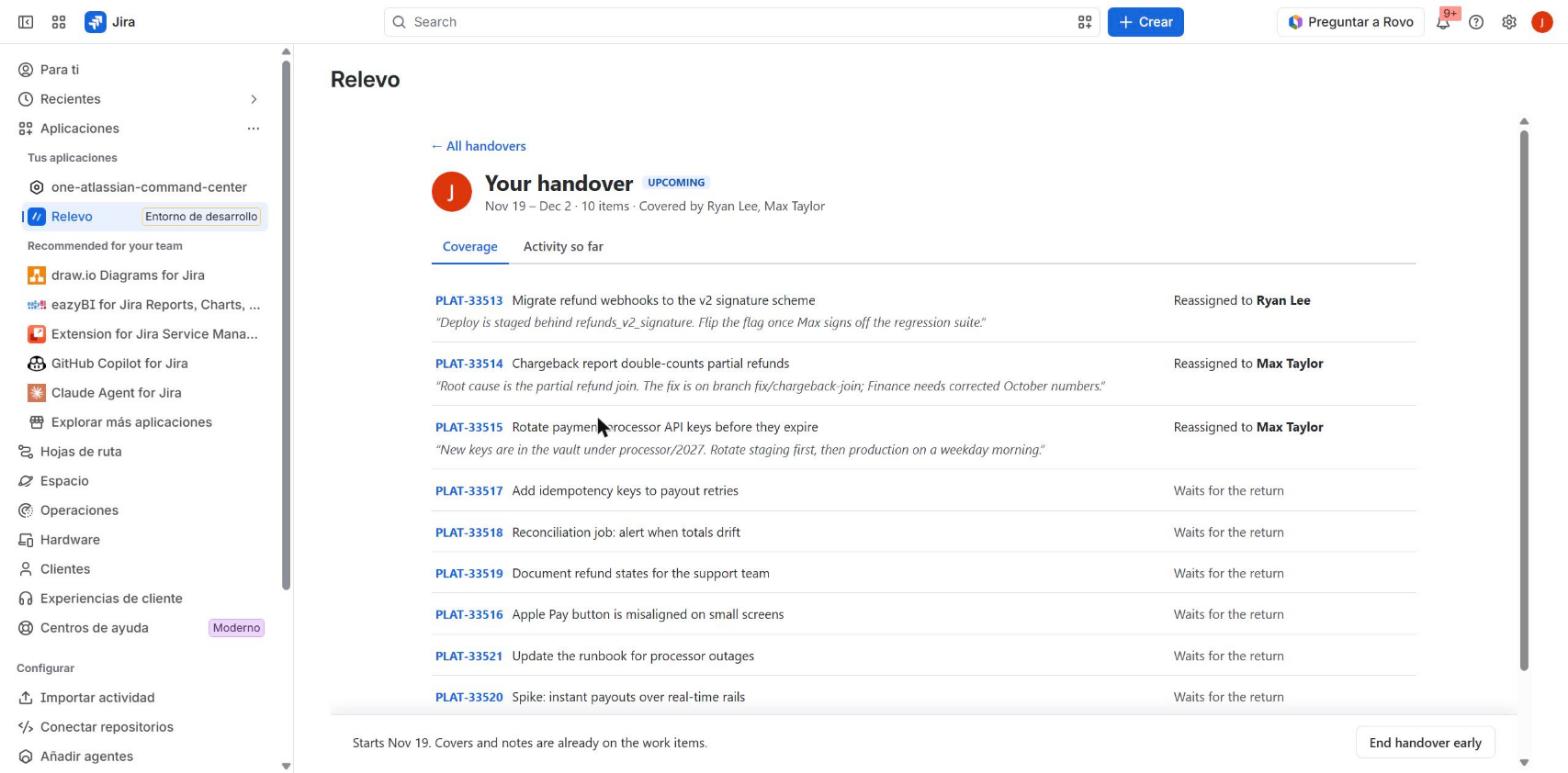
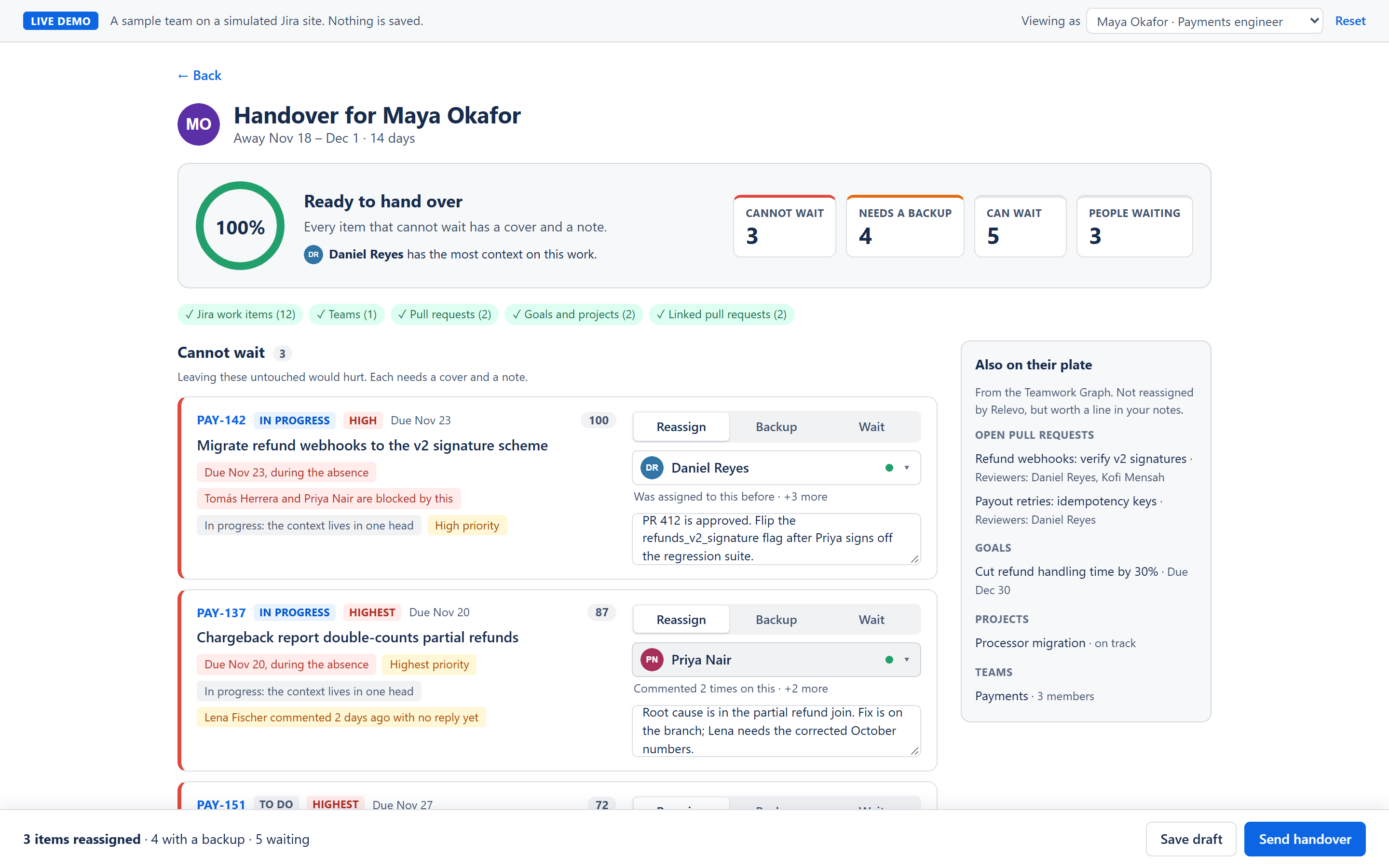
A real handover on a Jira Cloud site: three items reassigned, each carrying its note
-
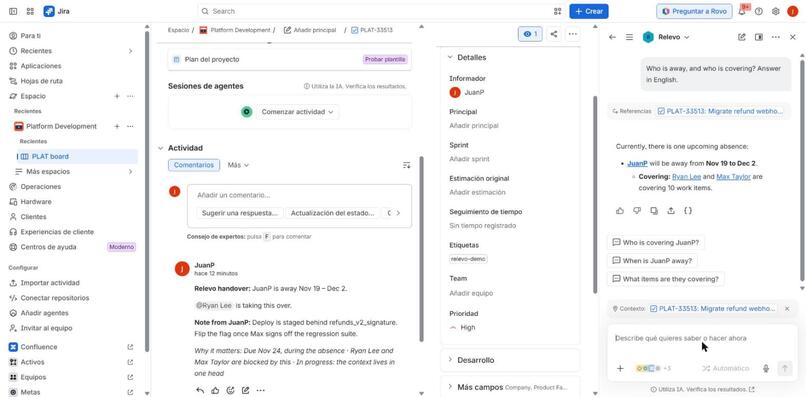
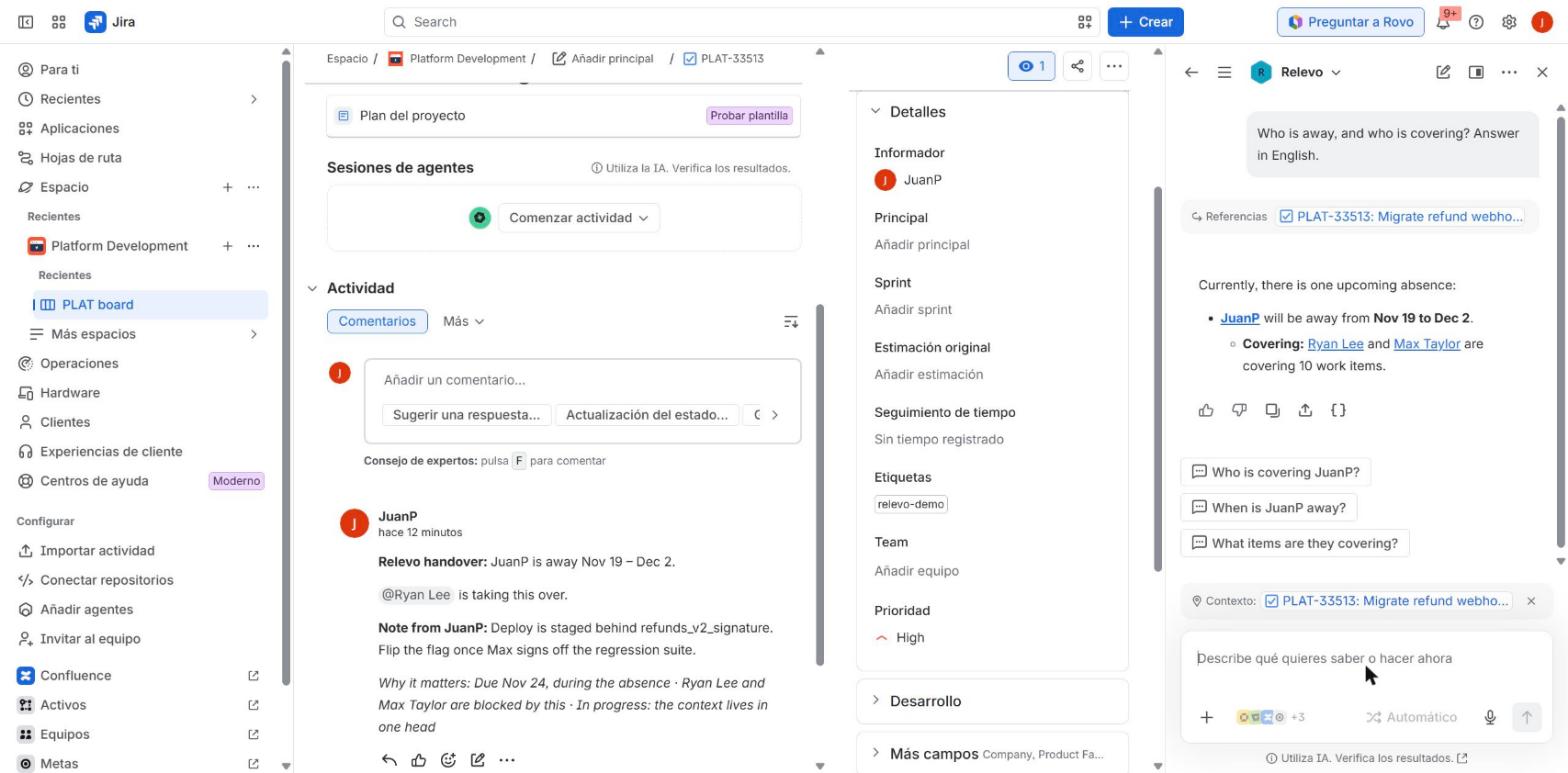
The Relevo agent in Rovo answers who is away and who is covering
-
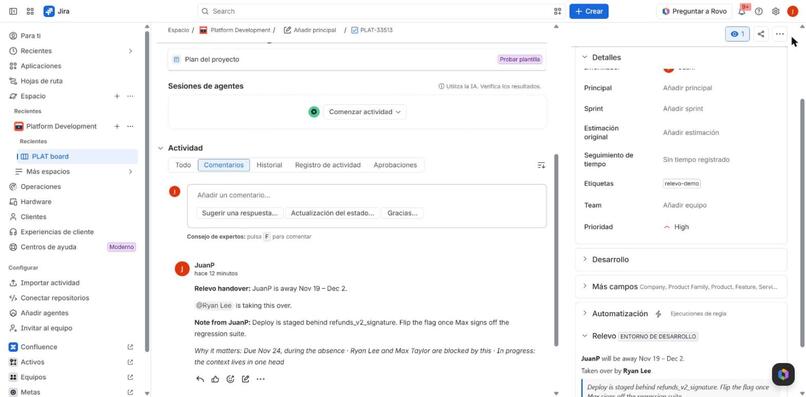
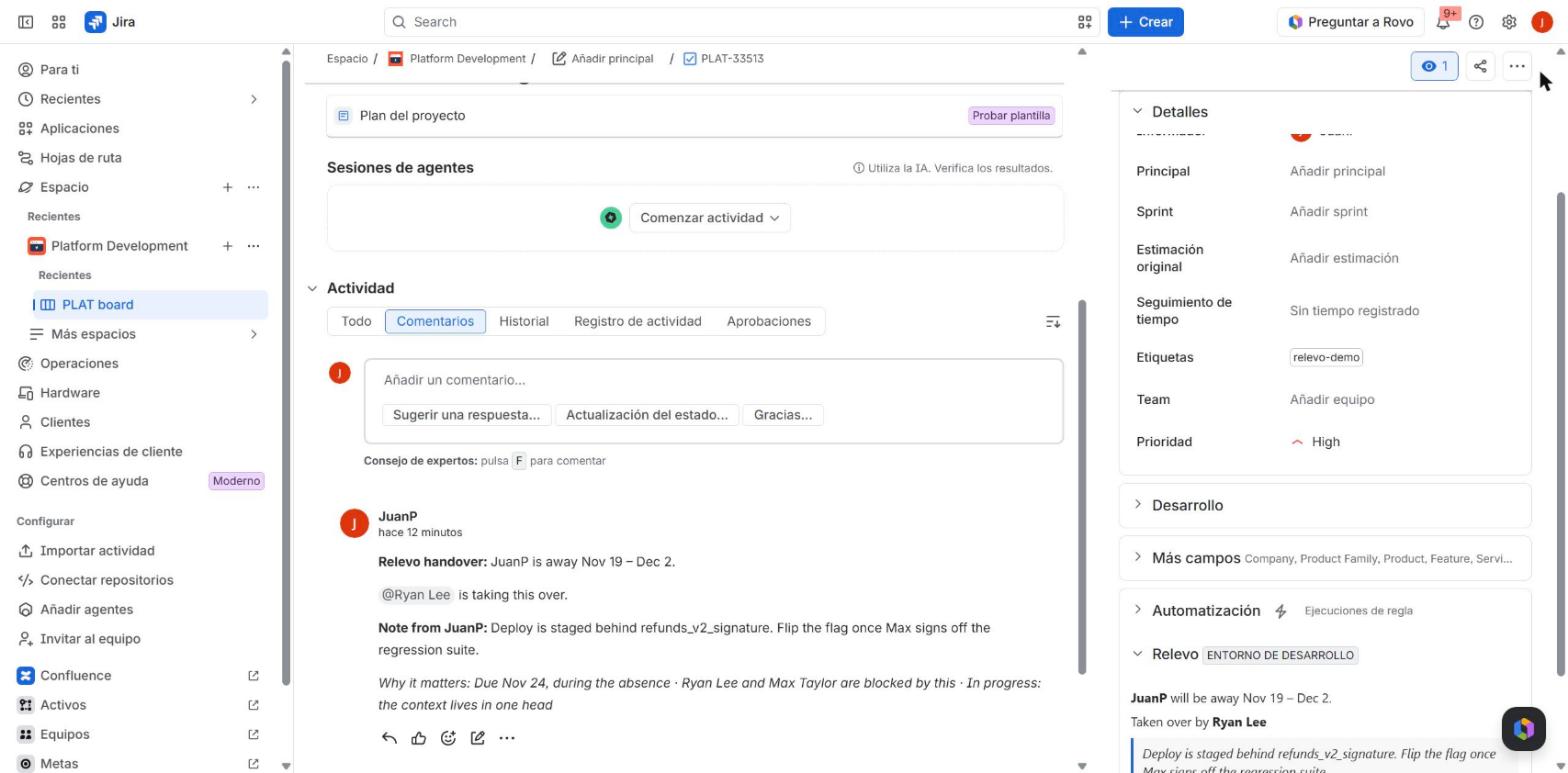
On the work item: the handover comment and the Relevo panel
-
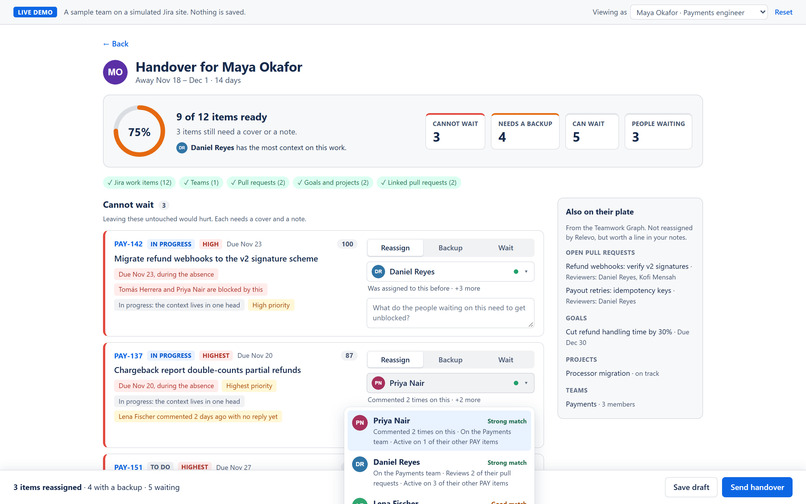
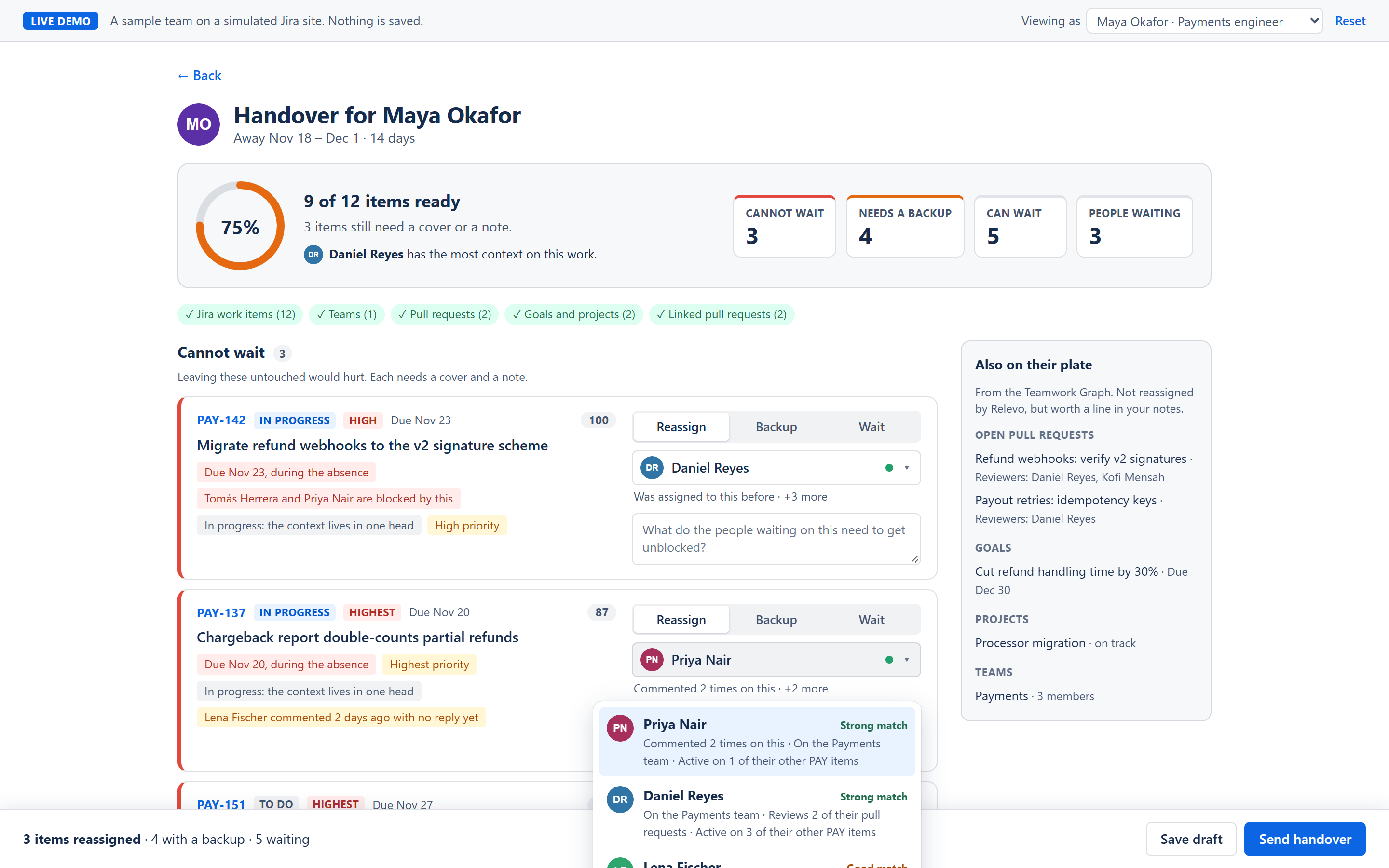
Cover suggestions come with evidence: history, comments, pull request reviews, team, current load
-
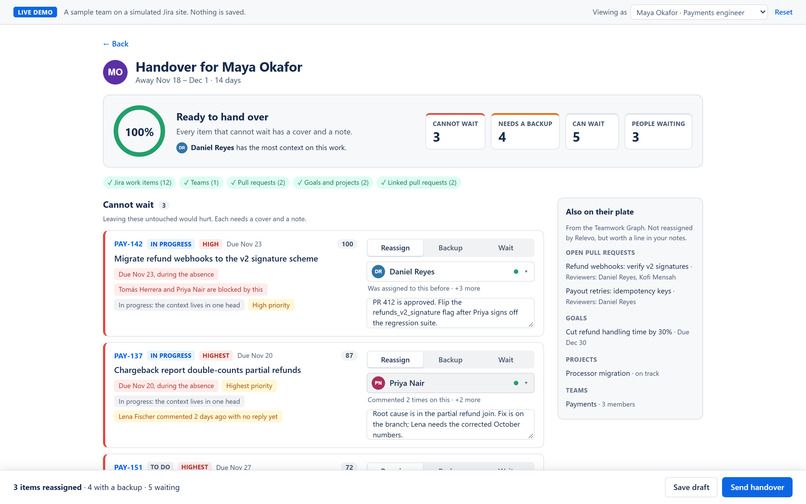
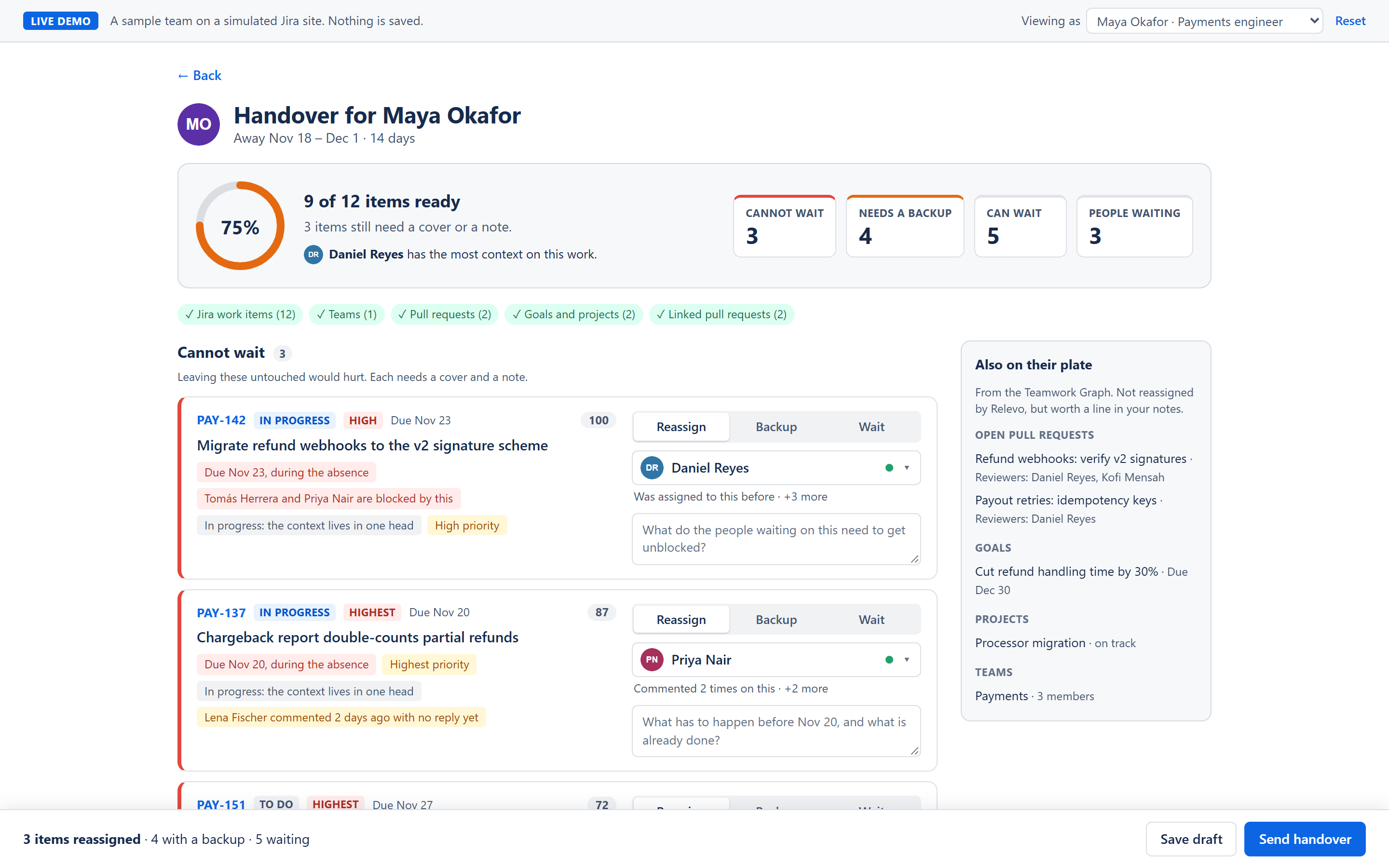
Every critical item needs a cover and a note before the handover can be sent
-
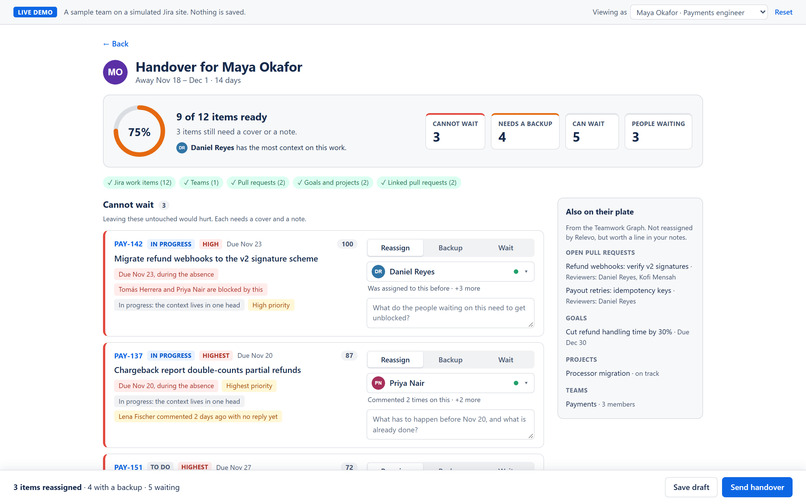
The plan: every open work item ranked by how much it hurts to leave it untouched, with its reasons
-
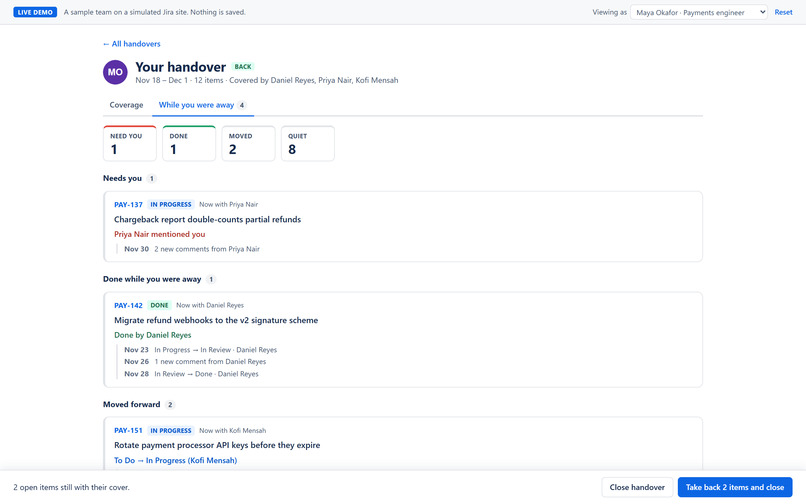
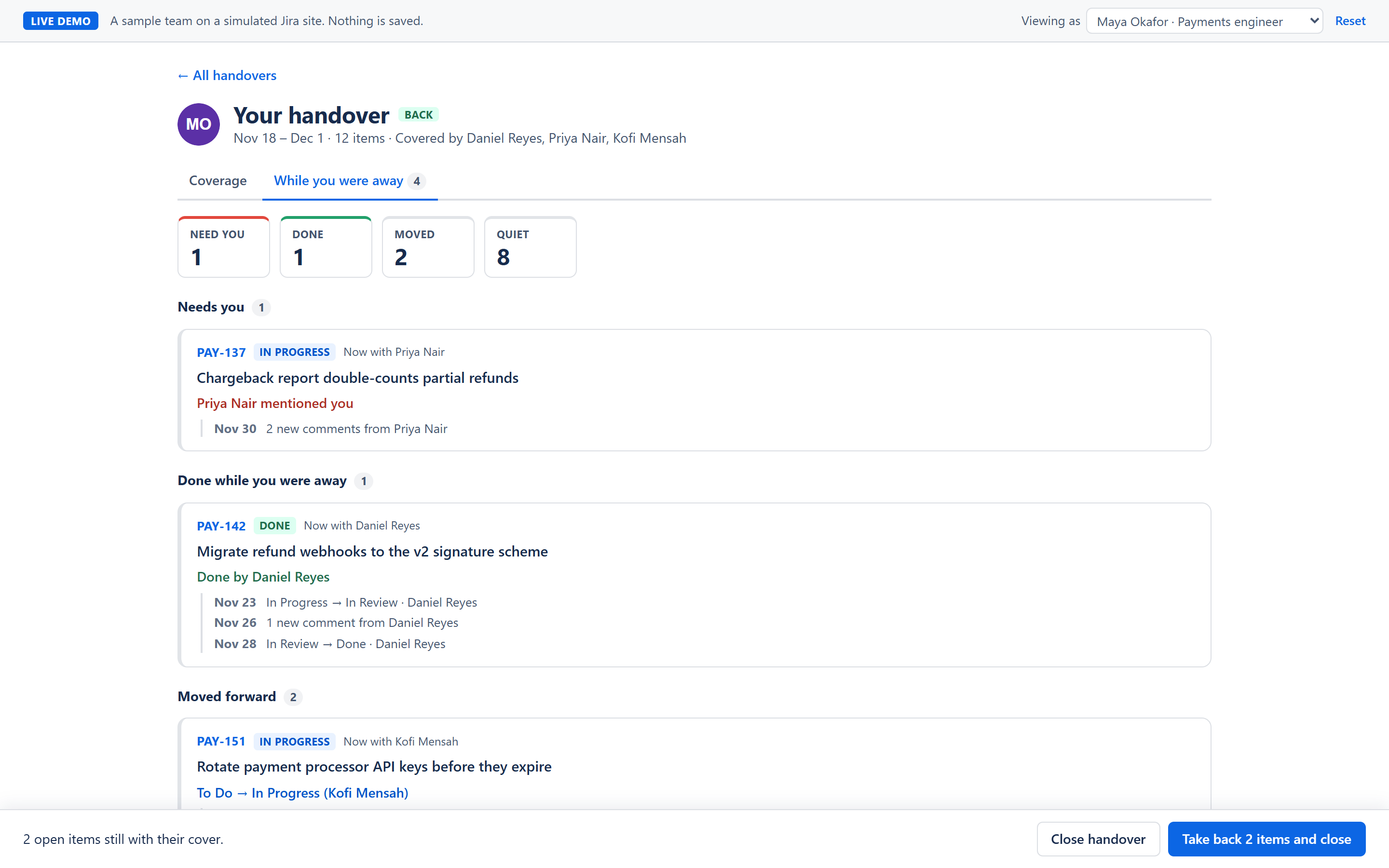
The return brief: what needs you, what got done and what moved while you were away
Inspiration
Every team loses context at the same moment: when someone steps away. Two days before a holiday you write a handover document. It lists twelve tickets with equal weight, hands them to whoever looks free, and is never read again. Two weeks later you come back to four hundred notifications and no idea which of your items moved, stalled or shipped.
The information needed to do this well already exists. Jira knows what is due and who is blocked. The Teamwork Graph knows who reviewed the pull request, who is on the team, who touched the work before. Nobody has time to assemble it by hand the afternoon before a flight.
What it does
Relevo turns that context into a handover in about two minutes.
- It ranks what cannot wait. For every open work item it scores how much it would hurt to leave it untouched for the whole absence: due inside the dates, people blocked by it, a sprint that ends while you are out, a question nobody answered, work in progress with no written context. Every score lists its reasons.
- It finds who has the context. For each item it ranks possible covers from evidence: assigned to it before, commented on it, reviewed the linked pull request, on the same team, reviews your pull requests. It discounts people who are already overloaded and skips people who are away on the same dates.
- You confirm, it does the busywork. One click reassigns, adds backups and leaves your note as a comment on each work item, where the cover will actually read it. A readiness ring shows what is still missing: every critical item needs a cover and a note before Relevo lets you send.
- It follows the work. A panel on each work item says who is away, who covers it and the note they left.
- It briefs you when you return. What needs you, what got done, what moved, and one click to take your reassigned work back.
The Relevo agent in Rovo answers "who is covering PAY-142?" and "plan my handover for the 20th to the 5th". It can save a draft, never more: a person always reviews and sends. The same capabilities are exposed as read-only MCP tools, so a coding assistant can find out who to ask while the owner of a ticket is out.
How we built it
- Forge, and nothing else.
jira:globalPageandjira:issueContextwith Custom UI,rovo:agent,rovo:skill,rovo:mcp, fiveactionmodules, Forge KVS. No remotes, no external fetch: the app is eligible for Runs on Atlassian and costs nothing to operate. - Teamwork Graph through curated queries:
atlassianUserInTeams,atlassianTeamMembers,atlassianUserPullRequests,atlassianUserGoalsAndProjectsandjiraWorkItemLinkedExternalPullRequests. Each lookup is independent, so a scope the admin did not grant degrades one section of the plan and the UI says which one. - Deterministic scoring. Risk and cover suggestions are transparent sums of named factors, not model output. The agent explains results; it does not invent them.
- Ports and adapters. The application layer talks to Jira, the graph and storage through small interfaces. In Jira they are backed by Forge; in the tests and in the public demo they are backed by an in-memory site. The demo on the landing page therefore runs the real product code.
- Tested on a real Jira Cloud site, not only in mocks. Real data exposed three bugs the mocks could not: finished work leaking in through a stale search index, automation accounts suggested as covers, and teams reported with zero members. All three are fixed.
- Tests. 93 unit tests and 24 browser tests. The browser suite also loads the production bundle through the real
@forge/bridgeagainst a simulated host, and the manifest is checked with Atlassian's validator.
Challenges we ran into
- Explaining a suggestion is harder than making one. The first version produced a ranked list. It only became trustworthy when every score carried its reasons and every cover carried its evidence.
- Not leaking through a convenience feature. A handover lists work item titles and notes. Relevo re-reads each item as the viewer before showing anything, so someone who cannot browse a project in Jira cannot see it through Relevo either.
- Preview APIs. Teamwork Graph fields can change. Pull request queries try a detailed selection first and fall back to a minimal one if the schema rejects a field.
- Keeping the agent safe. Agents triggered by automation cannot run write actions, and they should not reassign work on their own anyway. The agent drafts; the person sends.
Accomplishments that we're proud of
- A full loop: leave, be covered, come back, take the work back.
- The public demo is the product, not a video of it.
- Zero infrastructure and zero AI cost for the developer.
What we learned
Context is only useful at the moment of a decision. The same graph data that is noise on a dashboard becomes valuable when it answers one concrete question: who can pick this up on Monday?
What's next for Relevo
- Read planned absences from calendars through
atlassianUserLinkedExternalCalendarEvents, and offer to start a handover a week before. - Confluence pages someone owns, with a suggested new owner.
- Team view for managers: who is out next month and where coverage is thin.
- An Automation trigger so a rule can react when a handover starts.
Built With
- atlassian-forge
- javascript
- jira
- mcp
- node.js
- playwright
- react
- rovo
- teamwork-graph
- vite
- vitest
