Inspiration
Managing a growing portfolio of software projects showed me how difficult it can be to determine whether a release is actually ready. Build details, privacy decisions, store copy, screenshots, and approvals can all look correct individually while still contradicting one another. I wanted a tool that could turn that scattered evidence into a decision I could understand, inspect, and defend.
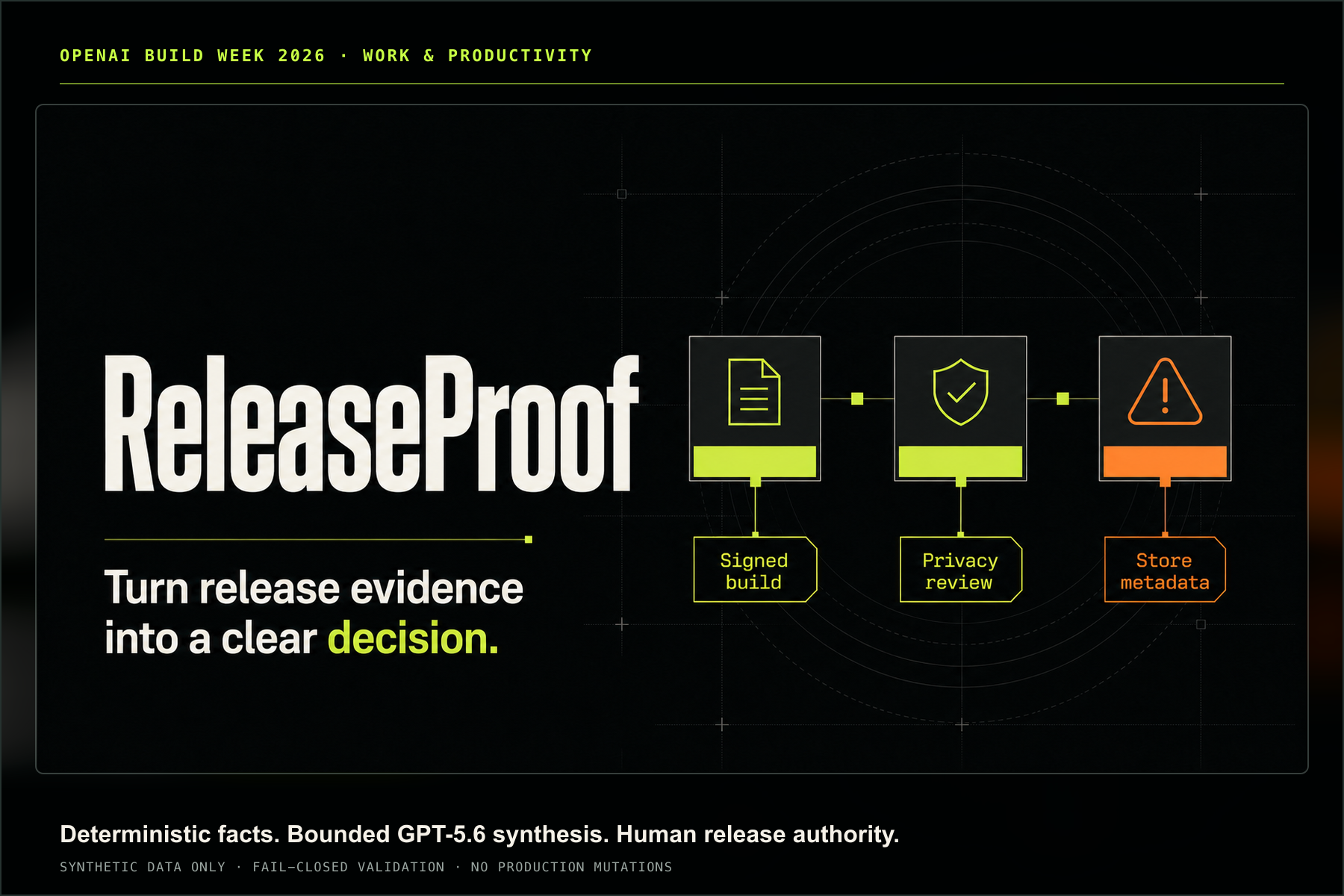
That idea became ReleaseProof. I also wanted to explore a responsible role for GPT-5.6: not allowing the model to decide whether a release is safe, but using it for bounded portfolio analysis after deterministic code establishes the facts.
What it does
ReleaseProof audits a fully synthetic (dummy data) portfolio of four release candidates. Its deterministic engine checks packet integrity, completeness, freshness, target alignment, approval ordering, and contradictions. It produces the decisive release status, findings, evidence, blocker counts, and prioritizes what needs attention first.
A separate Readiness Horizon projects each freshness-limited record to its planned release date. It flags evidence that is valid today but will expire before launch, without changing the current deterministic verdict.
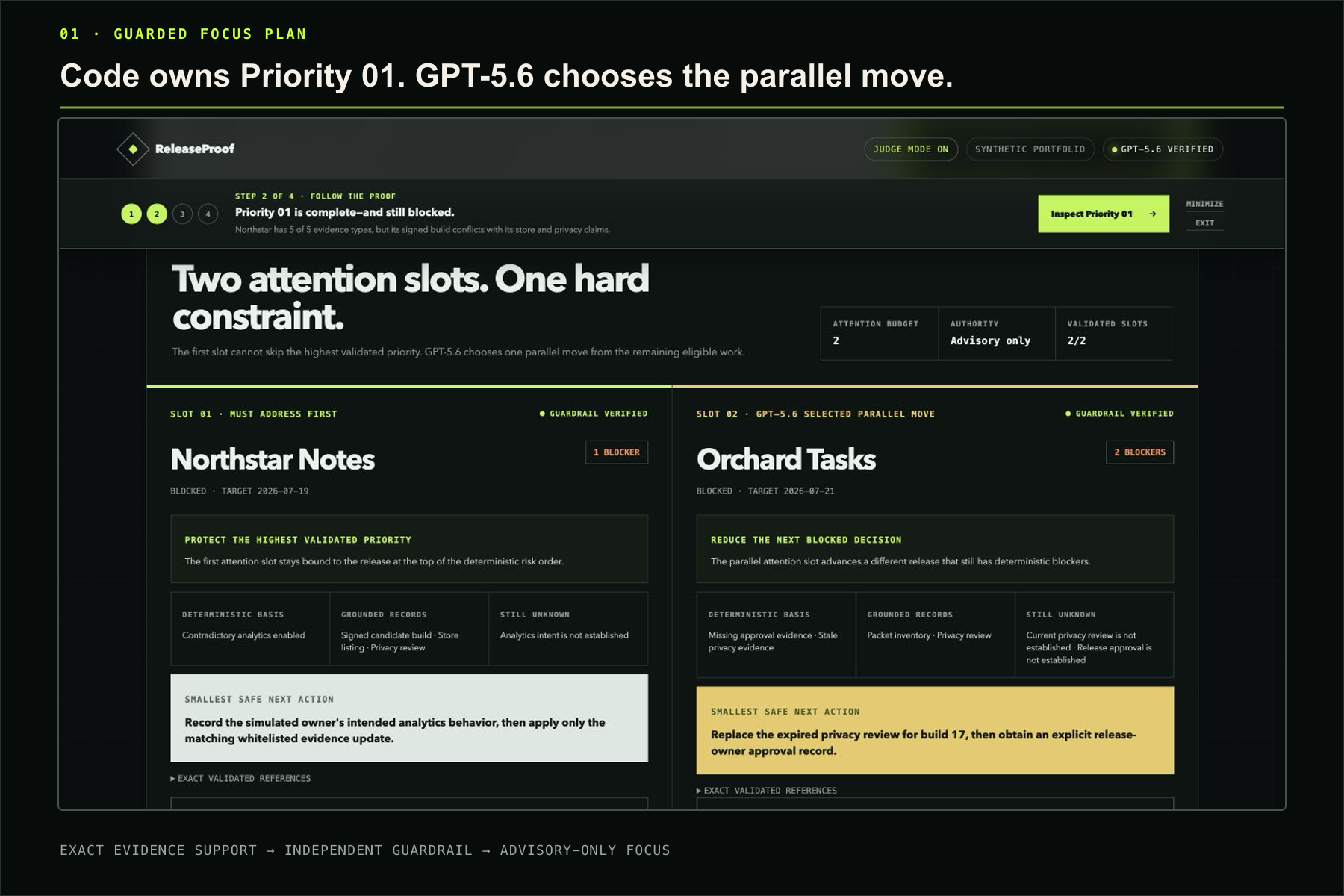
Only after deterministic code establishes those facts does GPT-5.6 review the complete audited portfolio—even when releases remain blocked. Code retains Priority 01, while GPT-5.6 identifies supported cross-release patterns and selects one eligible parallel move.
ReleaseProof validates model output in layers. Strict Structured Outputs constrain its shape; a complete server-side semantic guardrail checks every field against code-owned state; and the browser independently reparses the accepted response and verifies its state, GPT mode, and fingerprint before displaying it as verified. It rejects invented evidence, unsupported conclusions, incorrect priorities, incomplete support, unavailable actions, invalid next steps, and any attempt to claim execution or approval authority. Invalid model output fails closed rather than being repaired behind the scenes or presented as a successful result.
The guided demonstration begins with contradictory and aging evidence. A fictional resolution sandbox lets the operator test an owner-response premise without touching a real system. One branch stops safely because it would require a new signed build. The allowlisted branch reconstructs corrected synthetic records, retains the replaced evidence as superseded lineage, and reruns the complete audit.
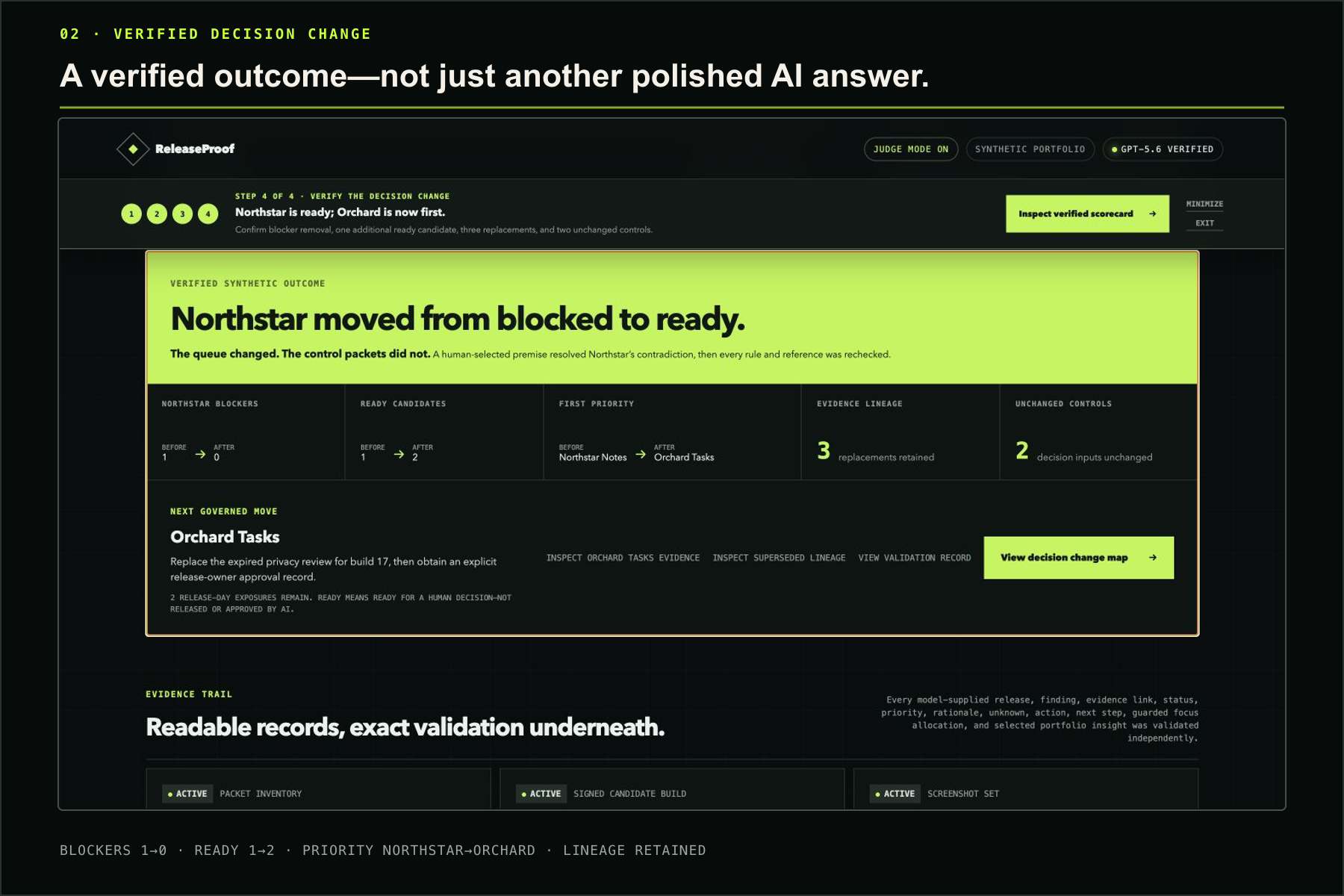
The verified outcome then proves exactly what changed: Northstar’s blockers move from 1 to 0, ready candidates increase from 1 to 2, first priority moves from Northstar to Orchard, three records are replaced with preserved lineage, and two control releases remain unchanged.
In ReleaseProof, ready always means ready for a human decision, never approved or shipped.
How I built it with Codex
I established the product boundaries: synthetic data only, no uploads or production mutations, and a human always retains release authority. I used Codex as my primary implementation partner to turn those decisions into typed evidence contracts, deterministic checks, GPT-5.6 Structured Outputs, independent guardrails, the interface, and automated tests.
Challenges I ran into
The moment that most influenced the product was seeing a genuine, structurally valid GPT-5.6 response violate a code-owned priority rule. ReleaseProof rejected it. Instead of weakening the validator, I strengthened the prompt while keeping the independent guardrail in control.
Accomplishments that I'm proud of
I am proud that GPT-5.6 is both meaningful and constrained. It makes real synthesis choices across four audited releases, but no model claim reaches the interface until the independent guardrail proves its support.
A bounded six-call evaluation covered three contradictory-baseline runs and three resolved-state runs. All 6 structured responses were accepted, all 6 focus plans verified, and all 3 before-and-after pairs produced the required exact decision changes. This was a repeatability sample for two fixed synthetic states—not a claim of general model accuracy.
Separately, the offline mutation evaluator rejected all 45 intentionally invalid cases without making any provider calls. These mutations targeted incorrect priorities, nonexistent or cross-owned evidence, incomplete focus allocations, unsupported reasoning, unsafe actions, and other trust-boundary failures.
The deployed runtime also passed the documented two-state hosted workflow, direct GPT-5.6 checks, responsive testing at 390 by 844 pixels, and a zero-console-warning/error browser rehearsal.
I'm especially proud of the Decision Proof Trace and verified outcome comparison. Together, they let a judge follow a recommendation from original packet evidence, through deterministic findings and bounded model synthesis, to independent validation and the final human boundary.
Most importantly, ReleaseProof demonstrates the entire workflow without real customer data, client-side secrets, production mutations, or a model-issued approval.
What I learned
The biggest lesson for me was that trustworthy AI is an architecture, not a confident tone of voice. A response can match a JSON schema perfectly and still cite the wrong evidence or violate policy. Reliable AI products need explicit boundaries, independent validation, and a clear path for saying “not verified.”
What's next for ReleaseProof
The next step is to extend the same authority model to additional release-evidence patterns without turning ReleaseProof into a generic dashboard. We would add more versioned synthetic evaluation cases, broaden adversarial testing, and study how model confidence should be calibrated and communicated.
For real organizational use, we would explore privacy-preserving, read-only adapters for approved evidence systems. That work would require a new security, authorization, and data-retention design. Deterministic checks would remain authoritative, and every integration would preserve the current fail-closed behavior, evidence lineage, and human decision gate.
The larger opportunity extends beyond software releases. The same pattern—deterministic facts, bounded model synthesis, independent validation, and human authority—can support other high-stakes portfolio and operational decisions where speed matters but traceability cannot be sacrificed.
Built With
- cloudflare-workers
- codex
- express.js
- gpt-5.6
- node.js
- openai
- openai-responses-api
- react
- structured-outputs
- supertest
- typescript
- vite
- vitest
- zod


Log in or sign up for Devpost to join the conversation.