-
-
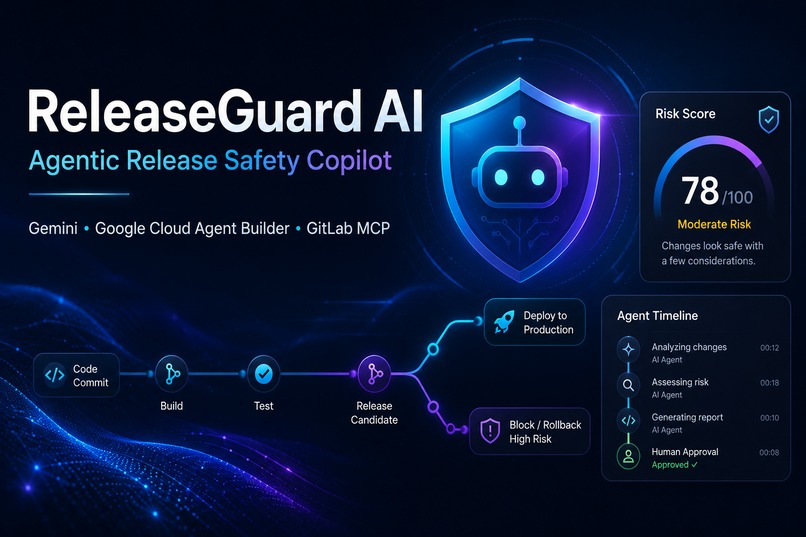
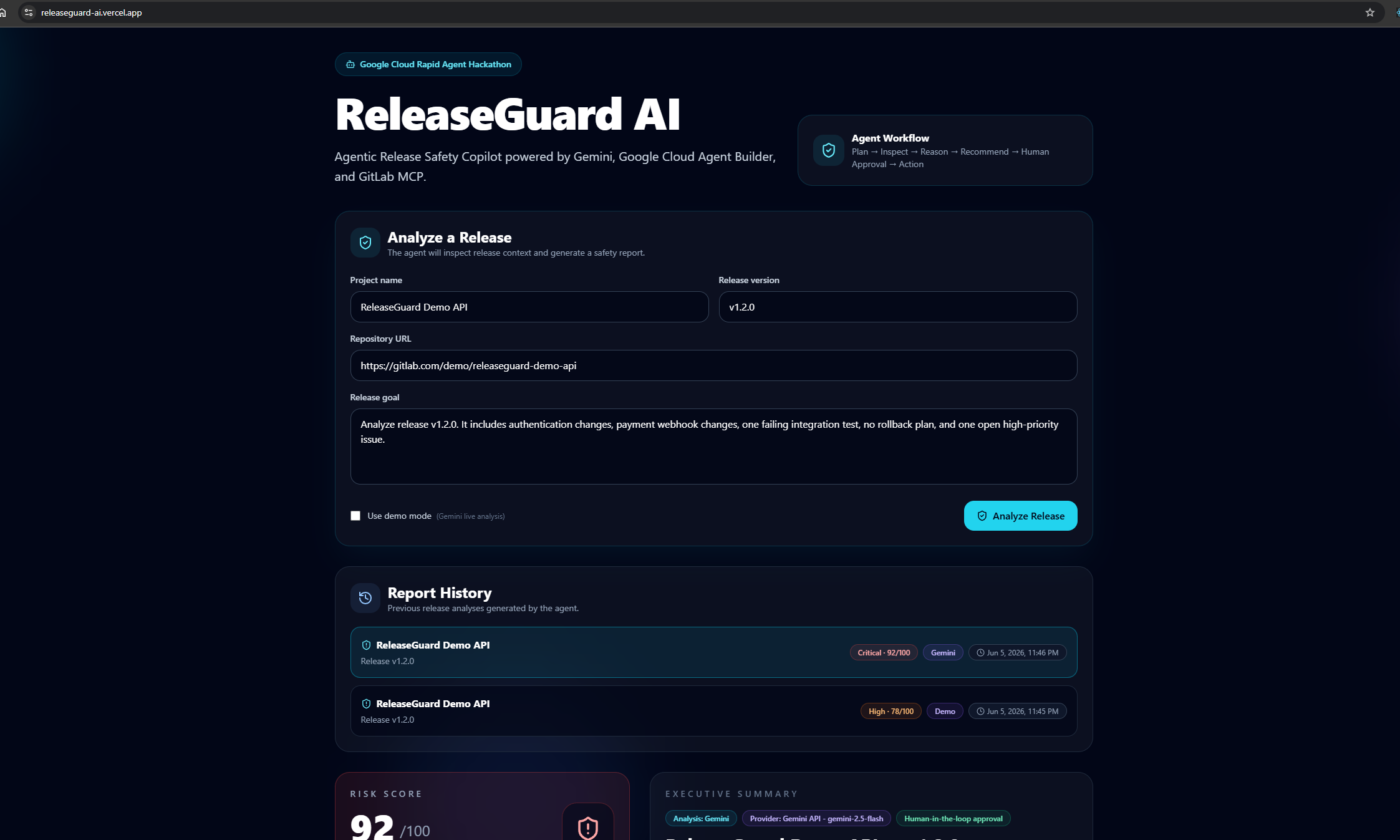
Gemini-powered release risk analysis with human approval and GitLab issue creation.
-
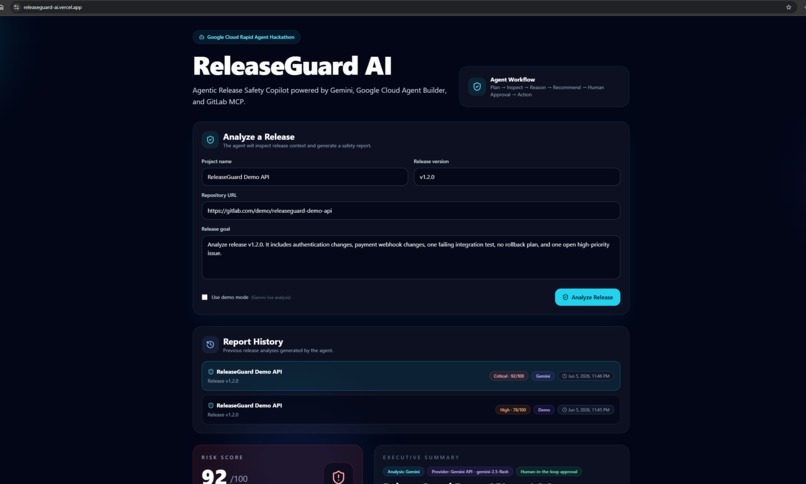
Live dashboard showing risk score, Gemini analysis mode, agent timeline, and recommendations.
-
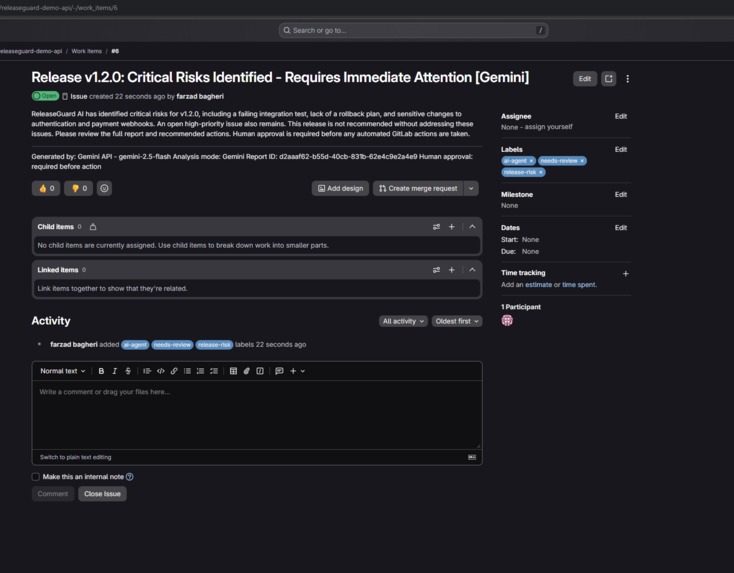
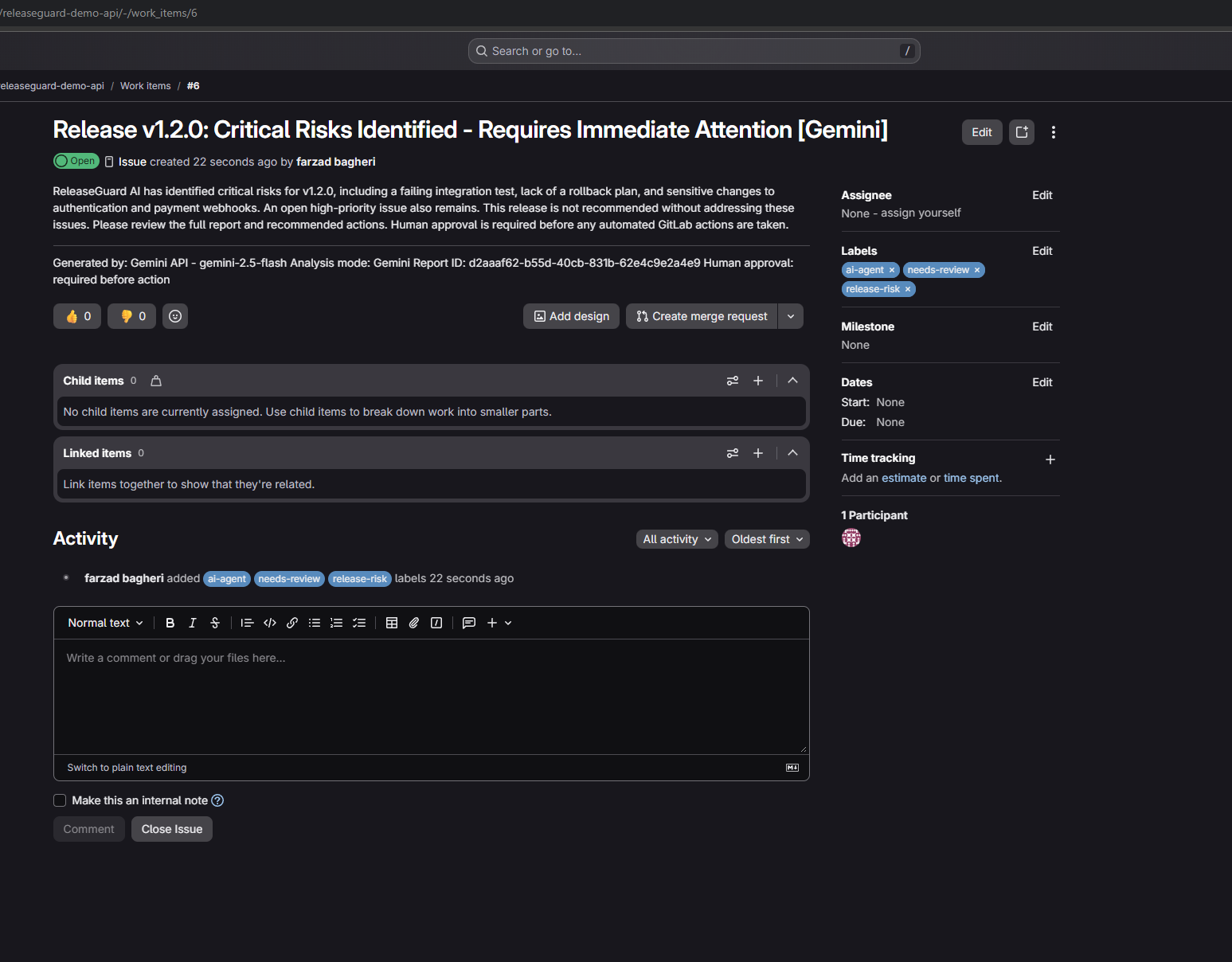
Real GitLab issue created by ReleaseGuard AI after human approval.
Inspiration
Modern software teams ship faster than ever, but release safety checks are still often manual. Before deployment, engineers need to verify pipelines, risky code changes, open issues, rollback plans, and release readiness.
ReleaseGuard AI was inspired by the real-world problem of release risk management. Teams do not need another passive chatbot. They need an agent that can understand release context, reason over risks, prepare a clear action plan, and take controlled action under human approval.
What it does
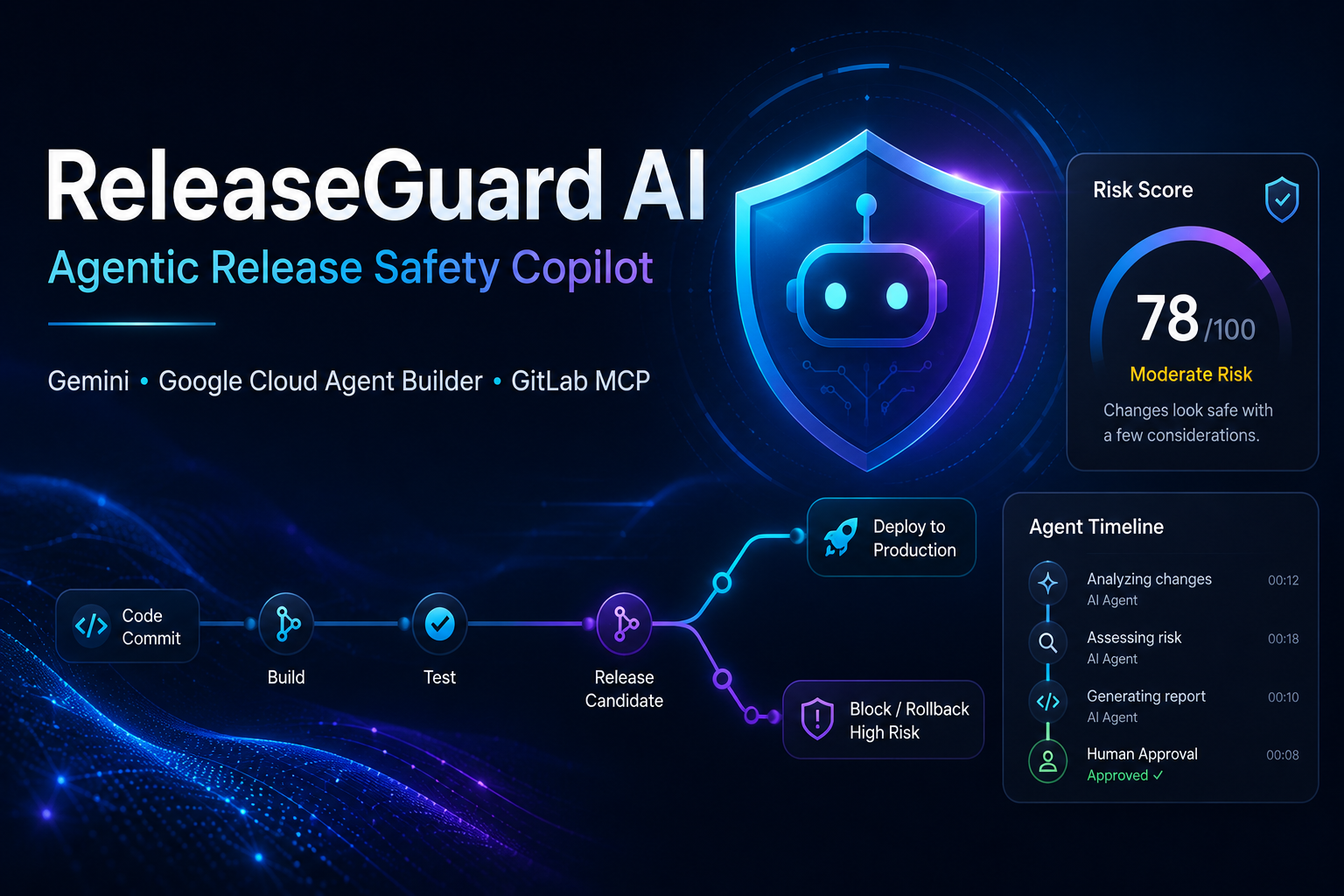
ReleaseGuard AI is an agentic release safety copilot powered by Gemini, Google Cloud, and GitLab.
The user enters a release version, repository URL, and release goal. The agent then analyzes the release context and generates a structured safety report containing:
- A release risk score
- A risk level
- An executive summary
- Detected risk factors
- Recommended actions
- An agent execution timeline
- A GitLab issue draft
The project includes both demo mode and live Gemini mode. In live mode, Gemini generates the release risk analysis. After the report is created, the user can review the GitLab issue draft and approve the action. Only after human approval does ReleaseGuard AI create a real GitLab issue through the backend action layer.
This keeps the agent useful, transparent, and controlled.
How i built it
ReleaseGuard AI was built as a full-stack agentic application.
The frontend is a React, TypeScript, Vite, and Tailwind CSS dashboard deployed on Vercel. It displays the release analysis form, risk score, agent execution mode, report history, risk factors, recommended actions, and GitLab issue approval flow.
The backend is an ASP.NET Core Web API deployed on Render. It exposes endpoints for release analysis, report history, and GitLab issue creation. The backend integrates with Gemini for live AI reasoning and with GitLab for real issue creation.
Gemini is used to generate structured release analysis reports. The backend asks Gemini to return valid JSON matching the release analysis schema. The response is then displayed in the dashboard and saved in report history.
GitLab is used as the action layer. The agent prepares a GitLab issue draft, but the user must approve it before the backend creates the issue in the GitLab project.
The project also includes Swagger documentation, a public GitHub repository, deployment documentation, and a demo-ready workflow.
Challenges i ran into
The main challenge was designing the project as a real agent instead of a normal chatbot. I wanted the system to plan, reason, generate structured output, and take action only after human approval.
Another challenge was integrating the Gemini response cleanly into a typed .NET backend. I had to ensure Gemini returned valid JSON that matched the ReleaseAnalysisReport schema.
I also had to connect the full production flow: Vercel frontend, Render backend, Gemini live analysis, CORS configuration, environment variables, and real GitLab issue creation.
Accomplishments that i'm proud of
I'm proud that ReleaseGuard AI goes beyond answering questions. It performs a real release safety workflow: analyze, score, recommend, prepare an action, wait for human approval, and create a real GitLab issue.
I am also proud of the clear dashboard experience. The user can see whether the report came from demo mode or Gemini, review the risk score, inspect the agent timeline, and approve the GitLab action.
The project is deployed live, includes Swagger documentation, and demonstrates a working end-to-end agentic flow.
What i learned
I learned that useful agents need more than a prompt. They need structured inputs, reliable outputs, safe action boundaries, and transparency.
I also learned how important human-in-the-loop design is. ReleaseGuard AI can prepare actions, but the user remains in control before anything is executed.
Technically, i learned how to connect Gemini with an ASP.NET Core backend, parse structured AI responses, deploy the backend and frontend separately, and integrate GitLab issue creation into the workflow.
What's next for ReleaseGuard AI
Next, i want to expand ReleaseGuard AI with deeper GitLab MCP integration, merge request analysis, pipeline failure explanation, automatic release note generation, rollback plan generation, and observability integrations.
We also want to add team policies, historical release comparison, Slack or email notifications, and more advanced approval workflows.
The long-term vision is to help engineering teams reduce deployment risk and ship software with more confidence.
Built With
- asp.net-core
- c#
- gemini
- github
- gitlab-api
- google-cloud
- react
- render
- rest-api
- swagger
- tailwind-css
- typescript
- vercel
- vite

Log in or sign up for Devpost to join the conversation.