-
-
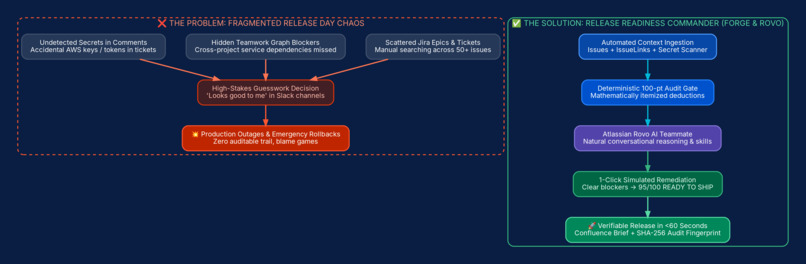
what it solves
-
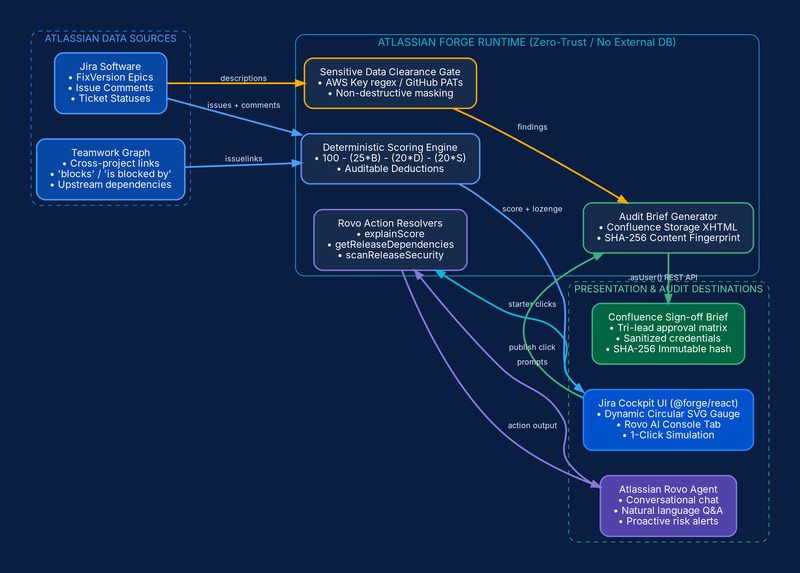
architecture
-
Thumbnail
-
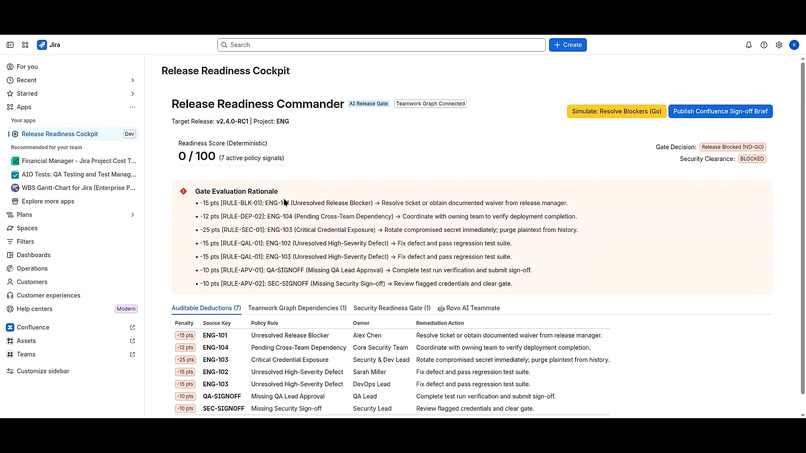
Rovo AI Teammate Console
Inspiration
Release managers, engineering leads, and DevOps teams face intense anxiety on release day. Before cutting a production deployment, they spend hours manually hunting through dozens of Jira tickets, Slack channels, and stale Confluence pages asking the same high-stakes questions:
- Are all Sev-1 blockers actually resolved or just marked done without testing?
- Is another team's upstream microservice dependency holding up our release?
- Did an engineer accidentally paste an AWS secret key or private SSH token into a bug ticket comment?
- Who officially signs off when an outage occurs?
When release decisions rely on intuition and fragmented manual checks, bad builds slip into production. We built Release Readiness Commander to replace human guesswork with an automated, deterministic, and auditable AI release gate running 100% natively inside Atlassian Cloud.
What it does
Release Readiness Commander acts as an automated release flight controller across Jira, Confluence, and Atlassian Rovo:
- Deterministic 100-Point Audit Engine: Calculates an auditable score starting at 100 with transparent mathematical penalties for unresolved blockers, flaky test runs, cross-project dependencies, and security violations. Releases are automatically categorized as NO-GO (<70), CONDITIONAL GO (70–84), or READY TO SHIP (≥85).
- Atlassian Rovo AI Teammate (
rovo:agent): Provides an interactive AI teammate inside Jira and Rovo Chat equipped with 3 discrete skills:explainScore(itemized mathematical deductions),getReleaseDependencies(Teamwork Graph blocker chains), andscanReleaseSecurity(credential leakage audit). - Teamwork Graph Blocker Intelligence: Traverses cross-project Jira
issuelinksacross separate microservice repositories to ensure upstream service releases cannot silently break downstream production deployments. - Sensitive Data Clearance Gate: Automatically scans issue descriptions and comments for AWS access keys, GitHub PATs, and SSH keys. Operates strictly non-destructively: Jira tickets are never altered, and masking is applied automatically to reports.
- Confluence Sign-off Brief & SHA-256 Audit Fingerprint: Publishes a one-click executive sign-off brief to Confluence containing the deduction breakdown, tri-lead approval matrix, sanitized credentials, and an immutable SHA-256 content-integrity fingerprint.
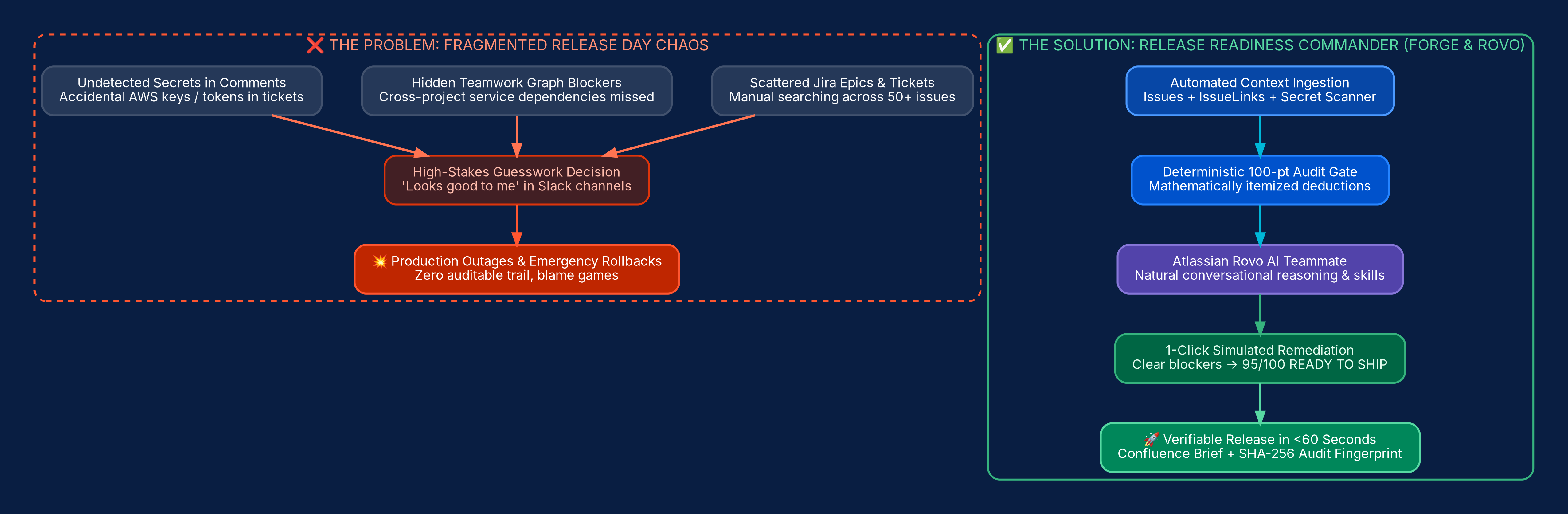
What it solves
(Insert diagram_what_it_solves.png here using the 📷 image button)
- Eliminates Manual Ticket Hunting: Replaces hours of searching across sprint boards with an instant, real-time audit across all release tickets.
- Prevents Silent Cross-Service Outages: Catches unreleased upstream microservice dependencies using Teamwork Graph link traversal before deployment.
- Blocks Credential Leakage Before Production: Automatically halts releases if unmasked API keys or secrets exist in tickets.
- Guarantees Audit Compliance: Replaces informal Slack approvals with a cryptographically fingerprinted Confluence sign-off page for compliance teams.
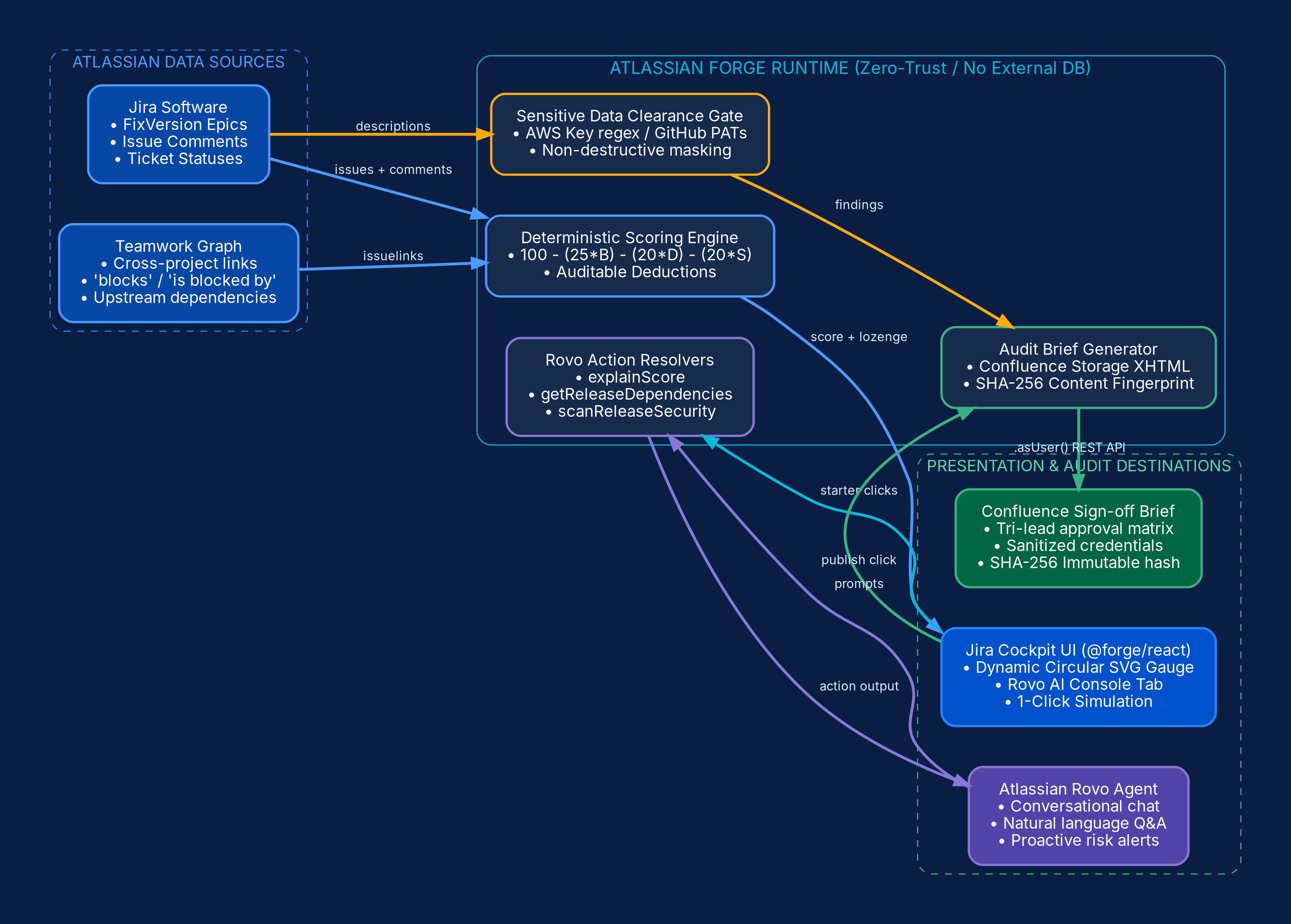
End-to-End Architecture & Workflow
(Insert diagram_system_architecture.png here using the 📷 image button)
The entire solution runs 100% natively within the Atlassian Cloud trust boundary with zero external databases and zero third-party servers:
- Automated Context Ingestion: When a release lead selects a release version in Jira, the app queries Jira Software issues, fixVersions,
issue comments, and cross-project issue links using
@forge/apiin the authenticated user's context (.asUser()). - Forge Cloud FaaS Core: Atlassian's isolated serverless runtime executes the deterministic scoring formula, sensitive data regex scanner, and SHA-256 hash generator in-memory without persistent external storage.
- Dual Interface Presentation:
- Jira Release Cockpit (
@forge/react): Renders the dynamic circular readiness gauge, the auditable deduction table, and a 1-click remediation simulator. - Atlassian Rovo Agent (
rovo:agent): An intelligent AI teammate answering natural-language questions and surfacing remediation steps in chat or via 1-click console starter buttons. - Confluence Audit Hand-off: Compiles and publishes formal Confluence storage XHTML containing executive summaries, lead sign-off matrices, and sanitized credentials.
How we built it
- Platform Runtime: Built 100% on Atlassian Forge Cloud (
@forge/[email protected]) with zero external servers, zero external databases, and zero data egress. - Frontend Cockpit: Built with
@forge/reactUI Kit, featuring a dynamic circular SVG readiness gauge, auditable deductions table, and an interactive Rovo AI console tab with dynamic active button highlighting. - Atlassian Rovo Agent: Implemented
rovo:agentwith modularrovo:actionskills inmanifest.yml(explainScore,getReleaseDependencies,scanReleaseSecurity). - Teamwork Graph Traversal: Recursively parses Jira
issuelinksacross multiple project spaces (such asAUTHandENG) to detect unreleased dependencies. - Automated Test Suites: Built comprehensive unit test suites (
tests/scoring.test.mjs,tests/securityGate.test.mjs,tests/confluenceReport.test.mjs) passing 8/8 automated tests.
Challenges we ran into
- Balancing Determinism with Generative AI: LLMs can produce hallucinations when calculating strict release math. We solved this with a hybrid architecture: the scoring engine is mathematically deterministic, while Rovo is leveraged for natural-language reasoning, root-cause explanation, and dependency exploration.
- Strict Non-Destructive Scanning: Enterprise release gates must never corrupt or alter source Jira tickets. We architected the secret
scanner to evaluate issue text in-memory and apply token masking (
AKIA****************WXYZ) exclusively to generated Confluence audit briefs. - UI Kit Component Constraints: Structuring rich interactive action cards, table cells, and status lozenges within Forge UI Kit required precise nesting to avoid UI layout warnings and rendering bugs.
Accomplishments that we're proud of
- Complete Tri-Product Integration: Seamlessly connects Jira Software, Confluence Cloud, and Atlassian Rovo in a single unified release workflow.
- Sub-60-Second Time-to-Clearance: Takes engineering leads from pre-release panic to an auditable, fingerprinted Go/No-Go decision in under 1 minute.
- Zero External Footprint: 100% compliant with Atlassian's cloud security model—no third-party AWS/GCP servers, no external databases, and zero credential leakage.
What we learned
- How to design modular Rovo Agent Actions (
rovo:action) that bridge the gap between conversational AI and deterministic backend business logic. - The power of the Teamwork Graph in surfacing hidden microservice dependencies that standard sprint boards overlook.
- How to use cryptographic content-integrity fingerprinting (SHA-256) within Confluence storage format to create legally defensible change-management audit trails.
What's next for Release Readiness Commander
- Bitbucket Pipelines & CI/CD Gate: Automatically trigger readiness evaluations on pull request merge or release tag creation.
- Jira Service Management CAB Approvals: Automatically serve as an AI Change Advisory Board approver for JSM change requests based on the readiness score.
- Historical Release Velocity Analytics: Benchmark release blocker frequency and security clearance times across quarters.
🏆 Bonus Tracks Justification
Submitting specifically for the Best Rovo / Assignable Agents bonus prize:
- Dedicated Custom Rovo Agent: Implemented a specialized
rovo:agent("Release Readiness Commander") designed as an AI release flight controller. - Three Reusable
rovo:actionSkills: explainScore: Translates deterministic mathematical point deductions into natural-language root-cause explanations and remediation guidance.getReleaseDependencies: Explores the cross-project issue graph to surface upstream microservice blockers holding up the release.scanReleaseSecurity: Audits release issues and comments in real time for leaked tokens or sensitive data.- Interactive Cockpit Console: Embedded 1-click conversation starters directly inside the Jira Cockpit UI (
@forge/react), enabling users to trigger Rovo's reasoning without leaving their Jira release dashboard.
🧪 Instructions for Judges (Testing the App)
- Jira Release Cockpit:
- Navigate to
https://ghost-dev.atlassian.net. - Click Apps → Release Readiness Cockpit (or visit the direct URL:
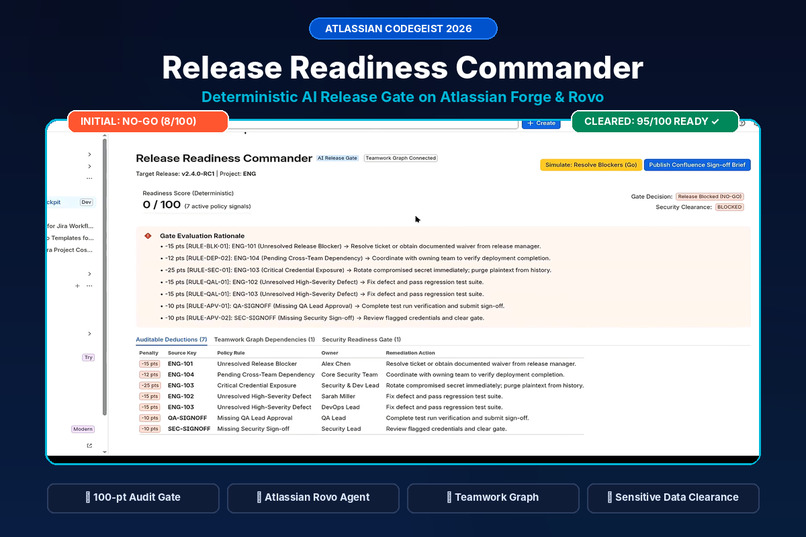
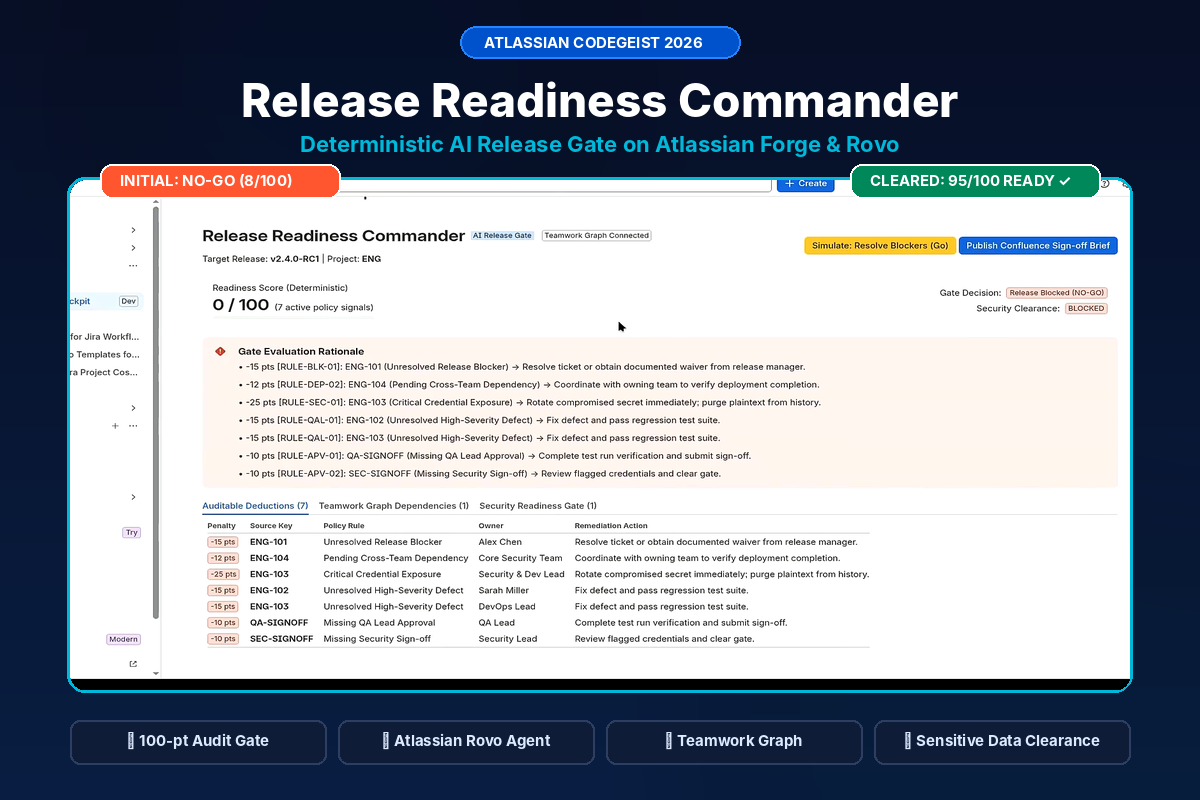
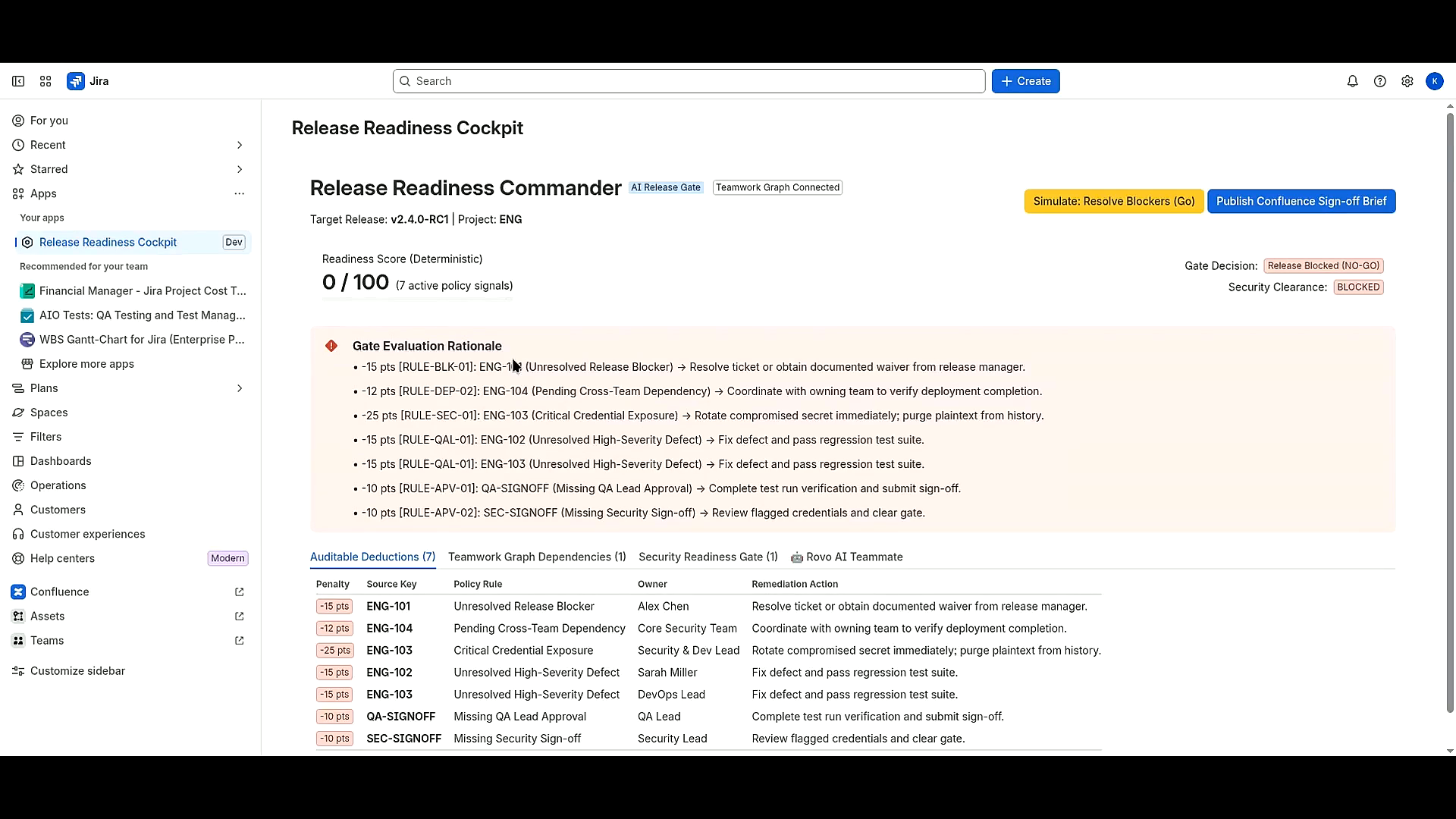
https://ghost-dev.atlassian.net/jira/apps/ari:cloud:ecosystem::app/5c1b3b3c-0be8-4cf1-a15b-9550459dc6d0/release-readiness-global-cockpit). - Select Release: v2.4.0-RC1 (Project: ENG) to inspect the initial NO-GO (8/100) score and deductions table.
- Interactive Rovo AI Teammate:
- Click the 🤖 Rovo AI Teammate tab in the Cockpit.
- Click conversation starters like "Why is release v2.4.0-RC1 No-Go? Explain the score" to trigger Rovo's explanation engine.
- Simulate Remediation & Publish:
- Click Simulate Remediation (All Gates Cleared) → Score updates instantly to 95/100 (READY TO SHIP).
- Click Publish Confluence Sign-off Brief → Generates an audit brief with masked secrets and a SHA-256 fingerprint.
Built With
- atlassianforge
- atlassianrovo
- confluencecloudrestapi
- forgeuikit
- javascript
- jiracloudrestapi
- node.js
- react
- sha-256
- teamworkgraph
