-
-
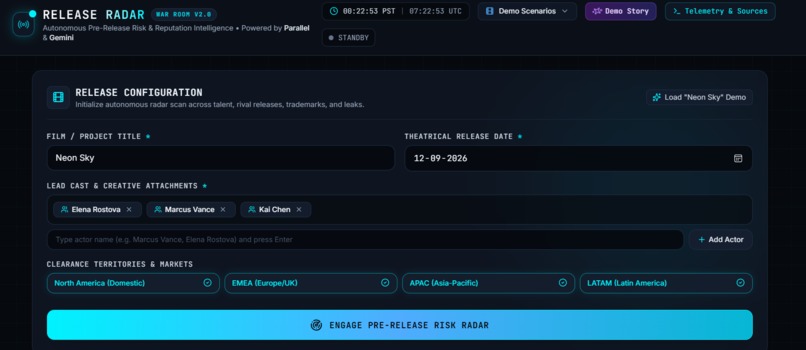
home page
-
logo
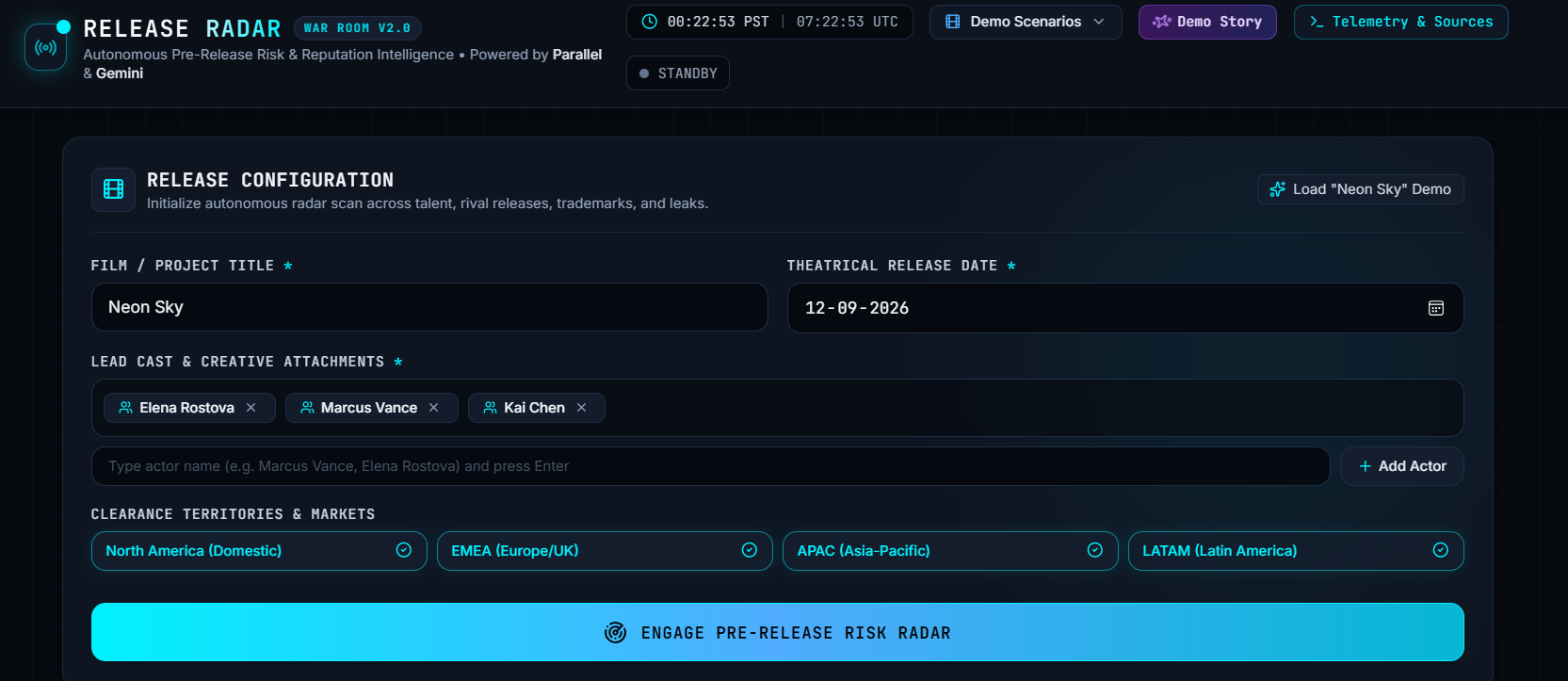
Release Radar: Autonomous Pre-Release Risk and Reputation War Room
Inspiration
In modern entertainment, producing a blockbuster is only half the investment; launching it into global theaters is where financial outcomes are determined. Major studios routinely commit over $\$150\text{M}$ in production budgets alongside an additional $\$100\text{M}$ in global prints and advertising (P&A).
However, during the critical final 30-day window leading to opening weekend, studios face severe operational blind spots:
- Attached talent suddenly becomes embroiled in unscripted podcast controversies, labor disputes, or legal audits.
- A competing studio shifts a major franchise tentpole into the same weekend corridor, monopolizing over $75\%$ of premium large format (PLF) and IMAX theatrical footprints.
- A foreign entity lodges a USPTO Class 41 trademark opposition against the project title.
- High-resolution third-act VFX concept art detailing plot twists leaks to online discussion boards.
Traditional media monitoring and tracking tools are entirely manual and reactive. By the time headlines break across entertainment trades, tens of millions in advance pre-sales are already compromised. We built Release Radar to provide studios with an autonomous, always-on AI Chief Risk Officer that proactively monitors the open web, quantifies threat levels, drafts instant crisis responses, and maintains continuous background surveillance.
What it does
Release Radar is an autonomous Pre-Release Risk and Reputation War Room designed for studio heads, distribution executives, and crisis communications leads.
- Autonomous Discovery and Web Grounding: The user supplies a project title, target release date, and attached talent. The system deploys targeted searches to uncover talent disputes, rival calendar shifts, trademark oppositions, and leaks across trade journalism, legal dockets, and forums.
- Composite Risk Indexing ($0\text{--}100$): Powered by Google Cloud Gemini, the agent calculates a normalized risk score $R \in [0, 100]$ classified into three defined statutory risk bands: $$\text{Risk Band} = \begin{cases} \text{LOW RISK (Clear to Release)}, & 0 \le R \le 30 \ \text{MODERATE RISK (Caution)}, & 31 \le R \le 65 \ \text{CRITICAL THREAT (Mitigation Required)}, & 66 \le R \le 100 \end{cases}$$
- Instant Crisis PR Studio: When a high-severity threat is detected, Gemini automatically synthesizes an on-record studio holding statement, strategic press talking points, and an anticipated media Q&A playbook across selectable strategic postures (Diplomatic/Cautious, Firm Denial, Transparent Review, Strategic Deflection).
- Statutory Clear-to-Release Report: Compiles a one-page clearance dossier with executive summaries, threat matrices, and territorial compliance tables, exportable as clean HTML, Markdown, or print-ready format.
- Always-On Living Surveillance: Unlike static search utilities, Release Radar registers scheduled background monitors via Parallel's Monitor API. The agent continues auditing the open web every 30 seconds even after closing the browser, delivering real-time incoming alerts upon return.
How we built it
Release Radar is built on a zero-secret, enterprise-grade architecture:
React (Frontend) ---> /api/* (Serverless) ---> Google Cloud Gemini
                             |
                             +---> Parallel Search  (live cited facts)
                             +---> Parallel Extract (full source content)
                             +---> Parallel Task    (deep cast dossiers)
                             +---> Parallel Monitor (always-on web watch)
- The Sequential Agent Pipeline: We structured a deterministic five-phase agentic loop: $$\text{GATHER} \longrightarrow \text{DEEPEN} \longrightarrow \text{REASON} \longrightarrow \text{WATCH} \longrightarrow \text{ACT}$$
- Gather (Parallel Search API): Executes targeted live discovery queries across trade publications (Variety, Deadline), legal databases (USPTO), and exhibitor calendars.
- Deepen (Parallel Extract and Task APIs): Scrapes un-truncated body text to eliminate headline-only bias, and synthesizes structured background dossiers with sentiment ratings for each cast member.
- Reason (Google Cloud Gemini): Processes grounded evidence, filters out noise, and computes composite threat scores by weighting severity values $s_i$, confidence metrics $c_i$, and category weights $w_i$: $$R = \min\left(100, \sum_{i=1}^{k} w_i \cdot s_i \cdot c_i \right)$$
- Watch (Parallel Monitor API): Registers living background watches with cron intervals.
- Act (Gemini PR Studio and Report Generator): Produces crisis communications and statutory clearance documentation on demand.
- Frontend and Tech Stack:
- Frontend: React 18, TypeScript, and Vite designed with a dark control-room theme.
- Styling: Custom Tailwind CSS tokens, SVG animated circular gauges, and studio clocks (PST and UTC).
- Backend: Vercel Serverless Functions in
/api/*paired with custom local dev middleware for seamless local testing. - Verification: Built-in Telemetry and Sources Drawer providing runtime auditing of all API calls, payloads, status codes, and latencies.
Challenges we ran into
- Eliminating Clickbait and Headline-Only Hallucinations: Large language models frequently overreact to sensationalized headlines. We resolved this by piping all search URLs through Parallel's Extract API, providing Gemini with complete, clean article bodies to reason over verified facts, legal filings, and quotes.
- Implementing True Always-On Background Monitoring: Traditional web apps lose state as soon as the client session disconnects. By pairing Parallel's Monitor API with persistent server-side storage, the system continuously audits the web independently of the frontend tab.
- Calibrating Nuanced Corporate PR Responses: Studio communications require strict diplomatic calibration. We engineered structured prompt architectures within Gemini that adjust vocabulary, framing, and defensive tone according to selected executive postures.
Accomplishments that we're proud of
- Full Runtime Multi-API Integration: Successfully integrated all four Parallel Web Systems APIs (Search, Extract, Task, Monitor) alongside Google Cloud Gemini in server-side runtime code rather than superficial mockups.
- Transparent Telemetry Inspection: Built a live network inspector into the war room UI, enabling judges and executives to verify every runtime query, payload, latency, and source domain.
- End-to-End Workflow Completeness: Delivered a finished product that spans project setup, automated multi-source threat discovery, risk index calculation, dynamic PR statement drafting, 24/7 web monitoring, and executive PDF/HTML report generation.
What we learned
- Grounding is Essential for Enterprise AI: Frontier models like Gemini achieve corporate-grade reliability when grounded with clean, structured web infrastructure purpose-built for AI agents.
- Autonomous Systems Require Living Sensory Feeds: Search should not be confined to one-off user prompts; modern autonomous workflows depend on continuous web monitoring and proactive background alerting.
- Domain-Specific UX Matters in High-Stakes Operations: In rapid crisis response situations, studio executives need immediate visual clarity, clear threat category breakdowns, and one-click mitigation tools.
What's next for Release Radar
- Advance Ticket Sales Telemetry: Integrating real-time box-office presale APIs (Fandango, AMC, Regal) to quantify the financial impact of detected PR issues on opening-weekend velocity.
- Automated Content Protection and DMCA Takedowns: Connecting direct API integrations with social platforms to issue automated intellectual property takedown notices the moment unreleased script leaks are detected.
- Algorithmic Exhibitor Allocation: Developing automated recommendations for shifting theatrical screen commitments to Dolby Cinema or standard DCP formats when IMAX corridors experience unexpected rival collisions.
Built With
- gemini
- parallel
- react
- typescript
- vercel


Log in or sign up for Devpost to join the conversation.