-
-
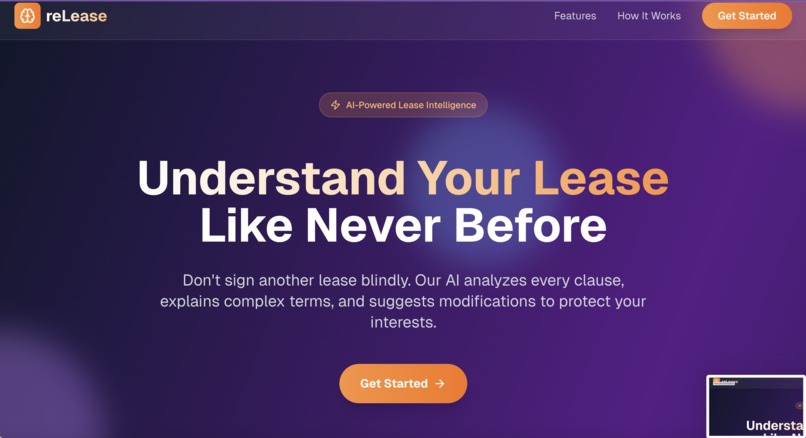
Home Page
-
Login Page
-
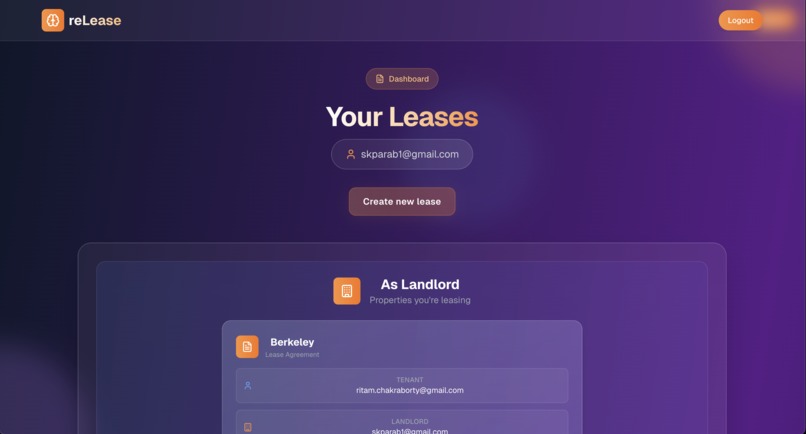
your Leases page
-
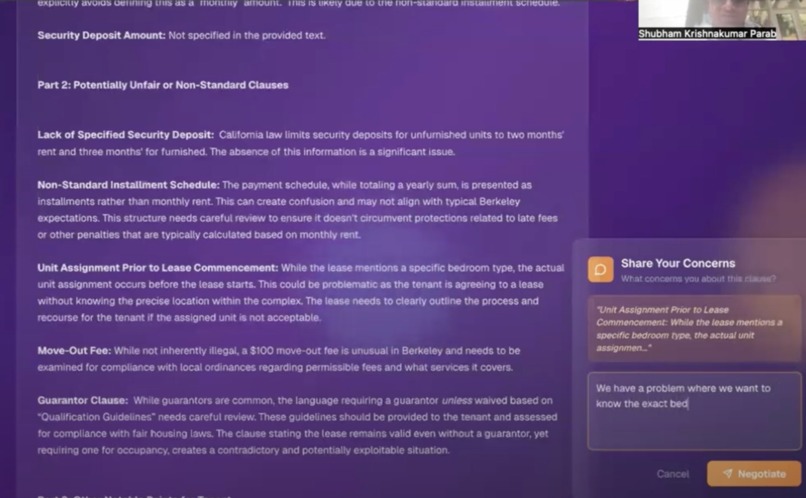
Letta Powered Text Editor


Inspiration
All of us have had confusing housing contracts for apartments, and we wanted to make a way that we could change things that we felt didn't make sense and understand more of the document. We found this common problem and from there decided to build a webapp that solves it.
What it does
reLease is built for both landlords and renters, with the renter able to put in a contract, ask for clarification and assurance over the contract, and send rewrites of the contract, powered by AI, to their landlord. Landlords can accept, deny, or send other messages back to their renters, overall making the contract process a cooperative one, not an alienating one. The idea is that reLease monitors and organizes the entire workflow of negotiating a lease. It avoids pointlessly long email chains and customer service calls and optimizes everything with clear concise LLMs.
How we built it
We built our frontend using Node.js, Tailwind for styling, and Supabase for authentication and data storage. Letta was powered by openai-mini-gpt-4.0 and was used for backend AI functions, run on a JavaScript backend. We also used Gemini for some lower level summary tasks to increase efficency.
Challenges we ran into
Using the new tool Letta was particularly challenging, such as how to develop AI agents on the fly and connect them to code on the backend and frontend and finding the best data sources to upload to Letta based off of it's websearches. Managing real time changes in the webapp between different users was also a necessary challenge, as it was needed to make our webapp responsive and useful in coordinating the relationship between landlord and tenant.
Accomplishments that we're proud of
Created a full backend powered by gemini that can summarize and reason Utilized Letta AI to store memory about the user and their lease, created an Agent that can websearch data sources to reference law sources Used Supabase for real time interaction between landlord and tenant, also used to authenticate users and store accounts Used multiple LLM's (GPT o4 mini through Letta + Gemini) to produce more accurate data
Successfully integrated Letta’s AI agent capabilities into a functional JavaScript backend, enabling real-time lease analysis and modification within a 24-hour hackathon timeline. Built a responsive frontend with Next.js and Tailwind that connects to the backend, providing an intuitive interface for users to interact with the AI-driven lease review process.
What we learned
During this intensive hackathon, our team gained significant expertise across several critical technologies. A cornerstone of our learning was the profound understanding and application of Letta AI. This powerful tool proved instrumental in enabling us to develop a bespoke AI agent tailored to our specific project requirements.
Despite initial integration challenges, we successfully configured the Letta agent to effectively leverage both proprietary data sources and to dynamically acquire and incorporate supplementary information through web searches, thereby expanding its knowledge base in real-time.
Furthermore, the hackathon provided invaluable experience in establishing and managing robust authentication systems within a full-stack application environment. This comprehensive approach ensured secure and seamless user interactions.
Finally, our deep dive into Gemini's capabilities and advanced prompt engineering techniques allowed us to integrate high-powered generative AI into our full-stack application, unlocking diverse real-world applications and demonstrating the practical utility of our developed solution.
Built With
- express.js
- gemini
- gpt
- javascript
- letta
- node.js
- supabase
- typescript


Log in or sign up for Devpost to join the conversation.