The moment this is built for
It is quarterly audit week at a bank.
An auditor points at one answer the internal AI knowledge assistant produced three months ago and asks a simple question: "Why was this released?"
The compliance officer opens her system. She needs, within about two minutes: which policy applied, what evidence existed at the time, who approved it — and whether anyone tried to override the decision.
Today she cannot answer that. Not because the AI was wrong, but because nothing recorded why it was allowed to be right.
That is the gap this project addresses. Generative AI made producing answers cheap. It did not make approving them cheap. The bottleneck moved from "we can't produce enough" to "we can't verify fast enough" — and verification, unlike generation, is what regulators actually ask about.
Why now, and why this is not hypothetical
Taiwan's Artificial Intelligence Basic Act passed its third reading on 2025-12-23. It establishes seven statutory principles — among them human autonomy, transparency and explainability, and accountability. Article 18 requires sector regulators to complete their implementing rules within two years.
That puts a dated, verifiable deadline on this problem: by late 2027, financial regulators in Taiwan will have concrete rules. Auditable AI approval decisions stop being a good idea and become a requirement.
(This project does not claim regulatory compliance or certification — see Non-goals.)
What it does
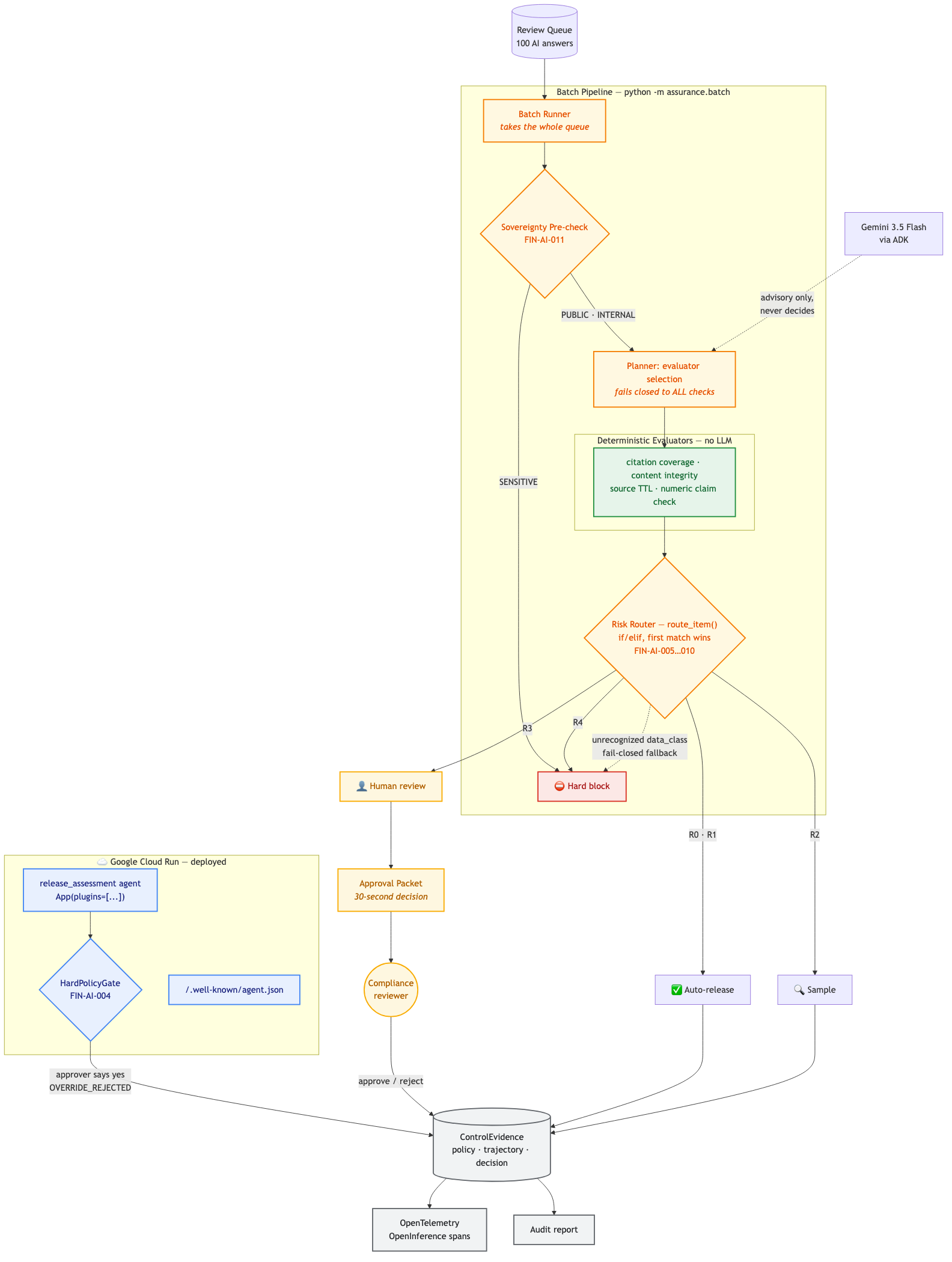
The agent processes a queue of AI-generated answers awaiting release. For each one it:
- Decides which checks are warranted — evaluation depth is tiered by risk, so a low-risk answer does not pay for a full evaluation
- Gathers evidence deterministically — citation coverage, content integrity, source TTL, numeric claim consistency
- Routes by risk — R0/R1 auto-release, R2 sample, R3 human review, R4 hard block
- Prepares an approval packet for the few items a human must judge — conclusion, governing policy, key evidence, execution path
- Emits ControlEvidence for every decision, including the trajectory it took
The human stays in the loop, but only where judgment is actually required.
Measured on a synthetic queue
100 assessments, three independent runs (one with the planner's API key pulled entirely). By assessment id, these are invariant across all three:
| Disposition | Count | Same items every run? |
|---|---|---|
| Escalated to human | 9 | Yes |
| Hard-blocked | 9 | Yes |
| Released (auto + sampled) | 82 | Yes, as a set |
18 of 100 items needed a person. Estimated review time: 240 → 43.2 minutes.
The split within the 82 — how many were auto-released versus sampled —
is not invariant: 54/28, 43/39, 59/23 across the three runs. That
boundary is a function of which evaluators the LLM planner selected; it
decides how much gets sampled for audit, never who gets escalated or
blocked. See evidence/S2-planner-variance.json.
Synthetic corpus. The baseline (2.4 min/item) is an estimate documented in
docs/baseline-estimate.md, not a measurement — the disclaimer is assembled from a
module constant so it cannot be omitted from the output. The claim does not hinge on
the exact figure.
The part that surprises people
A human with approval authority cannot override a hard policy.
Assessment ASMT-R4-LIVE is a prohibited operation. Submit it to the live service with an explicit approval, and the response is:
{
  "status": "BLOCKED",
  "decision": "OVERRIDE_REJECTED",
  "policy_id": "FIN-AI-004",
  "reason": "PROHIBITED operations cannot be released by any reviewer.",
  "note": "This policy does not accept human override."
}
The attempt itself becomes part of the audit record. This runs on the deployed Cloud Run service, not in a local mock — the evidence is committed at evidence/S8-e2e-r4-block.json.
What I learned
A correct outcome reached by the wrong path is still a bug
This was the hardest lesson, and I learned it by shipping the bug myself.
R4 was being blocked. Every test passed. The demo looked perfect. Then I read the actual execution path and found that the block came from HardPolicyPlugin misclassifying the request as an unregistered source — because assess_release has no url parameter, so the source lookup returned UNKNOWN and failed closed.
HardPolicyGate's R4 check had never executed.
The result was right. The reason was wrong. And it would have stayed invisible, because the framework short-circuits on the first plugin that returns a value, and nothing recorded which plugin decided.
The fix was not another check. It was making attribution queryable: every guardrail span now carries assurance.policy_id and assurance.plugin, and there is an assertion (assert_decided_by) that fails when a policy's decision comes from the wrong component. That assertion passes on the correct path and fails on the misattributed one — while a test that only asserts result == "BLOCKED" passes on both.
This is why the project treats execution trajectory as part of the evaluation contract, not just the final result.
Framework defaults sit on the unsafe side of the line
Three independent instances, all verified against the framework source:
| Where | Default behavior | Consequence |
|---|---|---|
| Agent-layer tool callback | stops on a truthy value | returning {} silently lets the tool run |
| Graph routing | unmatched route with no DEFAULT edge |
logs a warning, branch ends silently — no ControlEvidence |
| Plugin chain | first non-None return short-circuits |
later checks never execute |
None of these are bugs. They are reasonable defaults for general use. But each one resolves toward "quietly continue" rather than "explicitly refuse" — and for an assurance system, silence and refusal are entirely different outcomes. Only one of them leaves evidence.
Safety was not something the framework provided. It was something I had to add on top. I evaluated ADK's Graph Workflow for the risk router and did not use it — route_item() is a plain if/elif chain whose first branch rejects any unrecognized data_class. The fail-closed guarantee is the same; expressing it in ordinary code means it is testable without standing up the framework, and there is no silent-branch-end path to defend against.
Evaluator independence is not free
A model-based evaluator that shares a model family with the generator is not an independent check — it is a self-confirmation loop, for the same reason you should not have code reviewed by the instance that wrote it.
I do not have a solution for this within the project's scope, so the model-based evaluator is deferred rather than faked. Deterministic evaluators remain the decision authority precisely because their independence is structural rather than assumed.
How I built it
Stack: Gemini 3.5 Flash · Google Agent Development Kit 2.7.1 (plugins, action confirmation) · Cloud Run · OpenTelemetry with OpenInference semantic conventions · Python 3.14 · Pydantic
Method: Before writing production code I ran nine timeboxed verification spikes with explicit pass criteria and stop-loss conditions, deciding go/no-go on three of them. Each spike wrote its result to evidence/ as a committed JSON artifact.
That discipline paid for itself immediately — I read the ADK source directly rather than trusting documentation, and found that the plugin layer short-circuits on is not None while the agent layer stops on truthiness. Placing hard policy at the plugin layer was already my plan; the verification revealed that the reason I believed was wrong.
Committed evidence:
| Spike | Result |
|---|---|
| S1 fail-closed plugin gate | 6/6 — includes a prompt-injection adversarial test |
| S6 hard policy override resistance | 6/6 — includes a test that must fail when only the result is asserted |
| S7 OpenInference decision trace | 8/8 |
| S9 trajectory assertions | 12/12 — includes the misattribution regression |
Challenges
Correct outcomes hiding wrong causes. Covered above. This shaped the whole architecture.
Deployment assumptions that only break in production. adk deploy cloud_run does not bundle sibling packages, so assurance/ never reached the container. The API's app_name is the folder name, not the value passed to App(name=...) — and session creation silently accepted the wrong name, with only the subsequent call returning 404. An error that is not rejected at the earliest detectable point is the expensive kind.
Knowing what not to build. Local model deployment, fine-tuning, a full DLP platform, a web dashboard, multi-agent orchestration — all evaluated, all documented as out of scope with reasons. A verification pipeline that quietly expands its own scope would be a poor advertisement for itself.
Why Taskmaster
This is an autonomous multi-step workflow, not a multi-agent fleet — and that is a design decision, not a shortfall. The system's central claim is that release decisions belong to a deterministic policy engine rather than to a model. Adding agents that delegate to one another would weaken exactly the property it exists to demonstrate.
What it removes is real friction, by execution: a queue of 100 AI-generated answers goes in, the agent decides per item which checks are warranted, gathers deterministic evidence, routes by risk, and escalates only what needs judgment. 18 of 100 items reached a person. The other 82 carry committed evidence for why they did not.
Two components were built while evaluating the Fortified track and are kept because
they earn their place: the agent card at /.well-known/agent.json (discovery metadata
— deliberately not claimed as an enterprise Agent Registry) and a cross-process
approval store that survives process exit. Data sovereignty is enforced in the batch
layer only; the ADK plugin exists but is not registered in the deployed chain, and the
README says so.
What runs where: the release_assessment agent, HardPolicyGate, and the agent
card are deployed on Cloud Run. The 100-item batch pipeline runs locally, with its
output committed to evidence/S2-batch-run.json. The batch does not call the deployed
agent per item by design — the plugin-layer guarantee is already proven end-to-end by
S1/S6/S8, and routing 100 items through it would add cost without adding evidence.
Non-goals
This is an engineering research project, not a compliance product. It does not provide regulatory certification or legal advice, does not use real customer data (the corpus is synthetic), and does not claim coverage of OWASP's Agentic Top 10 beyond the two items with executable test evidence: ASI01 Agent Goal Hijack and ASI03 Identity & Privilege Abuse.
Review-time figures are estimates against a synthetic corpus, stated as such wherever they appear.
Live service: https://assurance-agent-6eqpujphvq-de.a.run.app
Source: https://github.com/CongRenHuang/ai-assurance-pipeline

Log in or sign up for Devpost to join the conversation.