-
-
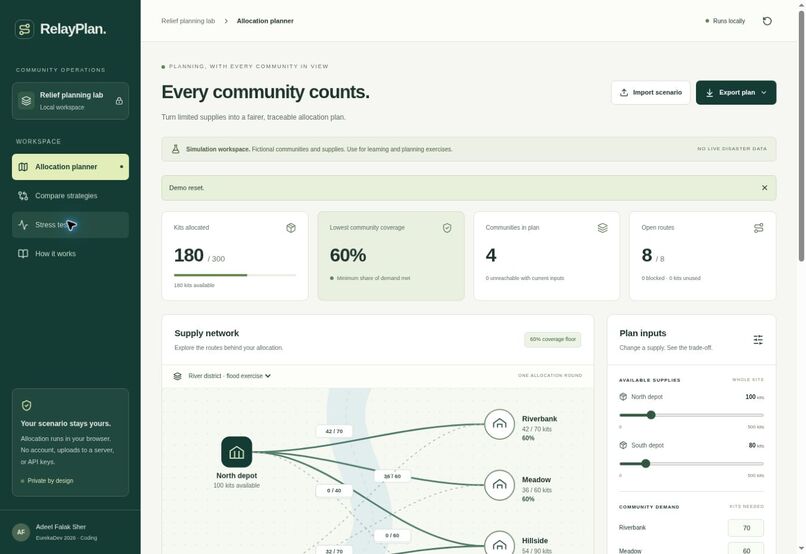
Editable planning inputs: change depot stock and community needs, then inspect a recalculated allocation.
-
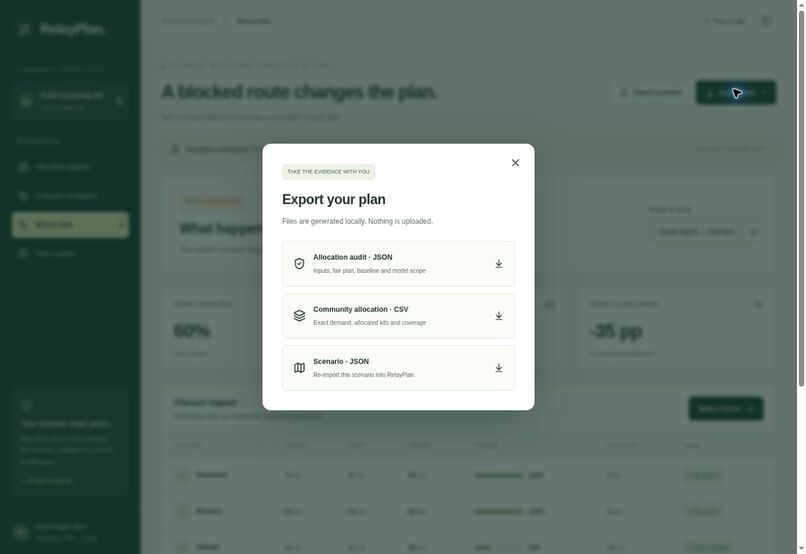
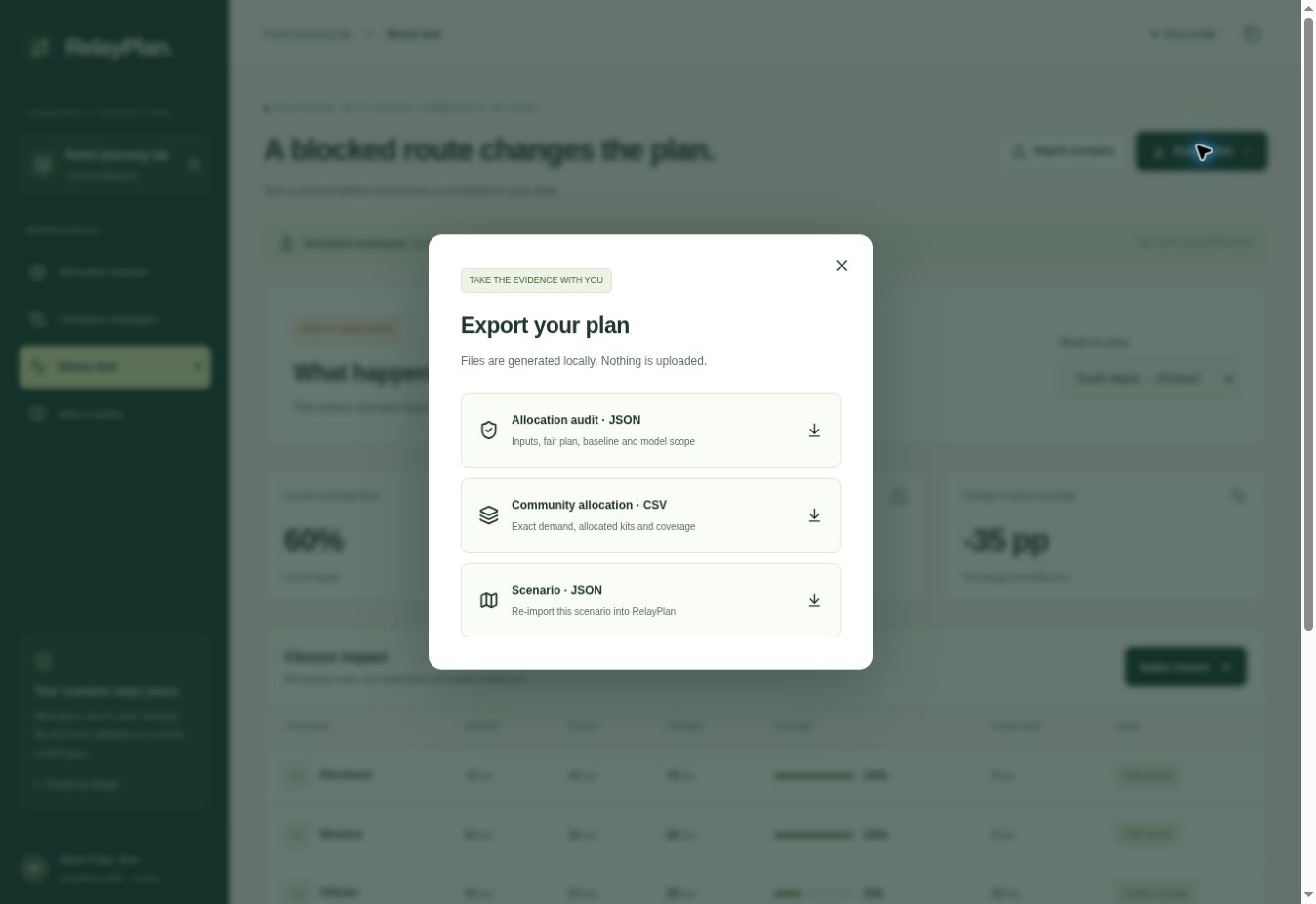
Local export: download an allocation audit, exact community counts or a reusable scenario without uploading data.
-
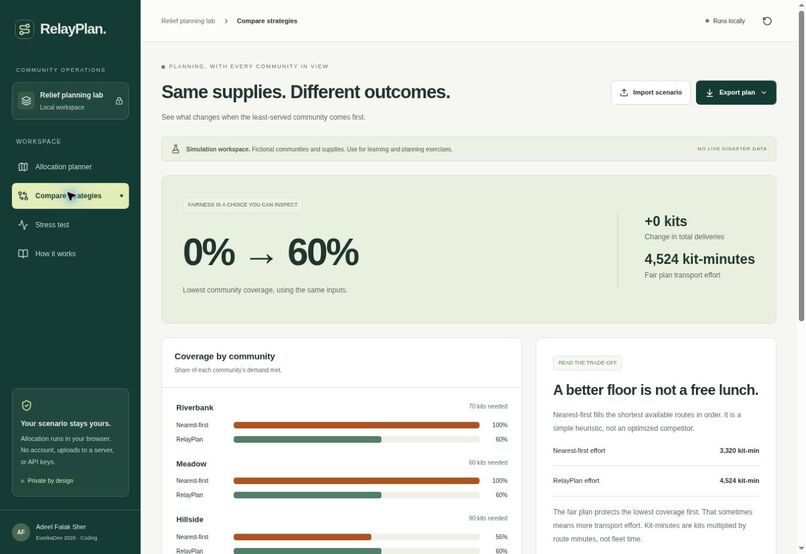
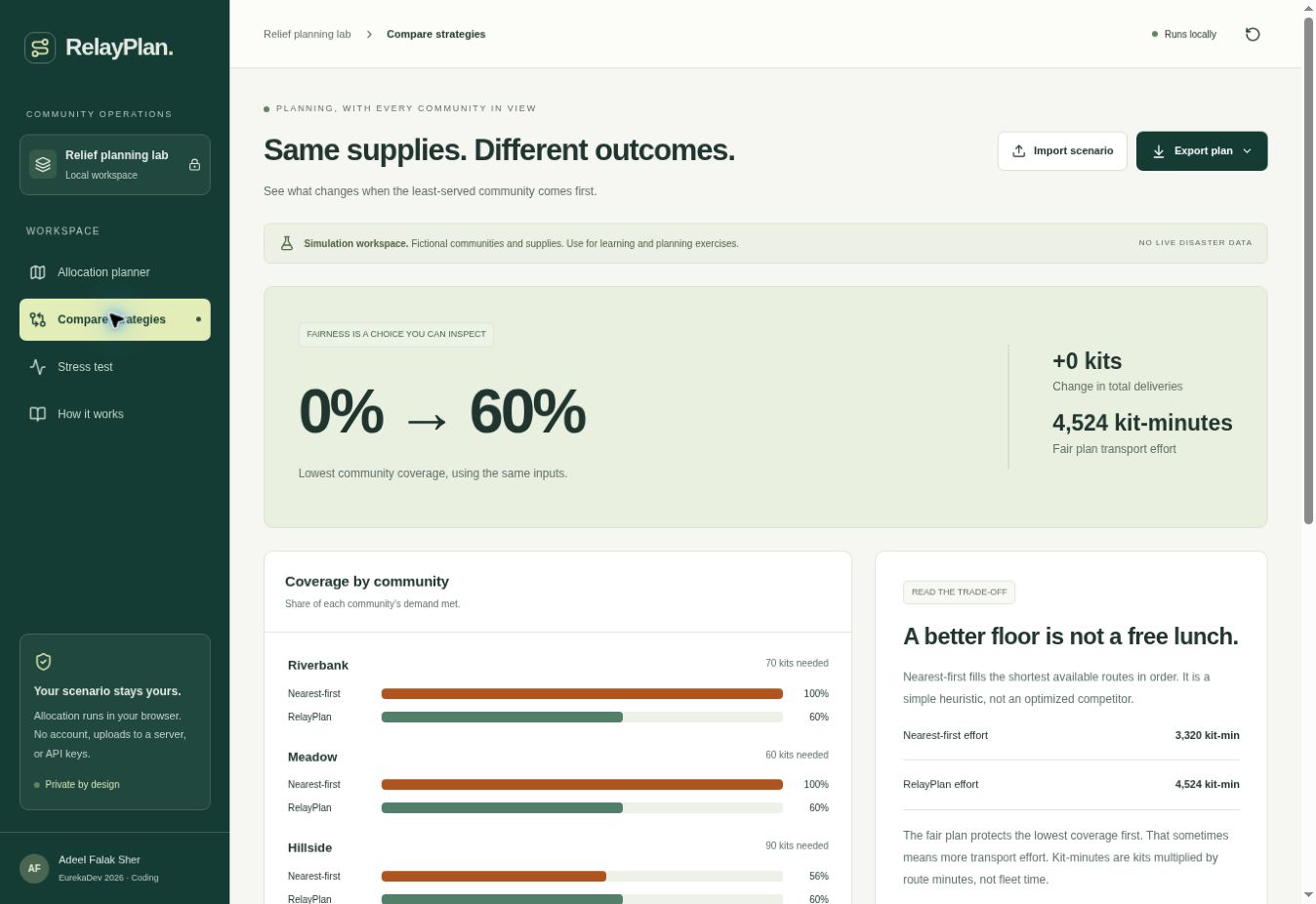
Same 180 kits: nearest-first has a 0% coverage floor, RelayPlan has 60%. Both transport effort values remain visible.
-
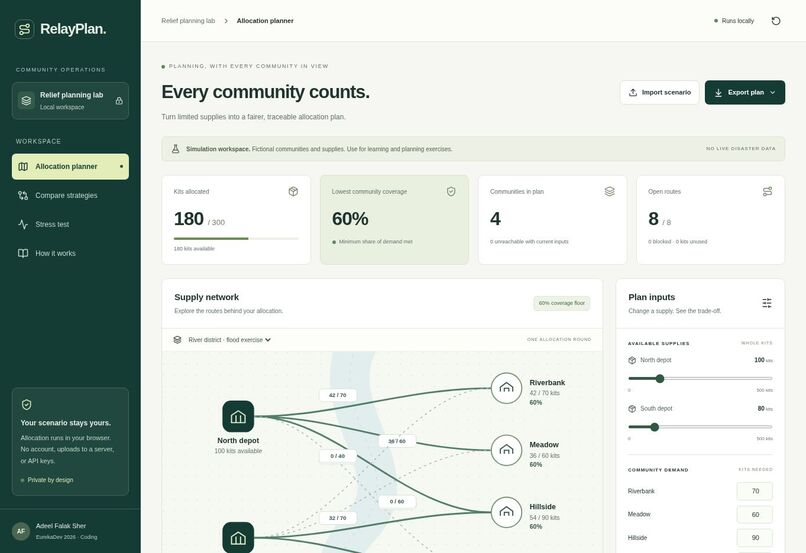
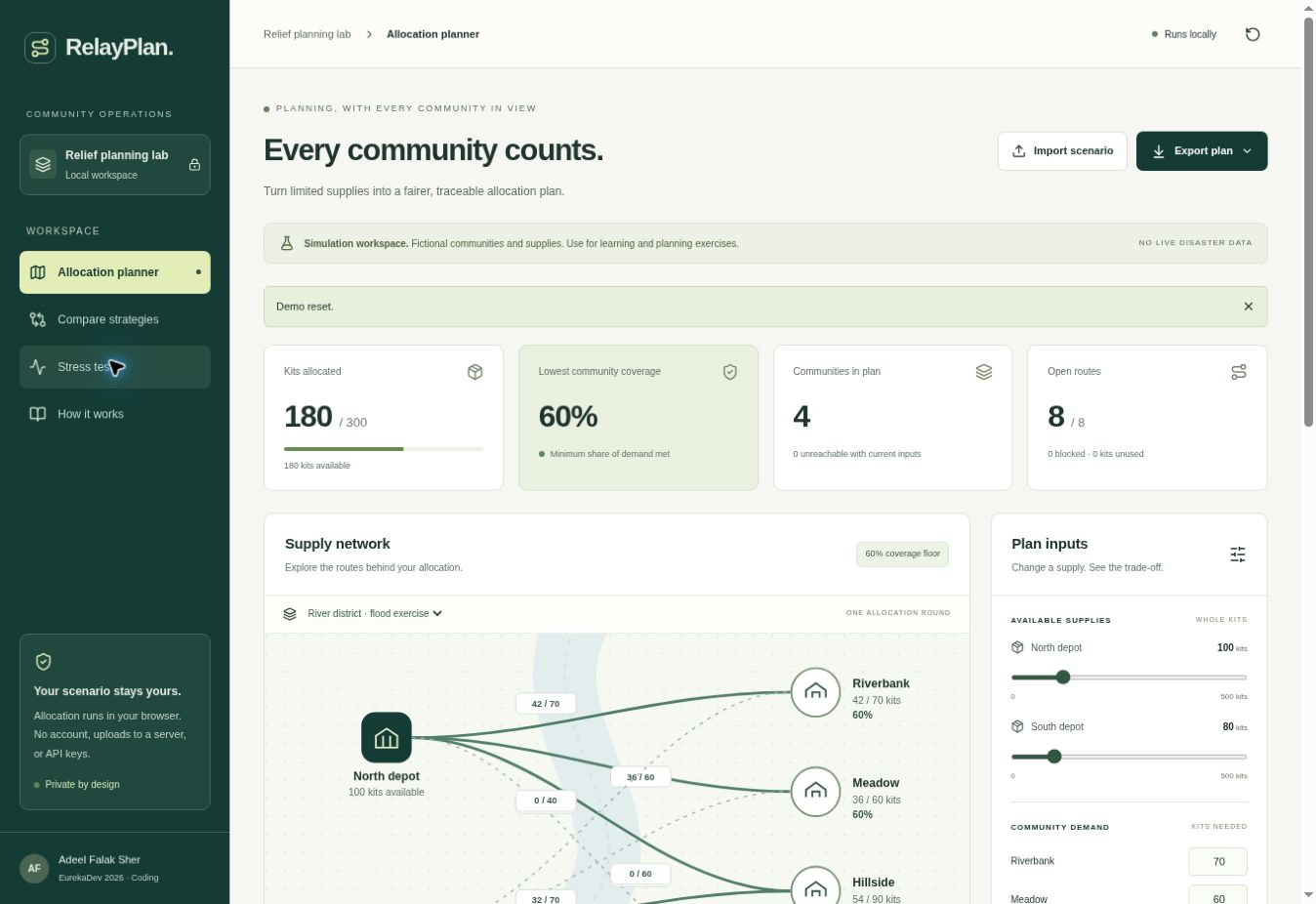
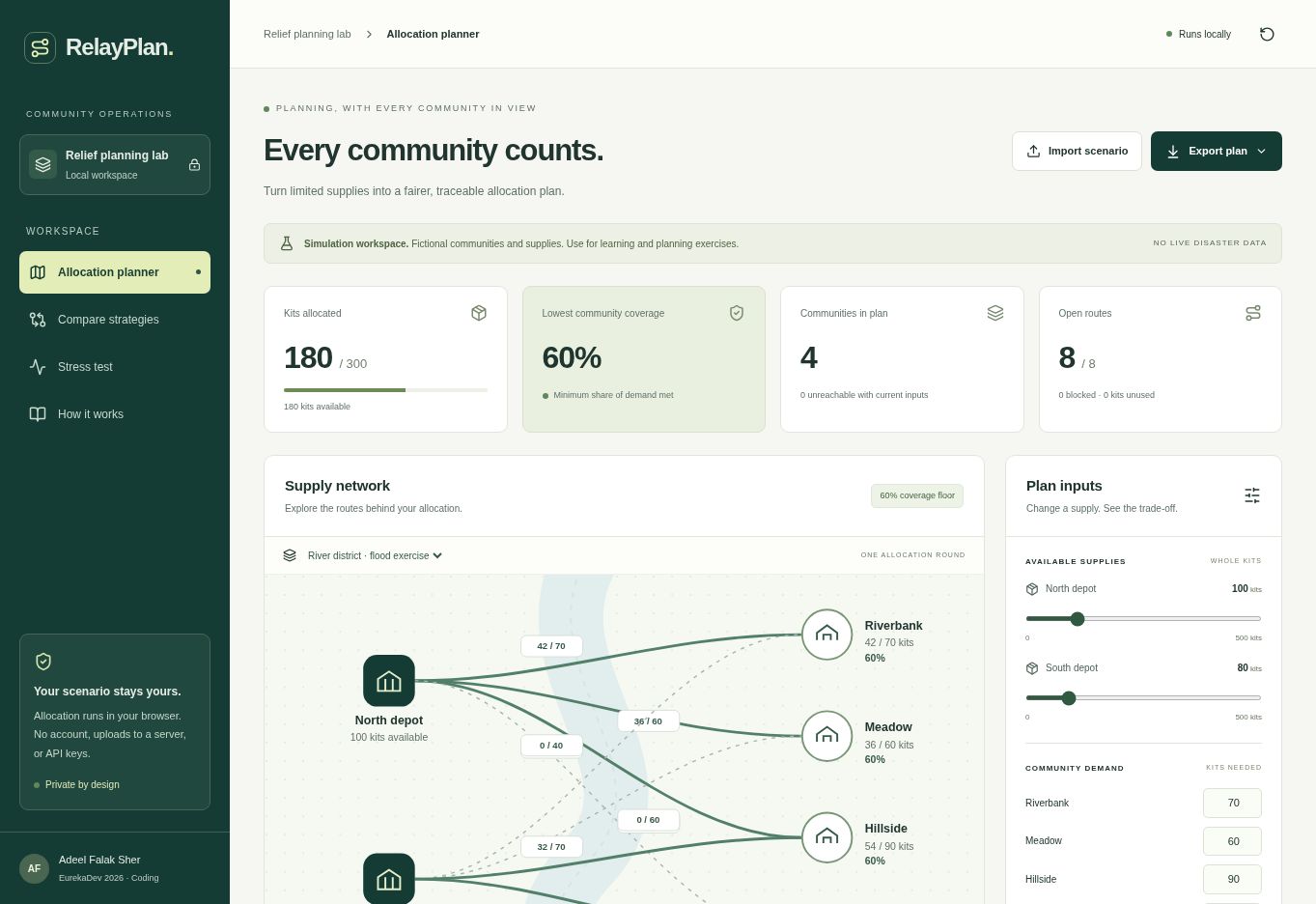
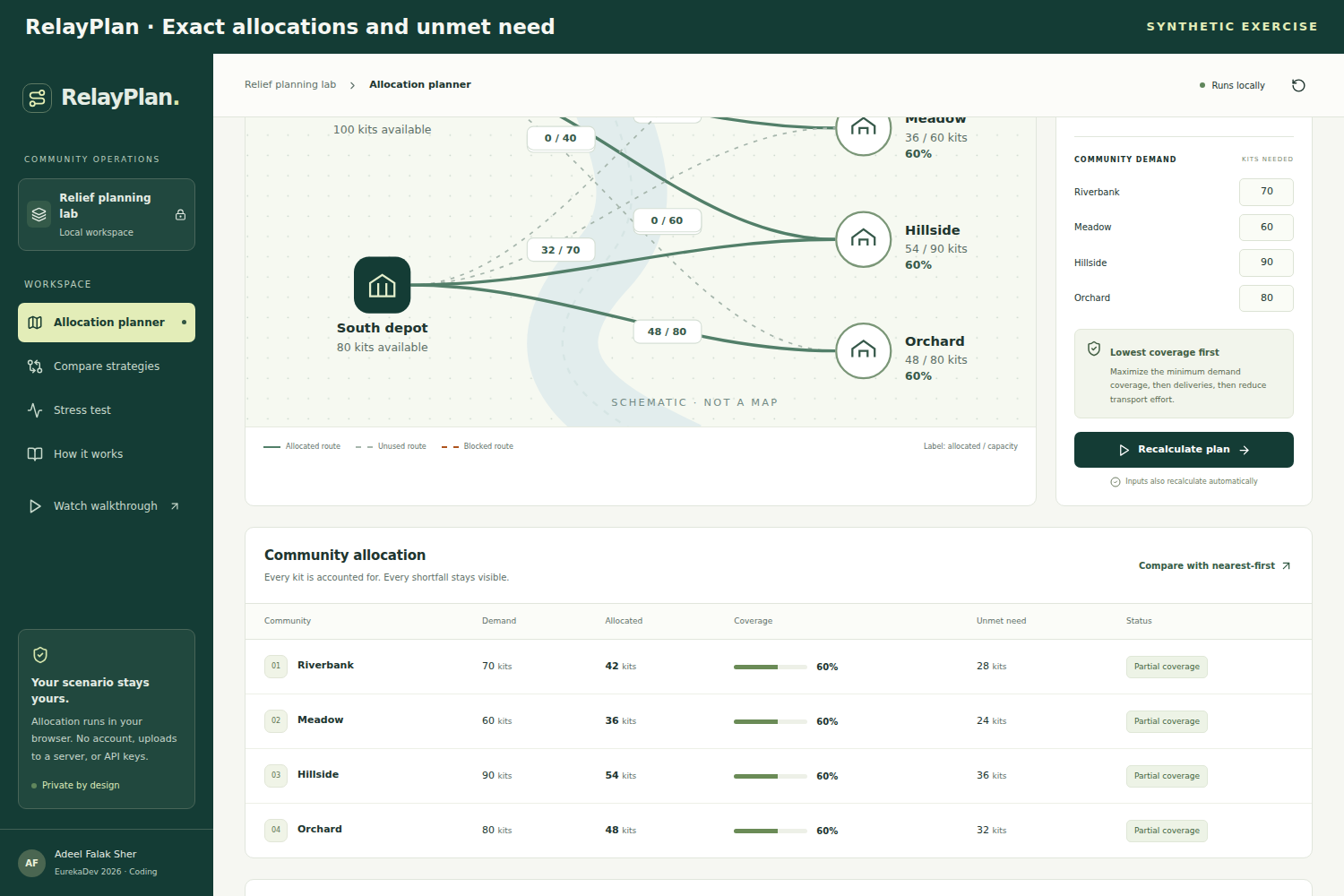
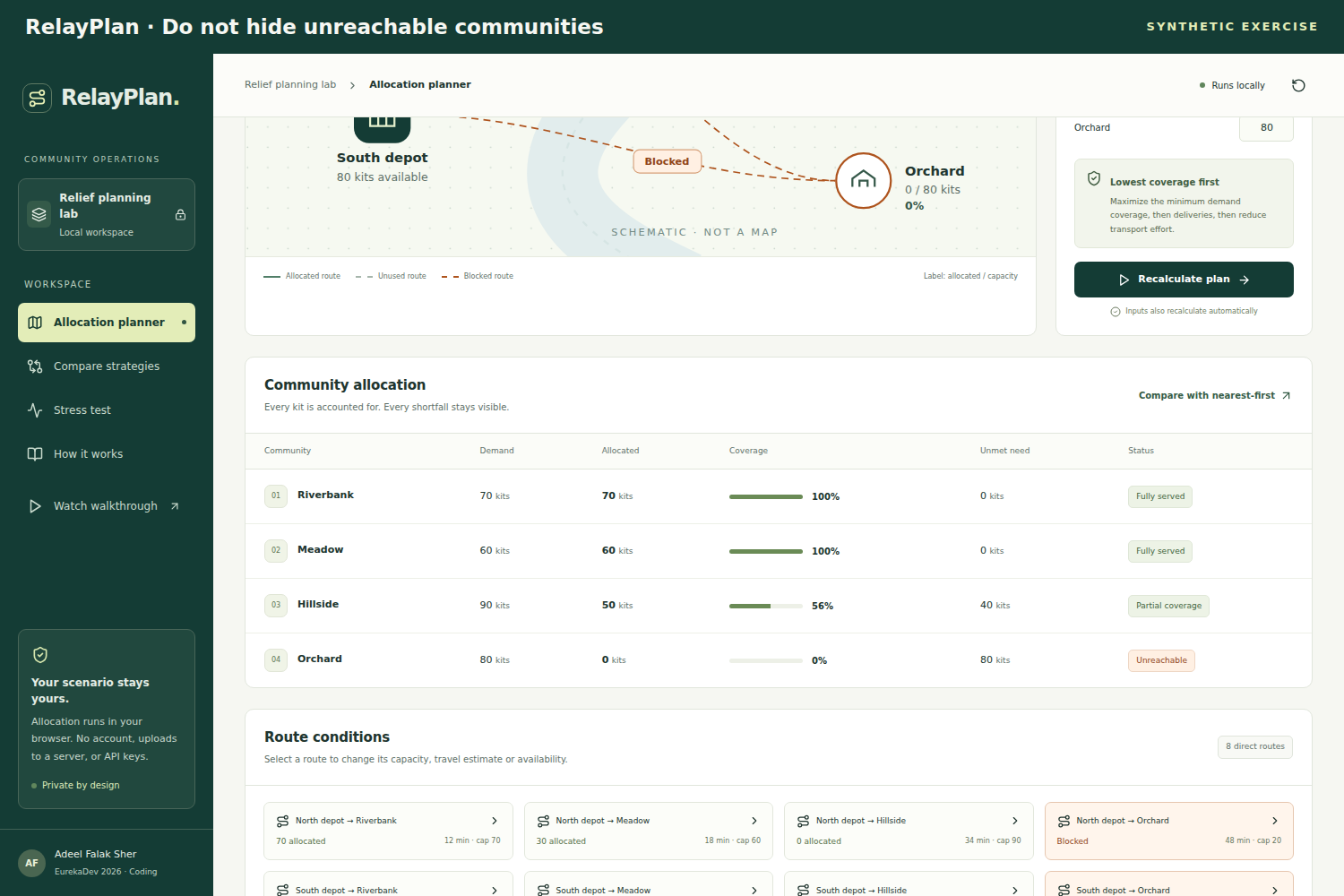
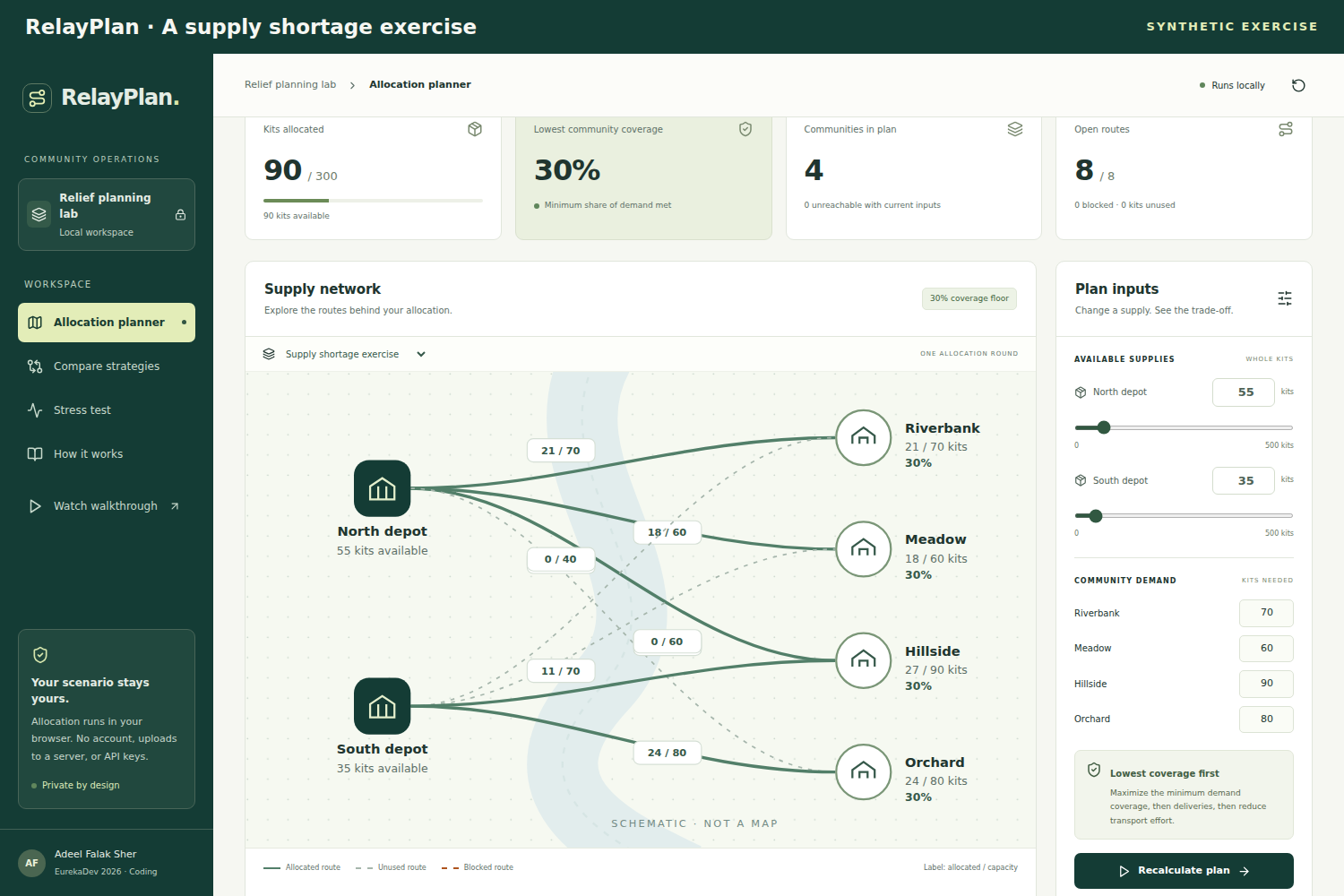
Allocation planner: fictional supplies, community demand and route capacities, with a 60% minimum coverage floor.
-
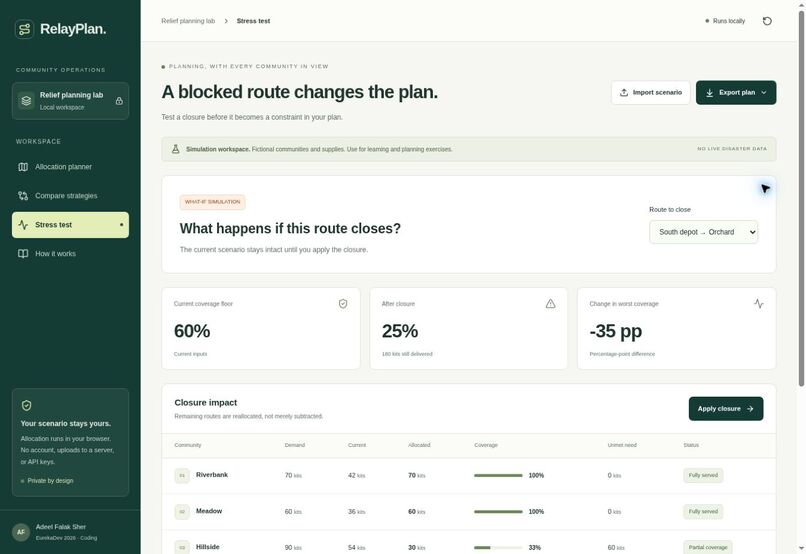
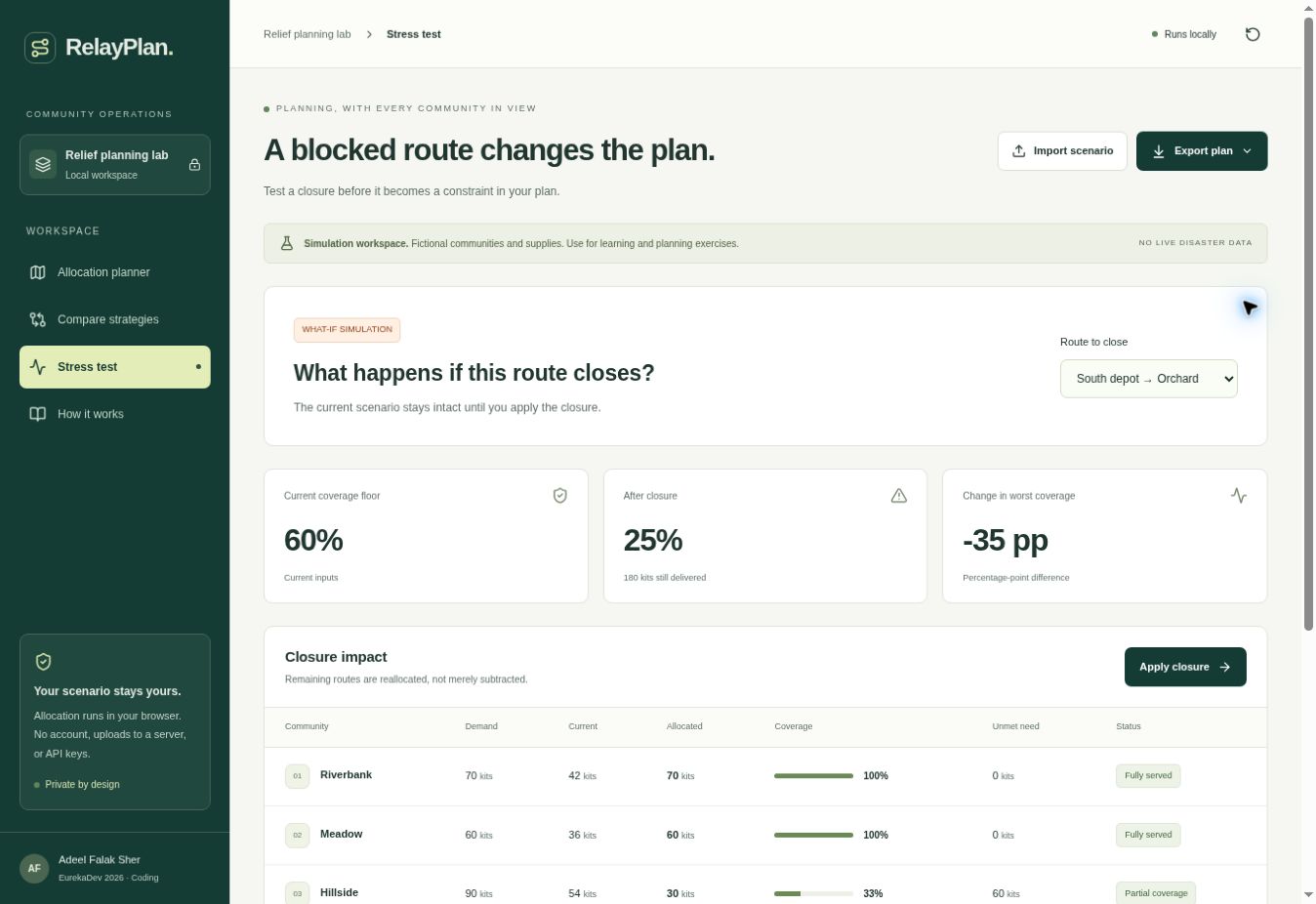
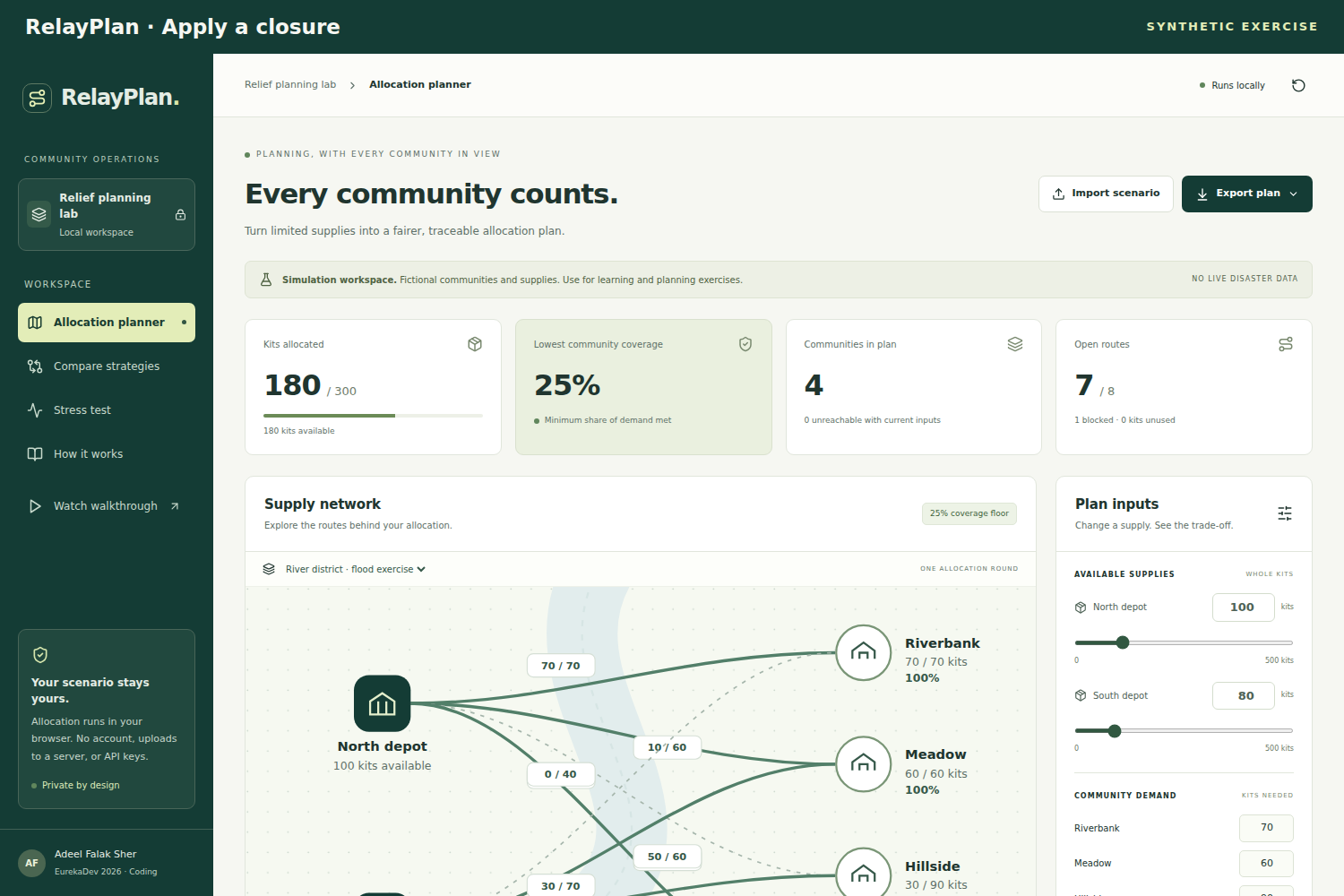
Route-closure preview: blocking South depot to Orchard lowers the coverage floor from 60% to 25% before applying the change.
-
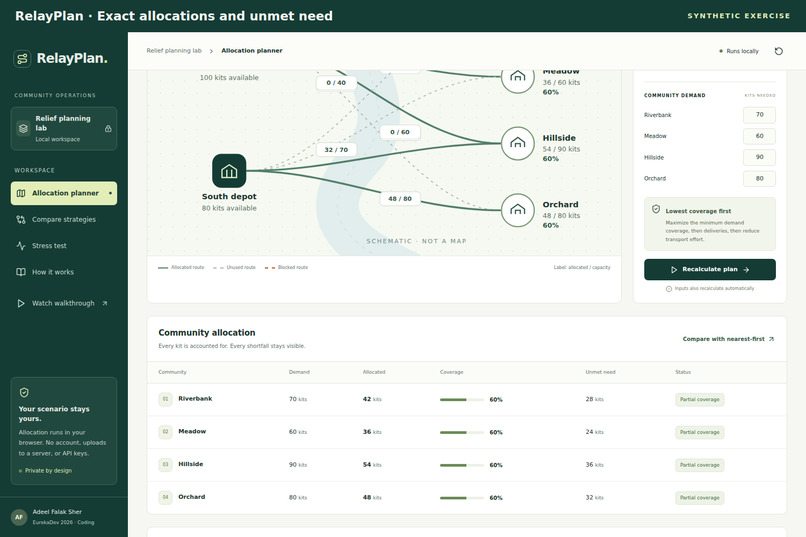
Community audit: 42, 36, 54 and 48 kits, with unmet demand visible for every fictional community.
-
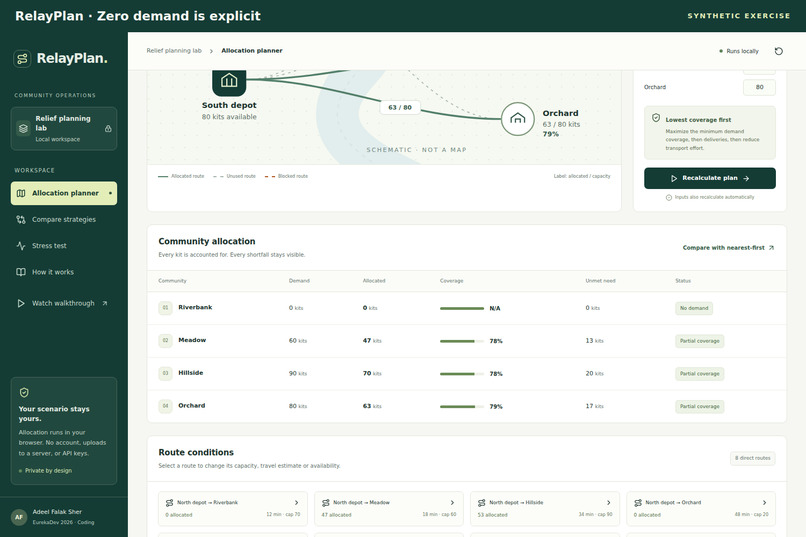
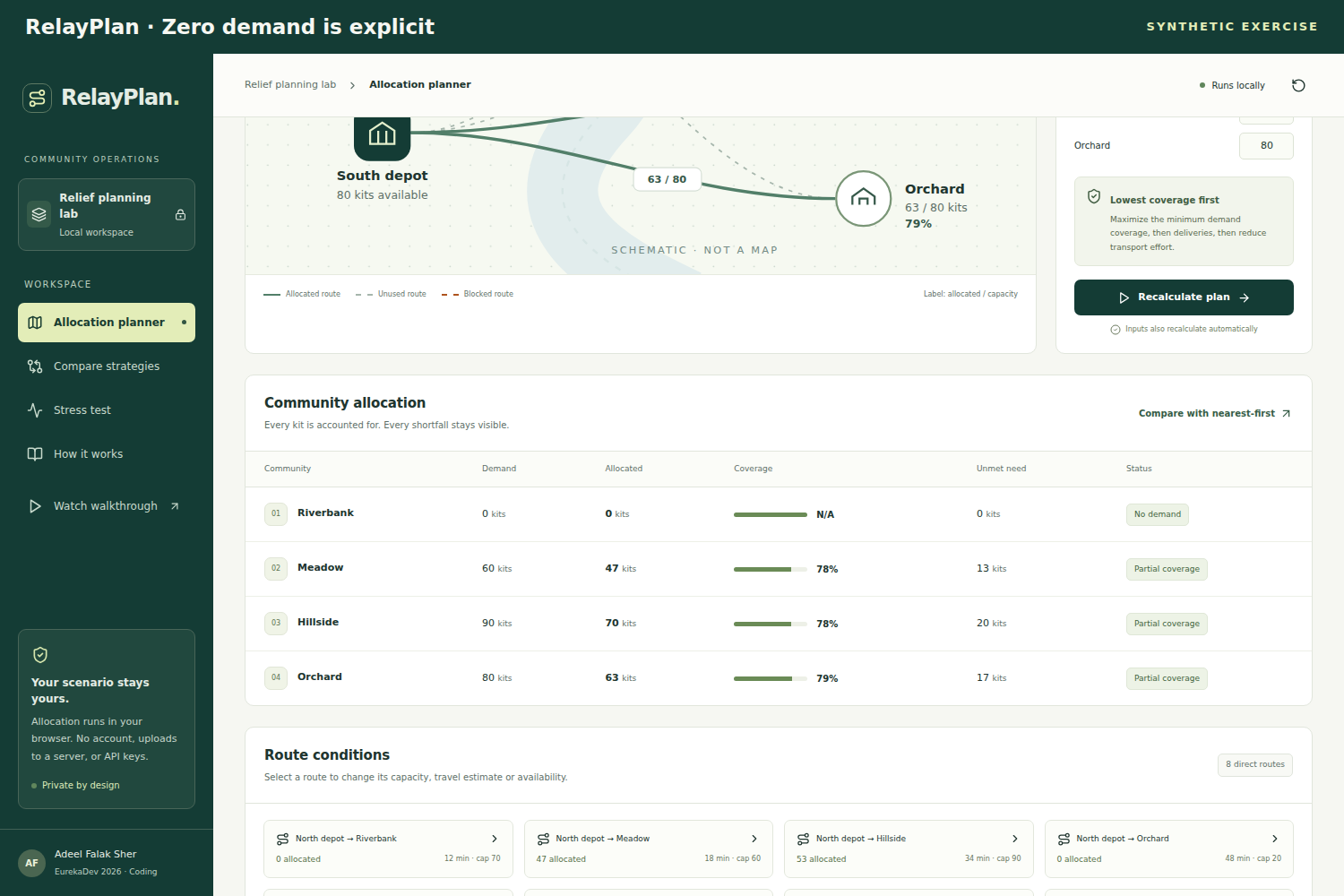
Riverbank has no demand in this test. Its coverage is N/A, while positive-demand communities constrain the floor.
-
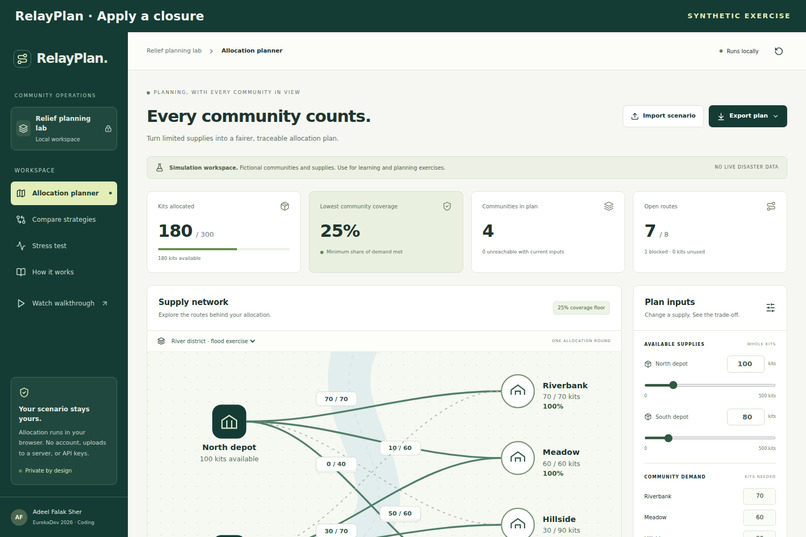
Applied closure: South depot to Orchard is excluded. The planner exposes the revised 25% coverage floor.
-
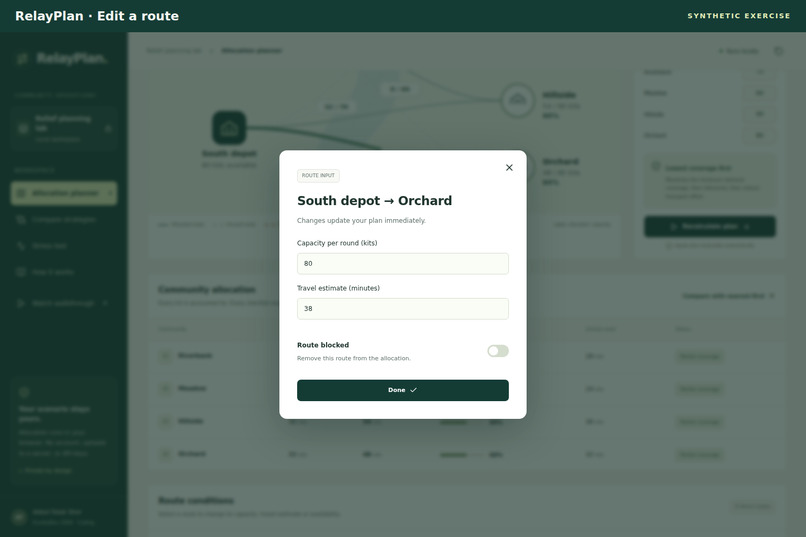
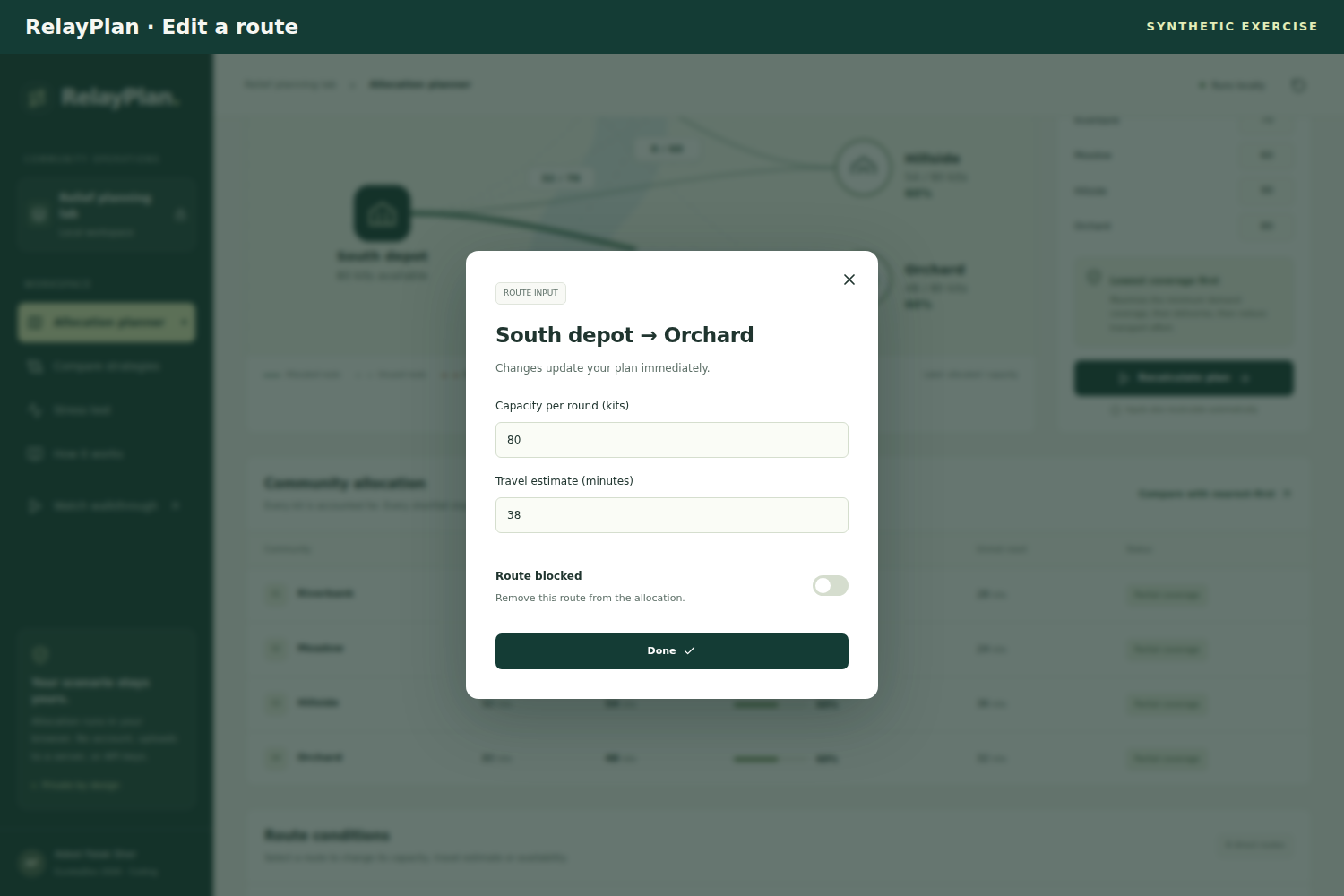
Route editor: change capacity and estimated minutes, or exclude a blocked route. Values recalculate locally.
-
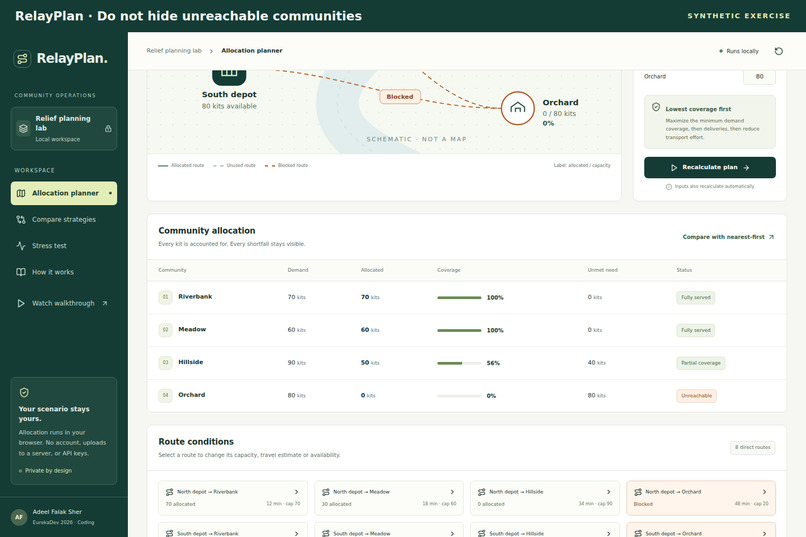
Both routes to Orchard are blocked. Its zero coverage stays in the minimum rather than being silently excluded.
-
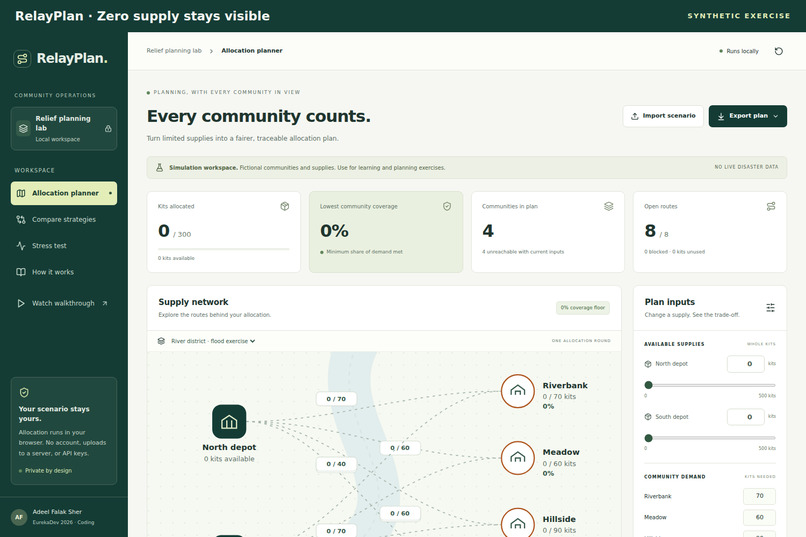
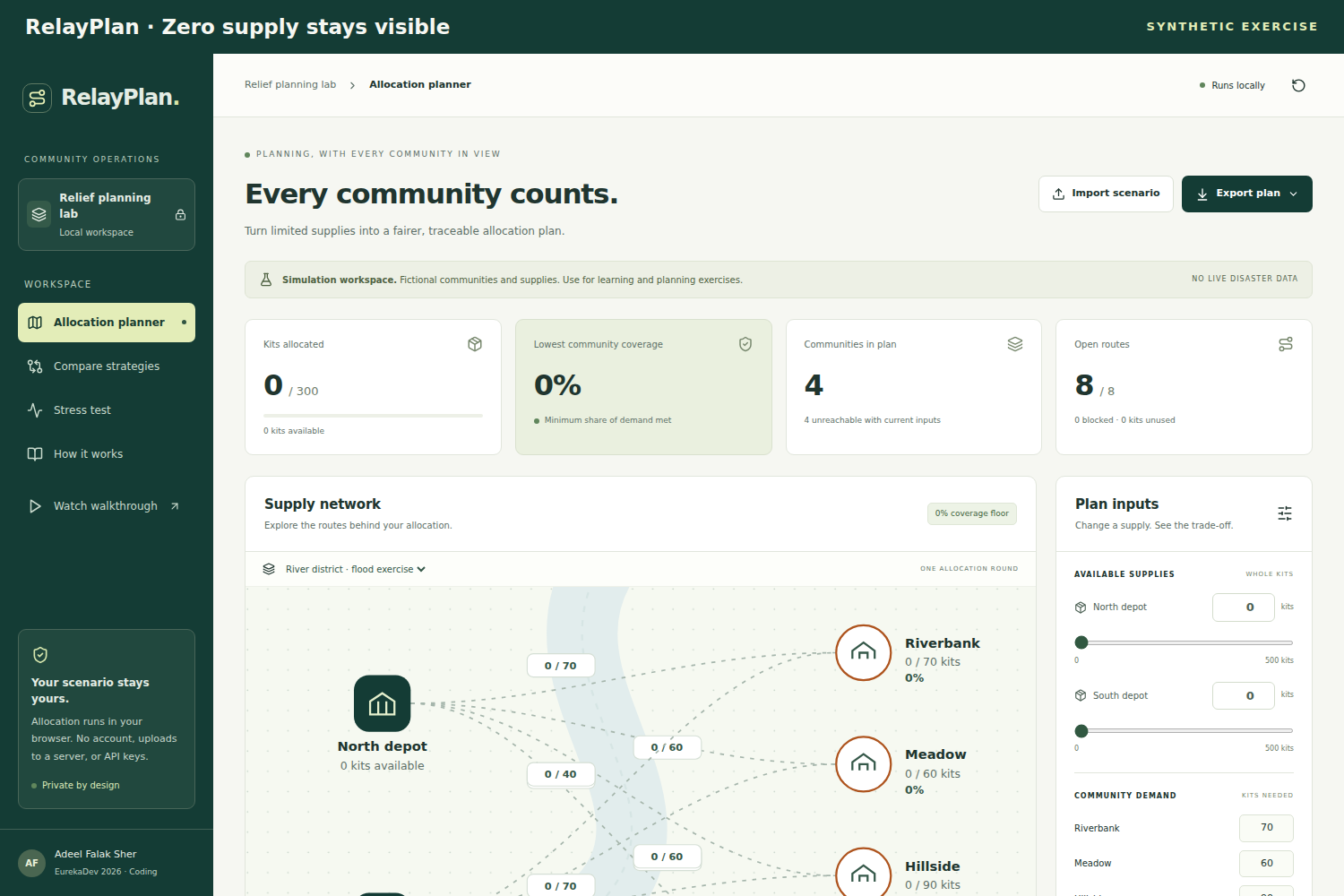
Zero-supply boundary: no kits can be delivered; positive-demand communities remain visible with zero coverage.
-
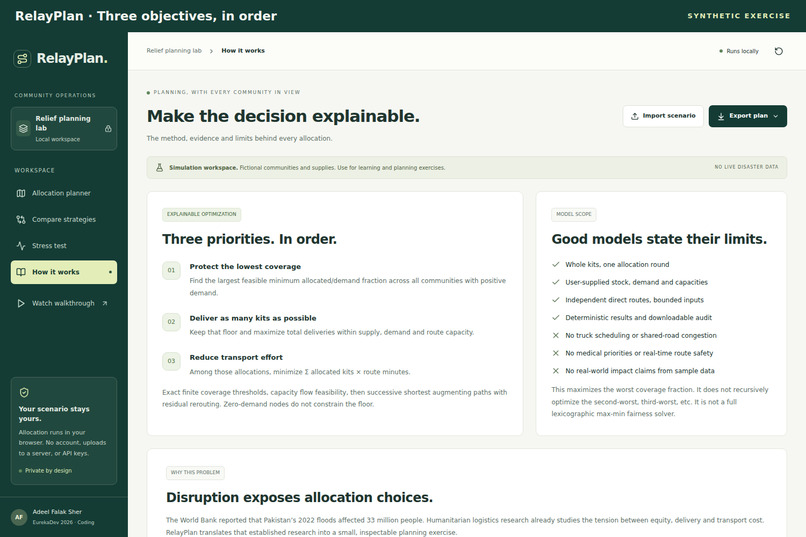
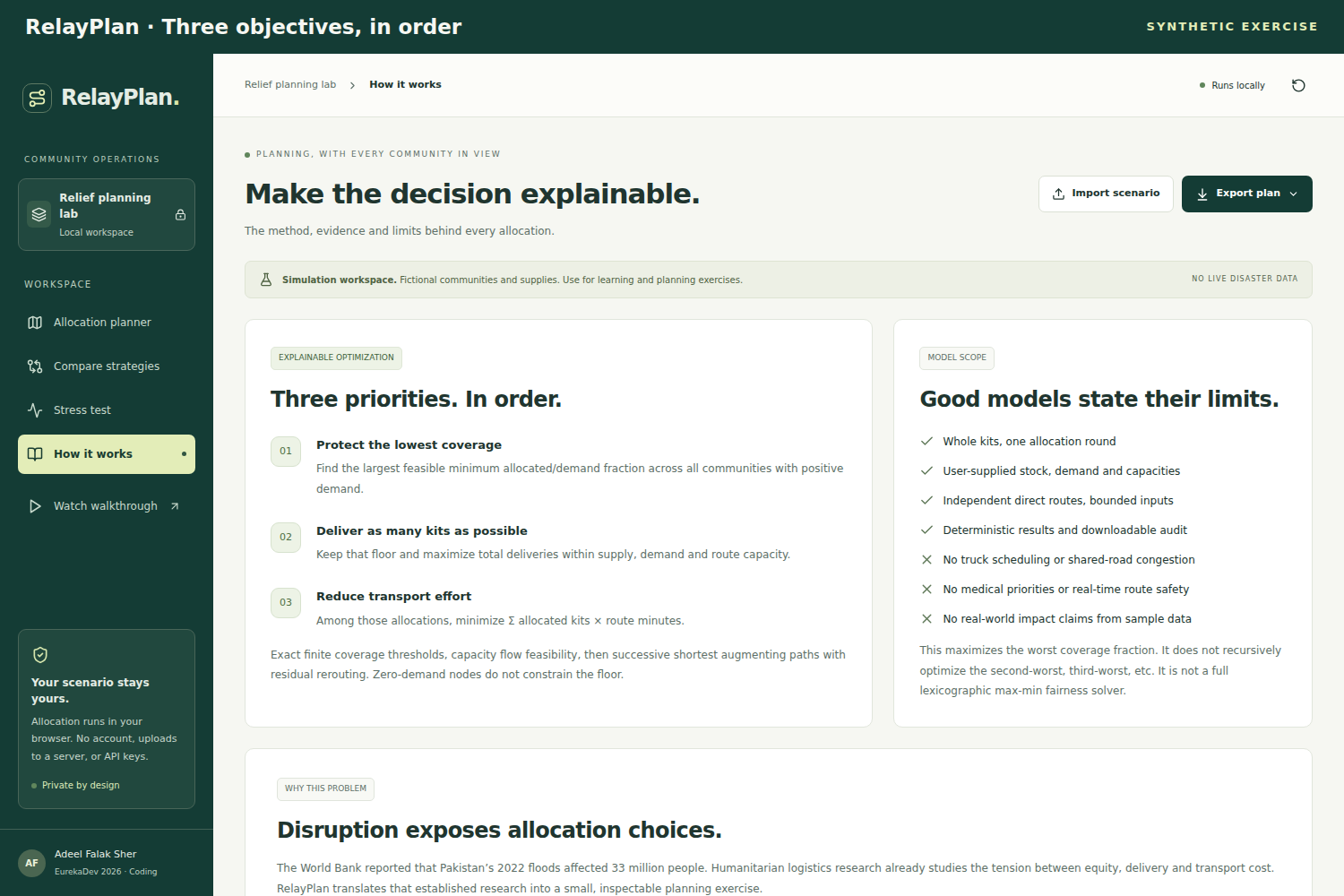
Method: maximize the worst demand coverage, preserve it while maximizing deliveries, then reduce transport effort.
-
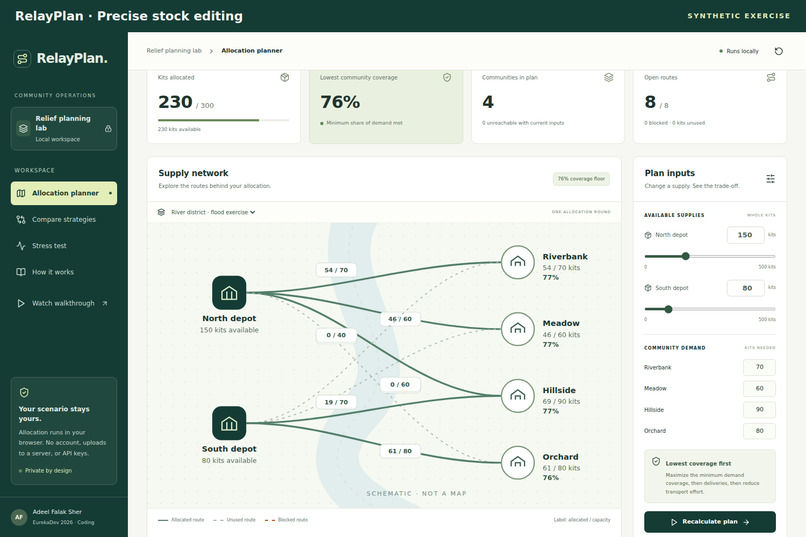
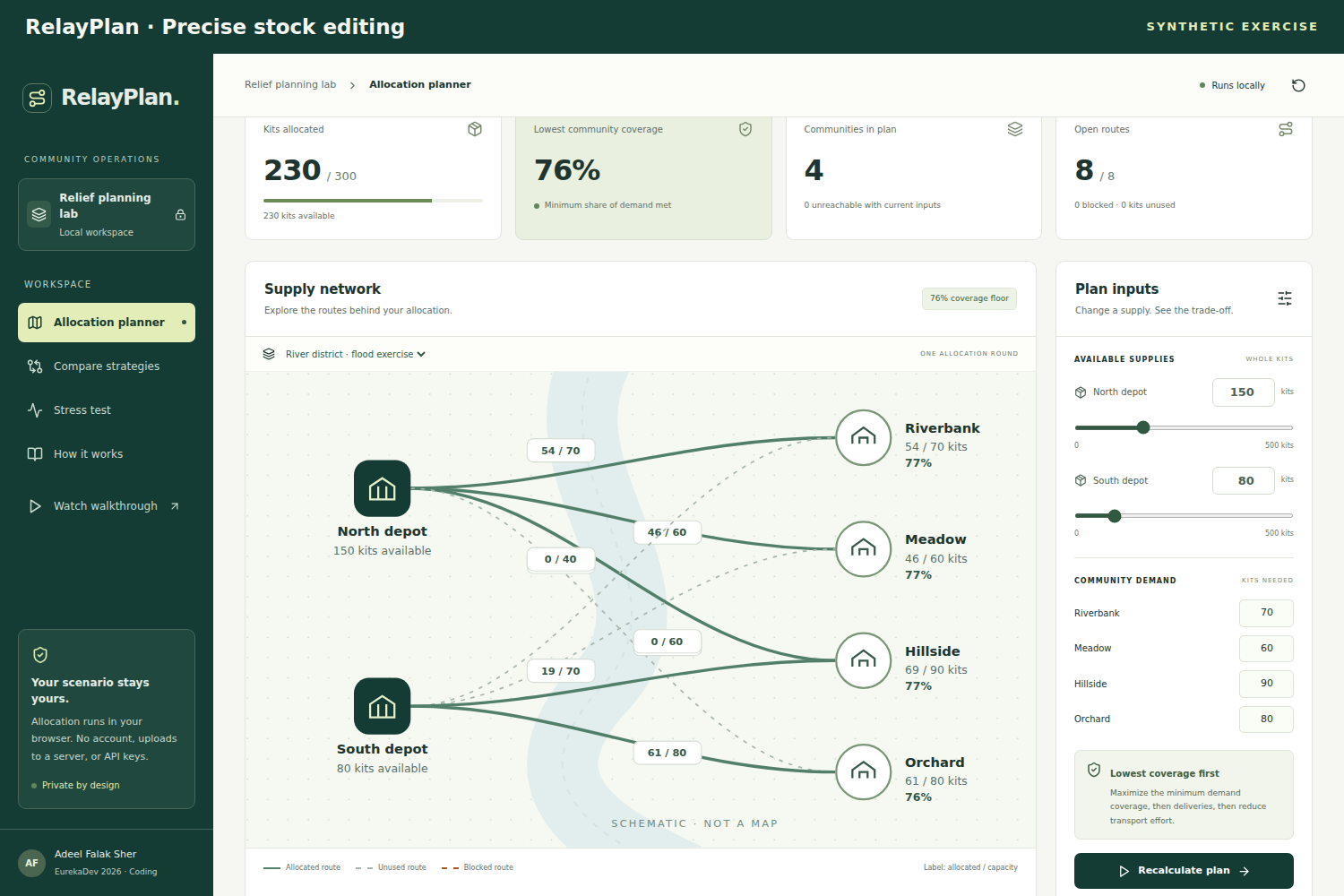
Stock can be entered as a number or adjusted with the slider. This exercise increases North stock to 150 kits.
-
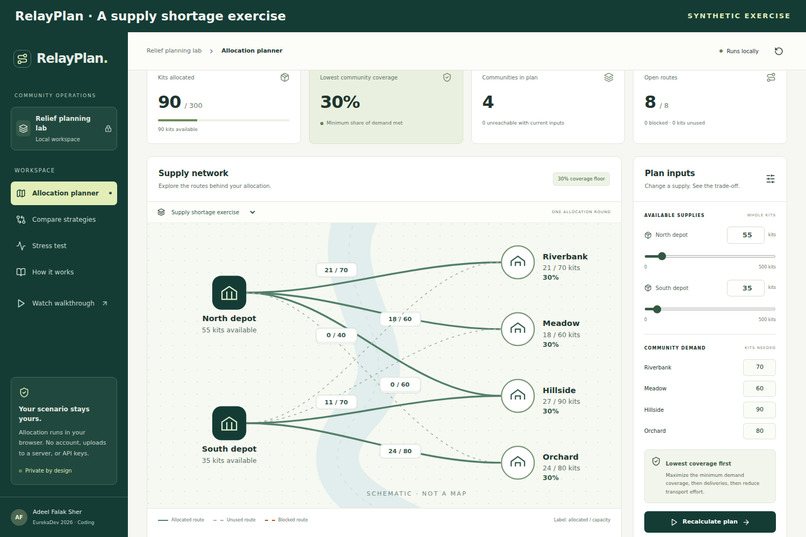
Shortage preset: 55 kits at North and 35 at South. Results reflect the actual constrained synthetic scenario.
-
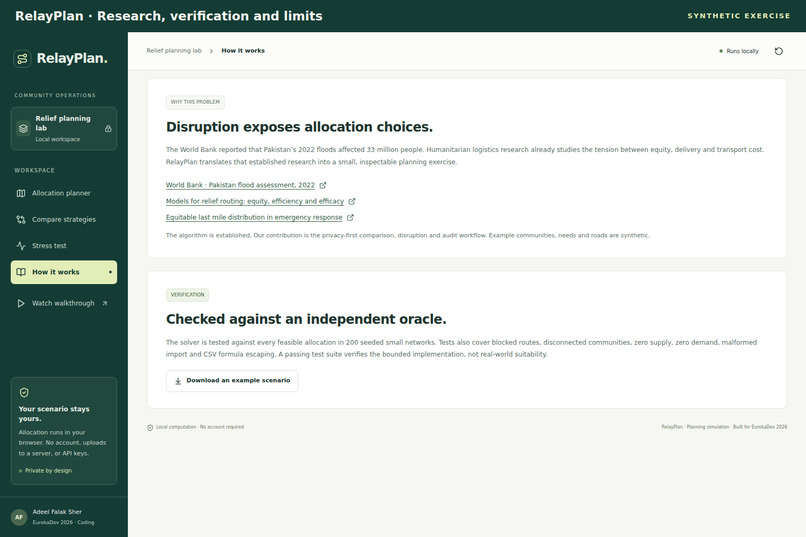
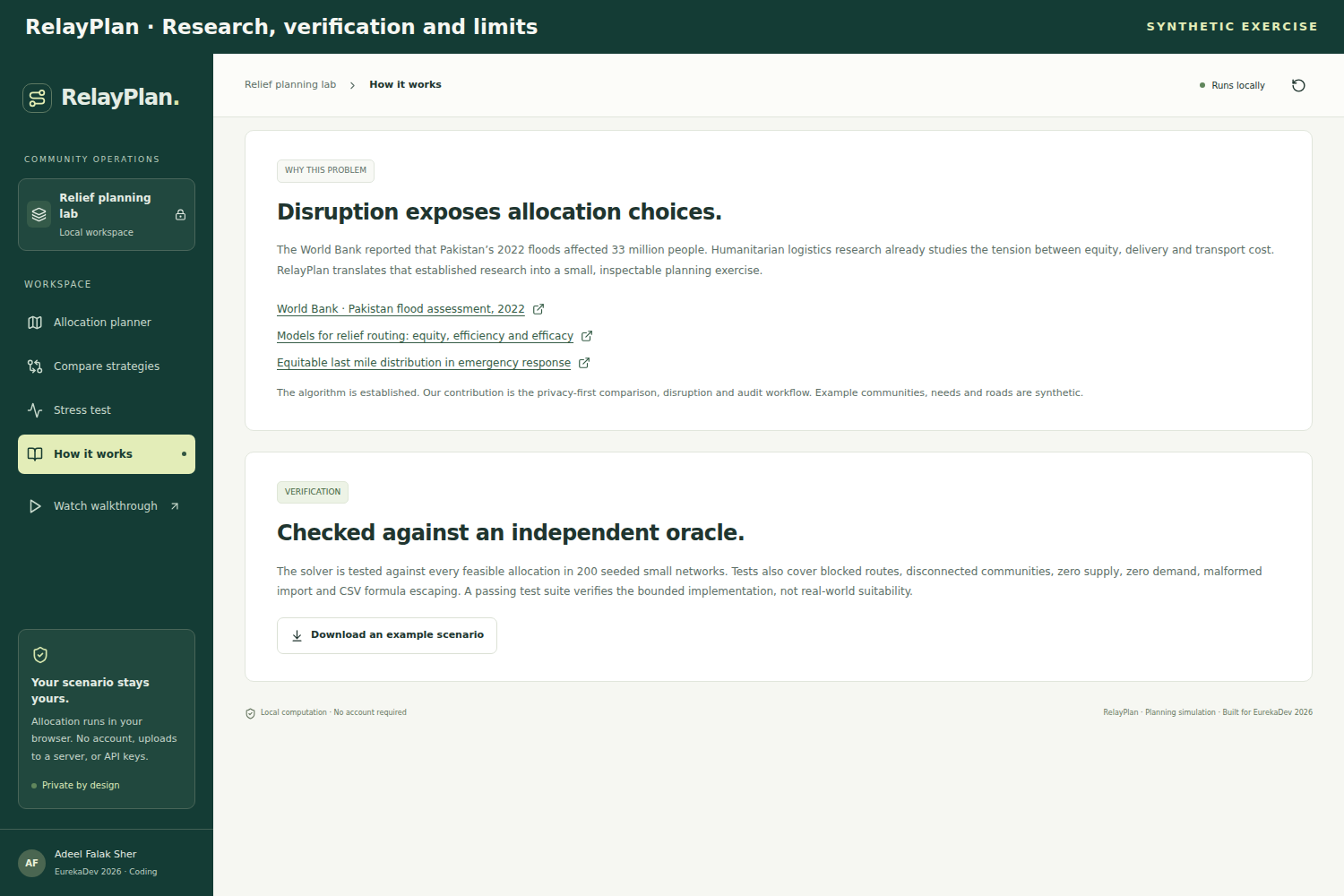
Research sources, model limits and independent exhaustive verification are documented in the app and repository.
Inspiration
Pakistan's 2022 floods affected 33 million people, according to the World Bank. Relief planning includes a difficult question: when supplies are insufficient, who receives the smallest share of what they need?
We wanted to make that allocation choice visible in a simple exercise. A nearest-first decision might deliver many kits while leaving one community without any. RelayPlan lets a user compare that outcome with a plan that explicitly protects the lowest demand coverage.
What it does
RelayPlan is a browser-based planning simulator. Users edit depot stock, community demand, route capacity, travel estimates and blocked routes. It produces an allocation, shows exact unmet need, compares a nearest-first heuristic, previews a route closure, and exports an audit or reusable scenario.
The default fictional exercise has 180 kits and 300 kits of demand. Both strategies deliver 180 kits. Nearest-first has a 0% minimum community coverage because Orchard receives none. RelayPlan allocates 42, 36, 54 and 48 kits to four communities, meeting 60% of each demand.
The trade-off is visible: 3,320 kit-minutes for nearest-first and 4,524 for RelayPlan. Kit-minutes mean kits multiplied by route minutes, not fleet time. Closing South depot → Orchard lowers the coverage floor to 25%, exposing the remaining route's 20-kit bottleneck.
All demo places, needs, supplies and routes are synthetic. There is no live geographic or disaster data, and no measured field-impact claim.
How we built it
React and TypeScript provide the interactive workspace. Vite and Tailwind CSS handle the build and styling, and Lucide provides icons. A pure TypeScript network-flow solver runs in the browser. Vercel serves the static app.
The solver first maximizes the smallest allocated/demand fraction across positive-demand communities. It then maximizes deliveries while preserving that floor, and finally minimizes transport effort. A finite search over integer coverage thresholds checks flow feasibility; successive shortest augmenting paths use reverse residual edges to revise earlier allocations.
This optimizes the worst coverage floor. It does not recursively optimize the entire ordered vector of community coverage and is not a newly invented fairness algorithm.
Challenges
The main technical challenge was preserving mandatory community coverage while improving total delivery and cost. A purely greedy approach locks in early route choices. Residual rerouting permits revisions, and a dominating reward ensures mandatory coverage outweighs any possible transport saving.
We also had to keep input and output trustworthy. The app validates bounded scenario files, rejects invalid routes and prototype-related identifiers, renders imported names as text, and escapes spreadsheet formula prefixes in CSV. Scenario data is processed locally rather than uploaded to a server.
Verification and what we learned
An independent brute-force oracle enumerates every feasible allocation in 200 seeded small networks and 100 irregular networks and compares all three objective values. Additional tests cover the sample scenario, closures, zero supply, disconnected and zero-demand communities, malformed imports and CSV escaping. The production build passes, and the live browser workflow covers strategy comparison, closure preview/application and scenario export.
The key lesson was that a single delivery total hides important differences. A useful planning tool shows both who is underserved and the cost of improving that outcome. Tests verify this bounded implementation, not humanitarian effectiveness.
Originality
This is a new project created during EurekaDev 2026. We did not reuse SATOpen or Daanish Alumni. Fair allocation and flow optimization are established research areas. Our contribution is the integrated private workflow: an explicit objective, baseline comparison, non-mutating disruption preview, reproducible audit, visible shortfalls and a simple independent oracle.
AI assistance was used in development. Demo narration is synthetic; the demonstrated results use the app’s fictional exercise.
What's next
Volunteer tabletop testing, interviews about actual planning constraints, a richer route network, uncertain demand and multiple kit types. Real operations would require expert review, validated input, vehicle and deadline constraints, and trustworthy road-status data.
Current scope: one kit type, one round, independent direct routes. No truck scheduling, shared-road congestion, medical priorities or real-time route-safety decisions.
References
- World Bank, Pakistan flood damage/loss/needs assessment, 28 October 2022: https://www.worldbank.org/en/news/press-release/2022/10/28/pakistan-flood-damages-and-economic-losses-over-usd-30-billion-and-reconstruction-needs-over-usd-16-billion-new-assessme
- Models for relief routing: Equity, efficiency and efficacy: https://www.sciencedirect.com/science/article/pii/S1366554511000639
- Equitable last mile distribution in emergency response: https://www.sciencedirect.com/science/article/pii/S0360835218305655
Built With
- lucide
- network-flow
- react
- remotion
- tailwindcss
- typescript
- vercel
- vite

Log in or sign up for Devpost to join the conversation.