-
-
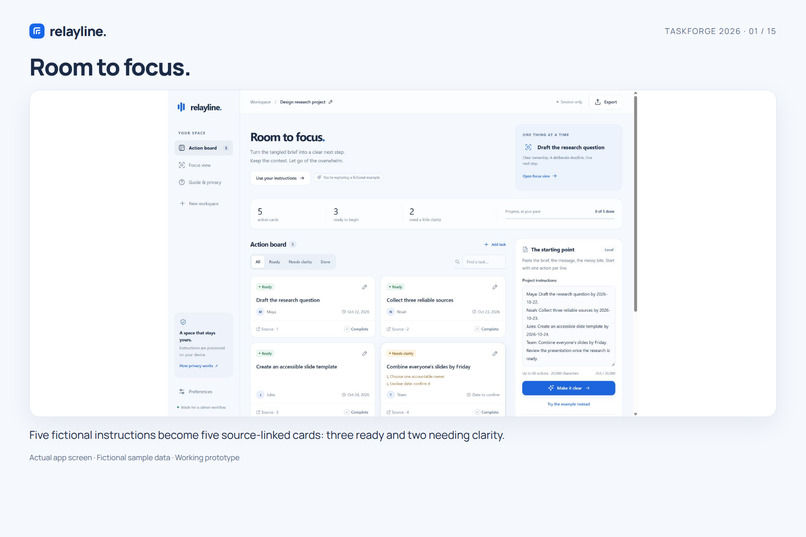
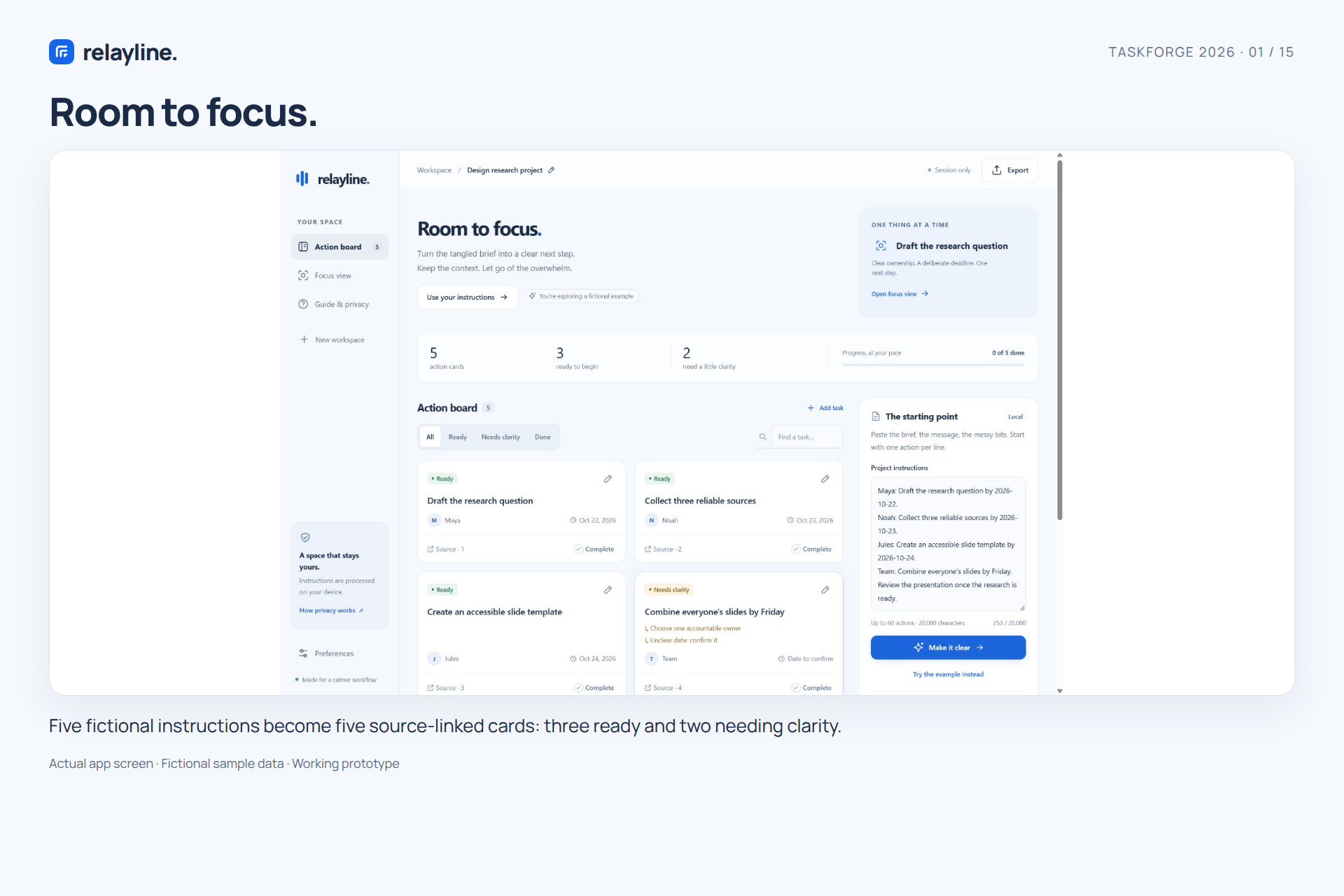
Five fictional instructions become five source-linked cards: three ready and two needing clarity.
-
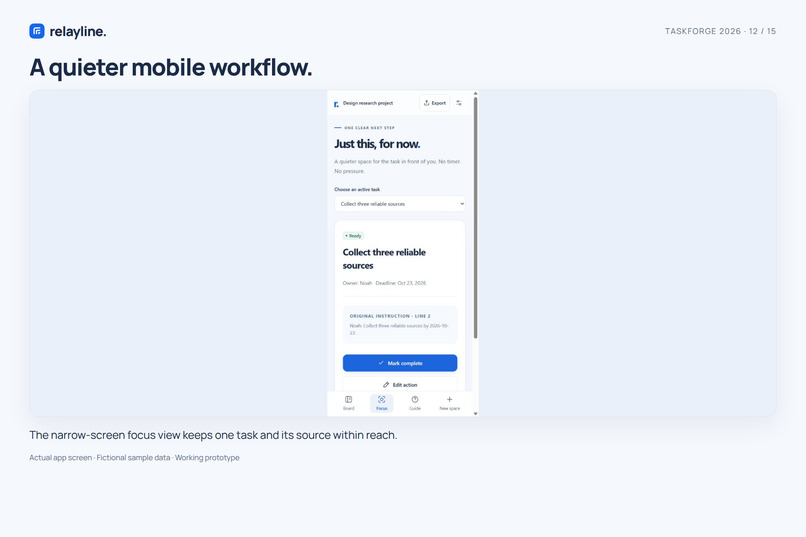
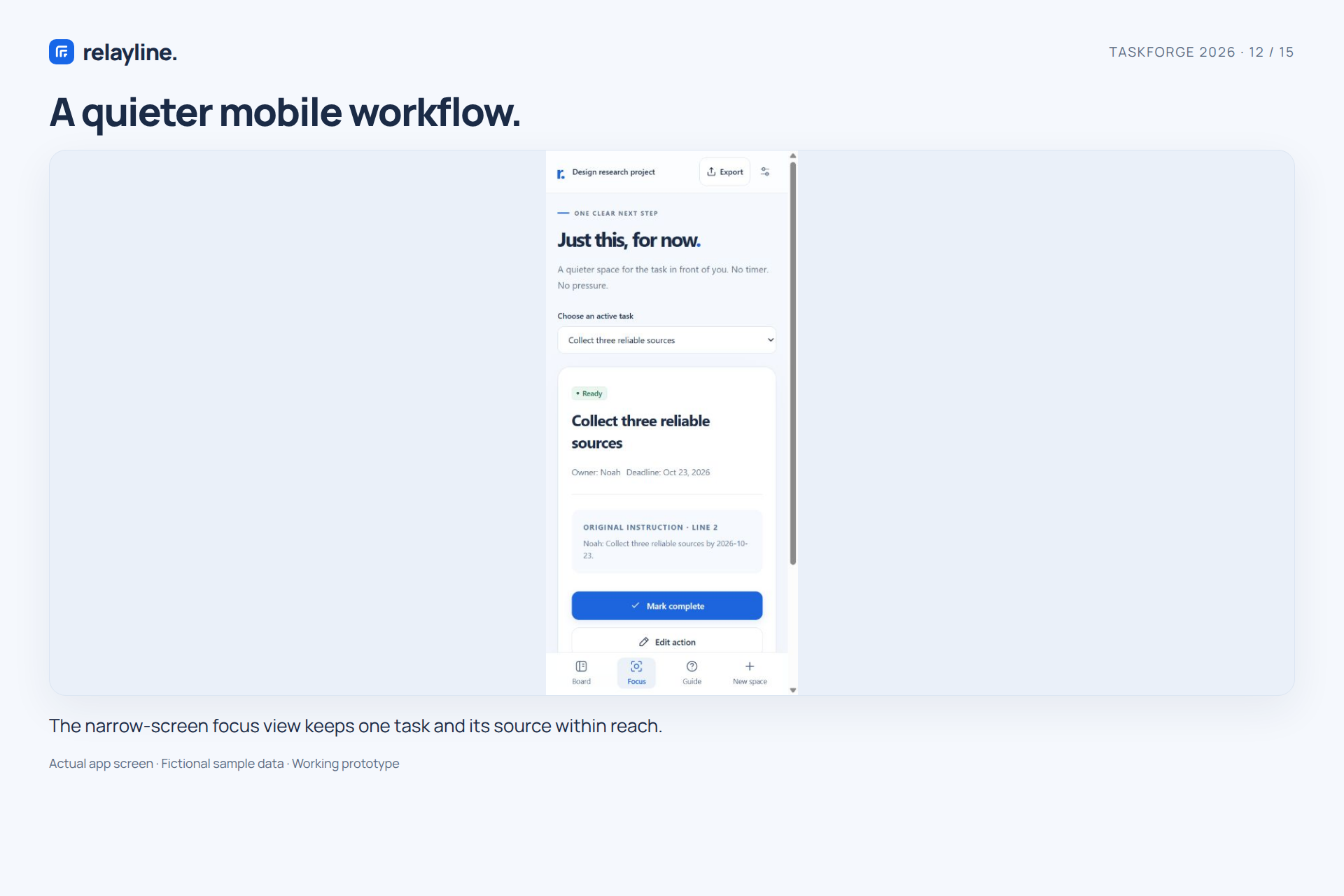
The narrow-screen focus view keeps one task and its source within reach.
-
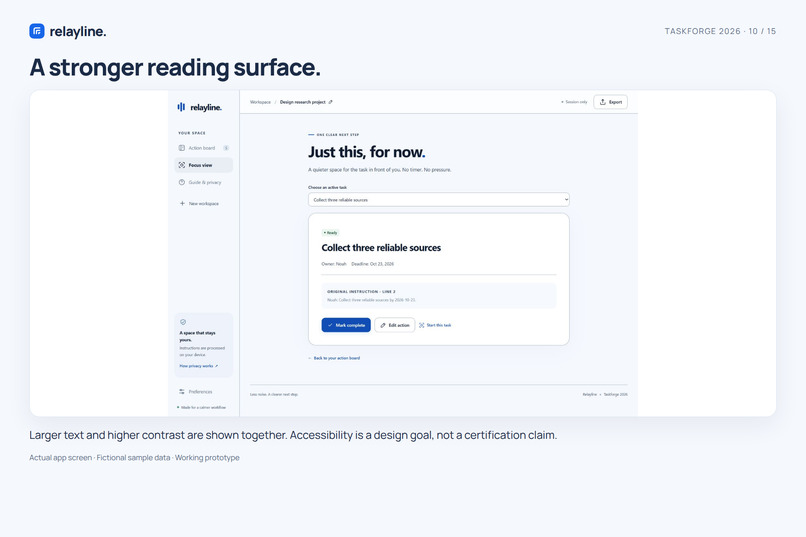
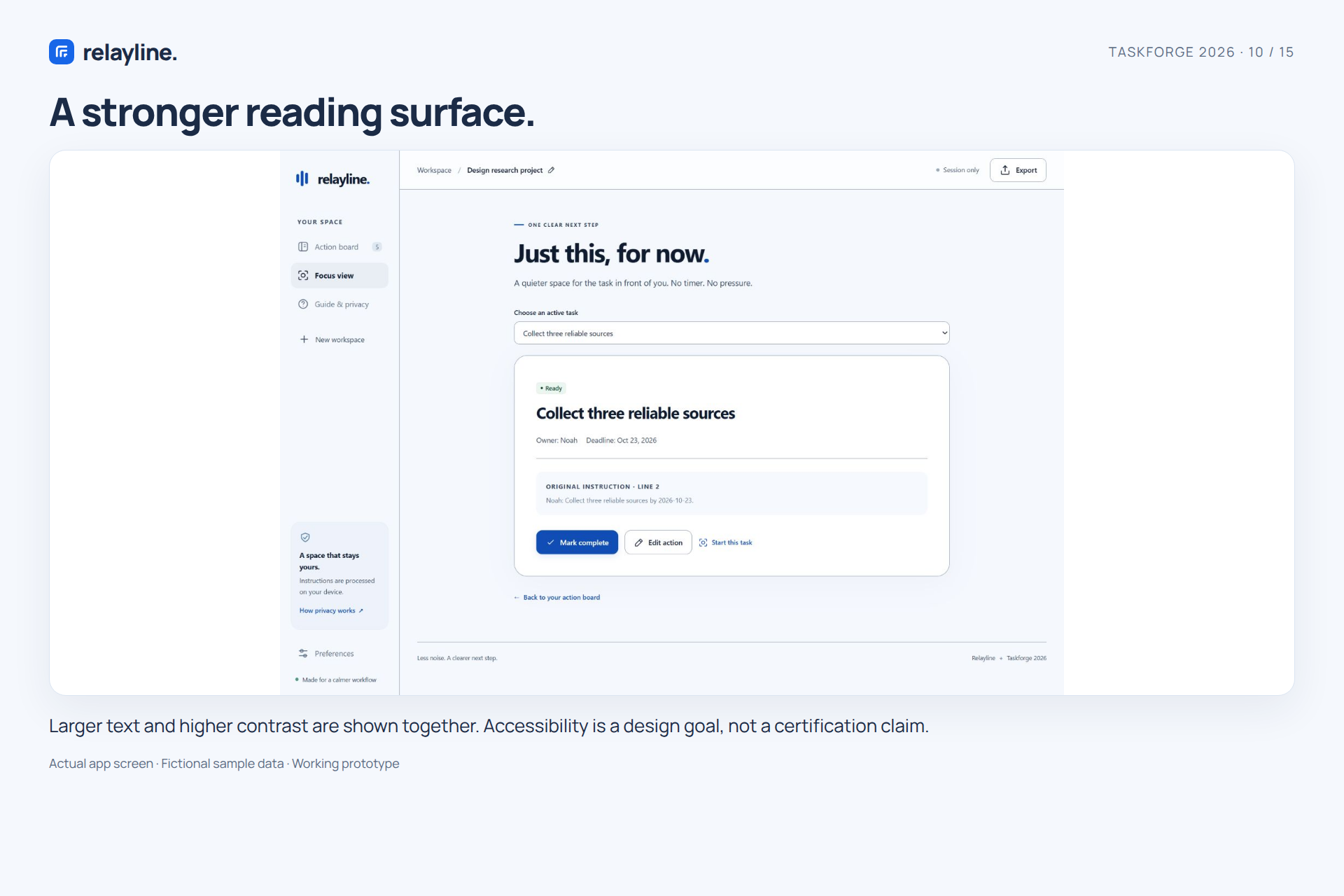
Larger text and higher contrast are shown together. Accessibility is a design goal, not a certification claim.
-
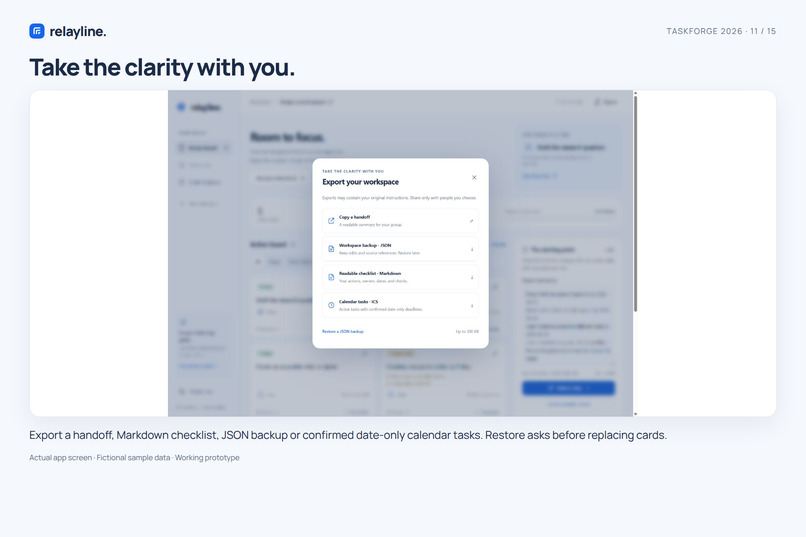
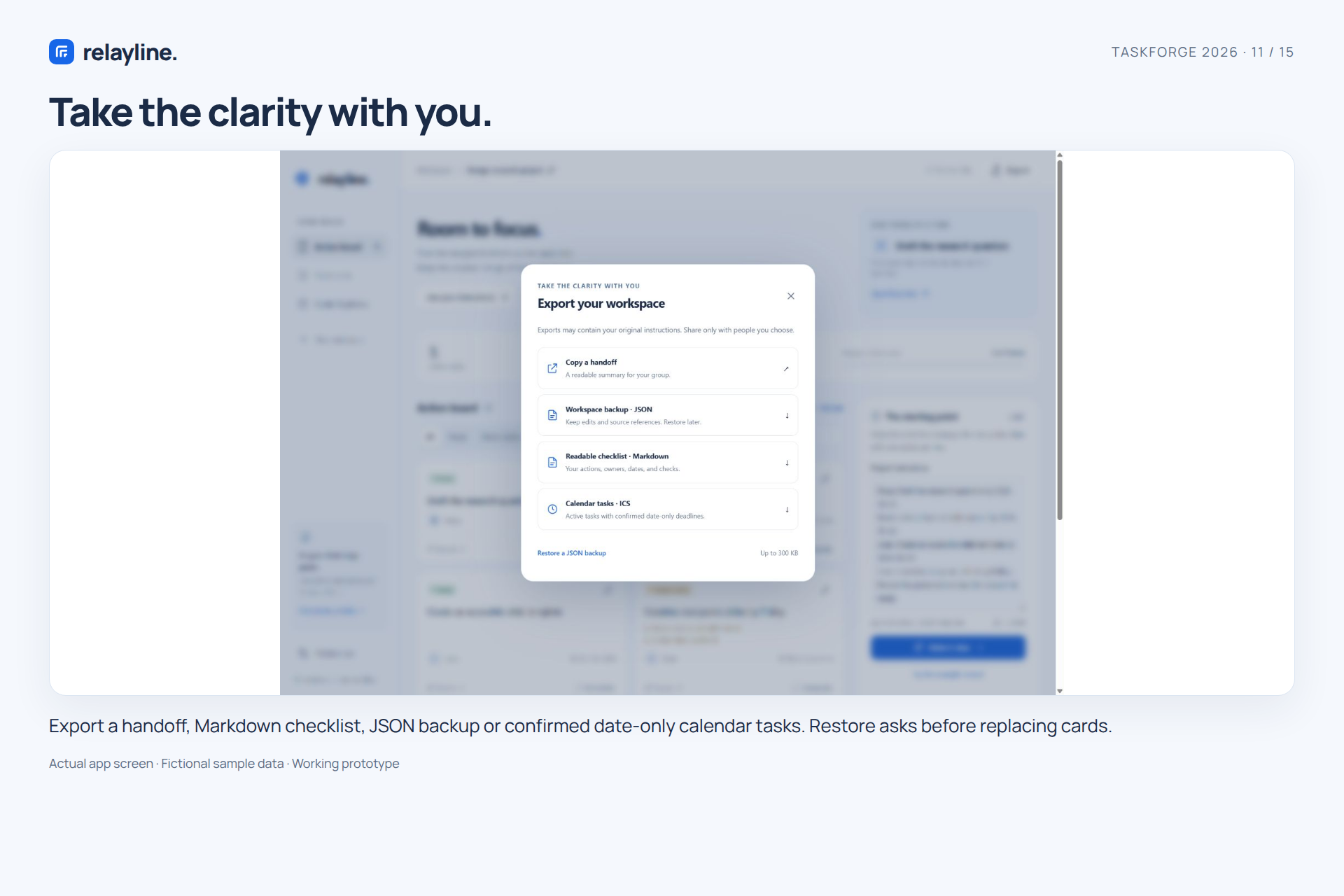
Export a handoff, Markdown checklist, JSON backup or confirmed date-only calendar tasks. Restore asks before replacing cards.
-
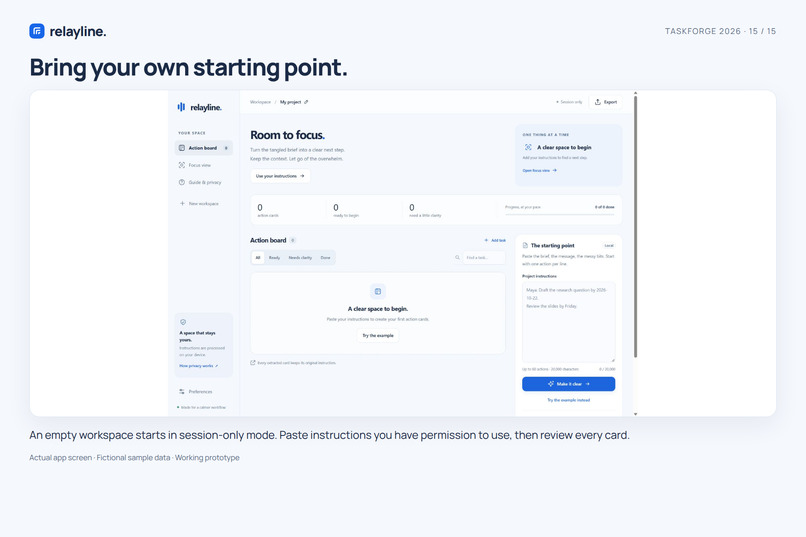
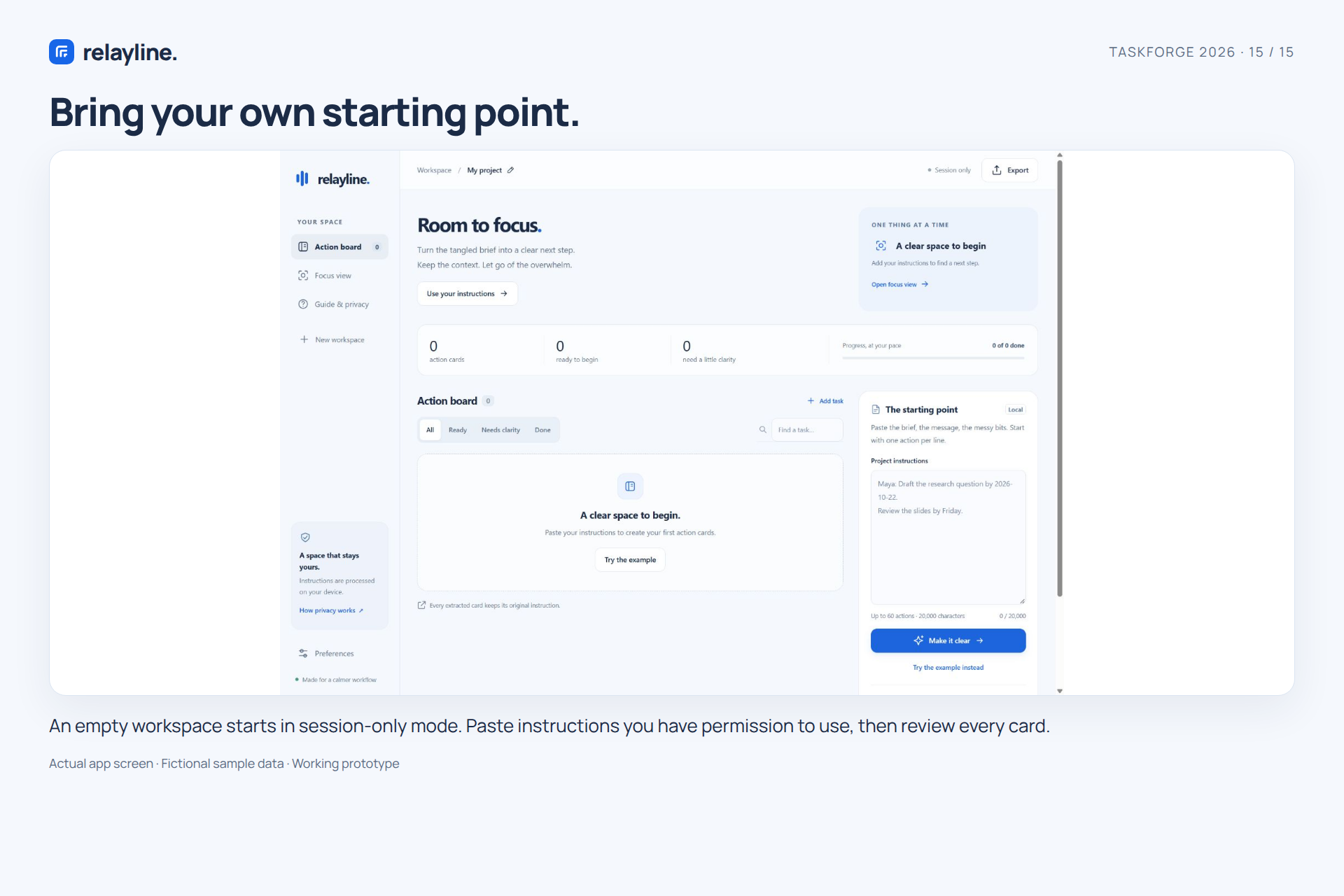
An empty workspace starts in session-only mode. Paste instructions you have permission to use, then review every card.
-
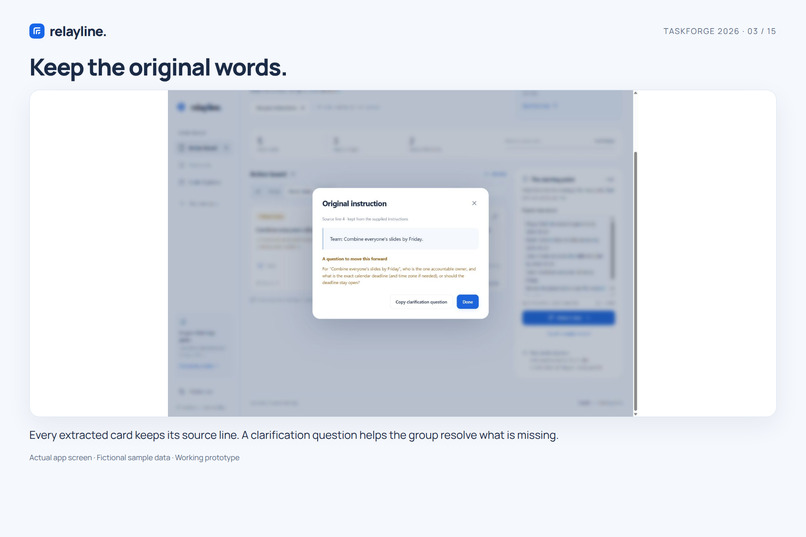
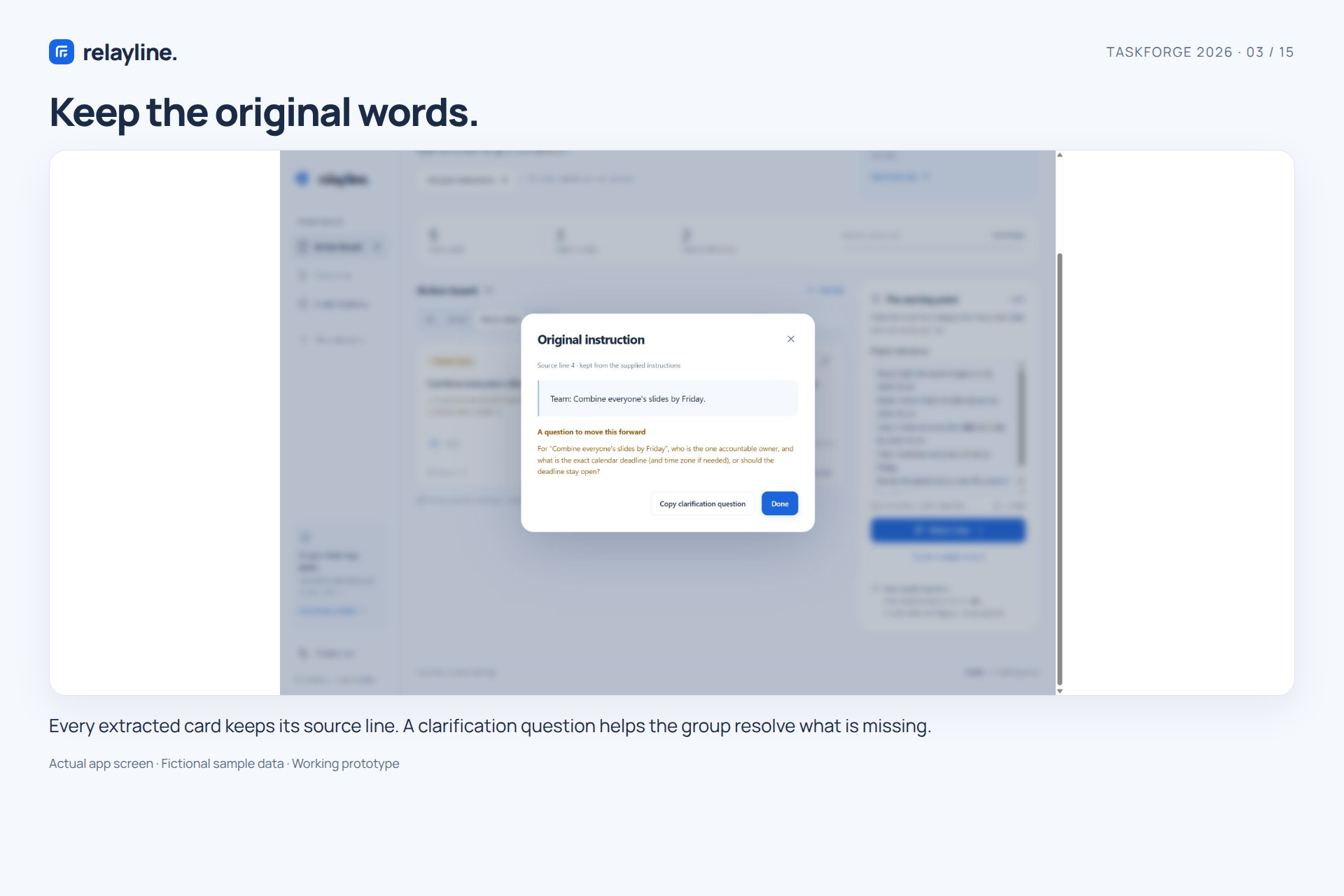
Every extracted card keeps its source line. A clarification question helps the group resolve what is missing.
-
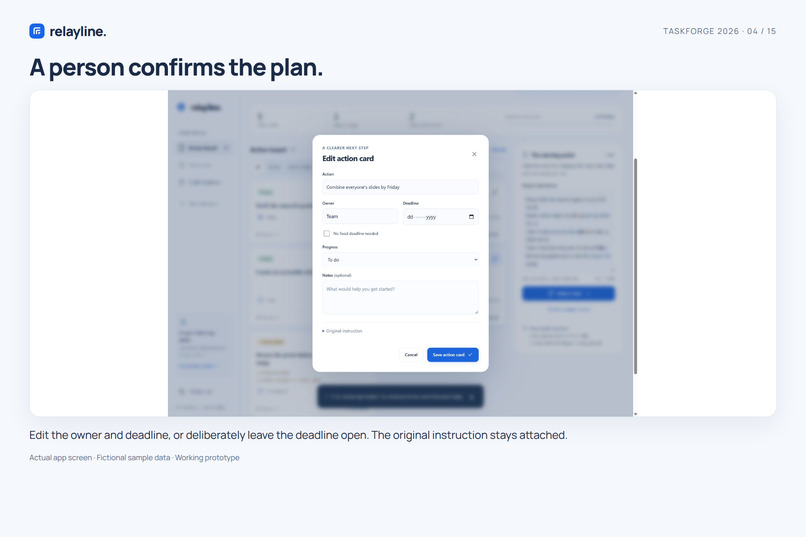
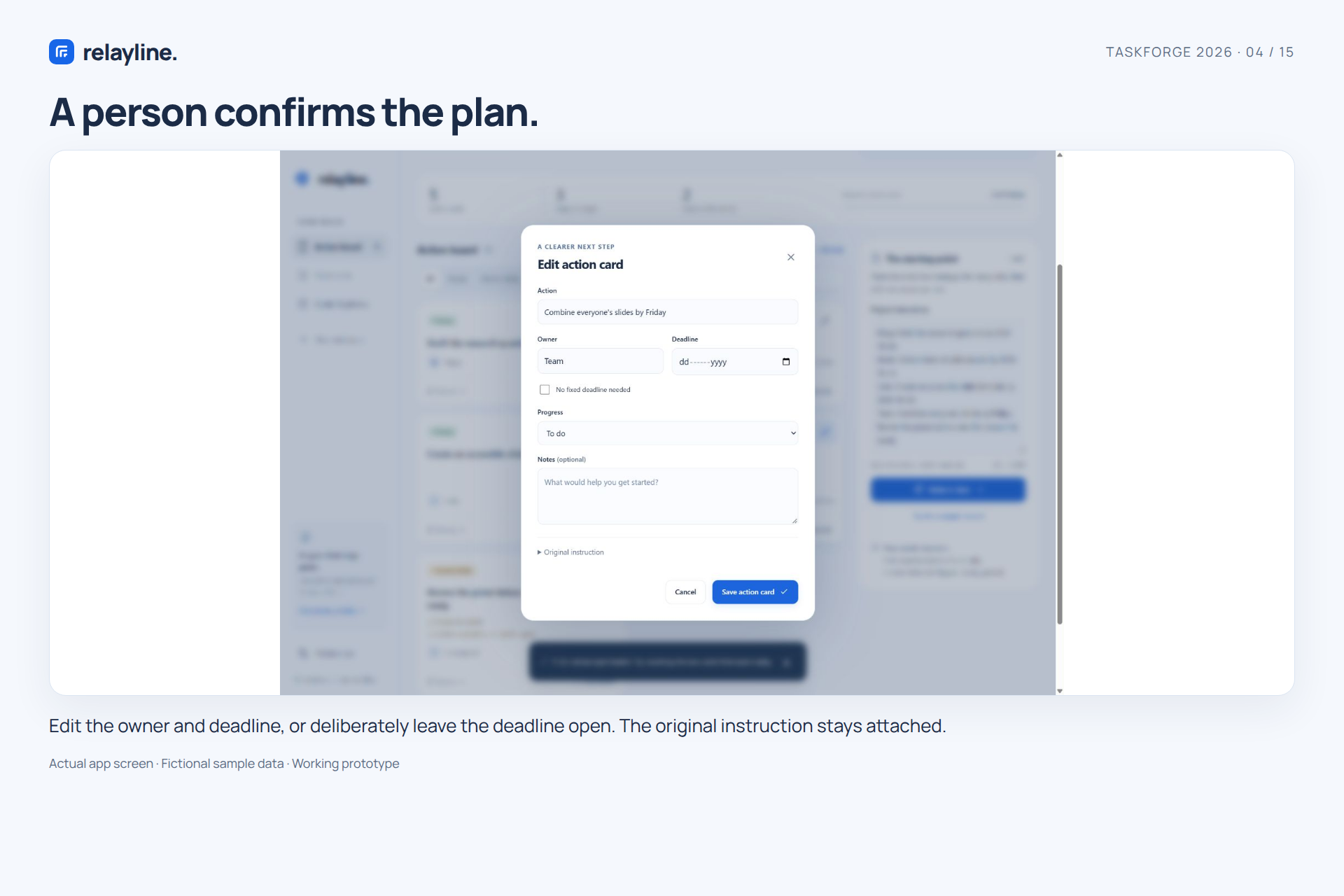
Edit the owner and deadline, or deliberately leave the deadline open. The original instruction stays attached.
-
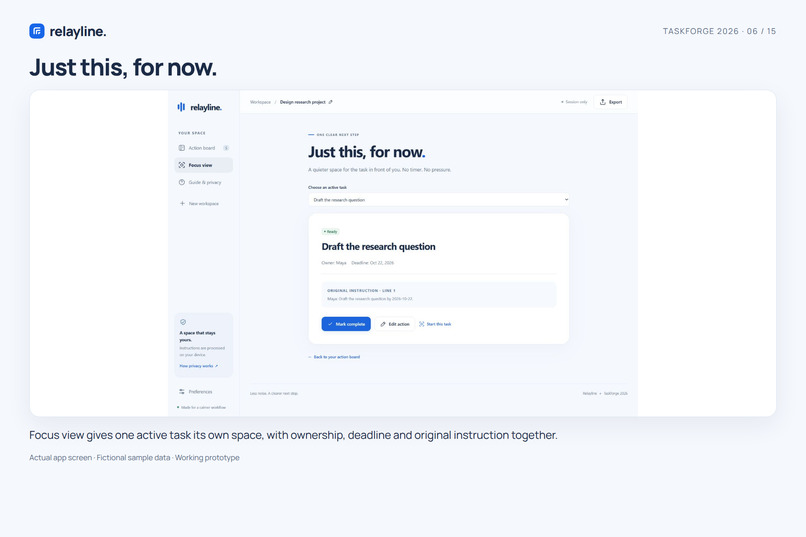
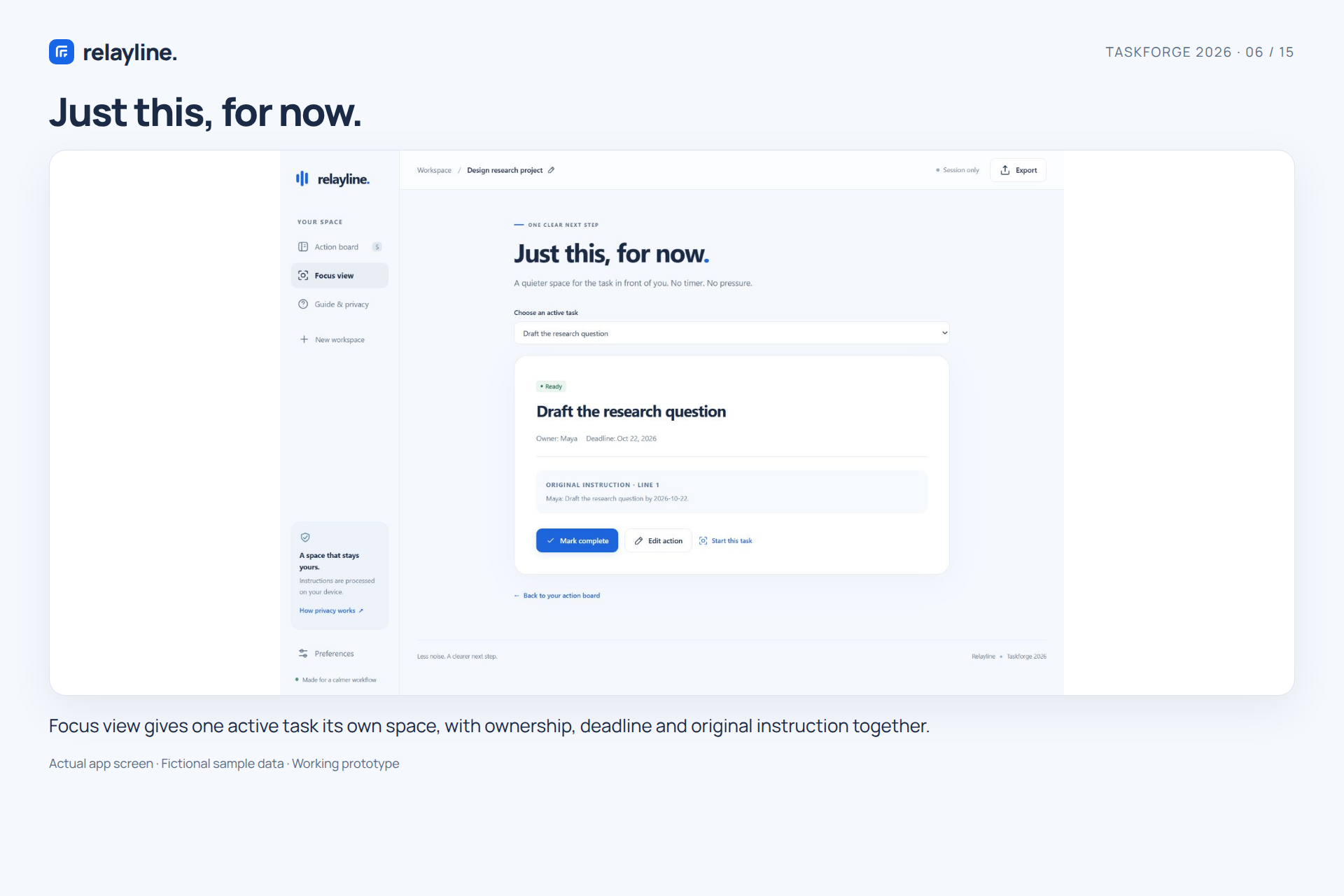
Focus view gives one active task its own space, with ownership, deadline and original instruction together.
-
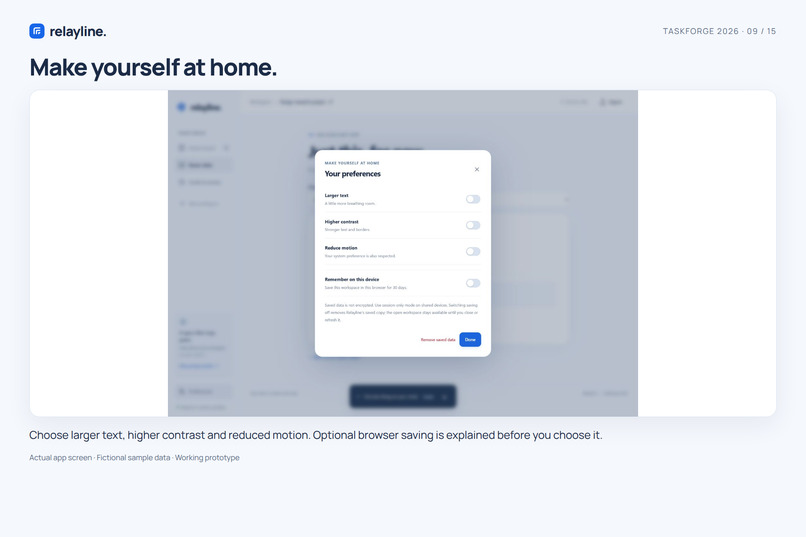
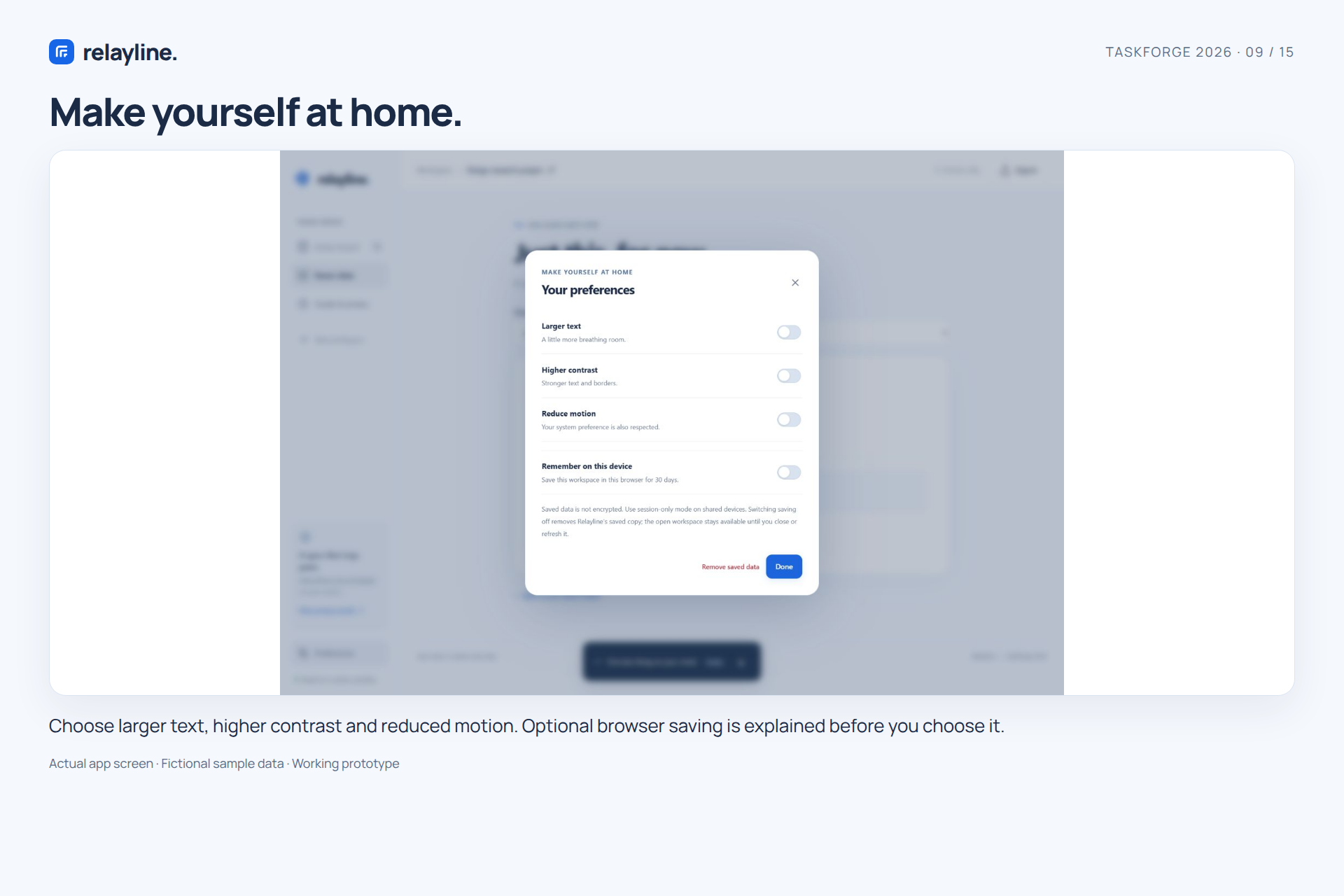
Choose larger text, higher contrast and reduced motion. Optional browser saving is explained before you choose it.
-
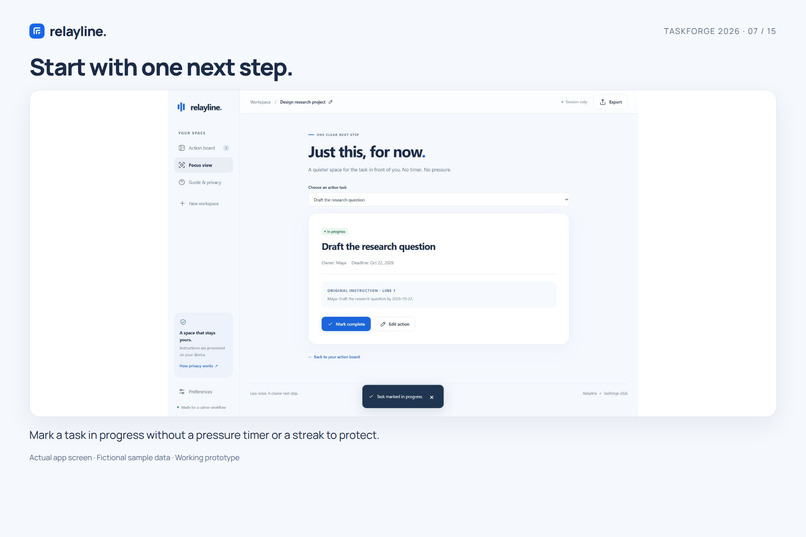
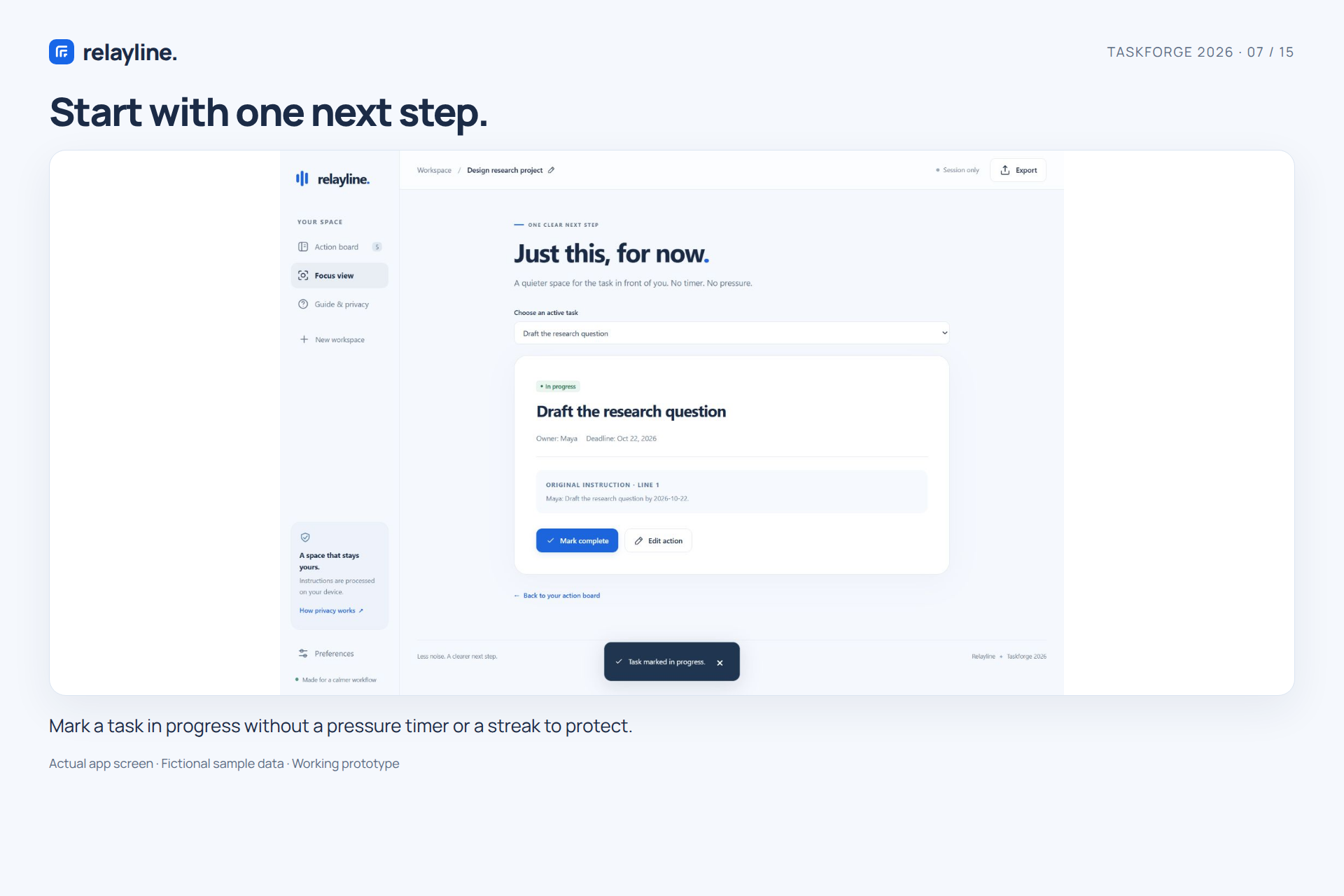
Mark a task in progress without a pressure timer or a streak to protect.
-
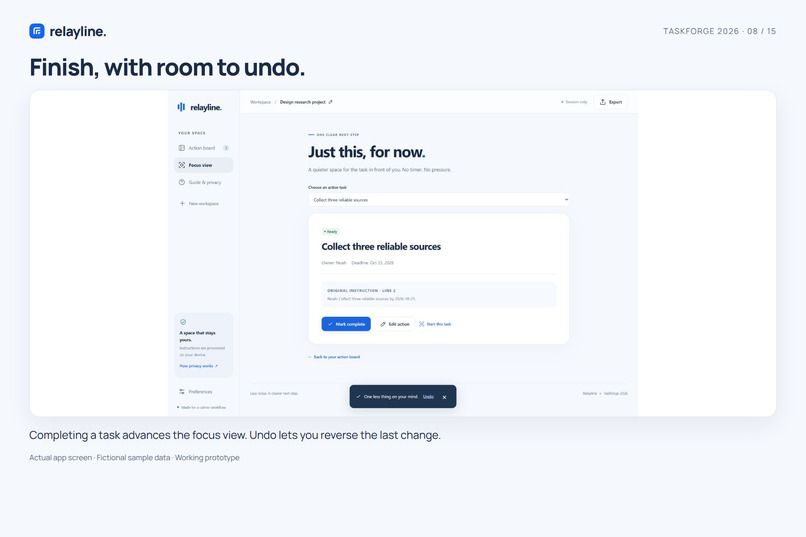
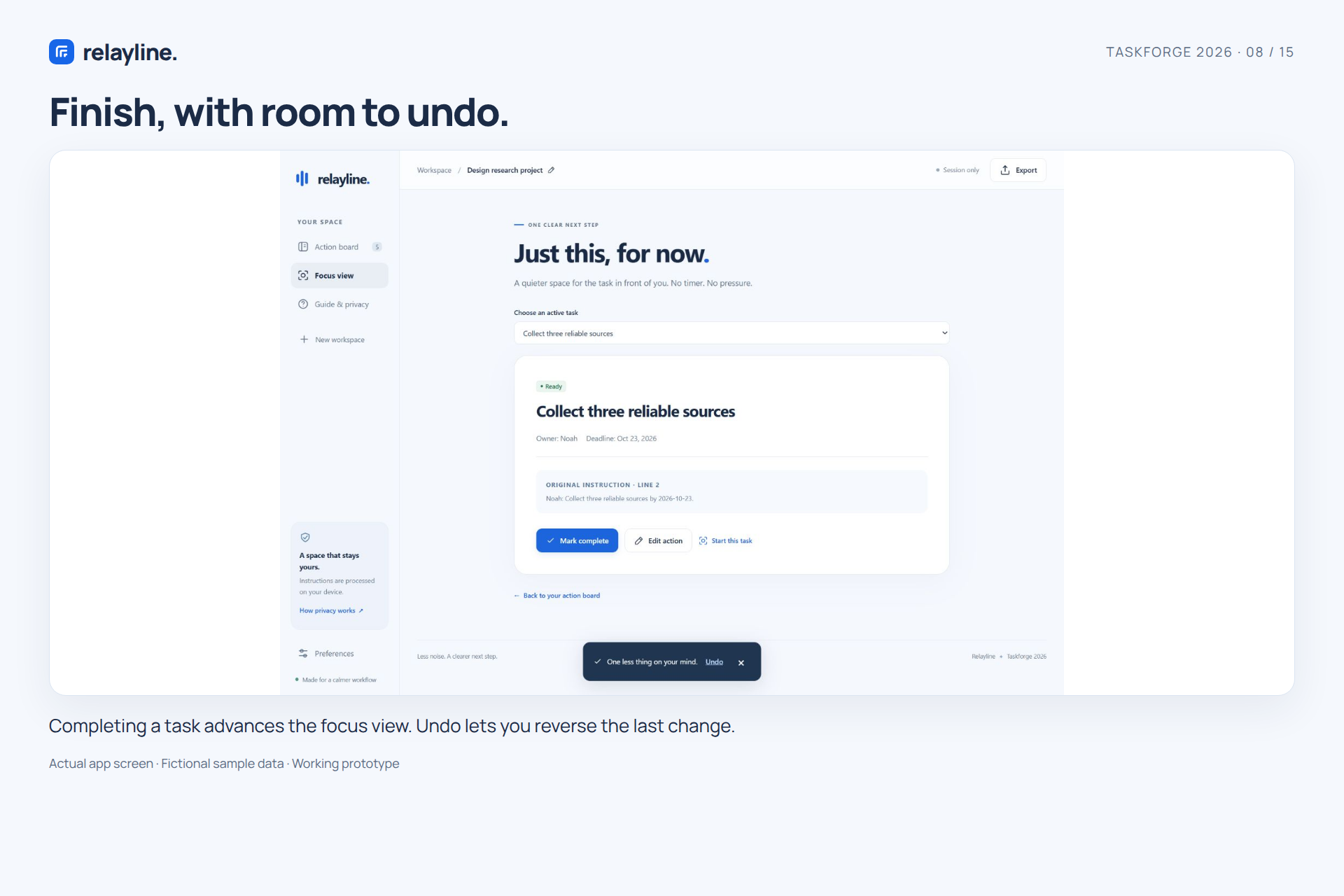
Completing a task advances the focus view. Undo lets you reverse the last change.
-
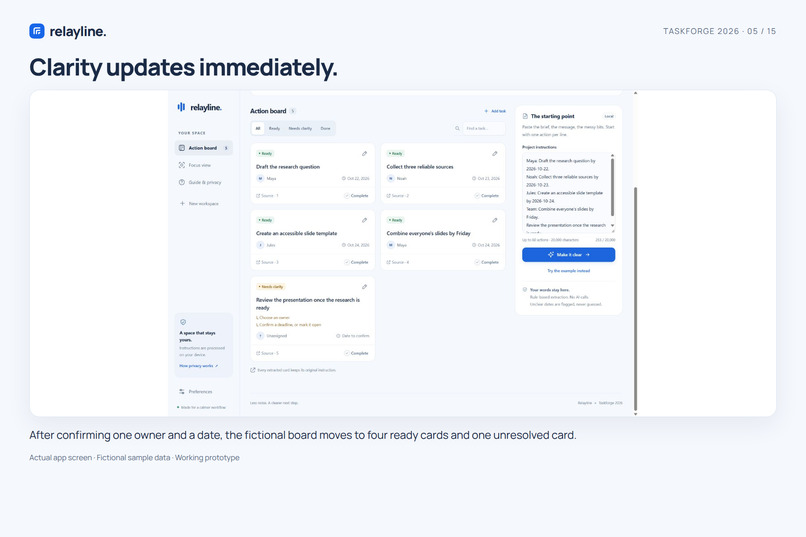
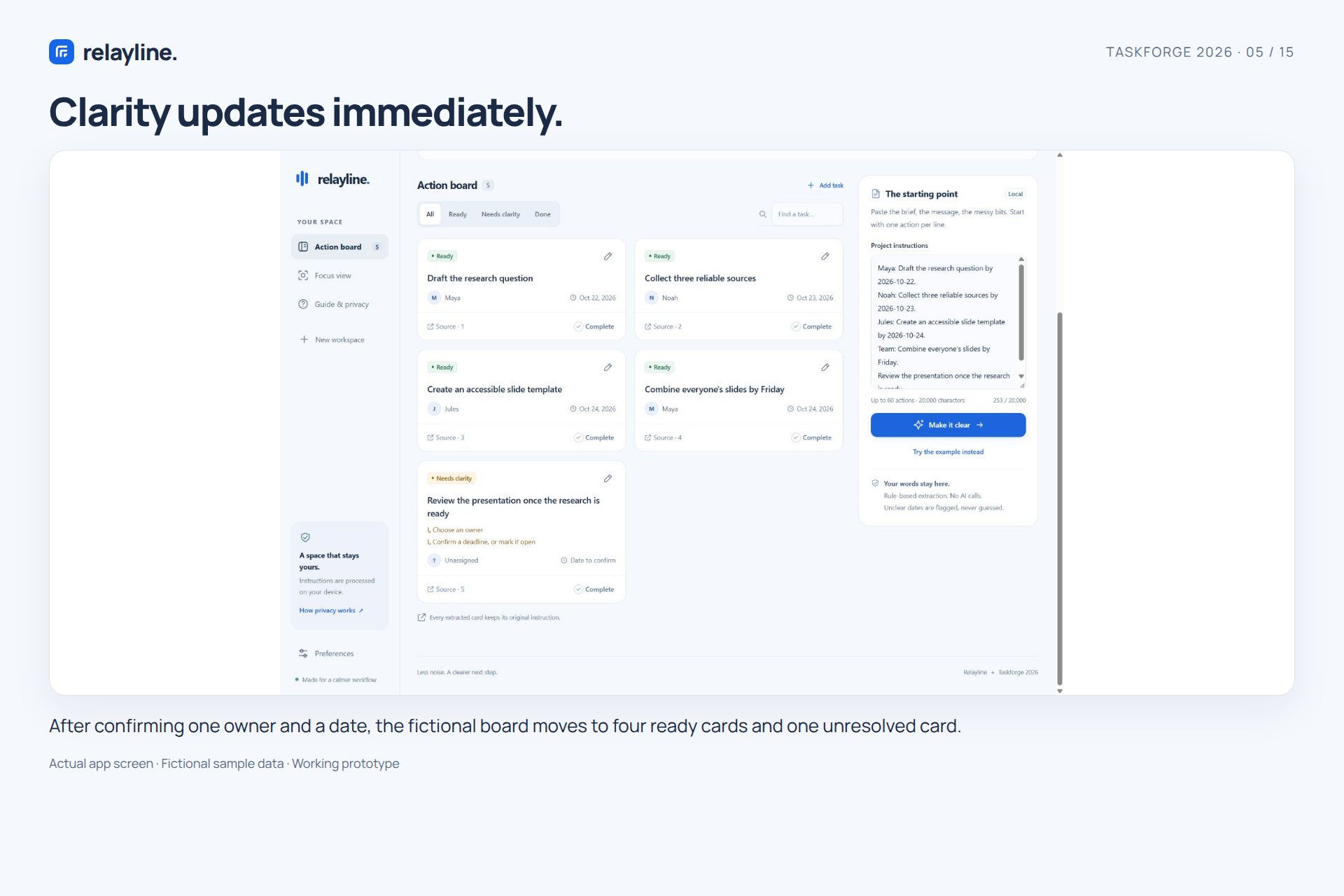
After confirming one owner and a date, the fictional board moves to four ready cards and one unresolved card.
-
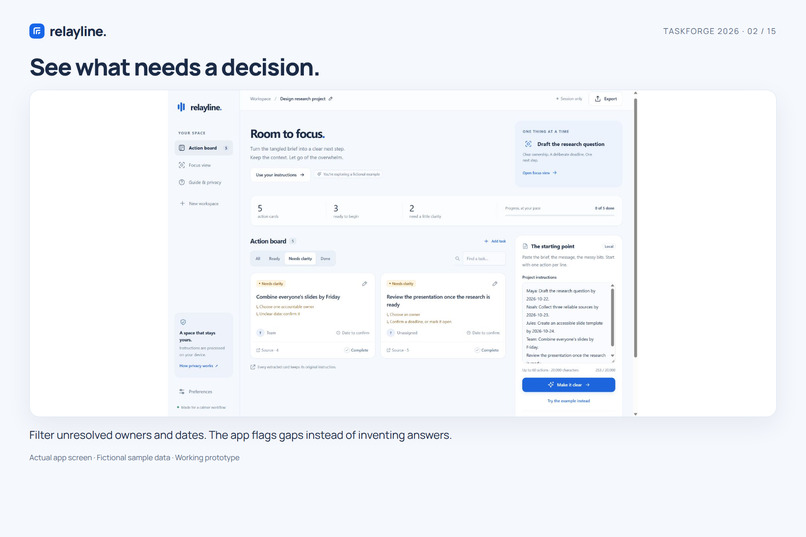
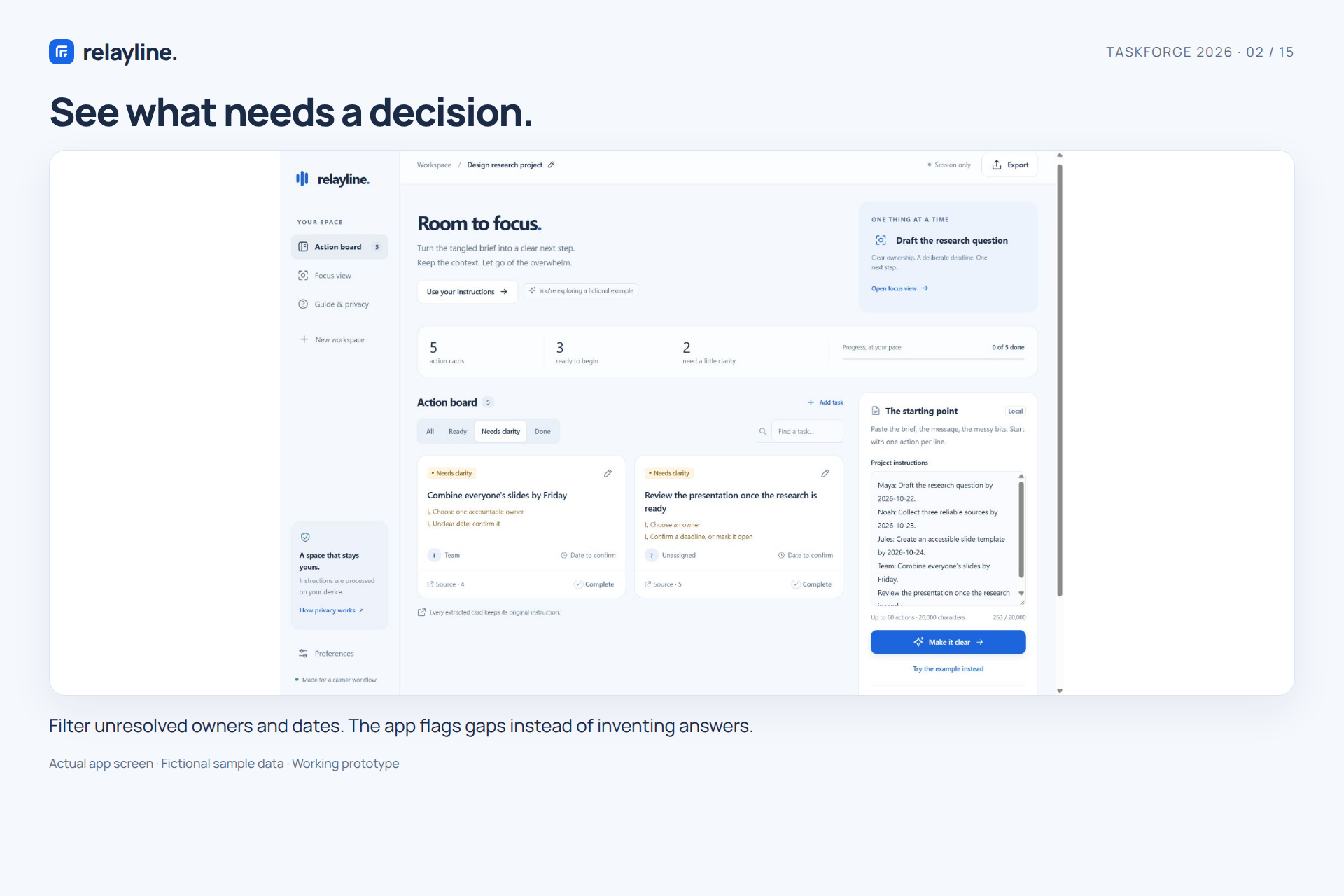
Filter unresolved owners and dates. The app flags gaps instead of inventing answers.
-
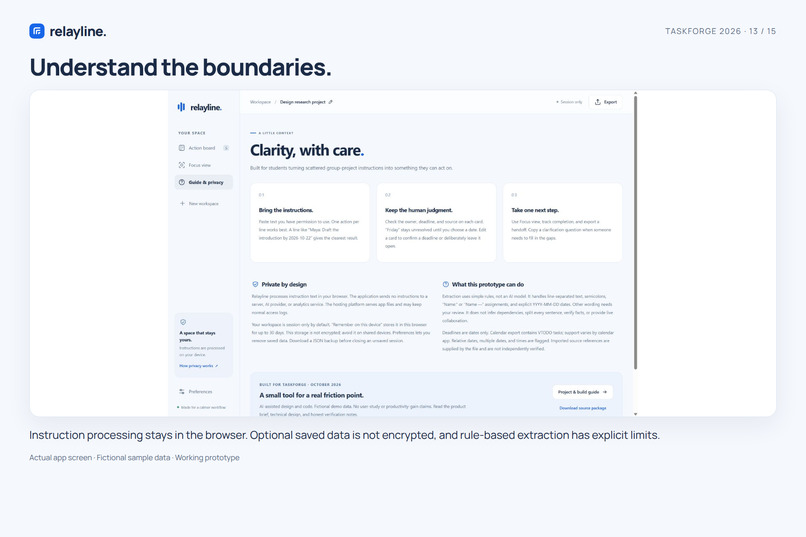
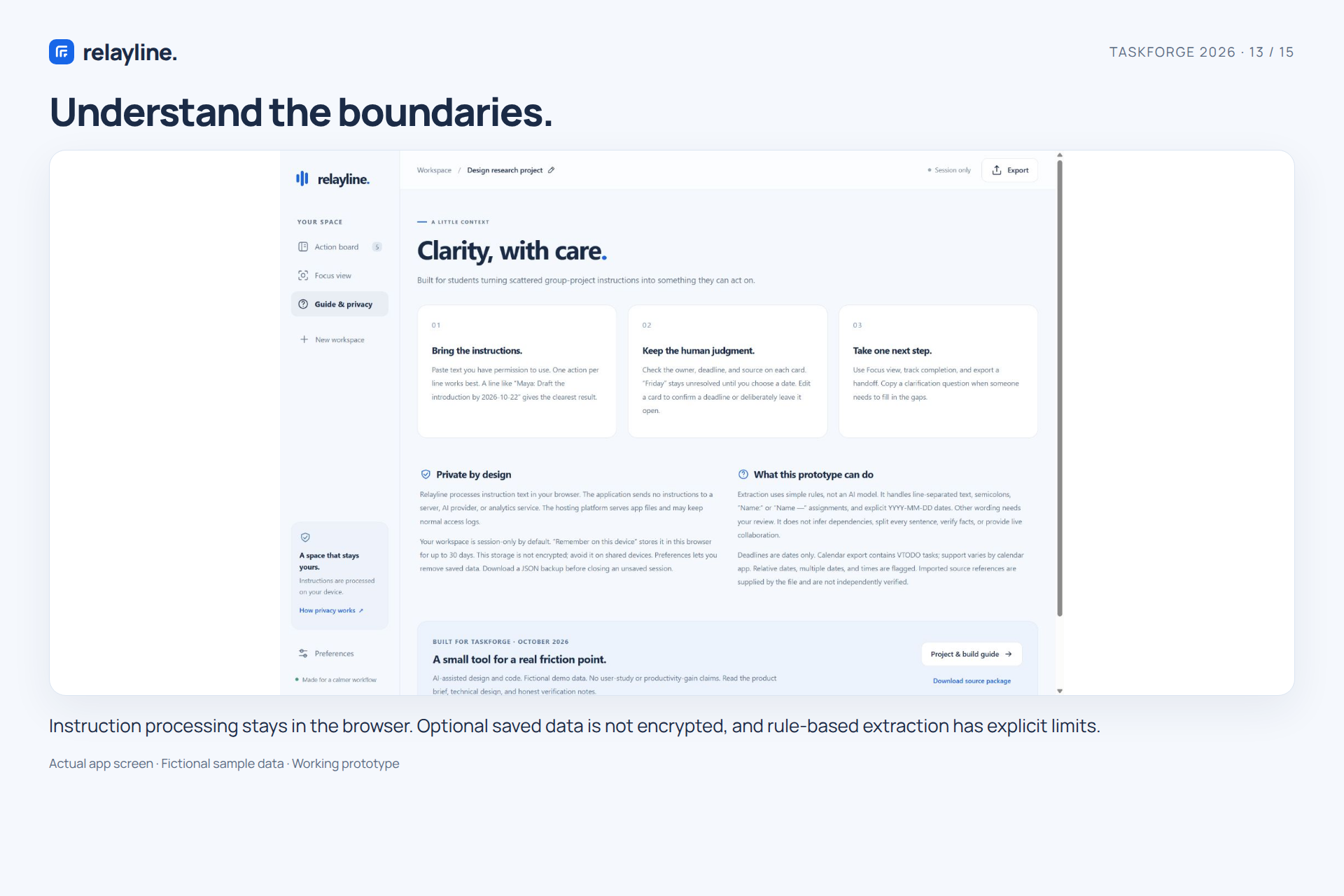
Instruction processing stays in the browser. Optional saved data is not encrypted, and rule-based extraction has explicit limits.
-
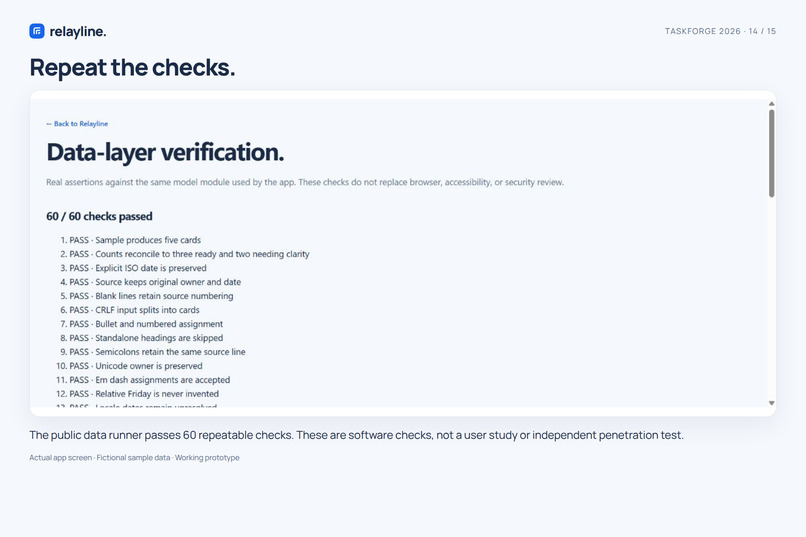
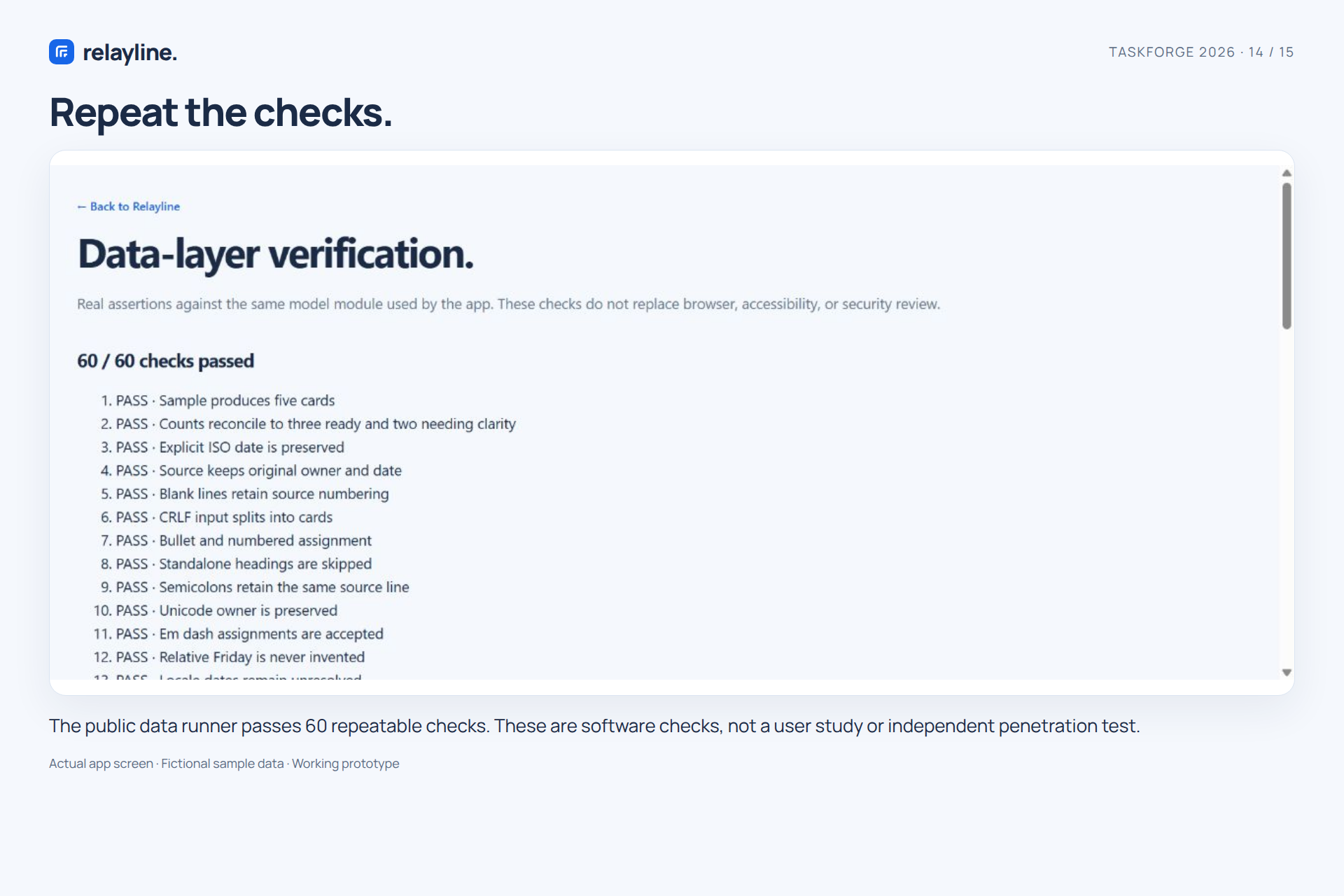
The public data runner passes 60 repeatable checks. These are software checks, not a user study or independent penetration test.
Inspiration
A student group brief often mixes actions, shared responsibility and vague deadlines in the same message. A task board can look tidy while those decisions are still missing. Relayline focuses on that handoff: keep the original words, show what needs a decision, and make one next action easier to see.
What it does
Relayline is a working browser-based productivity prototype for student project groups and people who find dense instructions difficult to turn into a starting point.
Paste one action per line or semicolon. The local parser creates editable cards, preserving the source line and original instruction. It recognizes simple owner assignments and explicit valid YYYY-MM-DD dates. Missing owners, shared ownership, relative dates and ambiguous date conditions stay visibly unresolved.
In the fictional demo, five instructions become five cards: three ready and two needing clarity. The “Friday” card needs one accountable owner and a confirmed date. Opening its source produces a copyable clarification question. A person can then confirm the deadline or deliberately leave it open.
Focus view shows one active task, its owner, deadline and source. Users can start, complete and undo an action, search/filter the board, rename the workspace and add manual tasks. Larger text, higher contrast, reduced motion, visible keyboard focus and native dialogs support a calmer experience.
How it was built
The application uses static HTML/CSS and native JavaScript modules, with a pure data model for parsing, validation, ordering and exports. No database, account, AI inference service or API key is required. ChatGPT Sites hosts the public app. No code has been uploaded to GitHub.
Instruction processing stays in the browser. Session-only is the default; optional local saving expires after 30 days of inactivity, checked when the app opens. Saved browser data is not encrypted. Hosting providers may retain normal access logs.
JSON backups retain edits and source references. Markdown provides a readable handoff. ICS exports confirmed active date-only tasks as VTODO records; calendar support varies. Strict import allowlists, size limits, duplicate-ID checks, literal text rendering and escaped/folded calendar output constrain untrusted input. The delivered HTML also carries a restrictive meta Content Security Policy; host response-only security headers are not claimed as verified.
The build guide provides the MIT-licensed source ZIP, PRD, technical design, setup instructions and verification record. Run locally with a simple HTTP server; no installation or build step is needed for the app.
Challenges and learning
The hardest product decision was what to leave unresolved. “Friday” should not silently turn into a guessed date, and “Team” should not imply clear accountability. Preserving the source makes the review visible.
Implementation challenges included date conditions, safe JSON restores, calendar escaping and mobile dialog behavior. Browser review found and corrected a hidden-state CSS issue and added a dismiss control for persistent Undo notices. The lesson was to verify the product flow, not just the parser.
Validation and accomplishments
The public browser test runner passes 60/60 repeatable data checks covering extraction, provenance, dates, strict imports, bounds, ordering, Markdown and ICS serialization. Browser checks cover editing, source inspection, focus, completion/undo, preference persistence/removal and responsive layouts at phone, tablet and desktop sizes. See the linked verification record for exact scope and limits.
The prototype demonstrates a complete small workflow with fictional data, portable output and a clear privacy model. It does not claim measured productivity gains, independent penetration testing, accessibility certification or validation with real students.
Limitations and next steps
This is a rule-based prototype. It does not interpret every sentence, infer dependencies, synchronize teammates, authenticate imported source references or coordinate work automatically. Users must review every card. Offline reload/install support is not claimed.
Next steps are permission-based usability sessions with students, screen-reader testing across browsers, better natural-language coverage with explicit confidence, and evaluation of whether clarification-first handoffs reduce missed ownership decisions.
AI assistance and project history
The Relayline concept and implementation were developed during the Taskforge event period with substantial ChatGPT assistance in product planning, design, code, documentation and tests. No real student messages or personal records are used.
Built With
- chatgpt-sites
- css3
- html5
- hyperframes
- javascript
- kokoro
- node.js

Log in or sign up for Devpost to join the conversation.