-
-
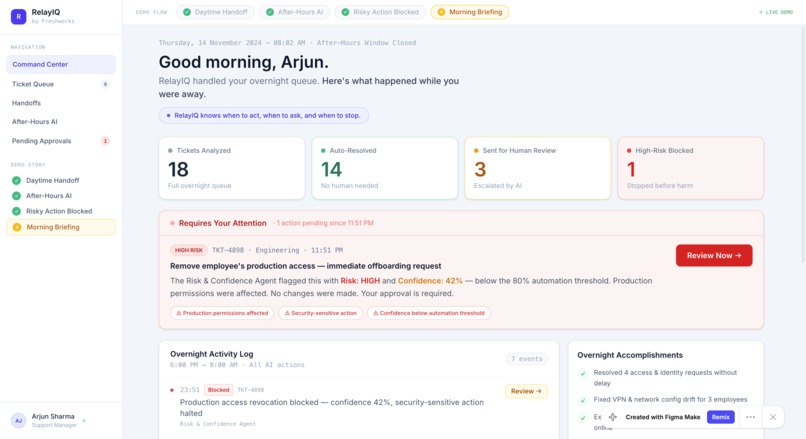
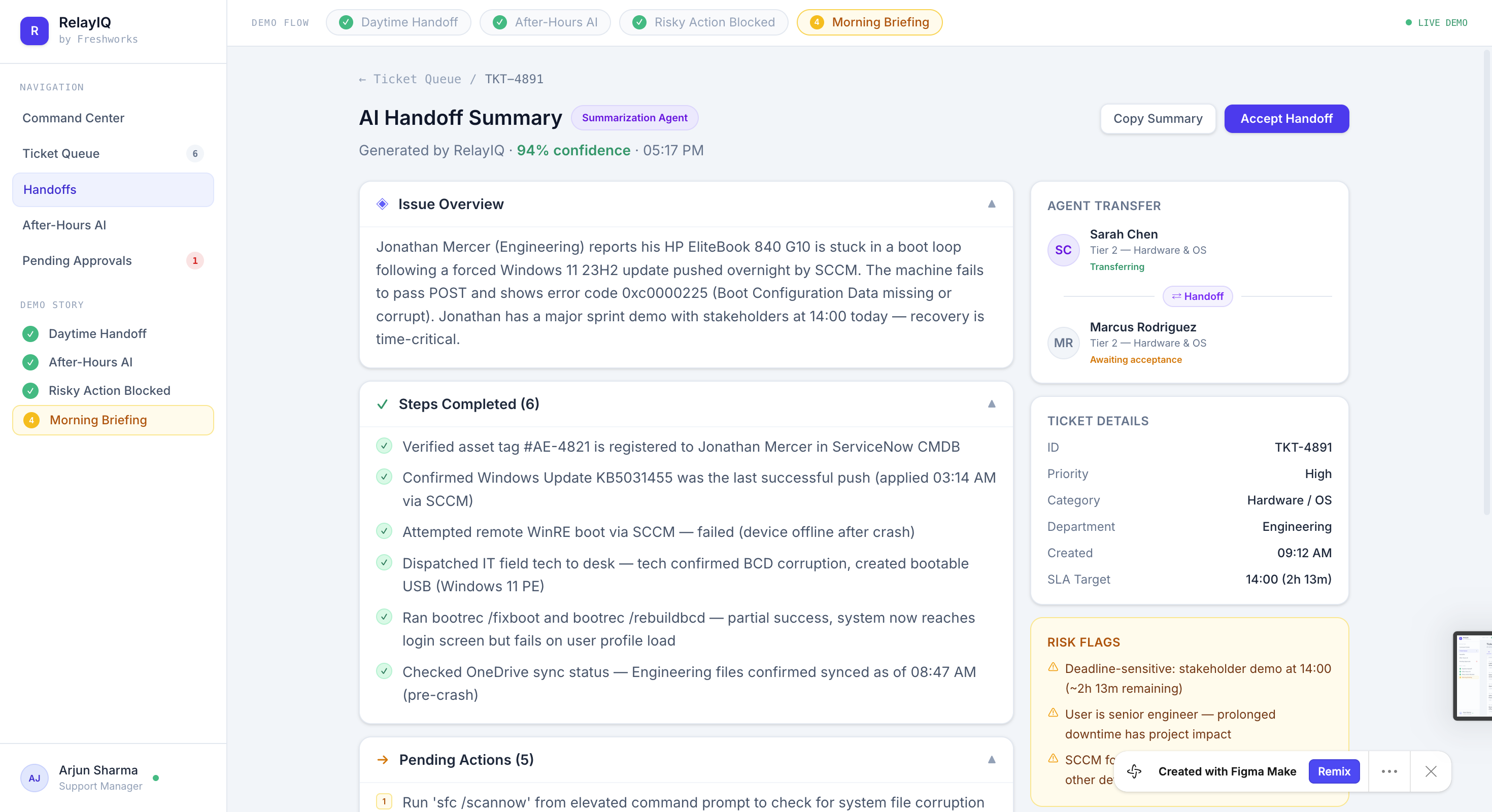
Dashboard Page
-
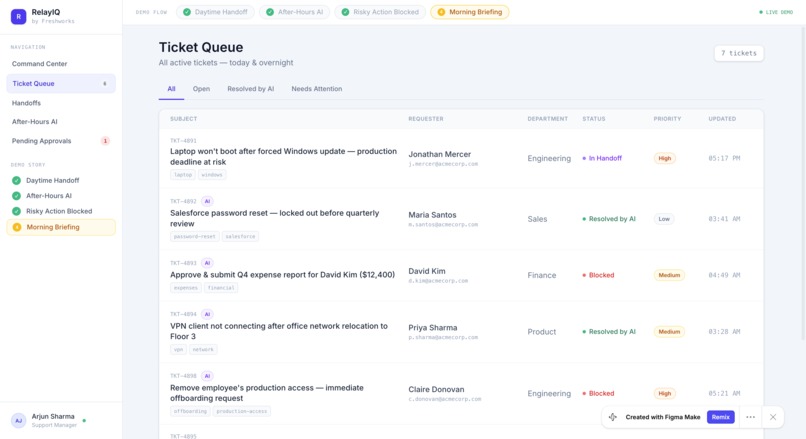
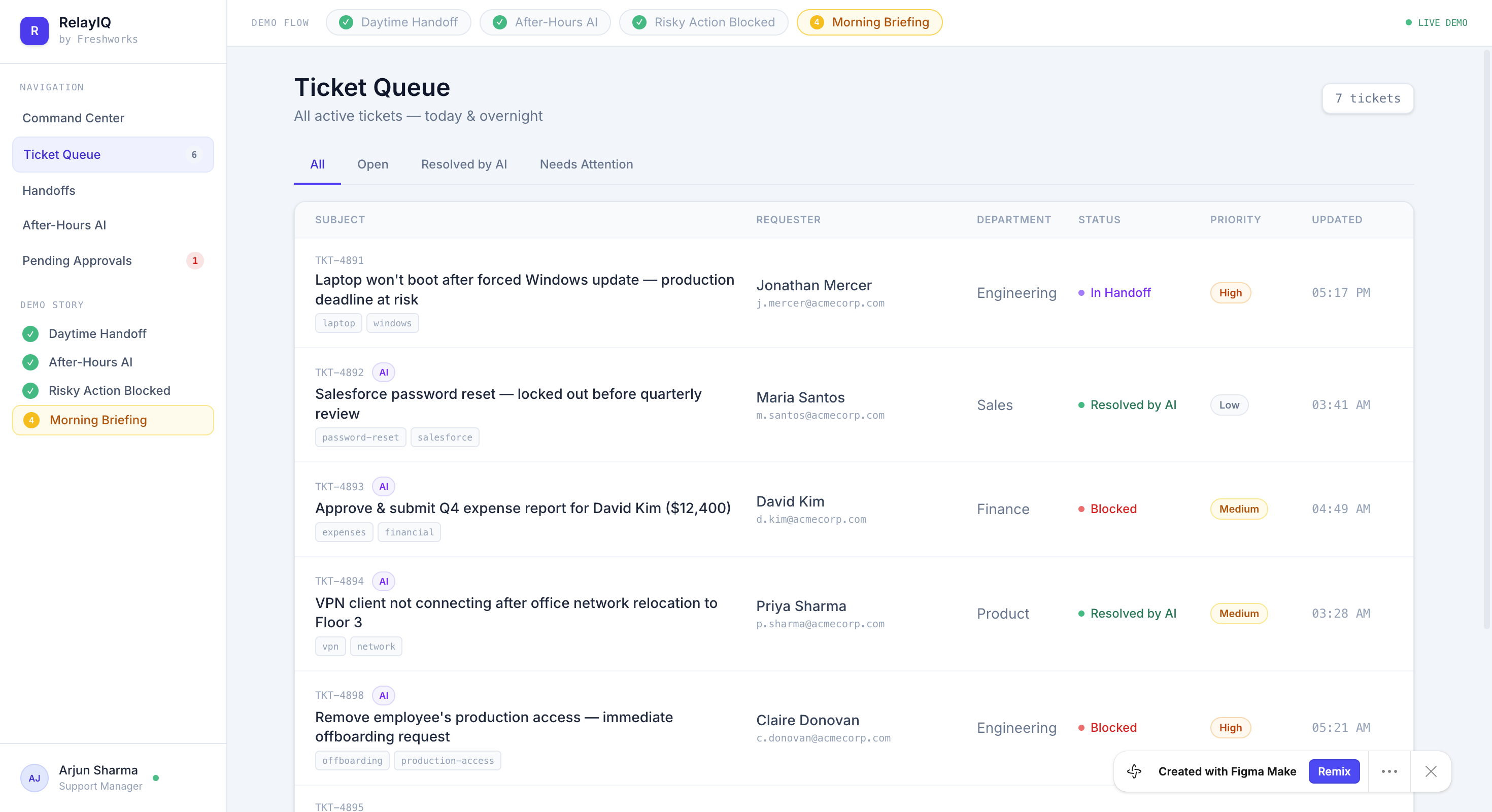
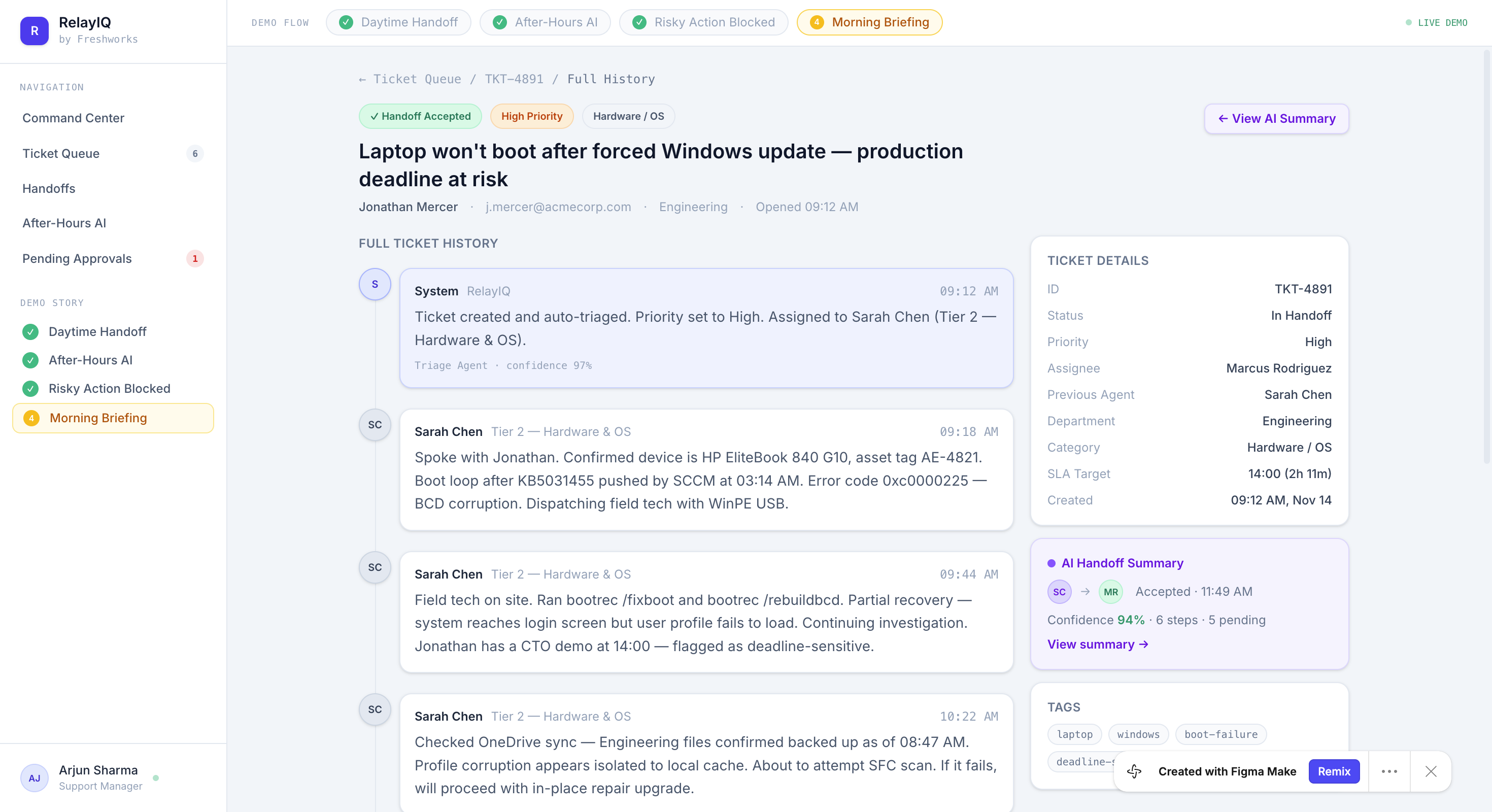
Ticket Queue
-
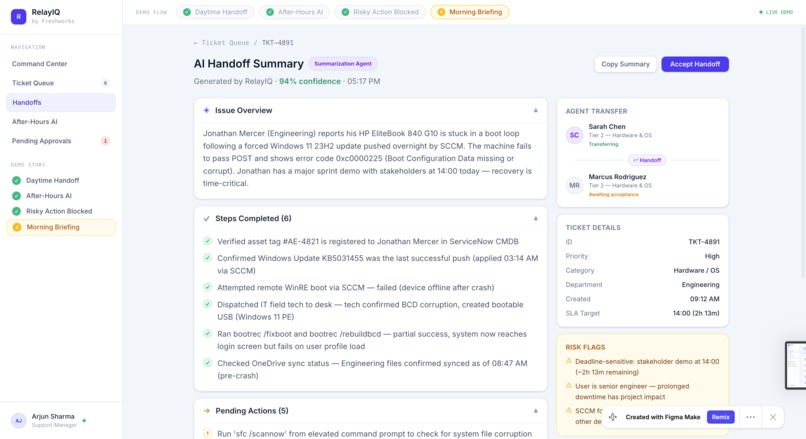
Handoff Handling
-
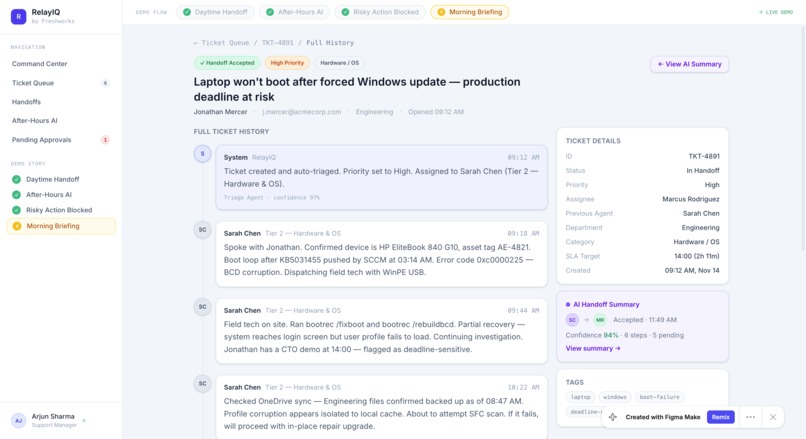
HandOff Acceptance
-
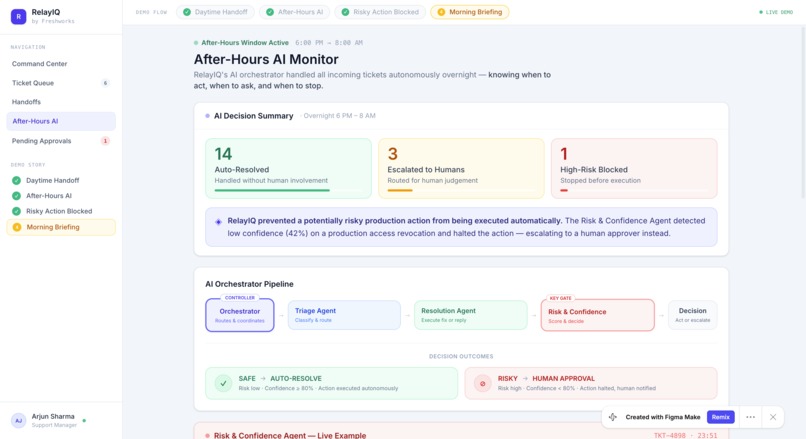
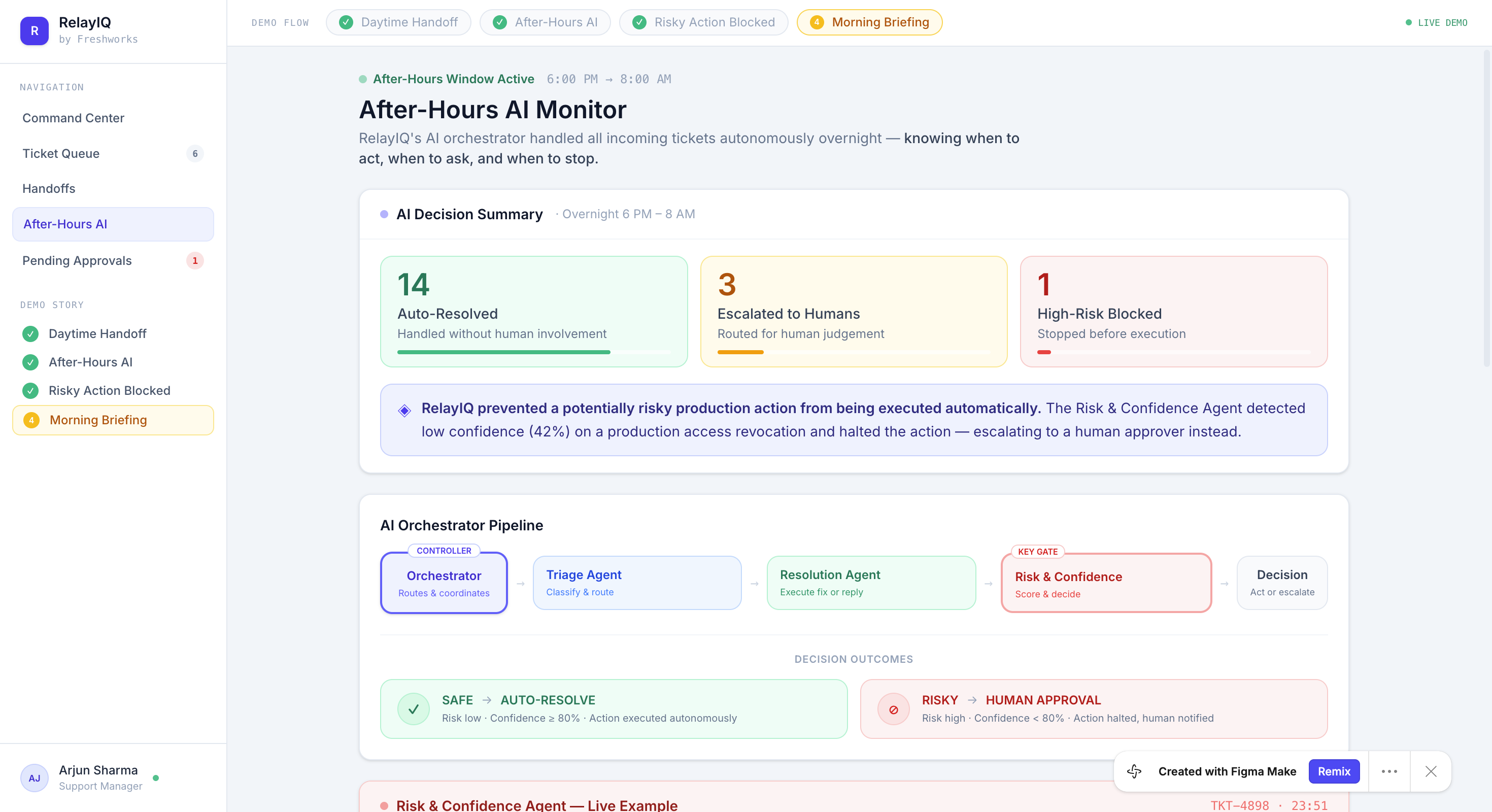
AfterHour AI
-
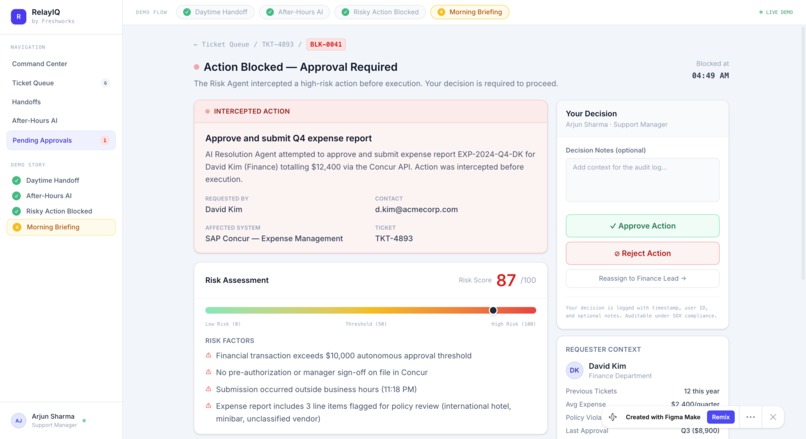
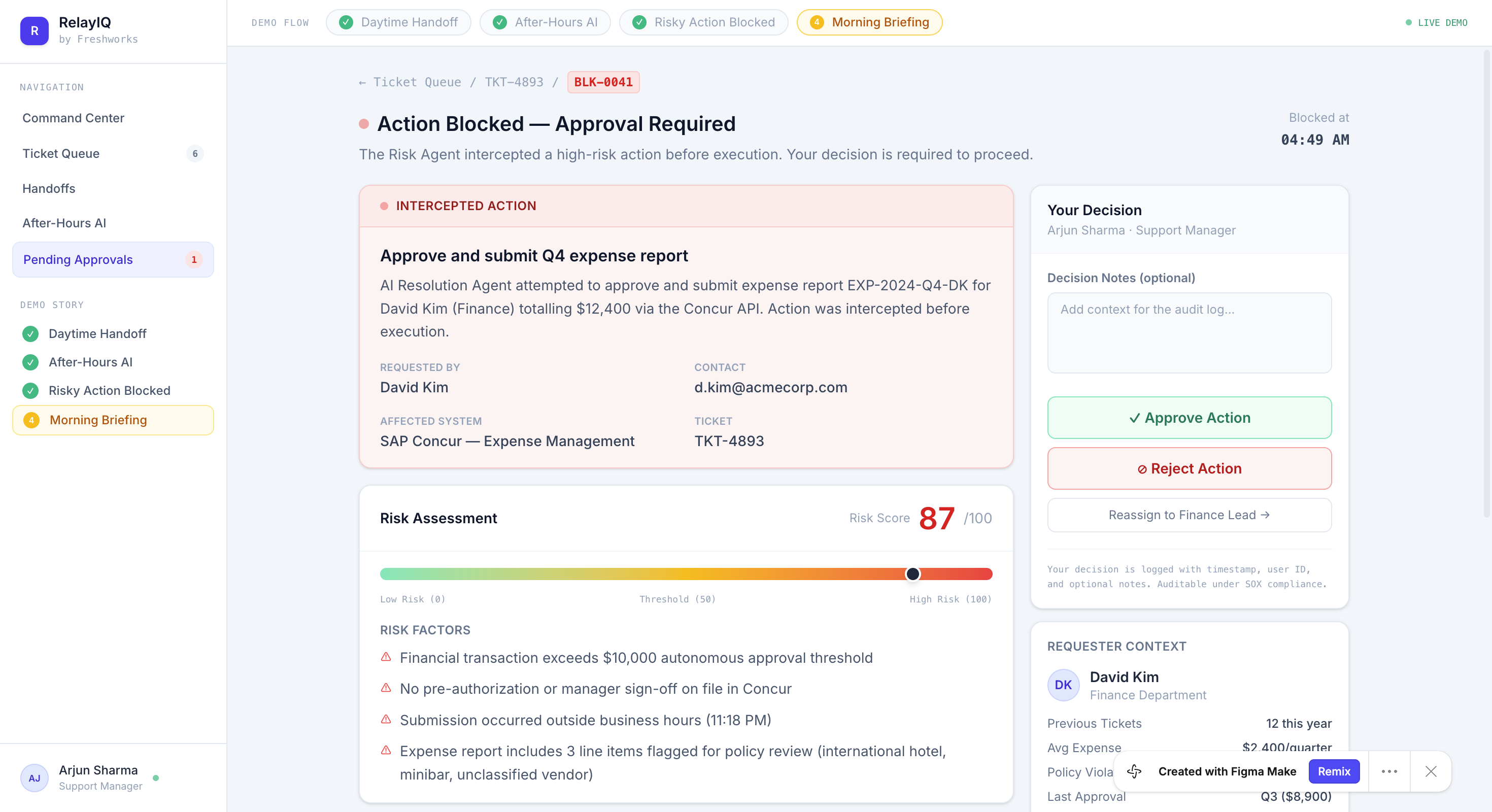
Pending Approvals
Inspiration
We've all experienced it: explain your problem to Person A, get transferred to Person B, and repeat the entire story from scratch — because the context didn't follow you. Then we found the number that made the problem impossible to ignore: 47% of IT tickets are submitted outside business hours.
That revealed something bigger.
Context doesn't just break when a ticket moves between people. It also breaks when a ticket moves across time — from today's support team to tomorrow morning's.
So we asked:
What if one agent could preserve context across both?
That became RelayIQ.
What it does
RelayIQ is an always-on, context-preserving support agent designed around one principle:
A ticket should never have to start from zero.
It operates in two modes.
By Day — Context Bridge
When a ticket changes hands, RelayIQ automatically creates a concise, structured handoff containing:
- The original problem
- What has already been tried
- The outcome of each attempt
- What remains unresolved
- Relevant context for the next agent
Instead of the next person asking, “What happened here?”, they can immediately continue from where the previous agent stopped.
And when a ticket moves again, RelayIQ builds on the existing context rather than starting over.
By Night — Autonomous Resolver
After hours, RelayIQ keeps working.
It resolves known, low-risk tickets autonomously using available knowledge and established resolution patterns.
When a ticket is unfamiliar, risky, or below its confidence threshold, RelayIQ doesn't guess.
It stops, explains what it found, and creates a structured handoff for the morning team.
The goal isn't maximum automation. It's trustworthy automation.
Built-in Trust Layer
RelayIQ makes trust part of the workflow:
- Confidence & risk scoring on every decision
- Human-in-the-loop approval for risky actions
- Feedback loops where human corrections improve future resolutions
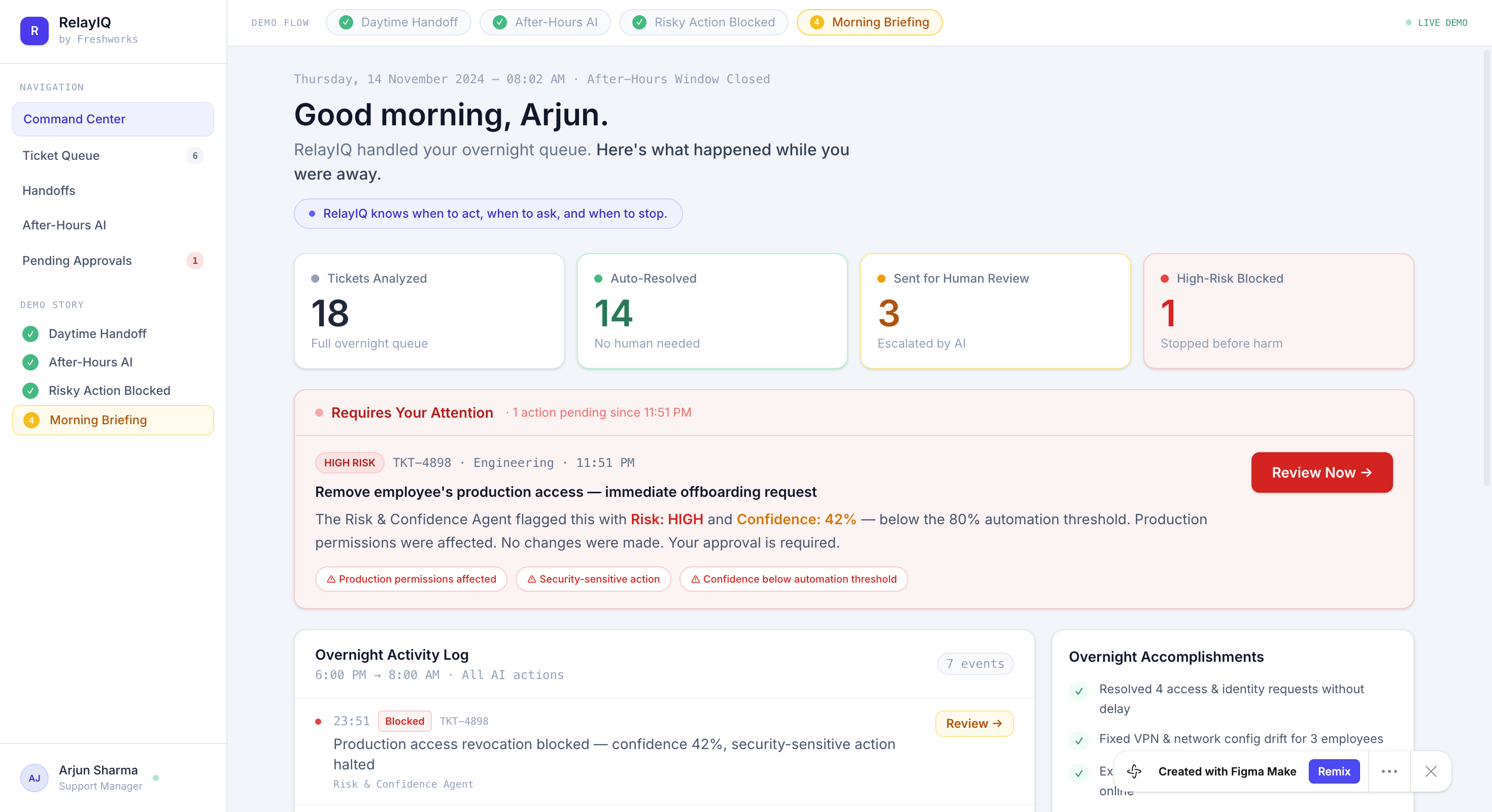
- Morning Briefing Dashboard showing what was resolved, what remains, and why
- Multi-hop handoff chaining so context compounds across Team A → B → C instead of disappearing at every transfer
How we built it
We started by mapping the complete ticket lifecycle and identifying the moments where context is most likely to disappear:
Creation → Handoff → Escalation → After-hours silence
We then designed RelayIQ as a multi-agent system with clearly separated responsibilities:
- Orchestrator Agent — coordinates the overall workflow
- Triage Agent — understands and categorizes incoming tickets
- Resolution Agent — determines and executes trusted resolutions
- Risk & Confidence Agent — evaluates whether an action is safe
- Summarization Agent — creates concise, context-rich handoff briefs
We architected the solution around Freshworks Agent Studio and MCP, allowing RelayIQ to fit naturally into an enterprise support environment rather than existing as an isolated AI chatbot.
Our prototype stack includes:
- Claude API for agent reasoning and orchestration
- Freshworks MCP Server
- Node.js + Express
- React + Tailwind CSS
- pgvector-based knowledge storage
- A scheduled off-hours worker
Before expanding individual features, we validated the complete end-to-end workflow:
Day handoff → Night resolution → Risky escalation → Morning briefing
This helped us prove that RelayIQ isn't three separate tools — it's one continuous context-preservation system.
Challenges we ran into
Knowing when not to automate
Our first instinct was to let the agent resolve as much as possible.
But we quickly realized that an agent nobody trusts is worse than no agent at all.
The harder problem wasn't teaching RelayIQ how to resolve tickets.
It was teaching RelayIQ when not to act alone.
That led us to make confidence thresholds, risk scoring, and human approval fundamental parts of the architecture.
Avoiding three separate products
At one point, RelayIQ was becoming three different products:
- A handoff assistant
- A night-shift support bot
- A knowledge system
We had to step back and ask what connected them.
The answer was context preservation.
Once that became the core mechanism, the three pieces became one continuous workflow.
Preserving context without creating information overload
Simply adding every previous interaction to a handoff would eventually create an enormous, unreadable summary.
We therefore focused on preserving decisions, attempts, outcomes, and unresolved actions while compressing redundant history.
The goal wasn't to remember everything.
It was to remember what matters next.
Accomplishments that we're proud of
Our biggest accomplishment was finding one insight that unified the entire product:
Context breaks the same way across people and across time.
That turned two seemingly separate support problems into one agentic workflow.
We're also proud that RelayIQ is designed as a genuine multi-agent system, with specialized agents responsible for different parts of the decision process rather than relying on one massive prompt.
Most importantly, we built trust into the architecture from the beginning.
Risk scoring, confidence thresholds, human approval, and feedback aren't afterthoughts.
They are part of how RelayIQ decides whether it should act at all.
What we learned
We learned that the best agent isn't the one that does the most. It's the one that knows exactly when not to act alone.
Capability makes an AI system impressive.
Confidence makes it useful.
Trust makes it deployable.
That realization shaped nearly every major design decision in RelayIQ.
We also learned that preserving context isn't about storing more information.
It's about delivering the right information, at the right moment, to the right person or agent.
That's what turns an AI assistant into an actual workflow partner.
What's next for RelayIQ
Our next step is connecting RelayIQ to the real Freshservice MCP server for live ticket read and write actions.
From there, we plan to:
- Add voice interaction so users can reach RelayIQ after hours without opening a chat
- Expand the feedback loop into continual learning across ticket categories
- Turn the Morning Briefing Dashboard into a full analytics view covering resolution rate, time saved, confidence, and risk trends
- Extend multi-hop handoffs across cross-team and cross-tool escalations, such as IT → vendor → IT
- Expand the knowledge layer so RelayIQ can make increasingly reliable resolutions across broader ticket categories
Ultimately, we want RelayIQ to make support feel continuous — regardless of who is working the ticket or what time it arrives.
No repeated explanations. No lost context. No starting from zero.
Built With
- claude
- express.js
- freshwork-agent-studio
- javascript
- mcp
- node.js
- postgresql
- react
- scheduled-worker
- sql
- tailwindcss

Log in or sign up for Devpost to join the conversation.