-
-
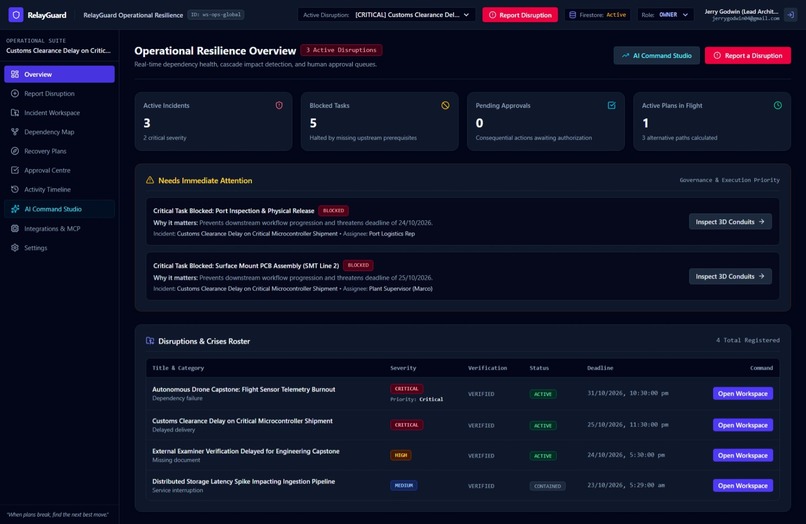
Introducing RelayGuard — Intelligent Disruption Recovery System
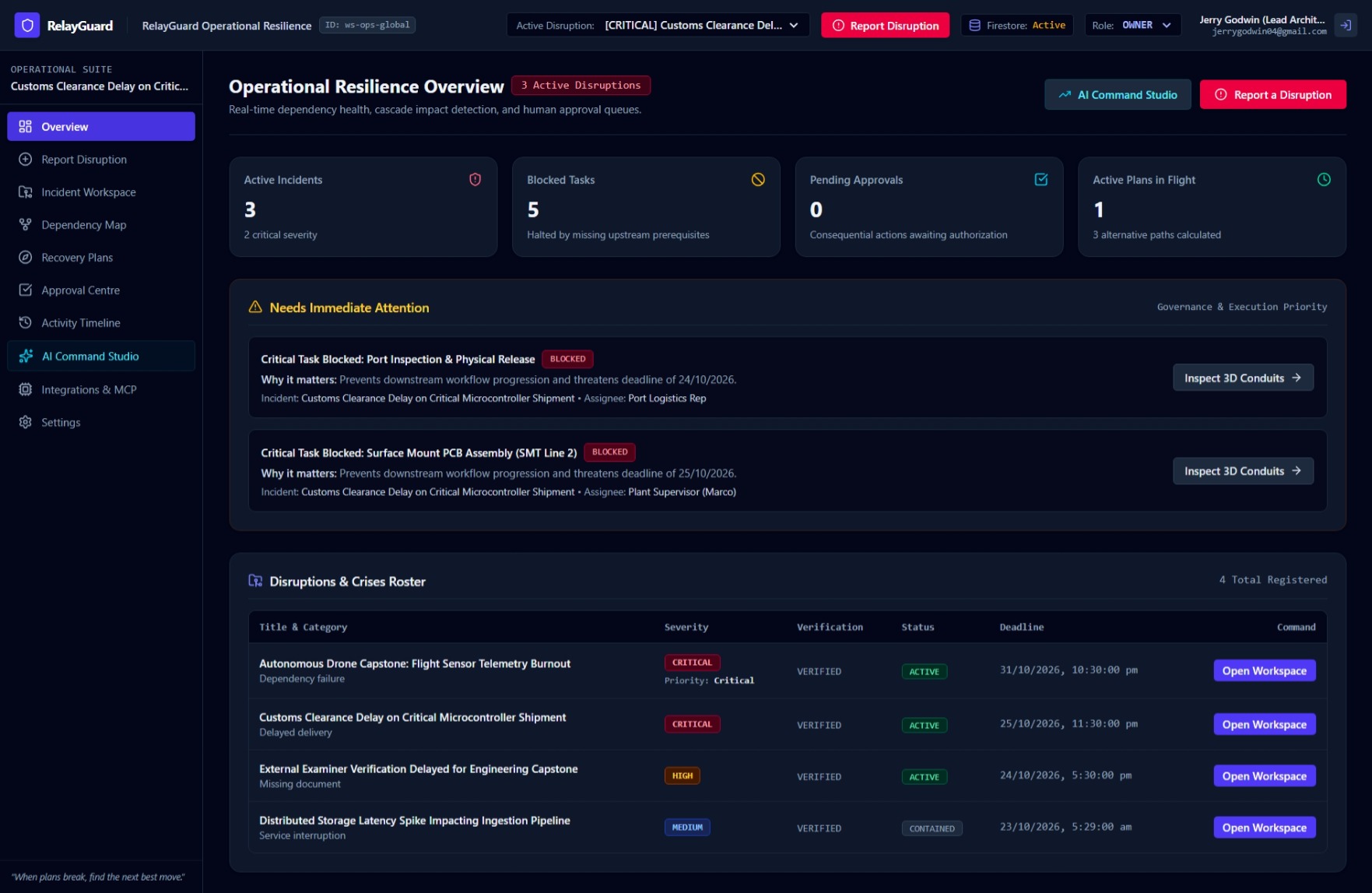
RelayGuard: Intelligent Disruption Recovery and Coordination System
Inspiration
Unexpected disruptions rarely affect just one task. A delayed delivery can postpone a project, a missing document can block an approval, and a missed deadline can affect several dependent commitments. Yet most existing productivity tools focus on recording problems and tracking tasks rather than understanding how disruptions propagate and coordinating a practical recovery.
We wanted to address a fundamental question: What if software could do more than tell us what went wrong? What if it could explain what is affected, identify what matters most, and help us recover intelligently? This idea inspired RelayGuard, an AI-powered disruption recovery and coordination system designed to turn unexpected problems into explainable, dependency-aware recovery plans.
Our goal is to make intelligent recovery accessible to individuals, students, freelancers, and teams that need to coordinate tasks, deadlines, resources, and commitments.
What It Does
RelayGuard transforms disruption management into a structured recovery workflow.
Instead of treating every problem independently, the platform examines the relationships between tasks, prerequisites, deadlines, and commitments to determine how an incident may affect the wider workflow.
Its core capabilities include:
- Disruption Intake: Capture unexpected events, describe their consequences, and identify affected tasks and constraints.
- Dependency Intelligence: Build an interactive dependency graph to identify blocked tasks, downstream impacts, critical dependencies, and work that can continue independently.
- Impact Analysis: Evaluate deadline pressure, task relationships, estimated recovery time, and missing prerequisites.
- Intelligent Recovery Planning: Generate and compare alternative recovery strategies, including minimum-disruption, fastest-feasible, and lower-risk approaches.
- Human-Approved Actions: Separate recommendations from execution, allowing authorized users to review consequential actions before approving them.
- Real-Time Coordination: Update incident information, recovery progress, approvals, and activity timelines as changes occur.
- Adaptive Replanning: Reassess affected tasks and create updated recovery-plan versions when new information changes the situation.
- Auditability: Maintain a traceable history of decisions, approvals, actions, and execution outcomes.
The central innovation is not simply generating an AI recommendation. It is connecting dependency analysis, constrained recovery planning, approval-controlled execution, and change-driven replanning into one coherent workflow.
How We Built It
RelayGuard is designed around a modular full-stack architecture.
Frontend
The user interface is built with React, TypeScript, Vite, and Tailwind CSS. React Router supports navigation, Lucide provides consistent icons, and React Flow can be used to represent task dependencies visually.
The interface is organized around incident workspaces, dependency graphs, recovery plans, approval queues, and activity timelines. The design prioritizes clarity, explainability, accessibility, and practical decision-making over decorative dashboards.
Backend
The backend uses Python and FastAPI to provide structured REST APIs for incident management, task relationships, impact analysis, recovery planning, approvals, and activity history.
Pydantic validates incoming data and structured outputs. SQLAlchemy manages database operations, while Alembic supports versioned database migrations.
Database
PostgreSQL stores persistent application data, including users, organizations, incidents, tasks, dependencies, recovery plans, proposed actions, approvals, notifications, and audit events.
This allows the application to preserve its state across browser refreshes and backend restarts while maintaining relationships between records.
Intelligence and Recovery Planning
The core recovery engine uses deterministic algorithms and explicit business rules to analyze task dependencies, identify blocked work, prioritize recovery actions, and validate candidate plans.
A directed dependency graph supports downstream impact analysis and topological ordering. Where the available data permits, scheduling logic can estimate completion times and identify critical paths.
AI can complement this deterministic foundation by interpreting natural-language incident descriptions, summarizing verified information, explaining plan differences, and proposing alternatives. Structured outputs must be validated against actual records and known constraints before they are accepted.
Real-Time Updates
Authenticated WebSocket connections allow connected clients to receive updates about incidents, tasks, approvals, recovery plans, and execution outcomes.
The backend persists relevant changes before publishing events, while the frontend refreshes authoritative data when necessary.
Agentic Integration
RelayGuard is designed to expose narrowly scoped tools through an MCP server using Streamable HTTP where the required protocol implementation is available.
Potential tools include incident retrieval, impact analysis, recovery-plan generation, plan validation, approval workflows, and replanning.
External actions remain subject to permissions, approval requirements, and integration availability. Simulated integrations must be clearly identified rather than presented as live third-party connections.
Challenges We Addressed
Understanding Cascading Dependencies
A disruption can affect tasks that are several steps removed from the original problem. RelayGuard addresses this by representing dependencies explicitly and tracing how an unavailable prerequisite can block downstream work.
Balancing AI Flexibility with Reliability
AI-generated plans can be incomplete, inconsistent, or based on assumptions. Our approach separates AI suggestions from deterministic validation, using actual task records, known constraints, and explicit approval rules to evaluate proposed actions.
Preventing Unsafe Automation
Automatically changing deadlines, assignments, or external commitments can create additional problems. RelayGuard distinguishes recommendations from execution and requires appropriate authorization before consequential actions proceed.
Maintaining Consistency Across Components
A recovery plan, dependency graph, and activity timeline must reflect the same underlying information. A persistent database, centralized API layer, structured validation, and real-time event handling help keep these views consistent.
Designing for Real-World Use
A useful recovery system must explain its recommendations instead of simply displaying a priority score. RelayGuard aims to show the affected records, reasons for prioritization, assumptions, uncertainty, and trade-offs behind each recovery decision.
What We Learned
Building RelayGuard reinforced the importance of combining AI with reliable software engineering.
We learned that useful agentic systems require more than an LLM and a collection of tools. They need clear tool contracts, validated inputs and outputs, explicit permissions, persistent state, observable actions, and a dependable mechanism for human oversight.
We also learned that dependency analysis and deterministic planning are essential complements to generative AI. AI can help interpret ambiguous information and communicate recommendations, while algorithms and business rules can verify task relationships and enforce known constraints.
Most importantly, we learned that the quality of an AI system should be measured not only by the recommendations it generates, but also by whether users can understand, verify, approve, and safely act on those recommendations.
Real-World Impact
RelayGuard is designed for situations in which disruptions have consequences beyond the original event.
A student team could use it when a missing document threatens a project submission. A freelancer could use it when a delayed client approval affects several deliverables. An operations team could use it to understand which commitments are affected by a resource interruption.
Across these scenarios, the same underlying process applies: capture the disruption, map dependencies, analyze consequences, compare recovery options, approve appropriate actions, and replan when circumstances change.
Our long-term vision is to make disruption recovery more transparent, coordinated, and accessible by helping people understand not only what has gone wrong, but also what they can realistically do next.
What's Next
Future development could include verified integrations with calendars, project-management systems, messaging services, and operational data sources; configurable recovery policies; richer scheduling constraints; and additional agentic workflows.
We also aim to evaluate RelayGuard using measurable outcomes, including the time required to identify affected tasks, the accuracy of blocked-task detection, the feasibility of generated plans, recovery time, and the number of actions completed without unauthorized execution.
RelayGuard turns disruption management from reactive problem tracking into explainable, approval-controlled recovery coordination.
Built With
- aiml
- amazon-alexa
- amazon-web-services
- amazonbee
- css
- datavisualization
- fastapi
- gemini
- generativeai
- github
- modelcontextprotocol
- postgresql
- python
- react
- tailwind
- typescript
- vite

Log in or sign up for Devpost to join the conversation.