Inspiration
Incident agents are getting more autonomous — but outages do not forgive messy handoffs. A worker can crash mid-run, come back late, and commit a duplicate fix. Or worse: retrieve a similar-looking runbook that is expired, failed before, or completely unrelated, and act on it anyway.
I built RelayGuard because agent memory needs the same rigor as production data: durable state, fencing, an audit trail, and guardrails before anything reaches remediation. CockroachDB is the natural fit — one survivable system of record for vector recall, leases, checkpoints, and the action ledger.
What it does
RelayGuard coordinates crash-safe incident handoffs for autonomous agents:
- Retrieve semantically similar memories from a 63-entry corpus (CockroachDB VECTOR)
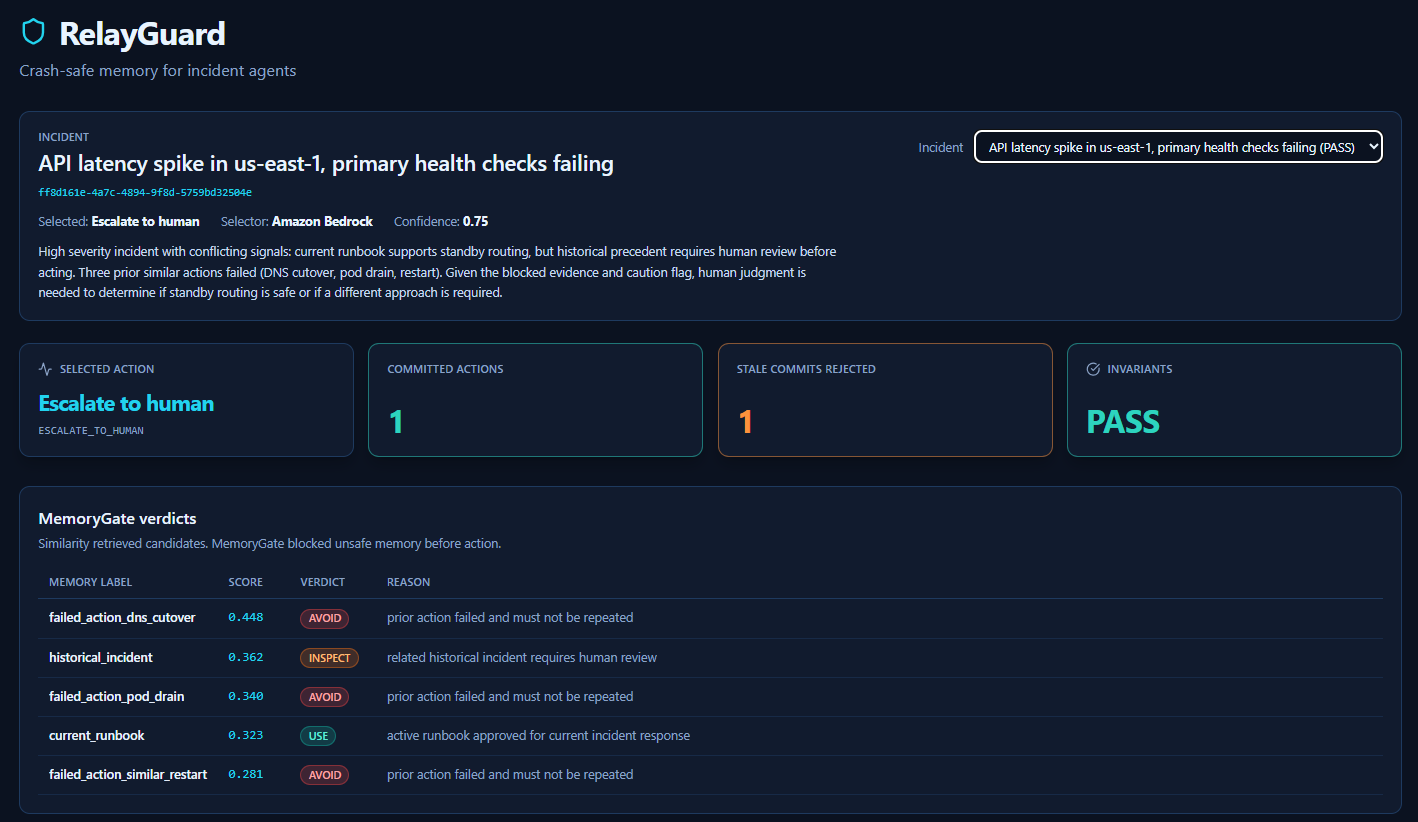
- Classify with MemoryGate — USE, INSPECT, or AVOID (similarity alone is not enough)
- Select an allowlisted action via Amazon Bedrock (or a deterministic mock for CI)
- Reserve in an idempotent ledger with lease fencing
- Resume from checkpoints after crash or failover
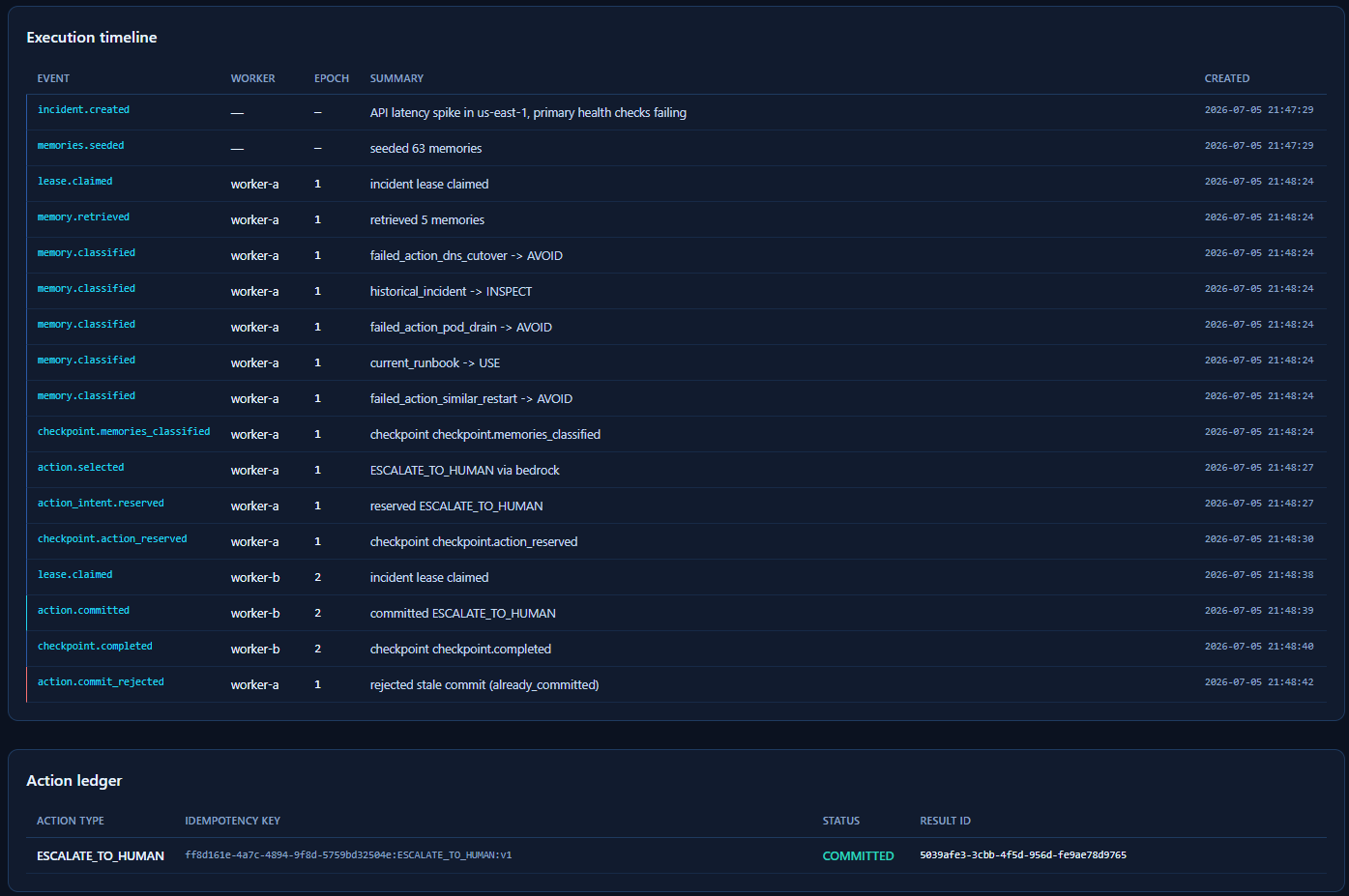
- Audit every retrieval, verdict, reservation, commit, and stale rejection
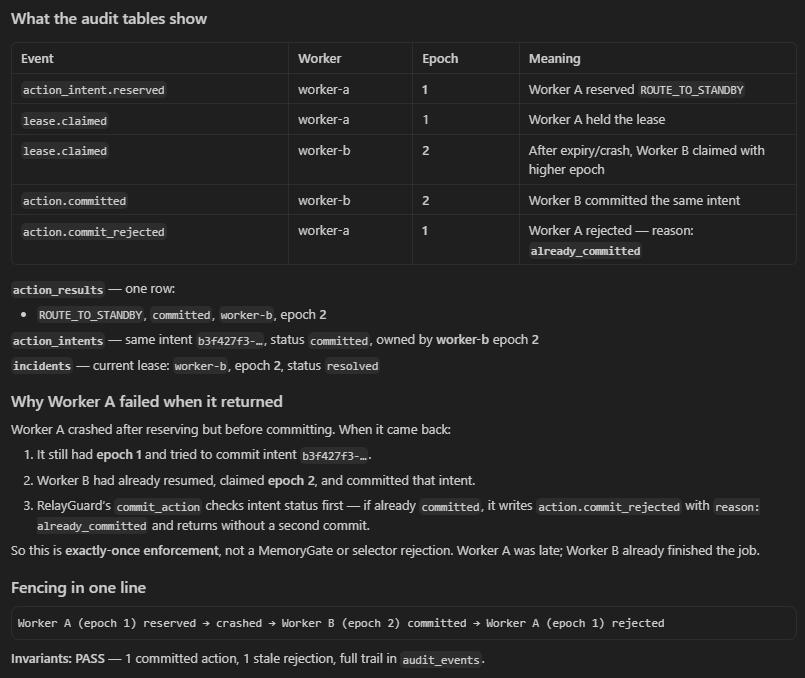
Live demo story: Worker A classifies memories, Bedrock chooses Escalate to Human when an approved runbook conflicts with INSPECT precedent and three blocked failures → Worker A crashes after reserving → Worker B resumes and commits once → Worker A's stale commit is rejected → Invariants PASS.
Judges can verify on the Railway dashboard or via read-only Managed MCP — no write credentials exposed.
How I built it
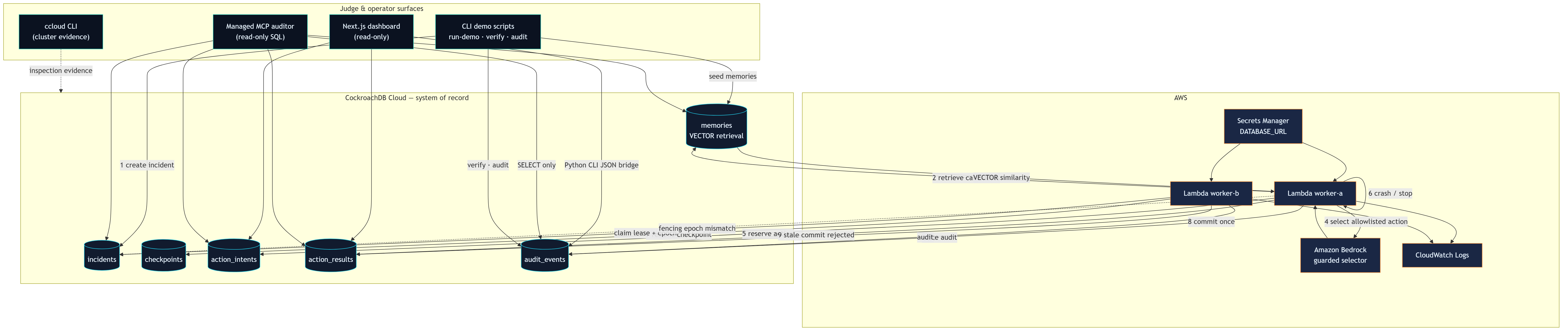
- CockroachDB Cloud — memories (VECTOR index), incidents (lease + epoch), checkpoints, action_intents, action_results, audit_events
- Python workers — MemoryGate classifier, semantic retriever, checkpointed worker runtime with serializable-conflict retries (40001)
- Amazon Bedrock — Haiku 4.5 inference profile for guarded action selection; optional Titan v2 embeddings
- AWS Lambda — regional workers, Secrets Manager for DATABASE_URL, CloudWatch proof
- Next.js dashboard (Railway) — read-only judge UI; server-side Python CLI bridge to CockroachDB
- Managed MCP — read-only SELECT on audit tables for post-incident proof
- Terraform + Docker Compose for Lambda deploy and local integration tests (79/79 passing)
Challenges I ran into
- Demo title drove retrieval — meta titles pulled noise into top-5; fixing the incident title to real ops vocabulary (API latency spike…) was required for a credible MemoryGate + Bedrock story.
- Bedrock IAM — inference profiles need foundation-model ARNs and one-time AWS Marketplace permissions for model enablement.
- Guarded selection vs hero narrative — Bedrock correctly escalates when USE and INSPECT signals conflict; that is a feature, not a failure — escalation is still a committed, audited action.
- Railway + CockroachDB SSL — bundled CA certs and trusting explicit RELAYGUARD_SSL_ROOT_CERT overrides across Lambda, Railway, and Windows dev.
- Prompt accuracy — AVOID memory content is stripped from the Bedrock prompt; INSPECT memories enter with an explicit caution flag — the selector design had to be honest about that in docs and demo narration.
Accomplishments that I'm proud of
- End-to-end crash handoff with provable invariants: 1 commit, 1 stale rejection, PASS
- MemoryGate blocking high-similarity failed actions while approving the current runbook
- Live Amazon Bedrock selector on the judge dashboard — not mock, not fallback
- 63-memory corpus with real VECTOR retrieval on CockroachDB Cloud
- Read-only proof paths — Railway dashboard + Managed MCP screenshots with no write creds in the browser or MCP session
- Full evidence bundle (
docs/evidence/) — CloudWatch, Lambda, Bedrock run, dashboard captures, reproducible demo scripts
What I learned
- Vector search is retrieval, not judgment — you need a gate between similarity and action selection.
- CockroachDB works well as agent execution memory: leases, epochs, and serializable transactions make "resume after crash" provable instead of hopeful.
- Bedrock fits guardrails, not autopilot — the best demo moment was the model choosing restraint (escalation) when precedent was ambiguous.
Built With
- amazon-bedrock
- aws-lambda
- cockroachdb-cloud
- docker
- managed-mcp
- next.js
- pytest
- python
- railway
- tailwind-css
- terraform
- typescript
- vector

Log in or sign up for Devpost to join the conversation.