Inspiration
Healthcare AI often focuses on making one agent smarter. We wanted to explore a different question: how can multiple healthcare agents collaborate more safely when important discharge information is handed from one agent to another?
Discharge workflows are high-risk because key details can easily be missed, such as severe allergies, anticoagulation requirements, renal dosing concerns, pending lab results, and follow-up timing. We wanted to build a system that does not stop at generating a draft, but instead turns the discharge process into a safer, reviewable, and operational workflow.
That idea led to RelayGuard.
What it does
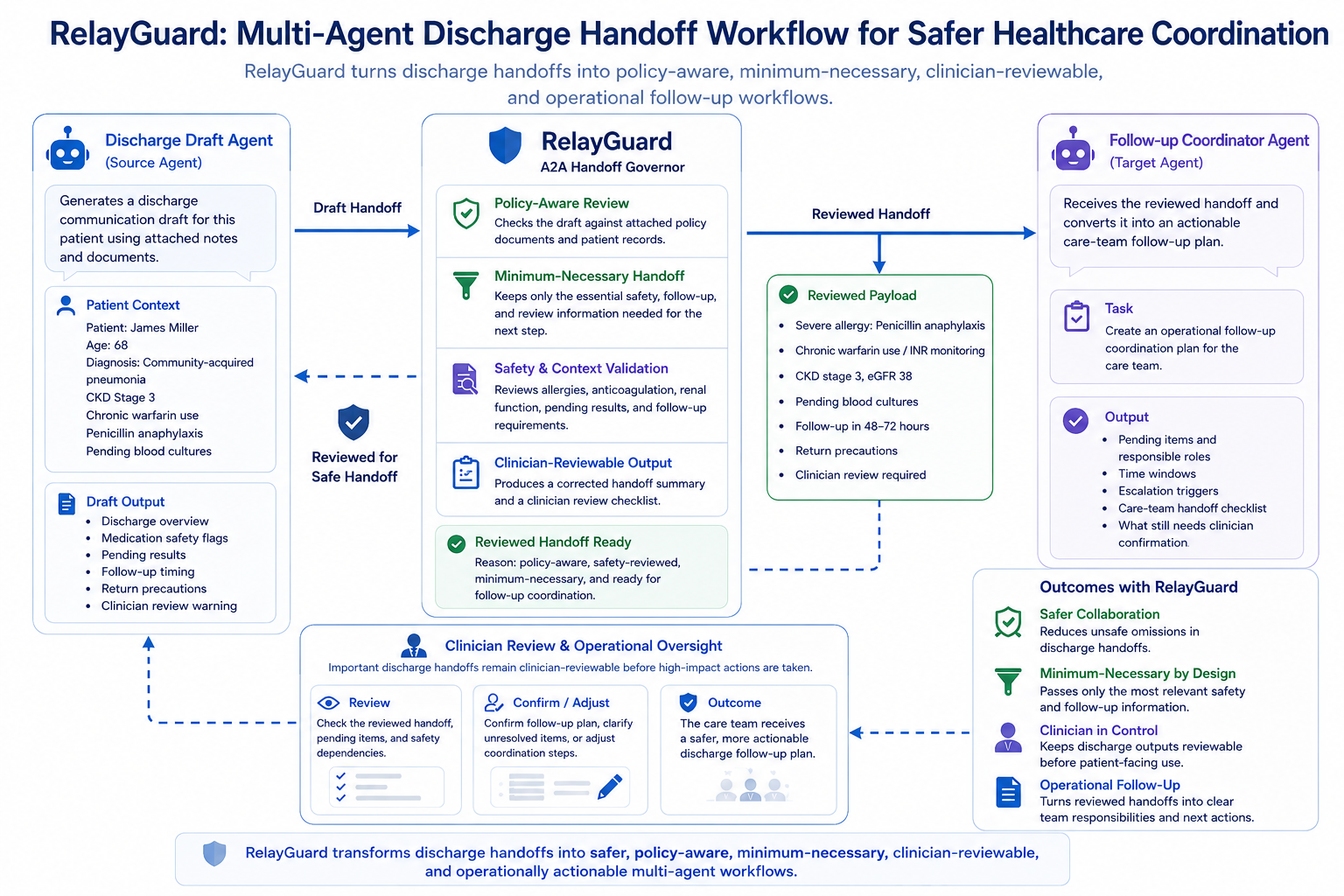
RelayGuard is a multi-agent discharge handoff workflow built in Prompt Opinion. Instead of relying on a single agent, the workflow separates the task into three focused roles:
- Discharge Draft Agent creates an initial discharge communication draft from patient-attached notes and documents.
- RelayGuard Agent reviews that draft against patient context and policy-grounded content, checks for safety and completeness, and produces a corrected minimum-necessary handoff plus a clinician review checklist.
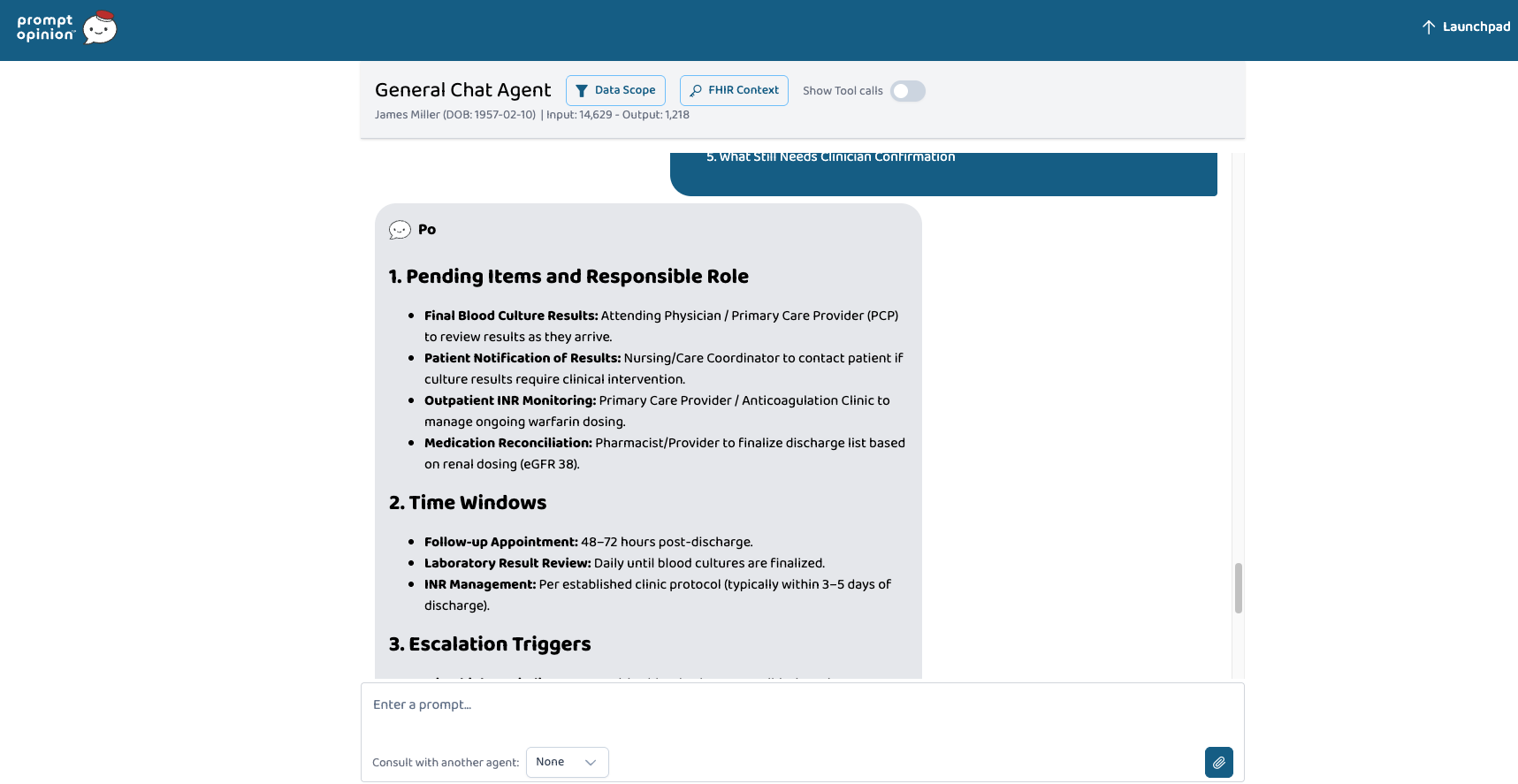
- Follow-up Coordinator Agent converts the reviewed handoff into an actionable care-team follow-up plan with responsible roles, time windows, escalation triggers, and items that still need clinician confirmation.
This makes the workflow more transparent, safer, and more aligned with real clinical coordination.
How we built it
We built the project entirely around the Prompt Opinion platform using the A2A workflow approach.
We started with a synthetic patient scenario involving:
- community-acquired pneumonia,
- penicillin anaphylaxis,
- chronic warfarin use,
- stage 3 chronic kidney disease with eGFR 38,
- and pending blood cultures.
We attached patient notes and discharge planning documents to the patient record, and we also created a grounded policy collection containing discharge, medication safety, and pending-results policies.
Then we configured three A2A-enabled agents:
- a drafting agent,
- a policy-aware review agent,
- and a follow-up coordination agent.
We designed each agent to do one job well, rather than asking one large agent to do everything at once. This improved clarity, output structure, and reliability.
Challenges we faced
One of the biggest challenges was deciding how much to ask each agent to do. Early versions of the workflow tried to make the review agent both summarize and validate the entire discharge handoff, which increased latency and made the workflow less stable.
We solved this by separating responsibilities more clearly:
- one agent drafts,
- one agent reviews,
- one agent operationalizes follow-up.
Another challenge was grounding the review agent in policy content while also keeping the workflow easy to demonstrate. We addressed this by using both patient-attached documents and a workspace collection for policy-aware review.
We also had to make sure the outputs stayed concise and clinician-reviewable rather than overproducing long summaries.
What we learned
We learned that in healthcare, the handoff between agents can be just as important as the intelligence of any single agent.
A strong multi-agent workflow should not only generate text. It should:
- preserve the most important patient-specific risks,
- apply policy-aware review,
- keep clinicians in control,
- and translate reviewed outputs into clear operational next steps.
RelayGuard helped us see that safer healthcare AI is not just about generation. It is also about review, accountability, and coordinated follow-up.
Why this matters
RelayGuard is designed as a safer pattern for healthcare agent collaboration.
Instead of ending with a draft, the workflow moves from: draft generation → safety and policy review → follow-up coordination
This creates outputs that are more actionable for care teams and more appropriate for clinician oversight.
Our goal was to show that multi-agent healthcare workflows can be built in a practical way inside Prompt Opinion while remaining patient-specific, policy-aware, minimum-necessary, and operationally useful.
Built With
- a2a-agents
- gemini-3-flash-preview
- prompt-opinion

Log in or sign up for Devpost to join the conversation.