Inspiration
We wanted to build a support system where every actor has an identity, every handoff preserves context, and every action is auditable — the way it should work but never does in practice.
How we built it
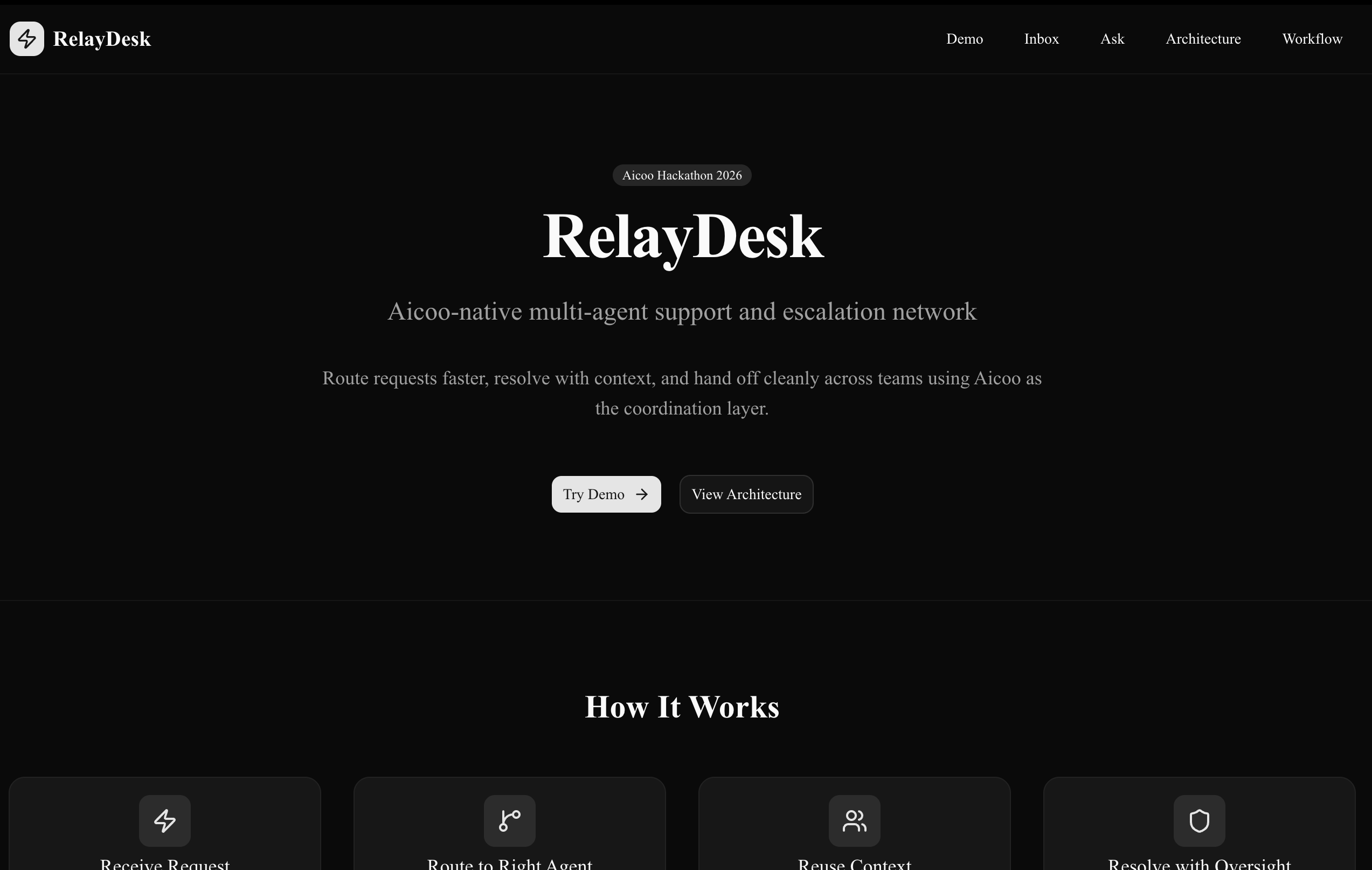
RelayDesk is built around Aicoo as the coordination layer — not bolted on after, but central to every routing and handoff decision.Each agent has a registered Aicoo identity with role, team, and capabilities. When a request comes in, NVIDIA NIM (Llama 3.3 Nemotron Super 49B) analyzes it for category, urgency, and sentiment. Aicoo then routes it to the correct specialist agent and attaches a context cell carrying the full case state — so the specialist never asks the customer to repeat themselves.
Human agents can review, override, or approve AI-drafted resolutions. Every action — AI or human — is written to the audit trail.
Challenges we ran into
Getting NVIDIA NIM to return reliable structured JSON required careful prompt engineering and a fallback layer
- Aicoo's context cell model required rethinking how we pass state — traditional prop drilling doesn't apply when agents are independent processes
- Balancing AI autonomy with human oversight without making the human-in-the-loop feel like a bottleneck ## What we learned
- Aicoo's agent identity model forces you to think clearly about what each agent is responsible for — it made our architecture cleaner than if we'd used raw API calls
- Structured JSON output from LLMs is fragile without defensive parsing — greedy regex + Zod saved us multiple times
- Vercel's serverless model means in-memory state dies between requests — something we had to design around carefully
Built With
- aicoo
- next.js
- nvidia
- react
- tailwind
- typescript
- vercel
- zod

Log in or sign up for Devpost to join the conversation.