-
-
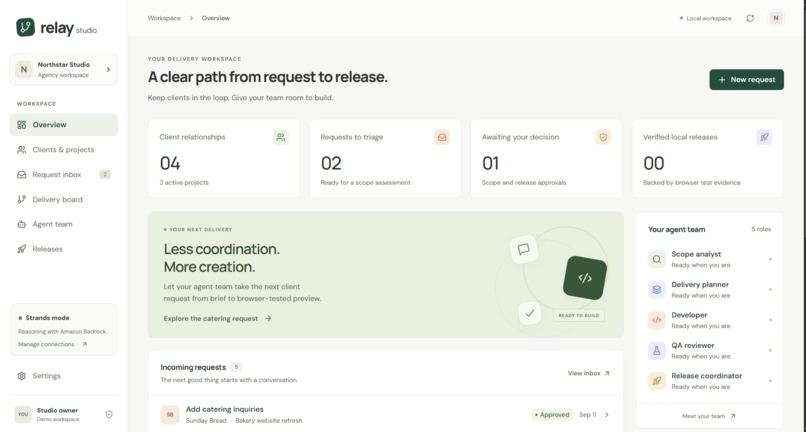
Interface of RelaystudioAI
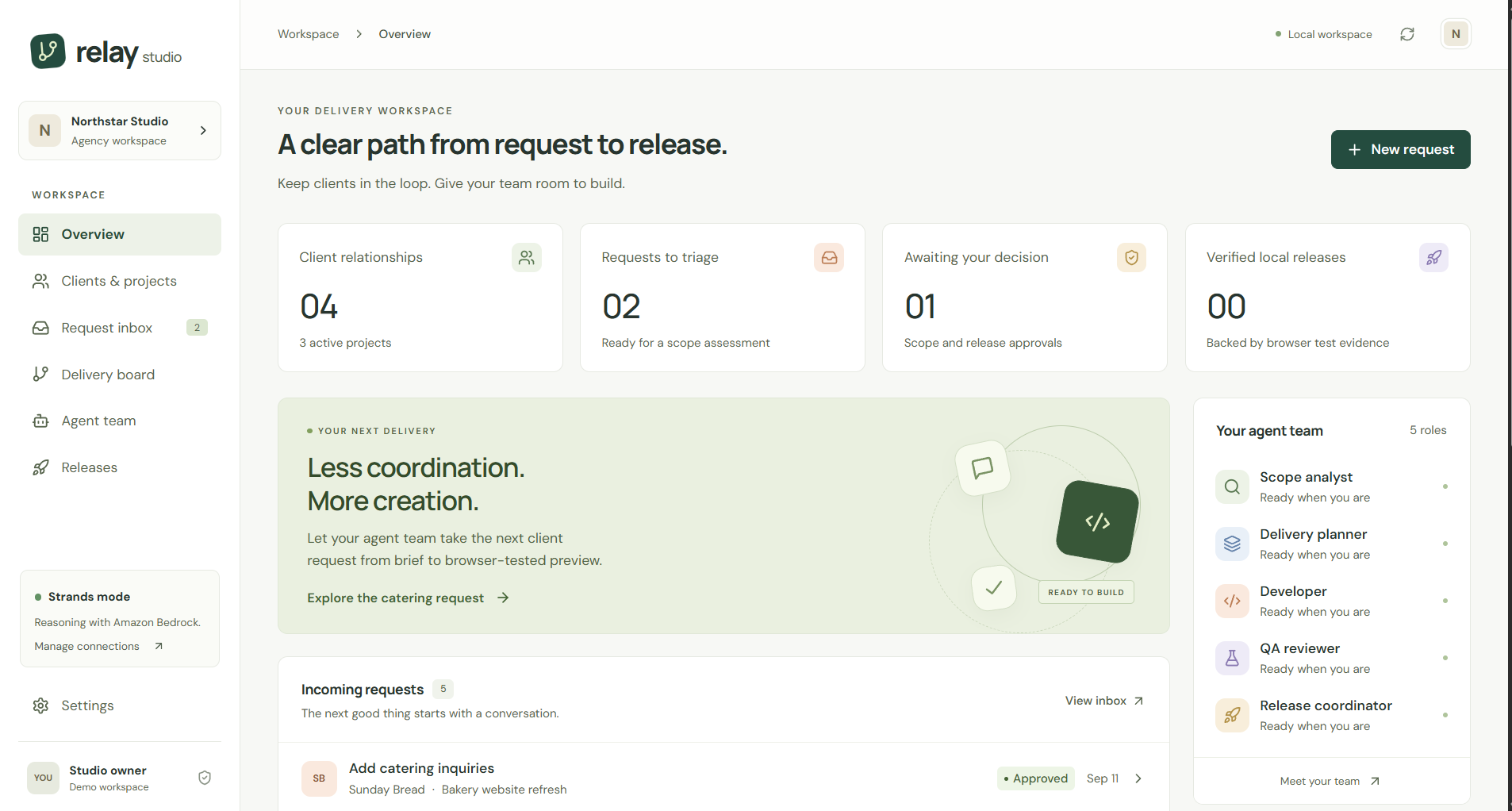
Small web agencies spend valuable time on the work surrounding a website change: understanding client messages, checking the agreed scope, collecting missing details, assigning tasks, testing the result, and getting approval. We built Relay Studio to bring those steps into one workspace. Our goal is to help professionals spend less time coordinating routine changes while keeping control over what gets built and released. What it does Relay Studio combines an agency CRM with a team of five specialized AI agents. It manages clients, project briefs, requests, delivery progress, test evidence, and release history. A request moves through a clear workflow: Client request → Scope assessment → Human approval → Delivery planning → Website generation → Browser testing → Human release approval The prototype demonstrates this workflow through Sunday Bread, a fictional bakery. It supports three working changes: adding a catering inquiry form, adding an external booking link, and updating opening hours. Each release preserves previously approved changes. When a request is ambiguous, Relay Studio asks for clarification. When a change is outside the original agreement, it identifies the additional scope and cites the relevant project brief. How we built it We built the CRM with React, the backend with Node.js and Express, and the agent workflow with the Strands Agents SDK and Amazon Nova 2 Lite through Amazon Bedrock. Five agents contribute distinct outputs:
- Scope analyst: Evaluates requests against the project brief.
- Delivery planner: Creates tasks and acceptance criteria.
- Developer: Produces structured content for the supported website change.
- QA reviewer: Reviews actual browser-test evidence.
- Release coordinator: Drafts release notes for human review. The application validates agent outputs, renders the website, and runs independent checks using Playwright and Chromium. A SHA-256 hash connects release approval to the exact tested artifact. Project state and delivery evidence persist locally. Challenges we ran into One challenge was separating agent judgment from application authority. Agents can interpret requirements and prepare work, but they cannot approve scope, override failed tests, execute arbitrary shell commands, or authorize releases. Live testing also exposed differences between valid JSON and valid business output. For example, a model could return a brief description alongside its evidence ID or copy unrelated opening hours into a catering change. We clarified the instructions and constrained the output schema while preserving strict validation. AWS model access presented another challenge. We moved from a blocked Anthropic Marketplace activation to Amazon Nova 2 Lite, configured narrowly scoped invocation permissions, and verified the complete workflow with live model calls. Accomplishments we’re proud of We completed a working CRM connected to real agent execution and a tested local delivery pipeline. Our verification includes 77 automated unit and integration tests, 12 browser workflow checks, and a live Nova rehearsal covering all five agent roles across three cumulative website changes. Those live deliveries passed 12, 13, and 13 browser checks, respectively. The result includes working previews, downloadable source and evidence, visible agent activity, and separate approvals for scope and release. What we learned Useful professional agents need clear responsibilities, reliable evidence, and explicit boundaries. A convincing workflow must show what changed, why it changed, how it was tested, and who approved it. We also learned that a focused implementation can demonstrate more value than a broad promise of autonomous development. Supporting a small set of changes let us verify the entire journey. What’s next We plan to add a dedicated client approval portal, team permissions, repository-specific implementation, durable background jobs, and public hosting. The current prototype produces local releases. Its catering form demonstrates validation and local confirmation rather than sending inquiries. An optional GitHub draft-PR export adapter is implemented and tested with controlled API responses; live export and production deployment remain future validation steps. ## Accomplishments that we're proud of
What we learned
What's next for Relay_Studio_AI
Built With
- agents
- amazon-web-services
- express.js
- node.js
- nova
- python
- react
- strands

Log in or sign up for Devpost to join the conversation.