-
-
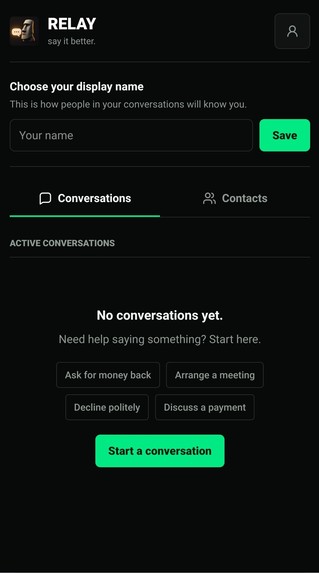
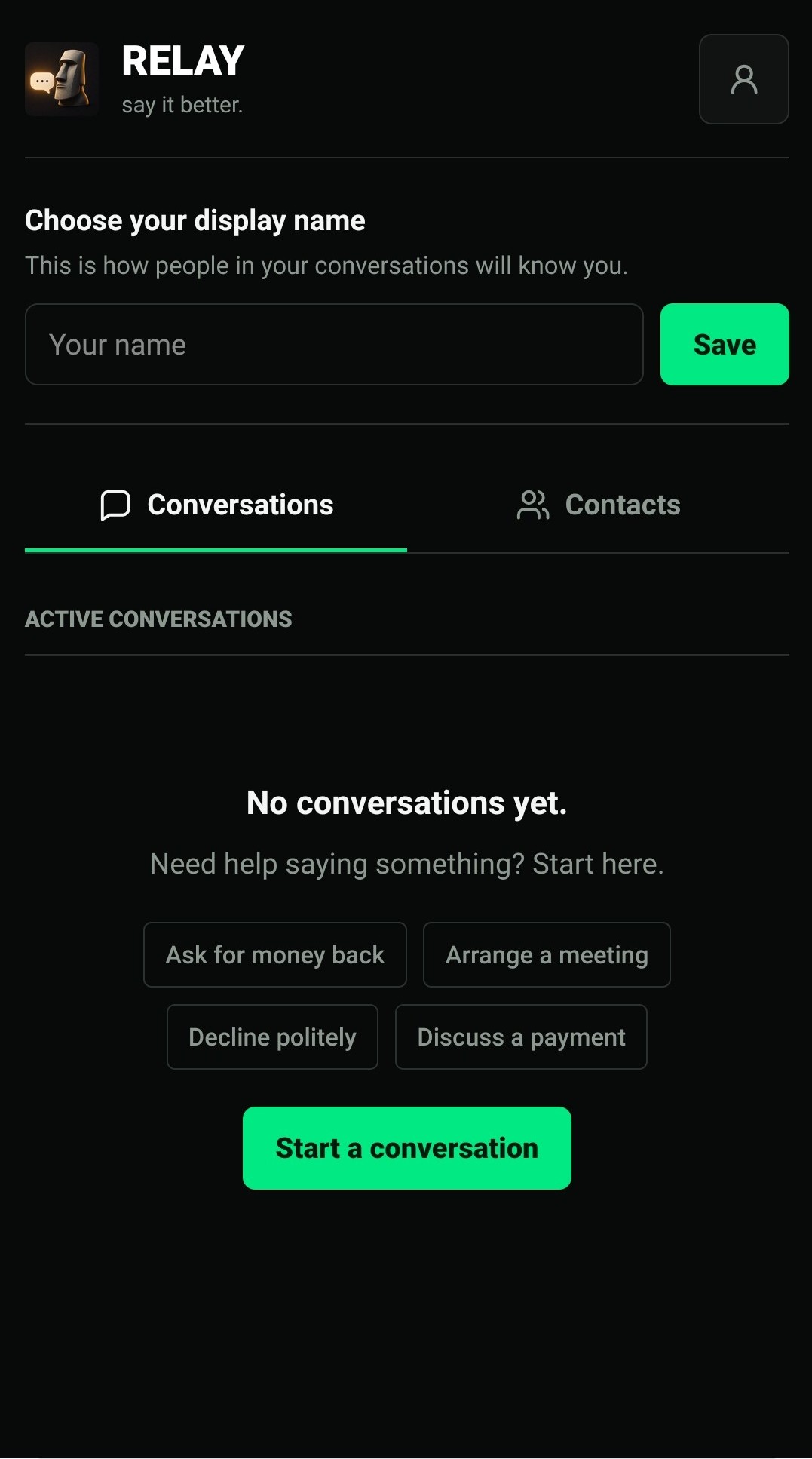
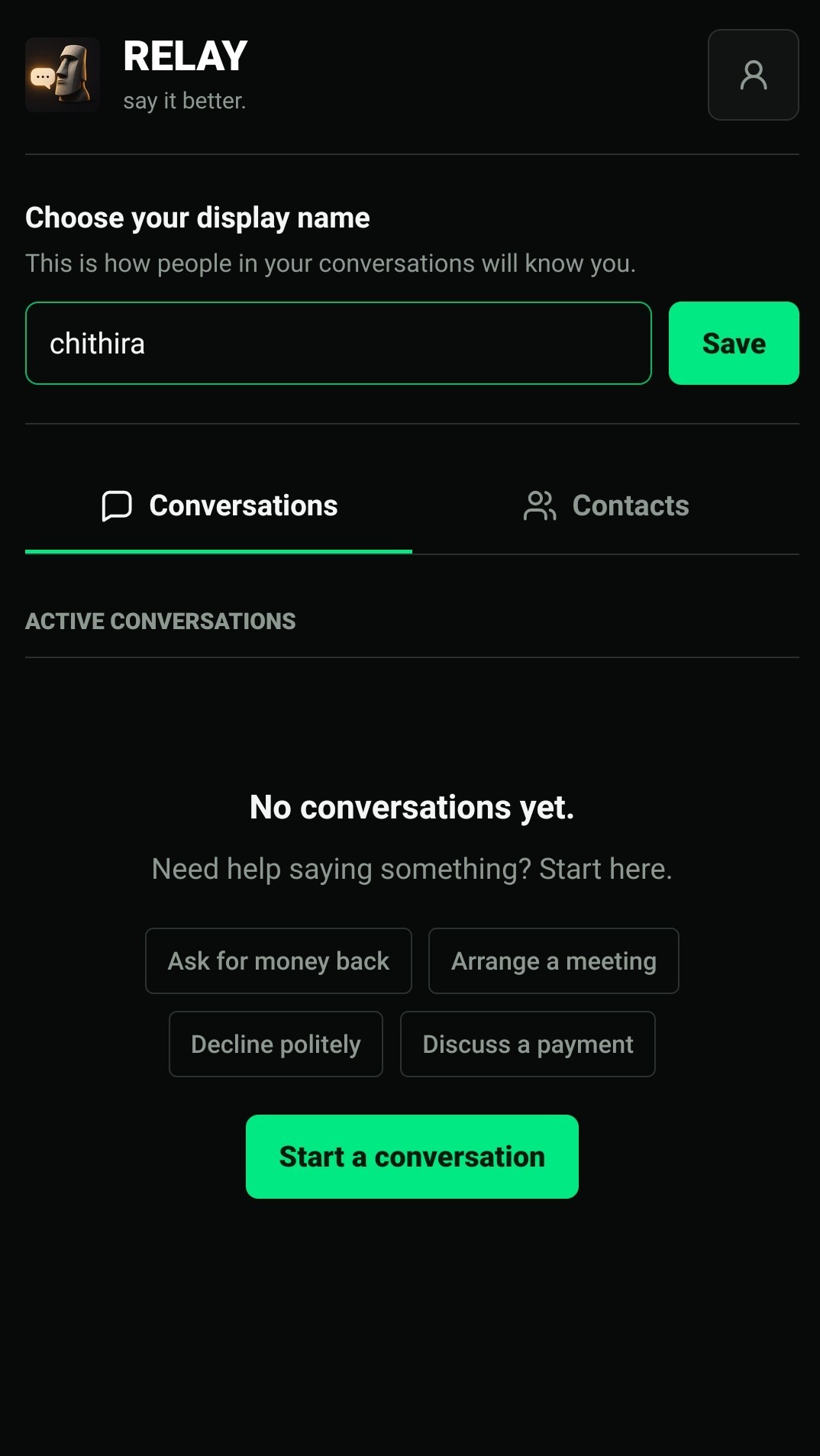
Home
-
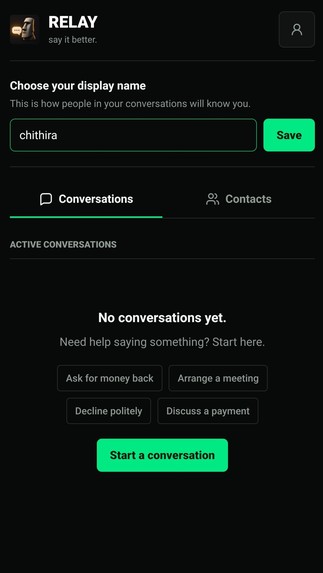
Starter
-
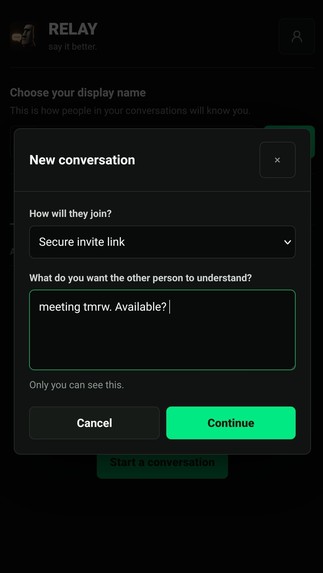
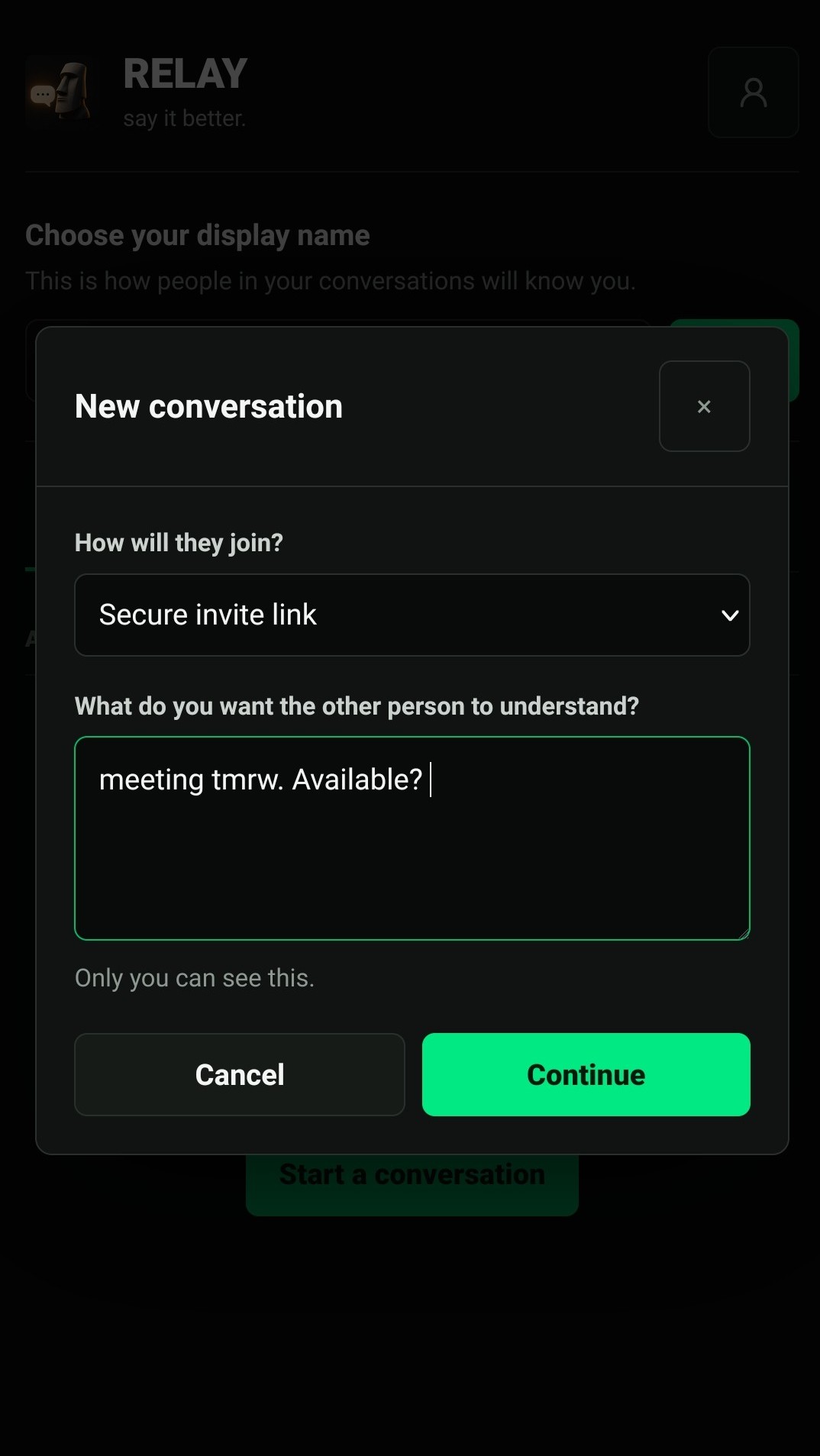
Input Message
-
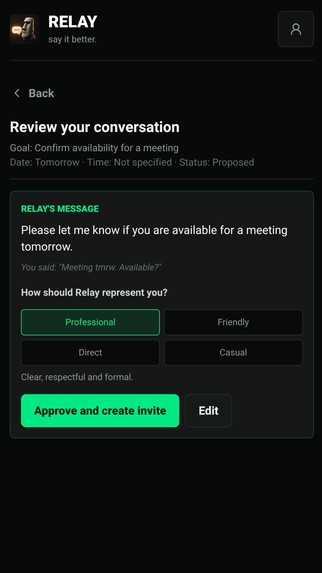
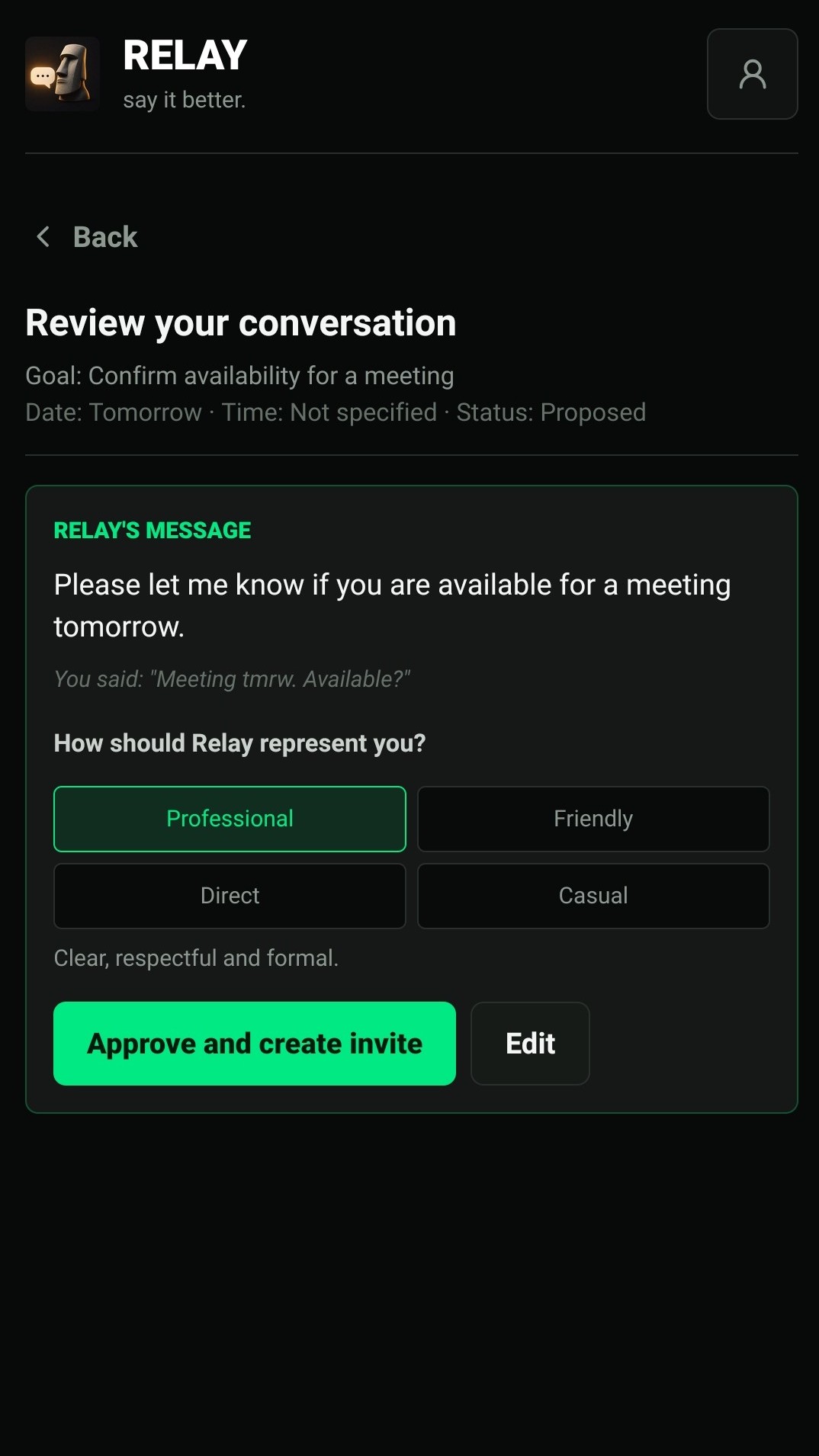
Tone + Approve
-
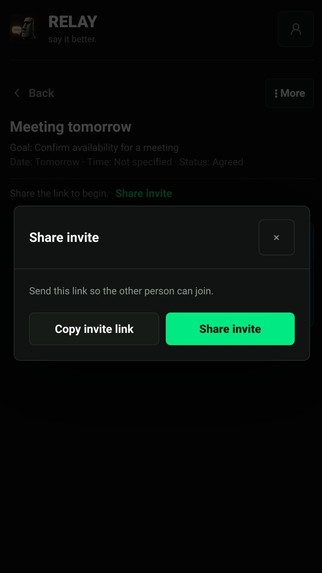
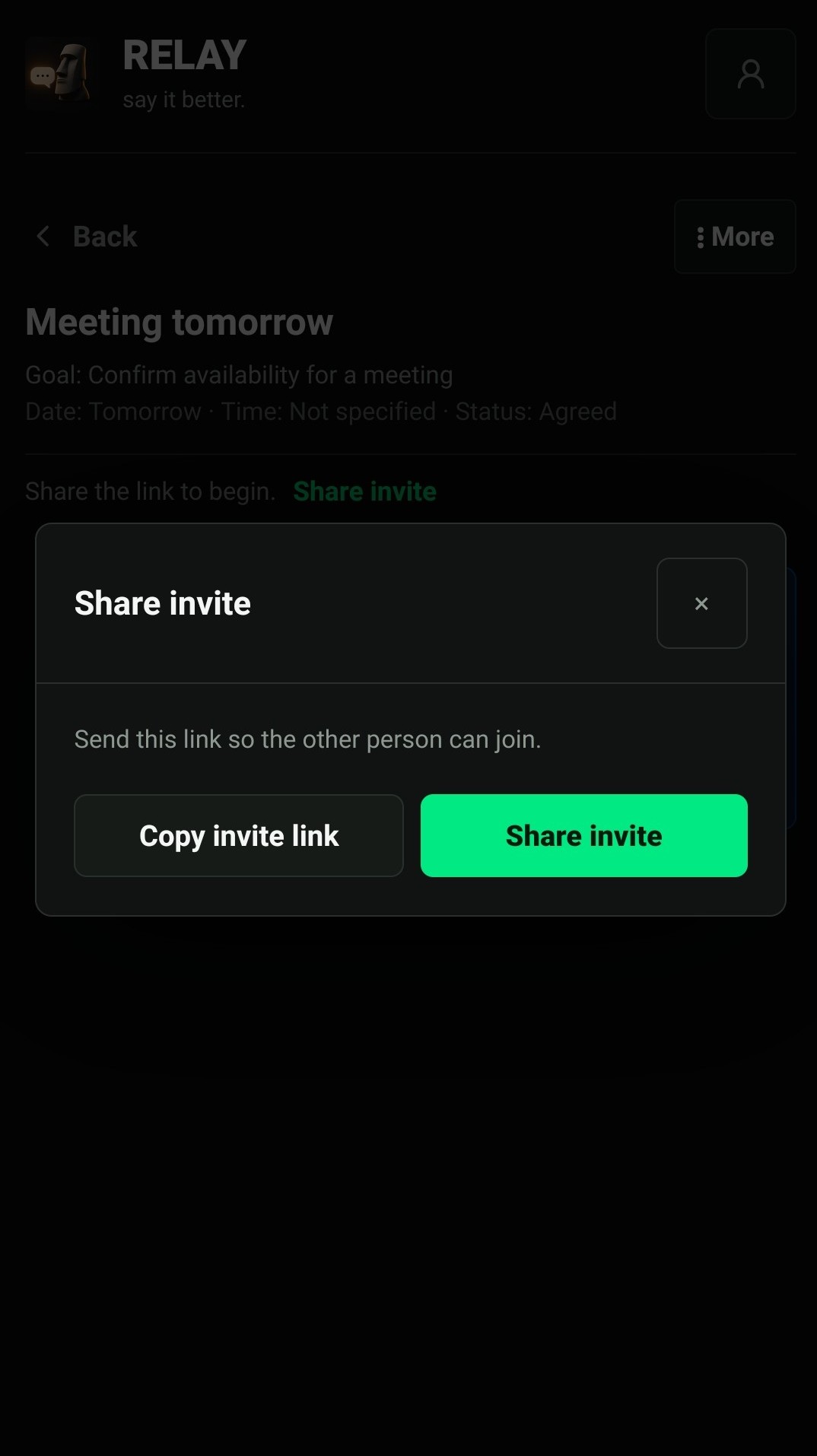
Invite
-

Paste link in Peer phone browser
-
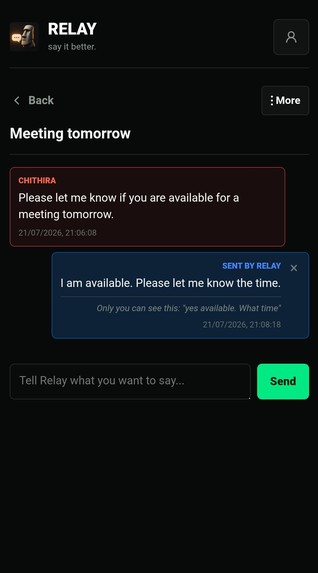
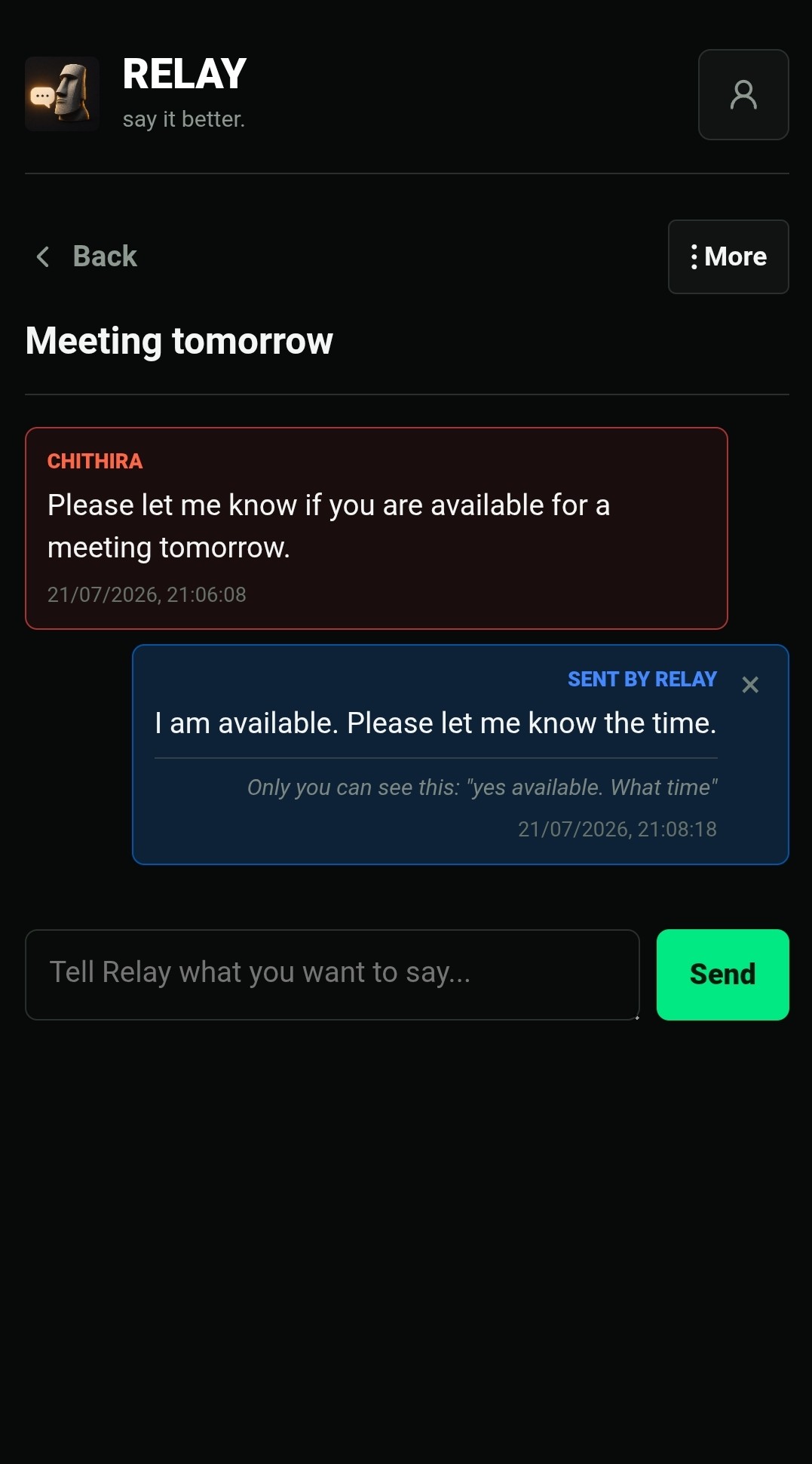
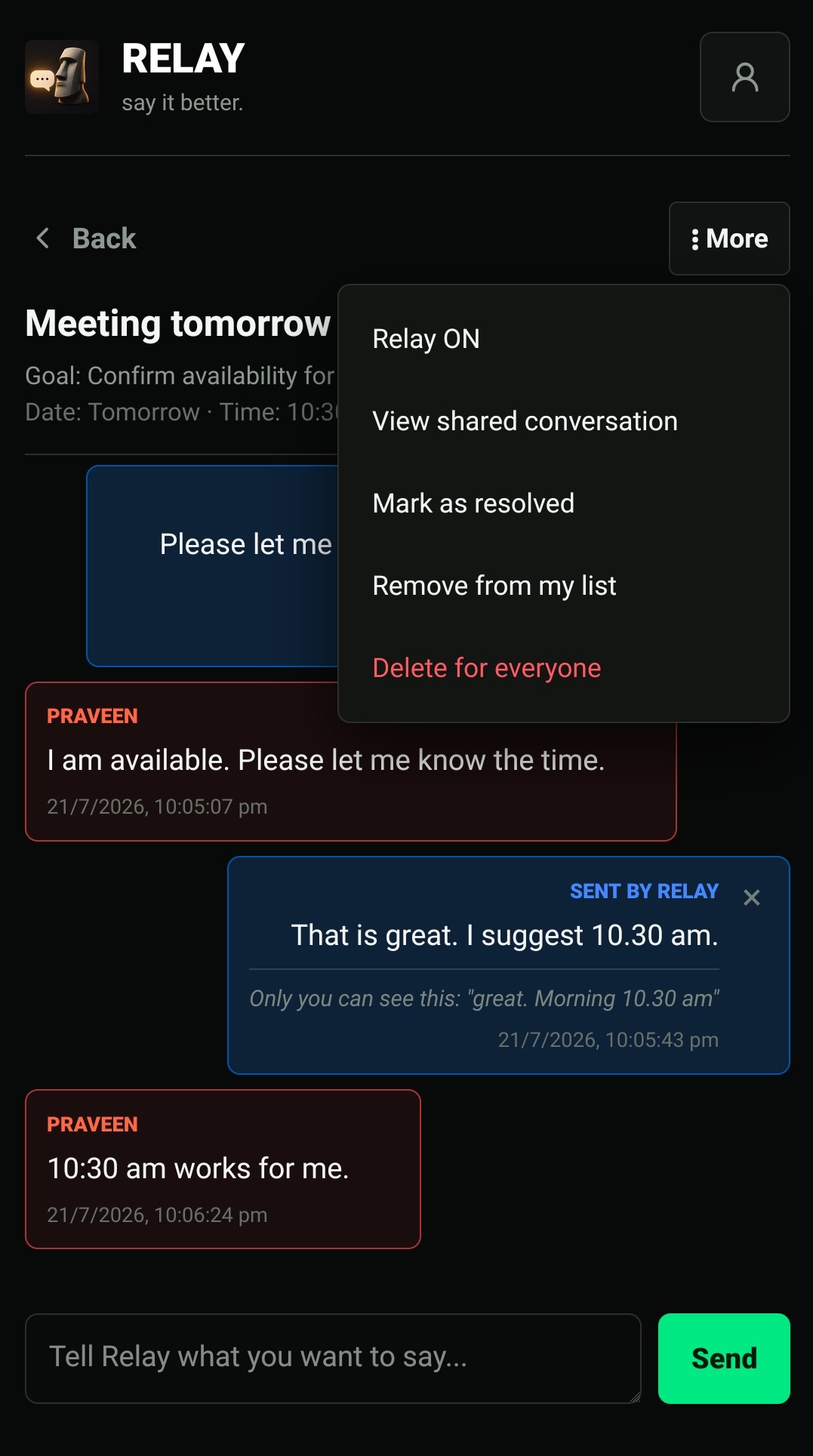
Peer Availability reply
-
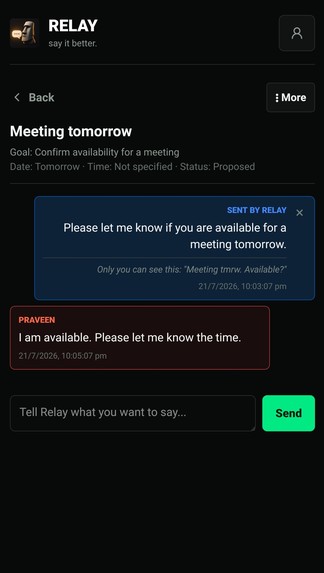
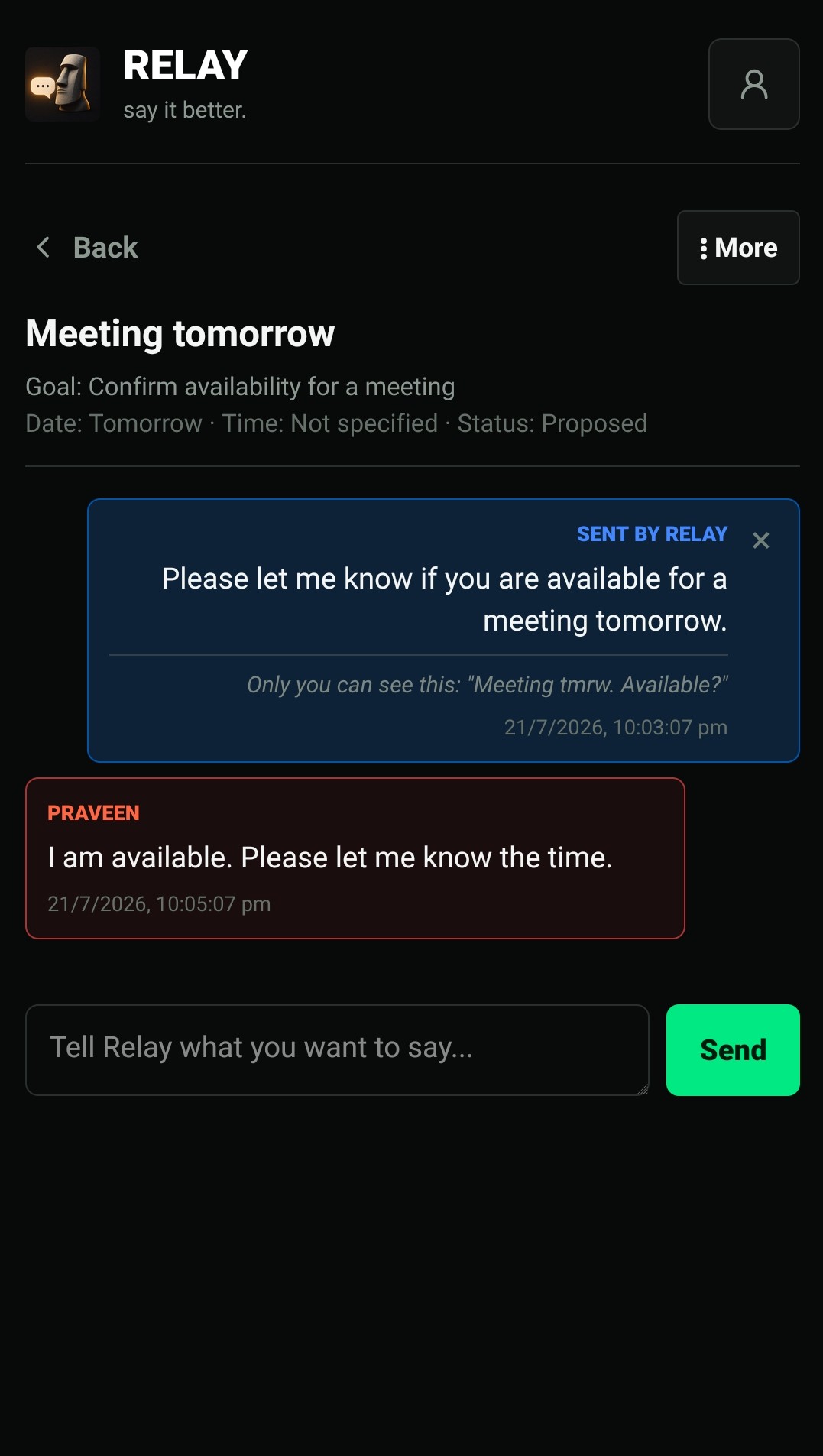
Same message on User Profile/Status Proposed
-
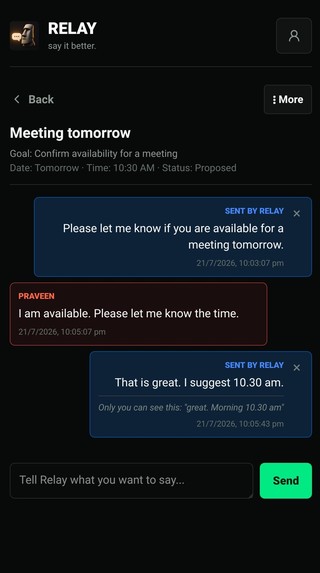
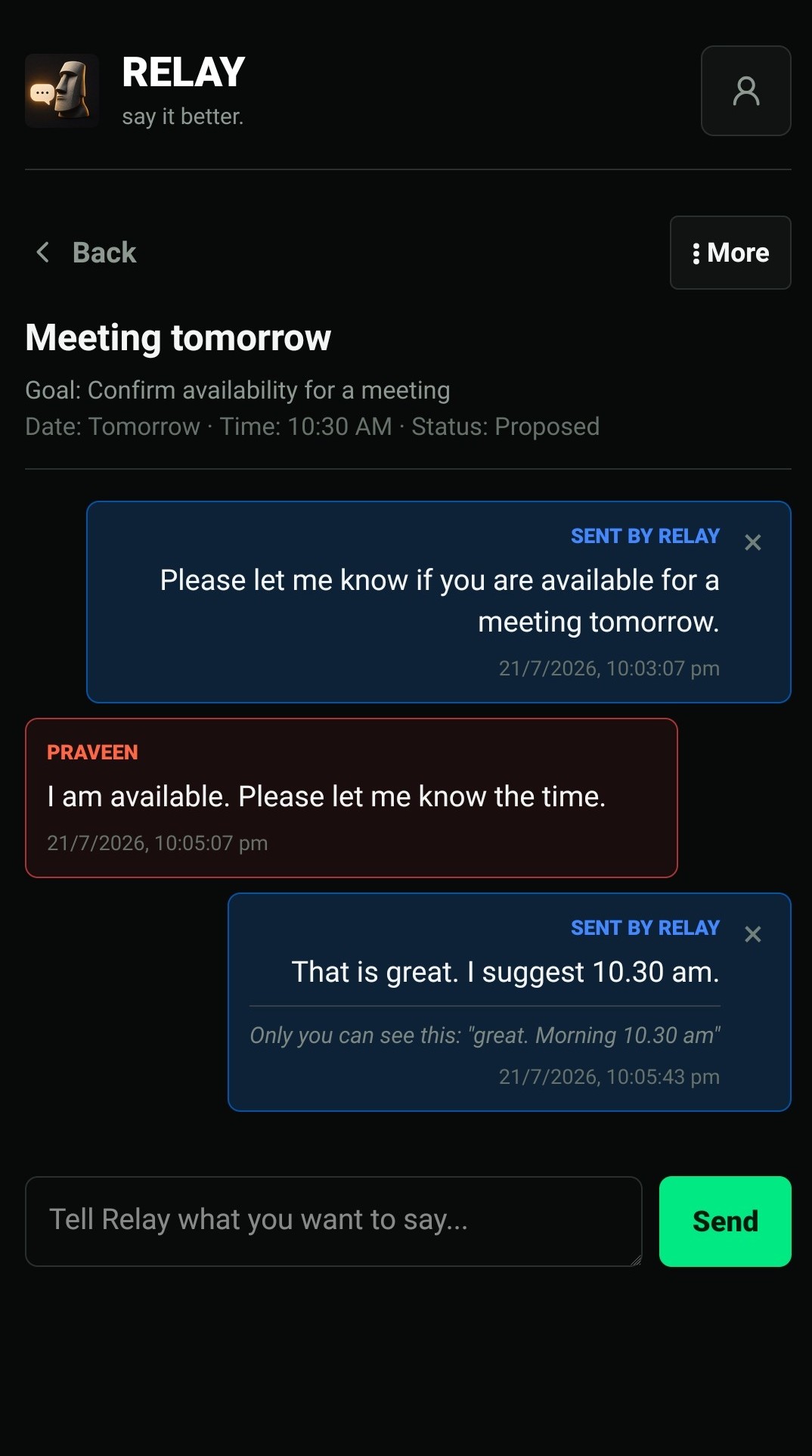
Time proposed, Status Proposed
-
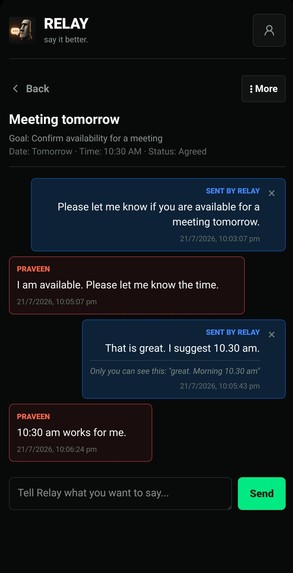
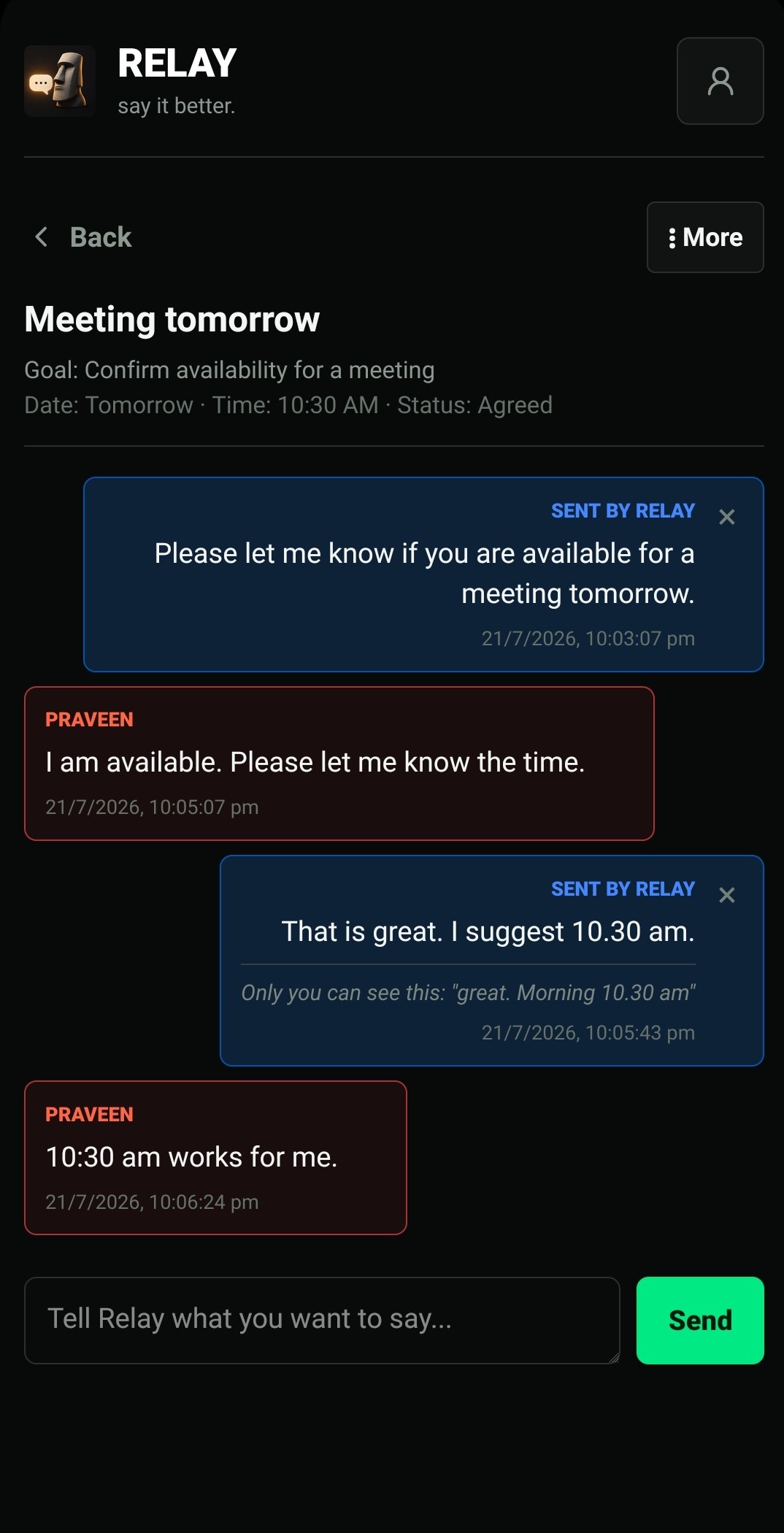
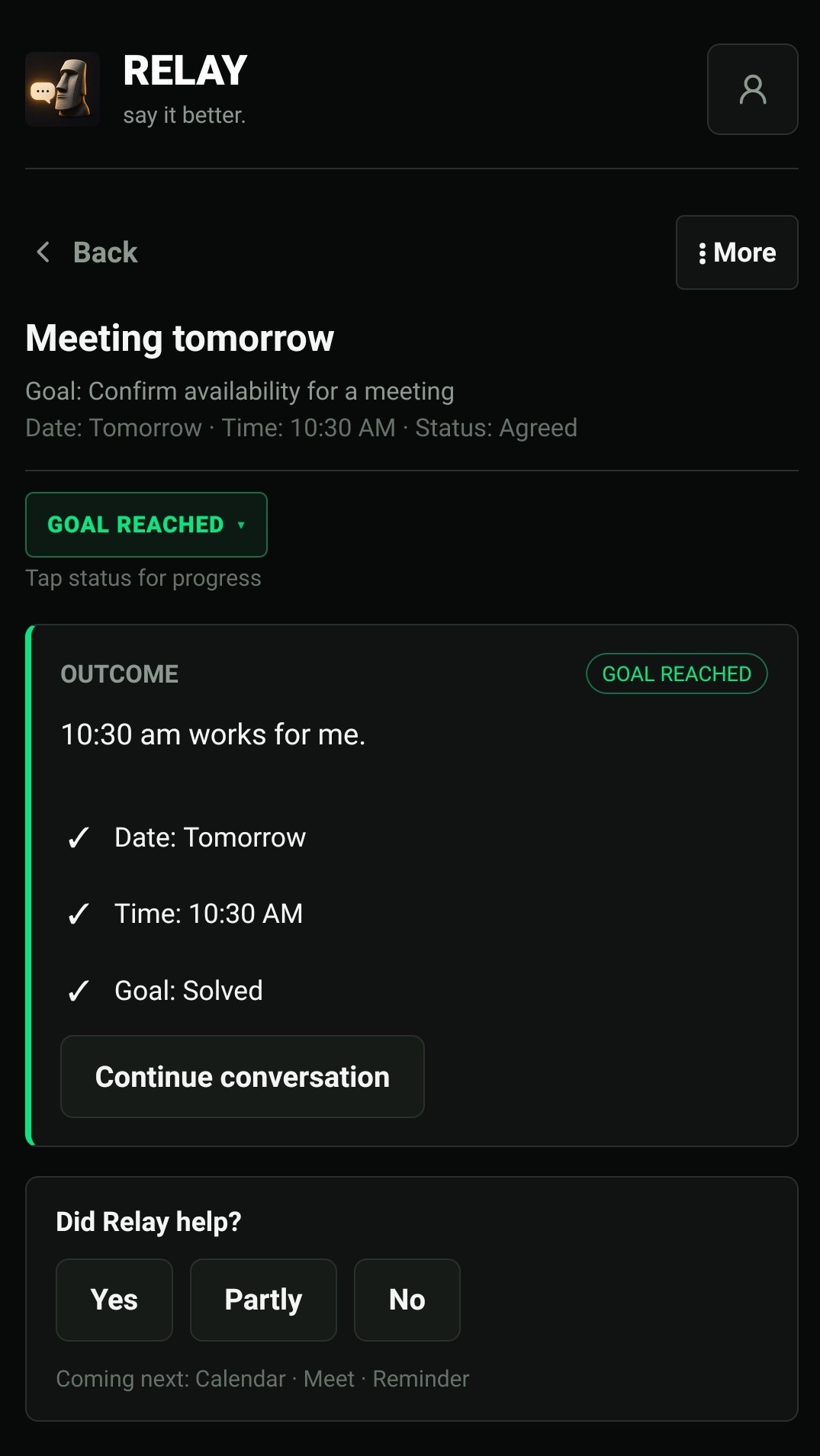
Meeting Status → Agreed
-
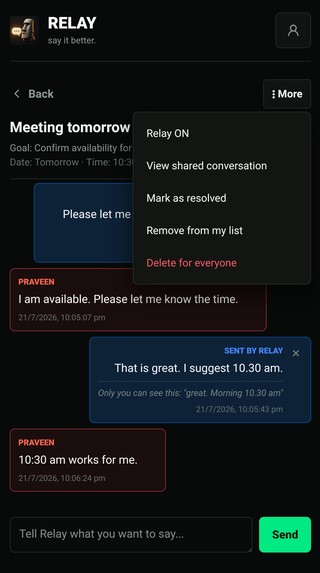
Mark Resolved
-
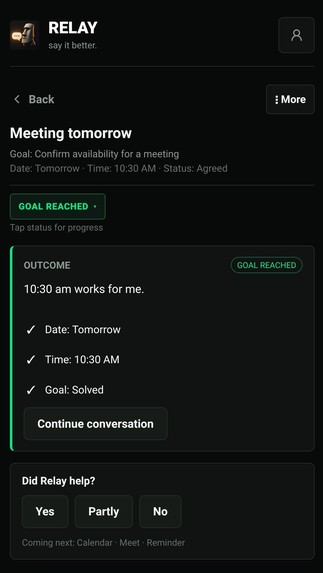
GOAL REACHED

Inspiration
People avoid important conversations every day—not because they do not know what they want, but because expressing it can feel awkward, emotional, or difficult.
A person may need to:
- Ask a friend to return money
- Follow up on a payment
- Invite someone to an event
- Negotiate a price
- Decline politely
- Arrange a meeting
- Discuss a sensitive issue
Most AI writing tools stop after rewriting a sentence. But the real problem often continues after the first message: the other person responds, details change, agreements must be confirmed, and the next step can easily be forgotten.
We experienced this ourselves while arranging an online meeting. The meeting time had already been discussed, but the conversation was buried in chat. The Google Meet was created 30 minutes late because the agreed time was lost in plain sight.
That led to the core idea behind Relay:
What if AI could understand what a person wants, represent it clearly, help both sides reach an outcome, and keep the human in control throughout the conversation?
What it does
Relay is a human-controlled communication representative.
A user privately explains what they want. Relay understands the goal, prepares a clear message in the chosen tone, and asks the user to approve it before anything is shared.
The other participant joins through a secure invite link and responds through their own side of the conversation.
Relay then helps the conversation move toward a clear outcome without exposing private instructions or making commitments without approval.
Product flow
Private intent
    ↓
Relay understands the goal
    ↓
Relay prepares the message
    ↓
The user reviews and approves
    ↓
The other participant joins
    ↓
Both sides communicate
    ↓
Relay tracks the outcome
    ↓
Goal reached, declined, or closed
Relay currently supports
- Private intent capture
- Goal extraction
- AI-assisted message drafting
- Professional, friendly, direct, and casual tones
- Human approval before sharing
- Secure participant invite links
- Two-sided conversations
- Private and shared message separation
- Conversation status tracking
- Goal and outcome tracking
- Human-readable conversation summaries
- Mobile-responsive interfaces
Live product: https://relay.durgaai.com
Why Relay is different
Relay is not only a grammar corrector or message rewriter.
A writing assistant improves a sentence.
Relay understands:
- What the user is trying to achieve
- Which details matter
- What remains unresolved
- Whether the goal has reached a clear outcome
For example, a user may privately say:
I want to ask my friend to return ₹1,000, but I do not want to sound rude.
Relay can identify:
- Goal: Request repayment of ₹1,000
- Tone: Friendly
- Outcome needed: A repayment date or a clear response
Relay can then prepare an approved message without exposing the user’s private thoughts, emotional context, or negotiation limits.
Relay separates three important layers:
- Intent — What the user wants
- Communication — How Relay represents it
- Outcome — What both sides finally agree, decline, or leave unresolved
Human-controlled safety model
Relay is designed around approval rather than silent automation.
The system follows these principles:
- Private instructions remain visible only to the person who wrote them.
- Relay does not share a message until the user approves it.
- A proposal is not treated as an agreement.
- Silence is not treated as confirmation.
- Relay does not automatically accept prices, meeting times, deadlines, or other commitments.
- Both sides remain in control of their own decisions.
Our architecture follows a Human → Agent → Agent → Human model:
Human A
    ↓
Representative A
    ↓
Representative B
    ↓
Human B
Each representative acts only on information confirmed by its own human.
This gives Relay the benefits of AI-assisted communication without allowing the AI to silently make commitments on behalf of users.
How we built it
Relay was built as a real-time web application with two connected experiences:
- A private conversation between the user and their representative
- A shared conversation between the two participants
The application includes:
- A private intent and drafting layer
- A strict conversation-state model
- Secure invite-based participant access
- Real-time message synchronization
- Approval-controlled outbound communication
- Goal and status extraction
- Separate private and shared views
- Mobile-responsive interfaces
Runtime AI
Relay currently uses a model-agnostic inference layer with:
- Groq-hosted
openai/gpt-oss-120b - Groq-hosted
openai/gpt-oss-20b - Multi-key rotation for reliability
- Cloudflare Workers AI as a fallback
These models help Relay:
- Interpret informal user input
- Identify the user’s goal
- Extract relevant details
- Prepare clearer messages
- Adapt communication tone
- Summarize conversation state
GPT-5.6 and Codex during development
GPT-5.6 and Codex were used throughout development to:
- Explore and understand the codebase
- Design the Human → Agent → Agent → Human protocol
- Define proposed, confirmed, declined, and unresolved states
- Separate private intent from approved shared communication
- Design the goal and outcome-tracking model
- Implement the review, approval, invite, and two-person conversation flows
- Debug real-time messaging
- Improve mobile responsiveness
- Refactor private and shared message handling
- Review trust boundaries and failure cases
- Simplify the user interface
What we built during OpenAI Build Week
Relay existed as an early communication experiment before Build Week. During the submission period, we extended it into the current human-controlled representative experience.
The Build Week work included:
- A redesigned private-intent flow
- Structured goal extraction
- Separation between user intent and Relay’s outgoing message
- Tone selection and message review
- Explicit approval before sharing
- Secure participant invite creation
- Two-sided private and shared conversation views
- Goal, conversation, and outcome states
- Protection against false agreement
- Mobile-responsive UI improvements
- Simpler status and action controls
- End-to-end testing of the two-person flow
Challenges we ran into
Avoiding the “grammar tool” misunderstanding
Early testers sometimes described Relay as a grammar correction tool.
We realized that showing only the original sentence and the rewritten message made the product look like a writing assistant.
To solve this, Relay now displays a separate structured goal.
For example:
- Goal: Get a clear response to the workshop invitation
- Status: In progress
- Tone: Professional
This keeps intent visible without repeating the full outgoing message and makes the difference between intent and communication clear.
Protecting private intent
A user may privately share information that should never be sent to the other side.
Examples include:
- Maximum negotiation budget
- Emotional context
- Personal concerns
- Preferred outcome
- Internal deadlines
We therefore created separate visibility rules for private instructions and shared messages.
Only approved communication is shown to both sides. The other participant never sees the user’s private goal framing, original wording, or internal constraints.
Preventing false agreement
An AI system can easily mistake a suggestion for a confirmed commitment.
For example:
Maybe 10:00 AM could work.
This is not the same as:
Yes, 10:00 AM is confirmed.
Relay therefore distinguishes between:
- Proposed
- Confirmed
- Declined
- Unresolved
A proposed value cannot become a confirmed agreement without explicit human input.
Simplifying the interface
Early versions exposed too many controls, status icons, and technical states.
We simplified the interface to prioritize:
- Goal
- Conversation
- Current state
- Next action
Rare or destructive actions are moved into a secondary menu.
Accomplishments that we are proud of
We are proud that Relay is not only a concept or static prototype.
The working MVP supports an end-to-end two-person flow:
Start a conversation
    ↓
Explain private intent
    ↓
Generate Relay’s message
    ↓
Select a tone
    ↓
Review and approve
    ↓
Create a secure invite
    ↓
The participant joins
    ↓
Continue the conversation
    ↓
Track the goal and outcome
We also created a distinctive brand identity using a stone representative and speech-bubble symbol to communicate patience, trust, and representation.
What we learned
The most important lesson was that communication is not only about writing better sentences.
People also need help with:
- Remembering what was discussed
- Understanding what has been agreed
- Knowing what still needs a response
- Following through after the conversation
We also learned that trust must be visible in the product.
Users need to know:
- What is private
- What will be shared
- What Relay understood
- What Relay is waiting for
- Whether something has actually been confirmed
Human approval cannot be hidden as an implementation detail. It must be part of the user experience.
What’s next for Relay
The next stage is to turn confirmed conversation outcomes into approved real-world actions.
Our connector roadmap begins with:
- Relay reminders
- Google Calendar
- Google Meet creation
- Calendar invitations
- Event updates and cancellations
The future flow will be:
Conversation
    ↓
Outcome confirmed
    ↓
User reviews the next action
    ↓
User approves
    ↓
Relay completes the action
For example:
Meeting time confirmed
    ↓
Schedule meeting
    ↓
Create calendar event
    ↓
Generate Google Meet link
    ↓
Set reminder
Relay will never silently book a meeting, send money, accept a deal, or make an important commitment.
The user will remain in control.
Our vision
Relay can support anyone who struggles to start, manage, remember, or complete important conversations.
Possible use cases include:
- Payment follow-ups
- Meeting coordination
- Marketplace negotiation
- Client communication
- Family conversations
- Event invitations
- Price and scope negotiation
- Difficult requests and refusals
Our long-term vision is:
Relay turns private intent into clear conversation, clear outcomes, and approved action—while keeping humans in control.
Relay — Say it better.
Built With
- cloudflare
- cloudflare-workers
- codex
- css
- durable-objects
- groq
- html
- javascript
- kv
- sqlite
- typescript
- websocket
- workers-ai
- wrangler

Log in or sign up for Devpost to join the conversation.