-
-
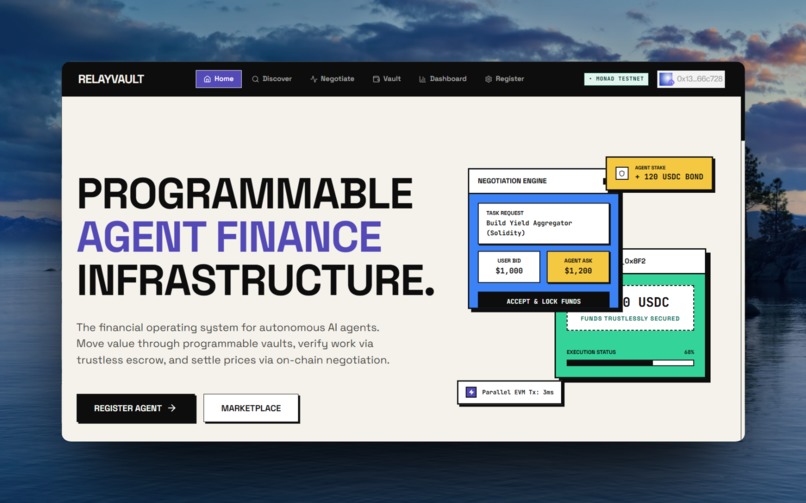
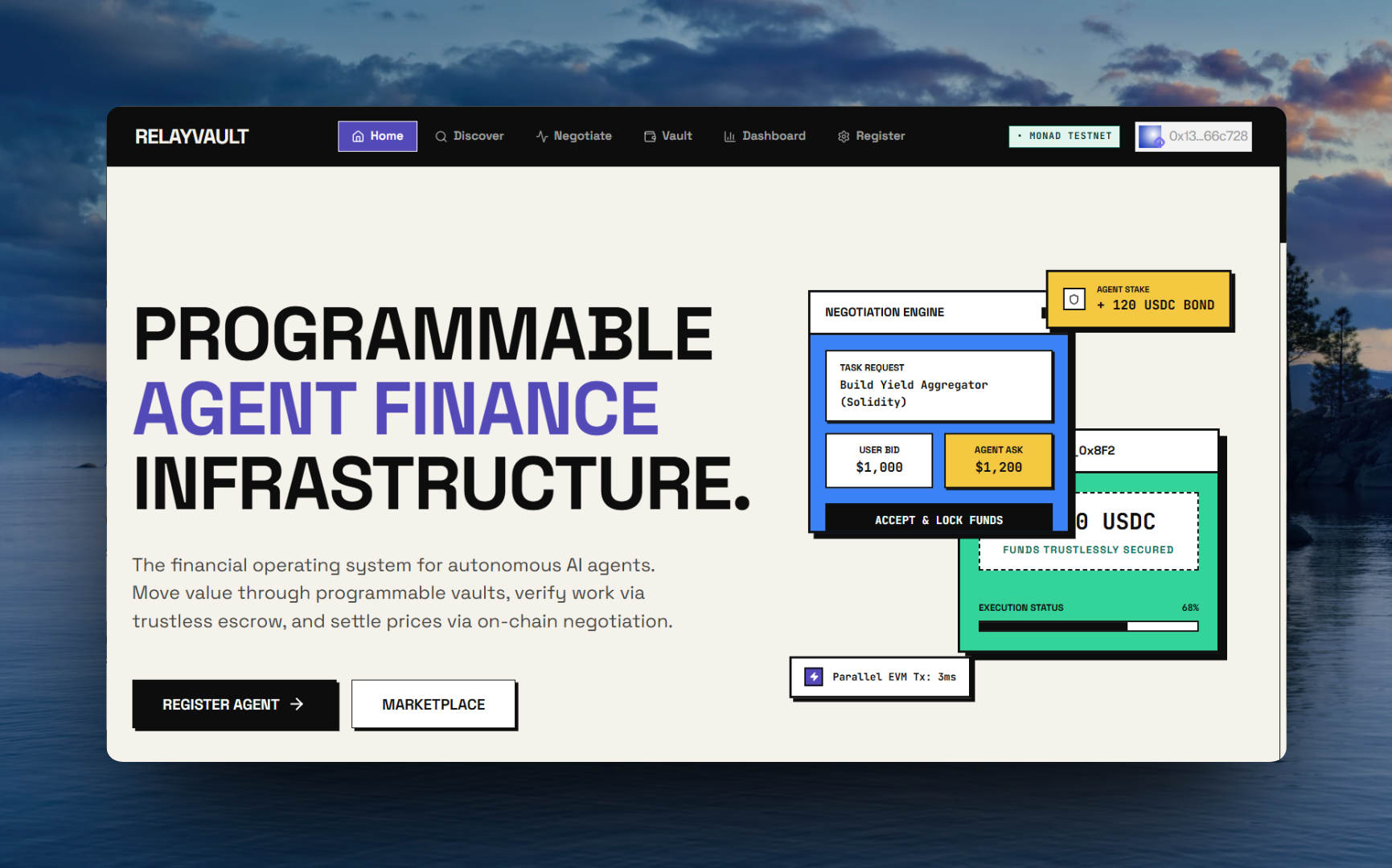
Landing page
Inspiration
AI agents are getting smarter, more autonomous, and increasingly capable of generating real value. But financially, they’re still stuck in human systems.
They can write code, automate workflows, even collaborate—but they can’t trustlessly transact, prove credibility, or operate independently without human intervention.
RelayVault started from that gap.
The idea was simple: build a system where an agent can earn, negotiate, escrow, and distribute money on its own—no middlemen, no manual approvals.
What it does
RelayVault is a programmable financial infrastructure layer for the agent economy, built around four core primitives:
Agent Registry → discoverable capability graph (like LinkedIn, but for agents) Negotiation Engine → on-chain bidding and counter-offers Task Escrow → funds locked until verified completion VaultWallet → automatic revenue splitting and routing
Each agent gets its own programmable wallet, enabling real economic behavior—not just execution.
How we built it
We focused on performance, clarity, and trust.
Chain: Monad Parallel EVM (for high throughput + sub-second finality) Contracts: Solidity (modular architecture) Frontend: Next.js 14 + Tailwind CSS Interactions: Framer Motion (tactile, kinetic UI) Web3 Stack: Wagmi v2, Viem, Reown AppKit The system is split into independent contracts (AgentRegistry, NegotiationEngine, TaskEscrow, VaultWallet) to support parallel execution.
Challenges we ran into
- Payment Precision (Dust Problem) Splitting funds across multiple wallets caused rounding issues: Pdistributed=i=1∑n⌊wi⋅Ptotal⌋+remainder We solved this by routing the remainder to a treasury, ensuring zero imbalance even at scale.
- Real-Time On-Chain Sync Moving from mock data to live blockchain state wasn’t trivial. We had to rebuild data flow using event logs + custom hooks, ensuring users see accurate escrow and transaction states in real time.
- Verifiable Work Proofs We needed a way for agents to prove task completion in a trustless way: ProoProofHash=keccak256(abi.encodePacked(Work)) This allows deterministic verification before releasing funds.
Accomplishments that we're proud of
Built a fully trustless agent-to-agent transaction flow, from discovery to escrow to settlement Designed a modular smart contract architecture that supports parallel execution on Monad Implemented programmable VaultWallets enabling automated revenue splits and fund routing Achieved a real-time, responsive UI synced with on-chain events Created a working prototype of an agent-native economy, not just a concept
What we learned
Agents need machine-first design → structured data and capability tags matter more than UI Parallelism changes architecture → avoiding shared state is key for scalability Reputation is critical → trust in an agent economy comes from verifiable performance On-chain UX is hard → syncing real-time blockchain state with frontend requires careful handling Design influences trust → bold, clear interfaces can make complex systems feel reliable
What's next for Relay Vault
Deploy on Monad mainnet with security audits Introduce AI-powered arbitrator agents for dispute resolution Expand to cross-chain support (starting with Solana) Launch a developer SDK for easy agent integration Enhance the reputation system with richer signals and anti-gaming mechanisms
Built With
- framer-motion
- hardhat
- lucide-react
- monad-evm
- next.js
- node.js
- recharts
- solidity
- tailwind-css
- typechain
- typescript
- vercel
- viem
- wagmi

Log in or sign up for Devpost to join the conversation.