Inspiration
During my internship, our team assigned work once a week. By Wednesday the plan was already wrong. Someone would get pulled onto a higher-priority ticket, and the tickets they had been assigned just sat there. At the same time, someone else had finished early and was looking for work. Nobody could easily see that a ticket should move, and asking "can I take yours?" felt awkward.
Jira already has good tools near this problem. The Capacity view helps a manager plan allocations ahead of time. The built-in Jira Delivery Agent nudges people about stale work. Apps like Unblocked flag stalled issues. But none of them answer the two questions I kept running into: "Who should take this?" and "What can I pick up?" That gap is what Relay is for.
What it does
Relay is a Forge app for Jira with a Rovo agent.
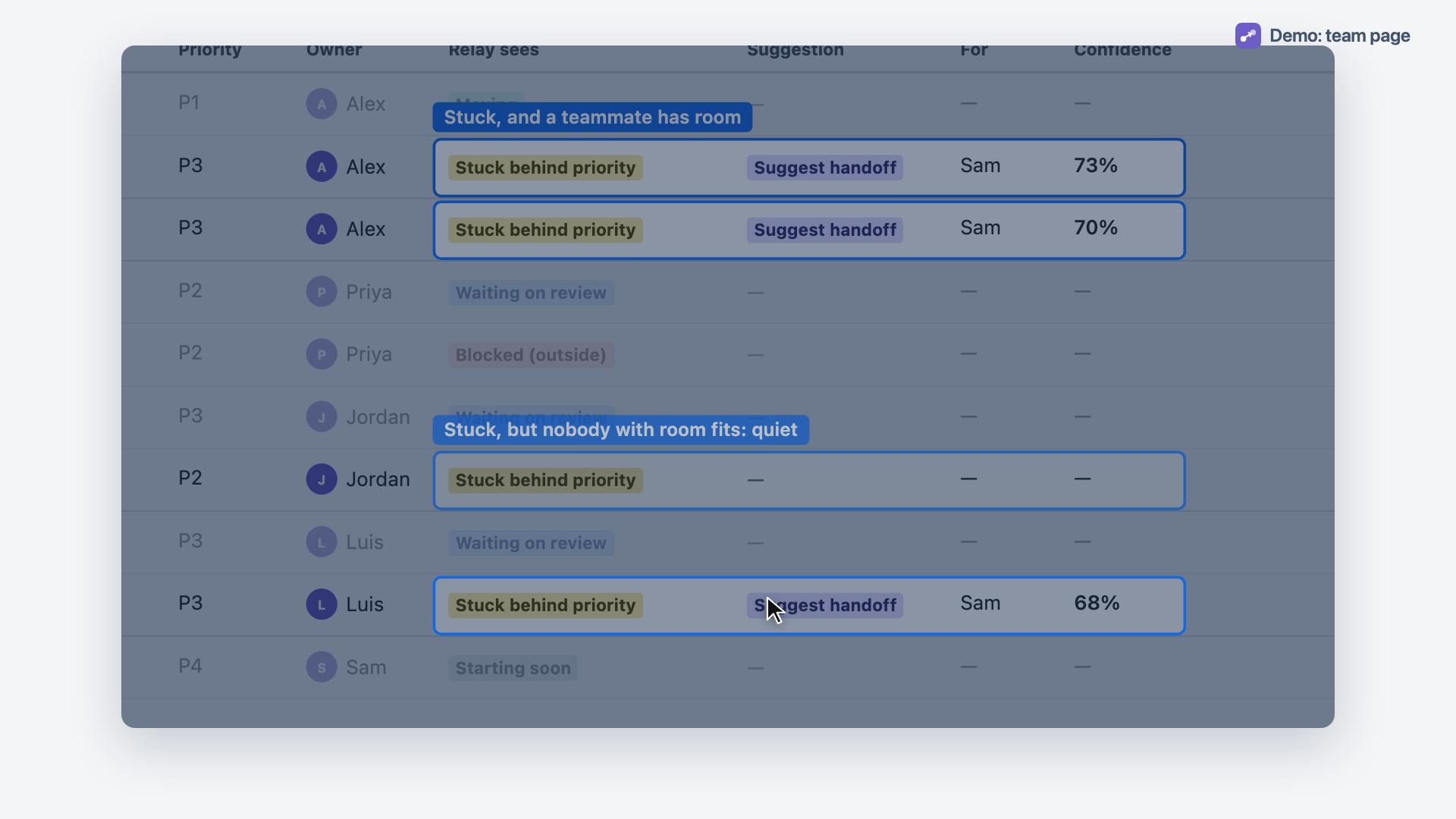
- It looks at each open ticket and decides what state it is really in: progressing, blocked on something outside the team, pulled behind priority work, waiting on review, or no real activity.
- For tickets that would likely move faster with someone else, it ranks teammates by fit (similar past work) and by how much room they have right now.
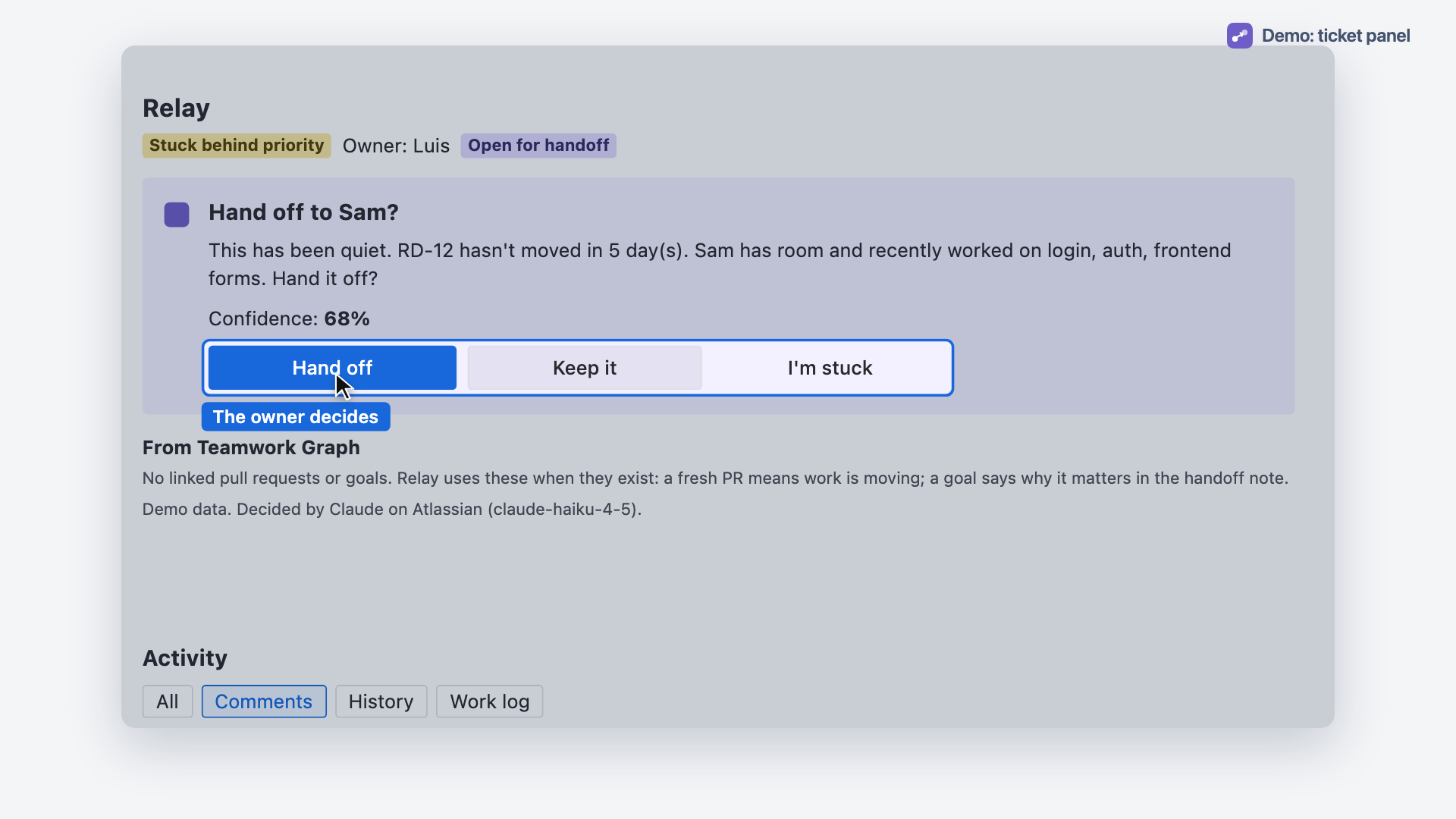
- It does not reassign anything on its own. It asks the current owner first, on the ticket: Hand off, Keep it, or I'm stuck. Only the owner can answer.
- If the owner agrees, Relay writes a handoff note on the ticket (status, recent context, and the goal it supports if one is linked), so the new person doesn't start from zero.
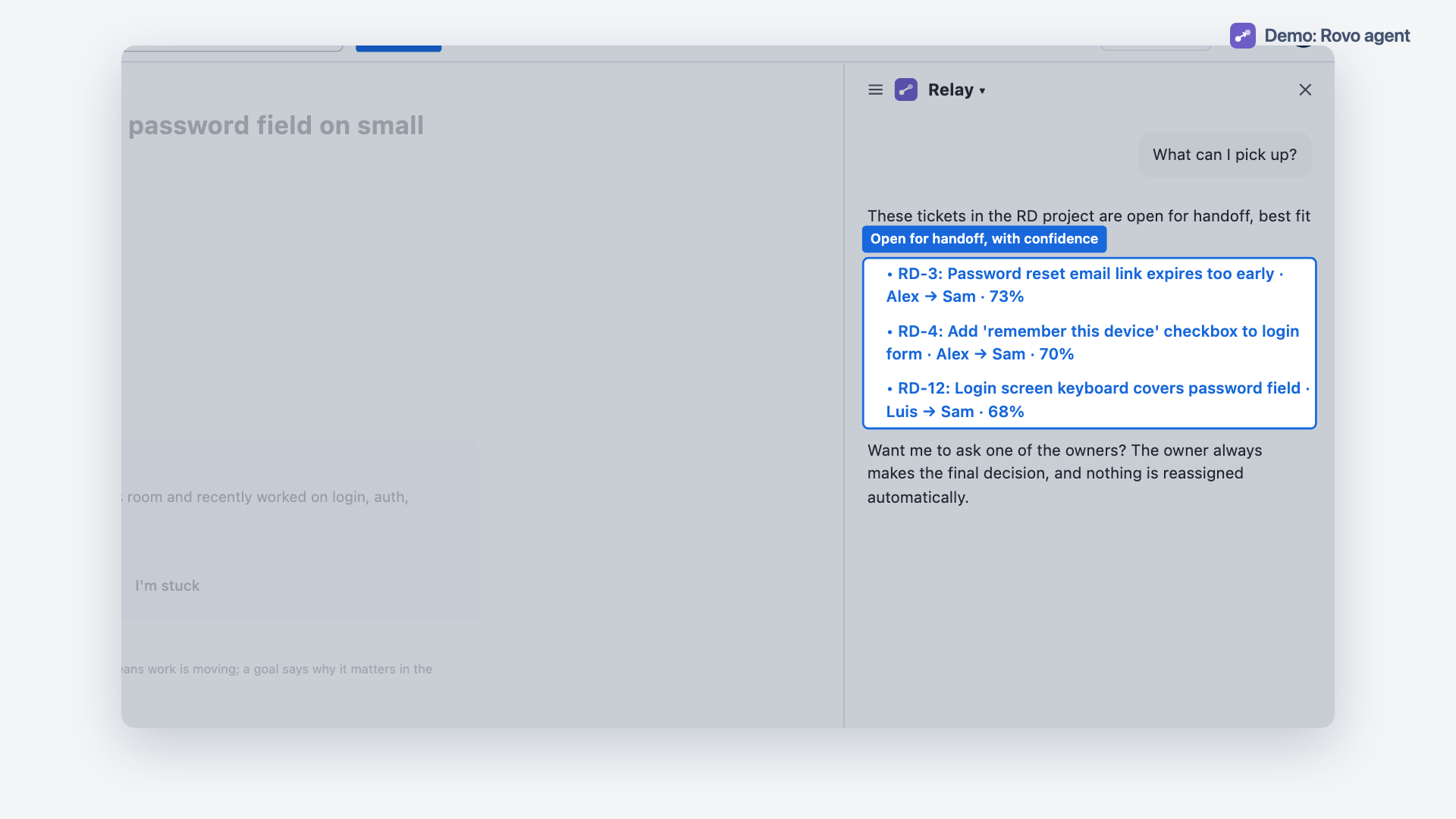
- Anyone can ask the agent "What can I pick up?" and get a short list of tickets that fit them.
Relay uses confidence bands to avoid noise. High confidence: suggest a handoff. Medium: ask the owner a question. Low: say nothing. False alarms are the fastest way to get an app like this ignored, so staying quiet is a feature.
How we built it
- Forge hosts everything: a UI Kit ticket panel and project page, a scheduled trigger that runs the scan, and Forge storage (KVS) for handoff state and settings.
- Jira Cloud REST API provides tickets, priority, status history and comments.
- Decision layer: Claude, hosted by Atlassian through Forge LLMs, answers fixed-choice questions with a probability for each option rather than free text: what state the ticket is in, whether the owner wants to keep it, and who fits best (or nobody). There's no API key, and ticket text never leaves Atlassian. In the prototype, the same questions ran through the "System One" decision API against Jev and the open-source Kev model. The app can still point at a self-hosted Kev.
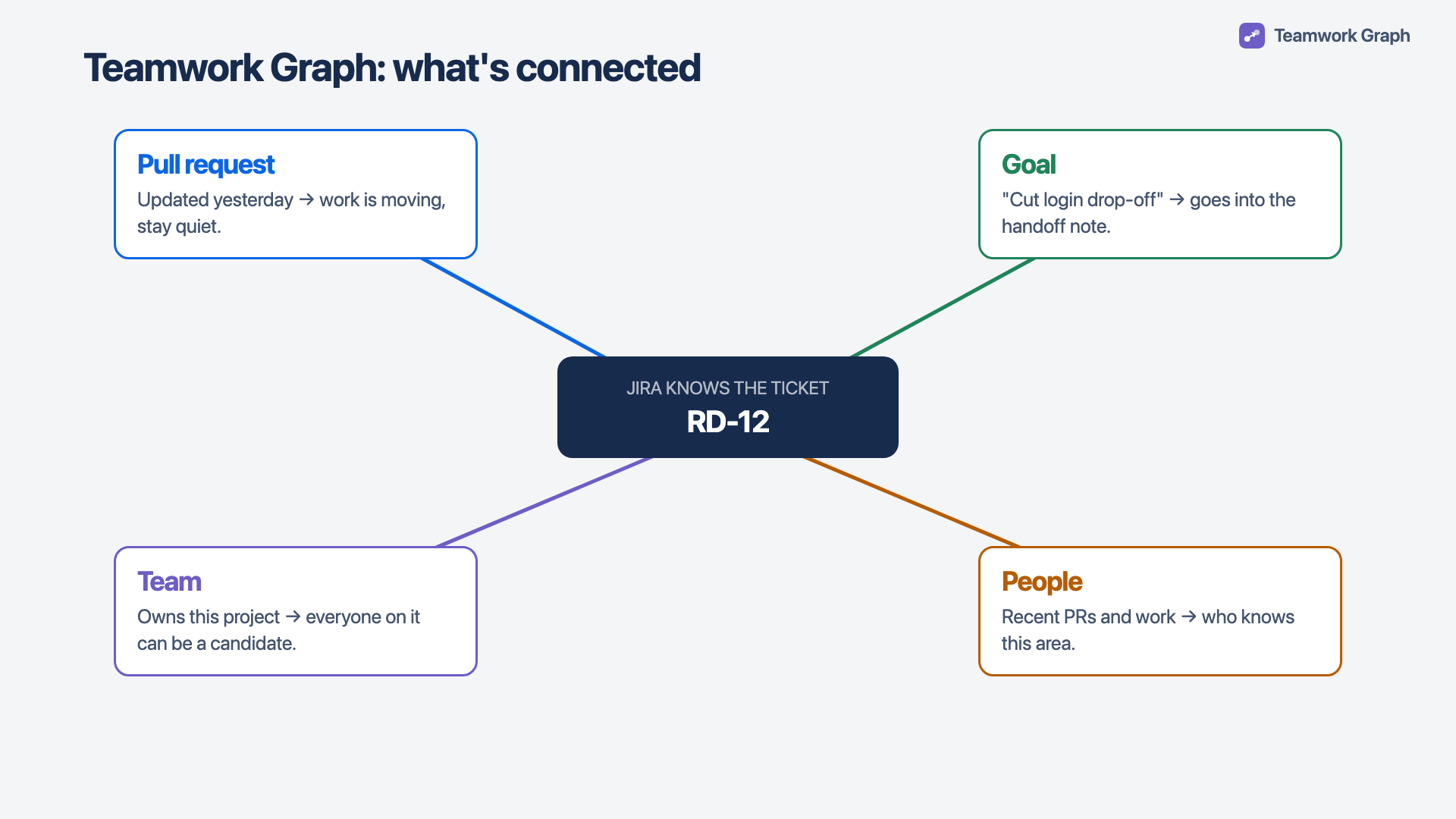
- Teamwork Graph (curated queries, read as the signed-in user): a ticket's linked pull requests and goals, each person's recent pull requests and work, and the members of the Atlassian teams linked to the space. A fresh PR means work is moving, so there's no false alarm. Goals go into the handoff note. Teammates who own no tickets yet become candidates.
- Rovo: a
rovo:agent("Relay") withrovo:actions (find pickups, suggest owner, what's stuck, propose handoff) and a reusablerovo:skillso other agents can call the matching logic. Rovo writes the chat replies.
Before building the app, I wrote an offline prototype in Python. It simulates a seeded team, and I wrote the correct labels by hand before running anything.
Challenges we ran into
- Not rebuilding what Atlassian ships. The Delivery Agent already does the "still on this?" nudge. I had to cut that and focus Relay on matching and handoff.
- Signals that aren't in Jira. In the prototype, one person looked free from ticket data alone but was actually on call. Ticket data misses that. I added an "I have room" toggle and plan to use calendar signals.
- Running the model locally. In the prototype, the open Kev-4B model ran on a 16 GB laptop, but slowly (about 4-8 seconds per call). That was fine for testing but too slow for the app, so the app uses Claude hosted by Atlassian.
- Testing an AI that only runs inside Atlassian. Forge LLMs can't be called from a laptop, so I built a temporary, key-protected test endpoint that writes the model's answers to the app's own logs. That kept the app egress-free.
- Data leaving Atlassian. The prototype sent ticket text to an outside model, which would rule out "Runs on Atlassian." Switching to Forge LLMs (Atlassian-hosted Claude) removed all egress, and the app is now eligible for Runs on Atlassian.
Accomplishments we're proud of
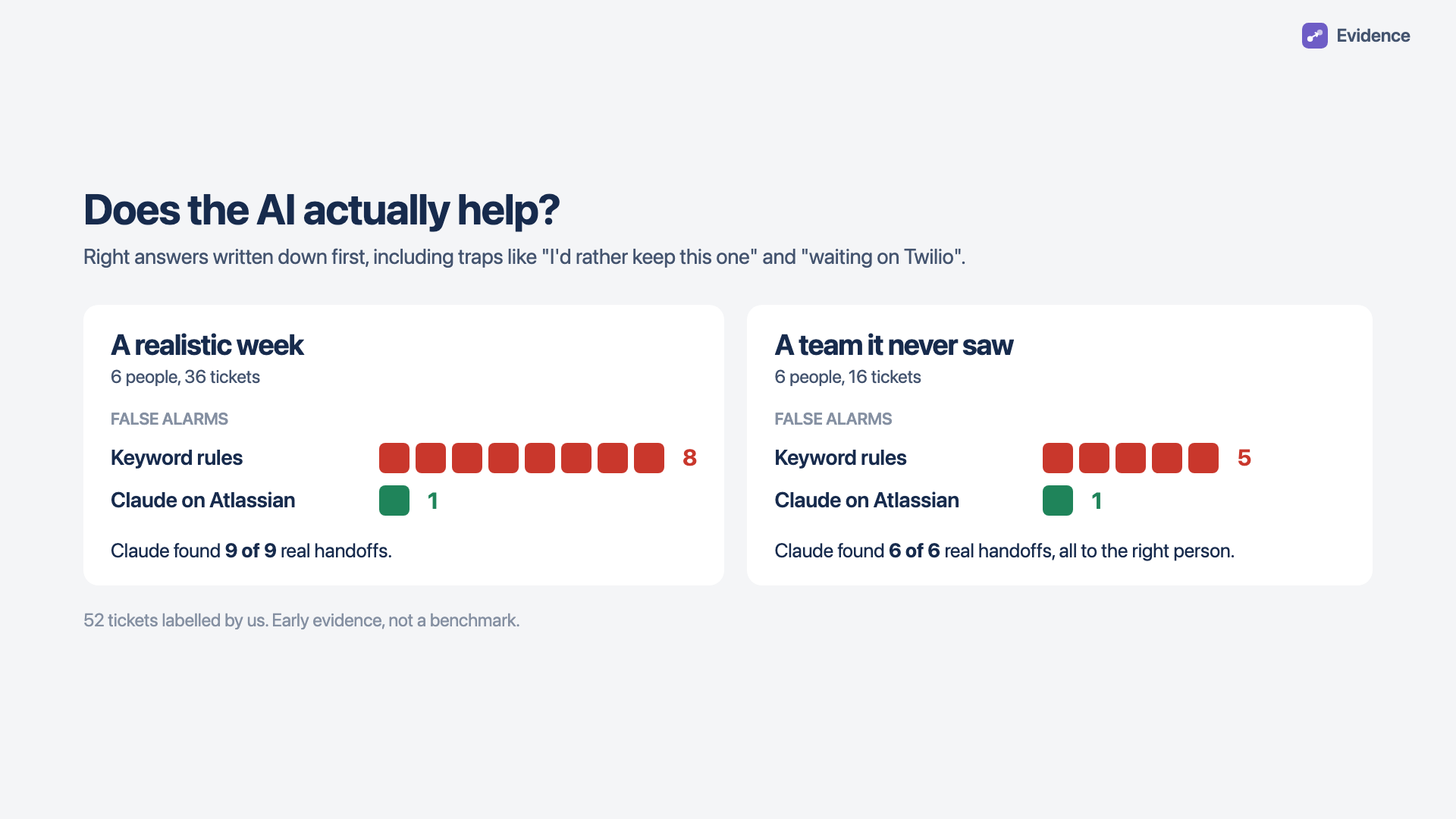
I tested Relay as it ships (Claude Haiku on Atlassian) against keyword rules, the kind of thing Jira Automation can do. I wrote two realistic six-person weeks, 52 tickets in total. I committed the right answer for each ticket before running anything, and 17 of them are traps: "I'd rather keep this one", "waiting on Twilio", "parked with the PM".
On a team the prompts were never tuned on (16 tickets):
| Approach | Ticket state correct | Real handoffs found | False alarms (of 10) | Right teammate |
|---|---|---|---|---|
| Keyword rules | 12 of 16 | 6 of 6 | 5 | 6 of 6 |
| Claude Haiku on Atlassian | 15 of 16 | 6 of 6 | 1 | 6 of 6 |
The first run also exposed a design flaw. The "who fits best?" question had no "nobody" option, so the model was pushed into suggesting a QA engineer for Stripe webhook work. Adding "nobody fits" removed that whole class of bad suggestions.
Caveat: 52 self-labelled tickets is a sanity check, not a benchmark. Full write-up is in the repo at docs/eval/README.md.
I'm also proud that the handoff is consent-based. Research on open-source projects found that harsh auto-close bots cleared backlogs but drove contributors away. Relay asks first.
What we learned
- Most idle work isn't laziness. People get stuck or pulled away. The tool should make asking for help easy, not shame anyone.
- A model that picks from fixed options with a probability is a better fit for "should we interrupt someone?" than a chatbot. It is cheaper, faster, and easy to threshold.
- Saying nothing is often the right answer.
What's next
- Add calendar and on-call signals from Teamwork Graph, so someone in back-to-back meetings doesn't look free.
- Test with a real team and measure how often suggested handoffs are accepted. (Not done yet.)
- Larger labeled test set, with thresholds tuned on separate data.
- Optional, opt-in git hook so unpushed work can count as activity.
- Publish on the Atlassian Marketplace.
