
Relay — verified crisis coordination inside Slack. Every need tracked, every promise proven.
Track: Slack Agent for Good. All data in the demo is fictional. Relay assists volunteer coordinators; it is not an emergency service.
Inspiration
In the 2015 and 2023 floods in our city, volunteers coordinated rescues and relief over group chats. Requests arrived as forwarded texts, screenshots, and panicked messages across a dozen threads. The same family got rescued twice while another was missed. People said "I'll go" and quietly dropped. Afterward, nobody could tell donors what had actually happened. In a disaster, the deadliest thing is a lost message — and every one of those failures is a state-tracking failure. Relay is the coordination layer we wished those volunteers had, built inside the tool they were already living in.
What it does
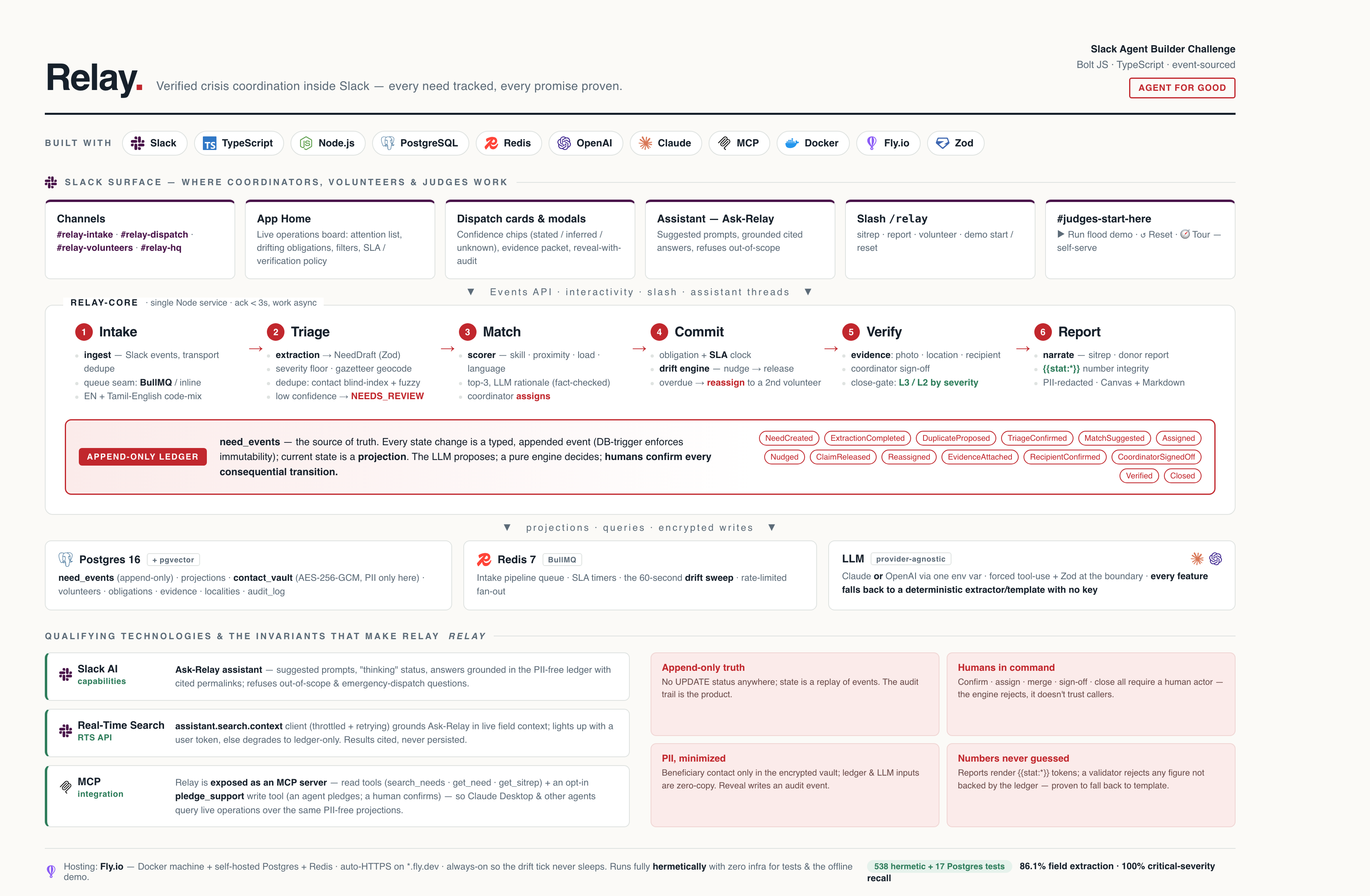
Relay runs the full relief loop inside a Slack workspace: Intake → Triage → Match → Commit → Verify → Report.
- Intake — free-text messages (English and Tamil–English code-mix), turned into structured Need records.
- Triage — the agent extracts type, urgency, location, and headcount; separates what was stated from what it inferred; dedupes; and posts a dispatch card for a human to confirm.
- Match — a deterministic scorer suggests the top volunteers by skill, proximity, load, and language; a coordinator assigns in one click.
- Commit — every claim becomes a tracked obligation with an SLA. If it drifts, Relay nudges the volunteer, and if they're stuck it proposes a reassignment.
- Verify — nothing closes on someone's word. Delivery requires an evidence packet (photo, location, recipient confirmation) and coordinator sign-off for high-severity needs.
- Report — a live situation report for coordinators, and a donor-ready impact report where every number links to a ledger event and beneficiary PII never reaches the model.
Qualifying technologies used
Relay uses all three, each with a real job.
- Slack AI capabilities — the Ask-Relay assistant (Bolt
Assistant). Opening a thread sets suggested prompts; a question sets a "thinking" status and returns an answer grounded in the PII-free ledger with cited permalinks. It refuses out-of-scope questions and, as a safety behavior, refuses emergency-dispatch questions ("Relay coordinates volunteer relief — it is not an emergency service"). - Real-Time Search (RTS) API — an
assistant.search.contextclient, hardened with throttling and retry, grounds Ask-Relay in live field context the ledger doesn't hold. It lights up when a Slack user token (xoxp-) is present; without one it degrades to a deterministic mock and answers ledger-only. Results are cited and never persisted, per the API terms. - MCP integration — Relay is exposed as a read-only MCP server:
search_needs,get_need,get_sitrep, over the same PII-free projections the app uses.npm run mcpplugs it straight into Claude Desktop, so an external agent can ask "list open critical needs" and get the same numbers as App Home.
How we built it — technological implementation
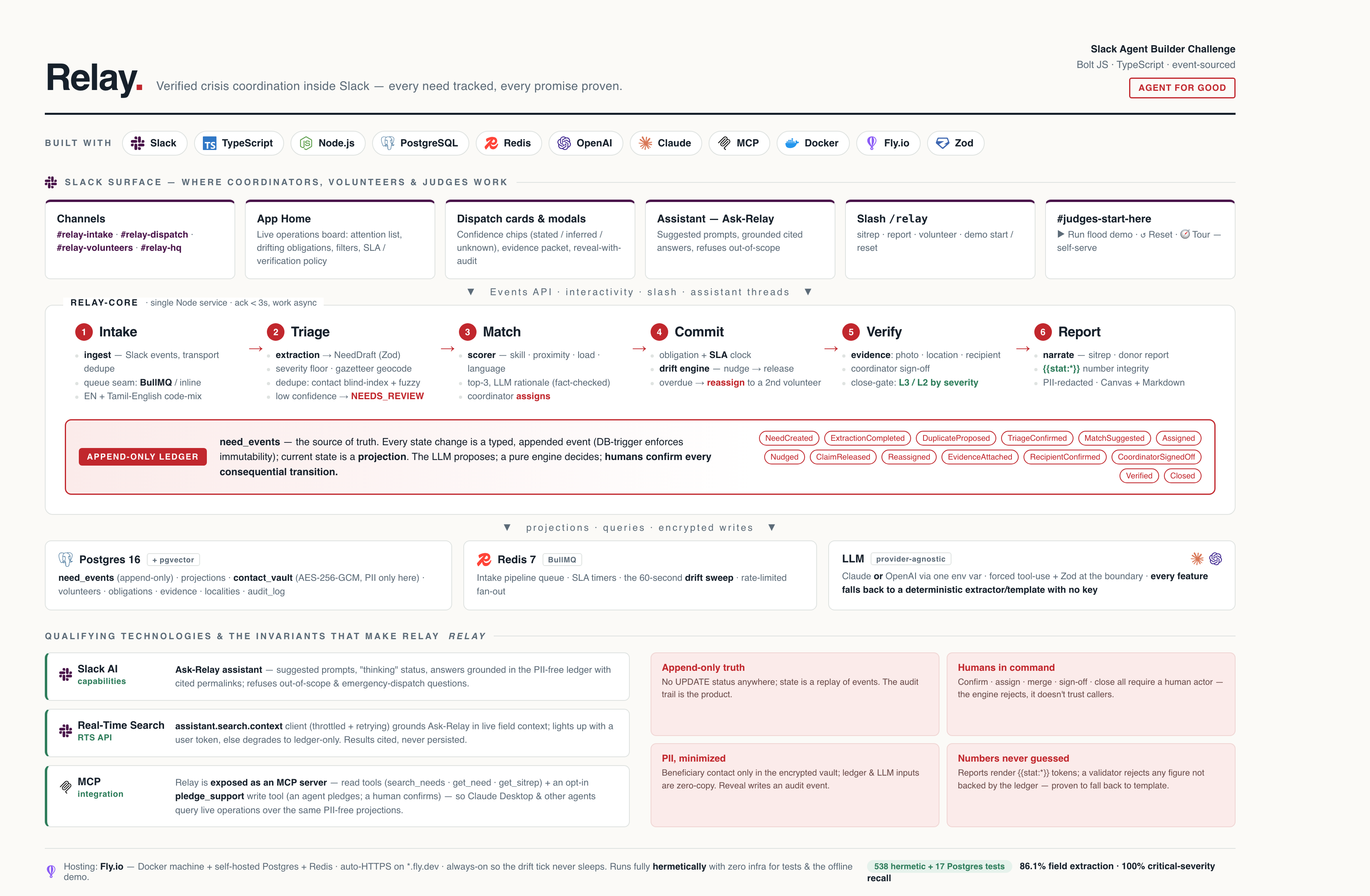
- Event-sourced, append-only ledger. State changes happen only by appending typed events to
need_events; current state is a projection. Immutability is enforced by a Postgres trigger — a normalUPDATE/DELETEis rejected ("append-only"), proven in an integration test. A logic change is a replay, not a migration. The audit trail is the product. - The LLM proposes; deterministic code decides. Extraction returns a Zod-validated
NeedDraft; the pure engine decides every transition. On a validation failure the pipeline runs one repair pass, then routes toNEEDS_REVIEW— it never guesses. - Humans in command. Confirm, assign, merge, sign-off, and close all require a human actor; the engine rejects agent/system actors on those transitions rather than trusting the caller. Dedupe auto-detects duplicates but the merge itself is a human click.
- Numbers are never hallucinated. Sitreps and reports render immutable
{{stat:*}}tokens computed from the ledger; a validator rejects any digit in the narrative not backed by a stat, regenerating twice before falling back to a deterministic template. Proven: a fabricated figure fed by a mock model never reaches the output. - PII minimized by construction. Beneficiary contact lives only in an AES-256-GCM
contact_vault; the ledger and every LLM input are zero-copy. A reveal writes anaudit_logrow. The donor report grep-verifies zero seeded phone numbers in its output. - Measured, reproducible quality. On a 40-message labelled set (
npm run eval): 86.1% field-level extraction accuracy, 100% critical-severity recall, 100% contact/locality accuracy. Separately,npm run loadreplays the flood's intake through the in-memory pipeline and reports intake p95 in the low fractions of a millisecond (≈0.1–0.2 ms) at several thousand msg/s — a local/hermetic engine measurement (no Slack/DB/Redis) that varies run-to-run, explicitly not a production SLA. - Provider-agnostic LLM. Claude or OpenAI via one env var; forced tool-use + Zod at the boundary. Every AI feature falls back to a deterministic extractor/template with no key, so the whole product — and the offline demo — runs with zero configuration.
- Tested. 538 hermetic unit tests (zero infra) + 17 Postgres integration tests. TypeScript strict, event-correlated structured logs.
- Hosting: Fly.io — an always-on Docker machine + self-hosted Postgres + Redis, with auto-HTTPS on
*.fly.dev. One machine is pinned up so the SLA drift tick and scheduler never sleep and the demo never cold-starts; a deep/healthzprobe (real pg query + Redis PING) gates rotation, and schema migrations run on boot. The whole product still runs fully hermetically with zero infra fornpm testand the offline demo.
Design
Relay is a balanced blend of frontend and backend — not a bot that prints text.
- App Home operations board — live counters, a "needs your attention" list (open-critical → drifting → at-risk), a drifting-obligations panel, type/severity/locality filters, and a verification-policy + SLA config panel.
- Dispatch cards with per-field stated / inferred / unknown confidence chips, an evidence checklist, and a reveal-with-audit control.
- Evidence packets and a Canvas/Markdown donor report — where every headline figure carries a 🔍 Audit control that reveals the redacted, ledger-derived evidence chain behind it (event type, evidence kind, time and actor role only — never a name, contact, note, or file reference): the proof behind the number, read-only over the append-only ledger.
- Situational garnishes —
/relay sitrepbest-effort uploads a live operations map (SVG on the fictional seed gazetteer), and a claimed obligation's card shows a pre-warmed backup (the genuine #1 alternative from the same deterministic scorer) so a hand-off is one tap. - A self-serve judge demo — a judge channel → ▶ Run flood demo plays the full 48-hour scenario (intake → triage → assign → drift → reassign → deliver → sign-off → close) in ~4 minutes, with an idempotent ↺ Reset.
Potential impact
Volunteer and mutual-aid organizations already coordinate crisis response in Slack; Relay meets them where they are instead of asking them to adopt a separate platform in the middle of a disaster. The same loop generalizes directly to food banks, blood drives, and search-and-rescue support — anywhere volunteers make promises that need to be tracked and proven. Disaster coordination is life-critical and evergreen. (We make no invented impact statistics here; the only numbers we cite are the measured extraction-accuracy figures above.)
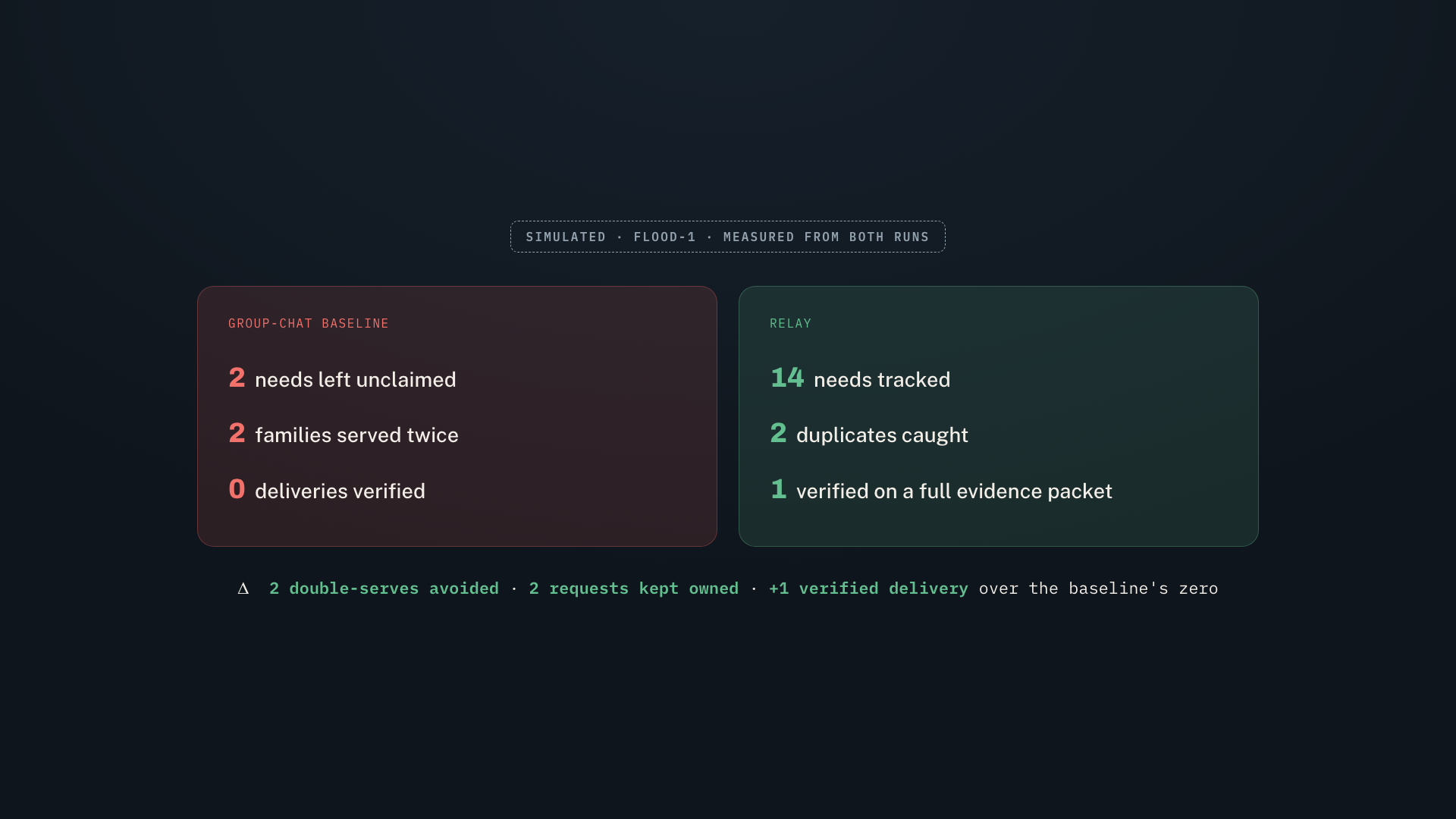
A measured, SIMULATED counterfactual. To turn "structured coordination beats an unstructured group chat" from an adjective into a number honestly, npm run counterfactual runs a naive group-chat baseline simulator (published rules R1–R4) and drives the identical fictional flood through the real Relay pipeline, then prints the delta. On flood-1 — measured from both runs, labelled SIMULATED, not a claim about any real deployment: the group-chat baseline leaves 2 unclaimed, 2 double-served, 0 verified, while Relay tracks 14 needs, dedupes 2, verifies 1 — a delta of 2 double-serves avoided, 2 requests kept owned instead of lost, +1 verified delivery. Every number comes from actually running both simulators; nothing is fabricated. And Relay holds AI agents accountable too: the MCP server carries one opt-in write tool, pledge_support, so an external agent can pledge to fulfil a need — but that pledge is a proposal a human must confirm through the exact same Assign gate, then it is tracked with the same SLA/drift/evidence as any human promise.
Quality of the idea / what exists today
Crisis coordination tools exist, but none close this loop inside the conversation with proof:
- Ushahidi / Sahana are web crisis-mapping platforms that live outside the tools volunteers chat in, and they don't track who committed to what or whether it happened.
- WhatsApp / group chats are where coordination actually happens today — with zero structure, no dedupe, and no accountability.
- Slack incident tools (incident.io and similar) target internal IT incidents and close on status flags, not verified fulfillment.
Relay's wedge: coordination inside the conversation, promises tracked as obligations with proof of delivery, and donor-grade accountability — an event-sourced ledger, verification gating, and a live judge-runnable simulation.
What's next
Slack Connect federation for multi-org shared operations; an SMS/IVR intake bridge for requesters who aren't in Slack; and packaged templates for food banks, blood drives, and SAR support.
Newly created & distinctness
Relay is a new project created during the submission period (first commit dated after May 20, 2026). It is unique and substantially different from our other entry, Kept: Kept tracks B2B customer promises; Relay is humanitarian crisis coordination — different problem, users, UX, and data model. Shared low-level patterns (an RTS client, ledger patterns, a redaction module) are reused as libraries, but Relay is a distinct product.
Built With
- mcp
- slack-ai-capabilities
- slack-real-time-search

Log in or sign up for Devpost to join the conversation.