-
Relay
Inspiration
Natural disasters often create information chaos.
Emergency requests become scattered across social media, messaging platforms, phone calls, and local networks. Relief organizations struggle to identify urgent needs, prioritize responses, and allocate resources effectively.
We wanted to create a platform that centralizes emergency information and uses AI to transform chaos into coordinated action.
With Google Gemini, we built Relay — a system that helps people, volunteers, NGOs, and authorities respond faster when every minute matters.
What it does
Emergency Request Reporting
Citizens can submit emergency requests through text, voice, or images.
AI Priority Classification
Automatically identifies high-risk situations requiring immediate attention.
Resource Matching
Matches requests with nearby volunteers, shelters, and aid providers.
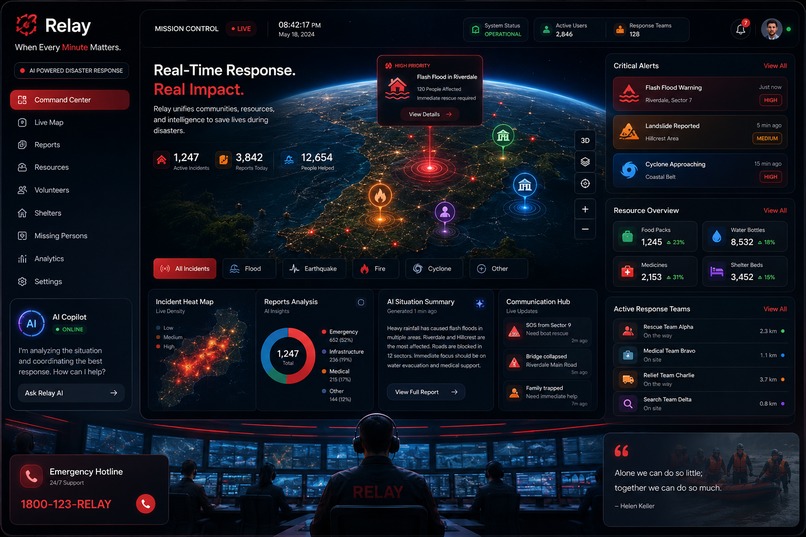
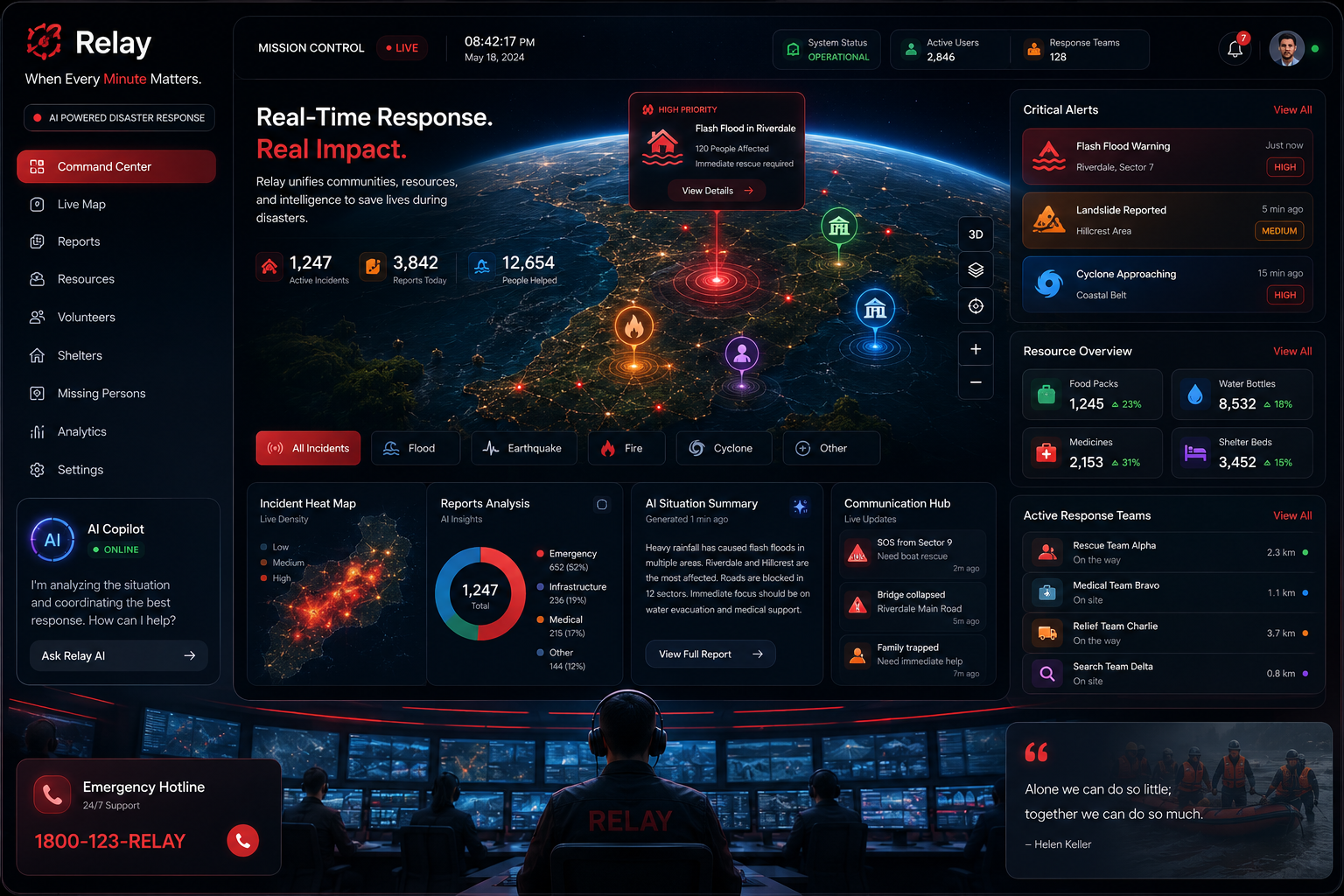
Disaster Intelligence Dashboard
Provides a real-time overview of affected areas.
Missing Person Tracking
Helps communities share and discover missing-person reports.
Relief Coordination
Tracks food, water, medicine, and shelter availability.
Multilingual Emergency Communication
Supports multiple languages during crisis situations.
How we built it
We built Relay as a cloud-native emergency coordination platform designed to operate during high-pressure situations.
The frontend was developed using React.js and Tailwind CSS to provide a fast, accessible experience for citizens, volunteers, and responders.
The backend was developed using Node.js and Express to process reports, manage resources, and communicate with Google Gemini.
Google Gemini acts as the intelligence layer of the platform. It analyzes incoming reports, classifies emergencies, identifies urgent cases, summarizes large volumes of information, and helps responders make informed decisions.
Google Cloud services provide secure deployment, storage, and scalable infrastructure capable of handling large numbers of requests during emergencies.
Throughout development, we focused on reducing response time, improving information accuracy, and enabling better coordination between communities and responders.
Challenges we ran into
Information Overload
Large disasters generate thousands of reports simultaneously.
Emergency Prioritization
Identifying truly critical situations required careful evaluation.
Resource Coordination
Matching available resources with real-time needs.
Reliability During Crisis
Ensuring the platform remains responsive under heavy demand.
Accomplishments that we're proud of
Built an AI-powered disaster response platform.
Developed intelligent emergency prioritization.
Created real-time resource coordination workflows.
Successfully integrated Google Gemini for crisis intelligence.
Built a scalable cloud-native architecture.
Designed a platform capable of supporting community resilience.
What we learned
- Crisis response workflows.
- Real-time data processing.
- AI-powered prioritization systems.
- Cloud-native scalability.
- Human-centered emergency technology.
What's next for Relay
Satellite Data Integration
Monitor disaster zones using satellite imagery.
Emergency Drone Support
Coordinate drone-based assessments.
Predictive Disaster Analytics
Identify high-risk regions before disasters occur.
Built With
- api
- authentication
- cloud
- express.js
- firebase
- firestore
- gemini
- maps
- node.js
- platform
- run
- typescript


Log in or sign up for Devpost to join the conversation.