-
-
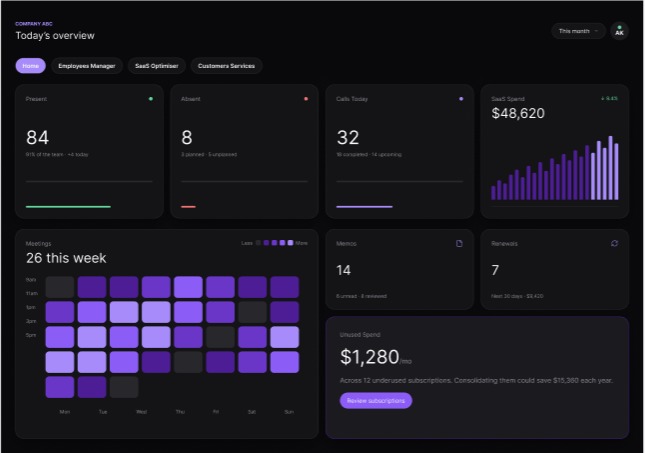
Dashboard
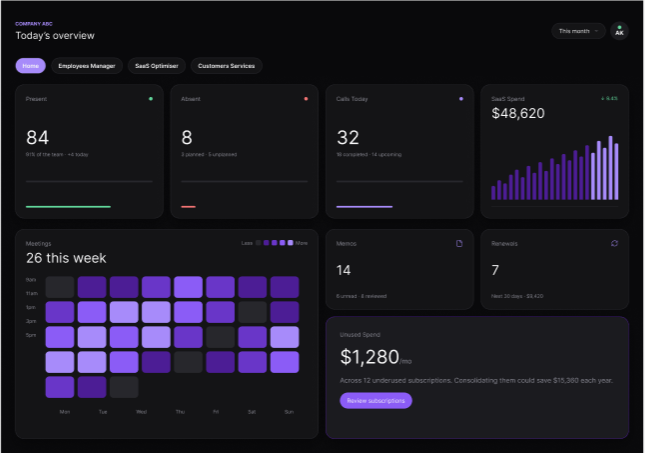
Inspiration
Businesses are rapidly adopting agentic AI and custom LLM-powered systems to automate their core workflows. But while AI is transforming areas like software development, analytics, and customer support, many essential operational tasks are still handled through emails, spreadsheets, dashboards, and manual follow-ups.
Employees forget to check in. Customers don't respond to renewal emails. Teams continue paying for unused software seats. Managers spend valuable time chasing people for information that could have been collected automatically.
We wanted to build something that focused on these overlooked parts of a business.
That is where Relay came from.
Relay is designed around a simple idea: businesses shouldn't have to wait for people to take action when an AI agent can proactively start the conversation.
What it does
Relay is a business optimization agent customized for each company, built around three core operational pillars:
- Employee Operations
Relay monitors employee operations and can proactively contact employees when something needs attention.
For example, if an employee hasn't checked in by the company's configured time, Relay can call them and determine whether they are:
Running late Working remotely On leave Forgot to check in Facing an issue that requires escalation
The conversation produces a structured outcome that updates the employee record and call log.
- Customer Lifecycle
Relay can proactively communicate with customers about important lifecycle events such as upcoming renewals, plan information, issues, and feedback.
Instead of sending another notification that may be ignored, Relay can have an actual conversation, understand the customer's situation, and turn it into a structured business outcome.
- Software / SaaS Optimization
Businesses can be spending thousands of dollars every month on software that isn't being fully utilized.
Relay tracks software, seats, active users, spending, utilization, and renewal dates to identify potential waste.
For example:
Figma — 40 seats, 12 active users 30% utilization — $800/month
Before renewal, Relay can call the responsible stakeholder and ask whether they want to maintain, reduce, or cancel the subscription.
The agent captures not only the decision, but why the decision was made, allowing the business to make better operational and financial decisions.
How we built it
Relay is built as a full-stack application using:
React for the frontend Flask for the backend and API layer SQLite for the application's database CALL-E for AI-powered phone conversations
The company first provides Relay with its operational context, including employees, customers, software subscriptions, and company policies.
The core workflow is:
Business Event → Relay → CALL-E Conversation → Structured Outcome → Database Update → Action / Escalation
CALL-E provides the conversational phone-call capability, while Relay provides the business-specific context, policies, decision logic, and operational workflows around those calls.
Every interaction is recorded in a unified call and audit log so the business can see what happened, what was decided, and what requires further attention.
Challenges we ran into
One of our biggest challenges was making the phone calls useful rather than just conversational.
A successful AI call shouldn't end with a transcript. It should result in something the business can act on.
We therefore designed our workflows so that conversations produce structured outcomes that can update the underlying business data.
Another challenge was designing Relay to be proactive without becoming intrusive. Different businesses have different policies and operating hours, so Relay needs configurable rules around when an agent can act and when a situation should be escalated to a human.
We also had to think carefully about how different business operations could interact with each other. For example, an employee being offboarded can directly affect the company's SaaS subscriptions and unused seats.
Accomplishments that we're proud of
We're particularly proud that Relay goes beyond demonstrating an AI voice call.
The call can actually change the state of the business.
For example:
Employee offboarding → CALL-E call → confirmation → employee updated → assigned SaaS seat flagged → software spend recalculated → activity logged
Similarly, a SaaS renewal can go from:
40 seats → 12 active → renewal call → stakeholder decision → updated seat count → updated spending
This creates a tangible connection between conversational AI and measurable business optimization.
We're also proud of building a unified platform rather than three disconnected demos. The same company policies, data, call logs, analytics, and operational context can be used across different areas of the business.
What we learned
Building Relay taught us that the most valuable part of an AI agent isn't simply its ability to generate a response.
An agent becomes significantly more useful when it has:
Context + a goal + the ability to communicate + the ability to take action.
We also learned that voice is particularly powerful for operational workflows where a simple email or notification isn't enough. A conversation allows the agent to ask follow-up questions, understand the reason behind a decision, and handle situations that wouldn't fit neatly into a form.
Most importantly, we learned that AI should not just automate existing workflows — it can make businesses more proactive.
What's next for Relay - An AI Agent for Optimizing Business Operations
Our next step is to make Relay a continuous operational layer for businesses.
We plan to add:
Time-based and event-based automatic calls Deeper HR and CRM integrations SaaS usage integrations Duplicate and overlapping software detection Shadow IT discovery Budget threshold alerts Renewal countdowns with escalating urgency Automated payment and dunning workflows More advanced customer right-sizing Shared RAG across company policies and knowledge Centralized human escalation More comprehensive analytics and operational insights
Our long-term vision is for Relay to continuously look across a business, identify where time, money, or productivity is being lost, and proactively start the conversations needed to fix it.


Log in or sign up for Devpost to join the conversation.