-
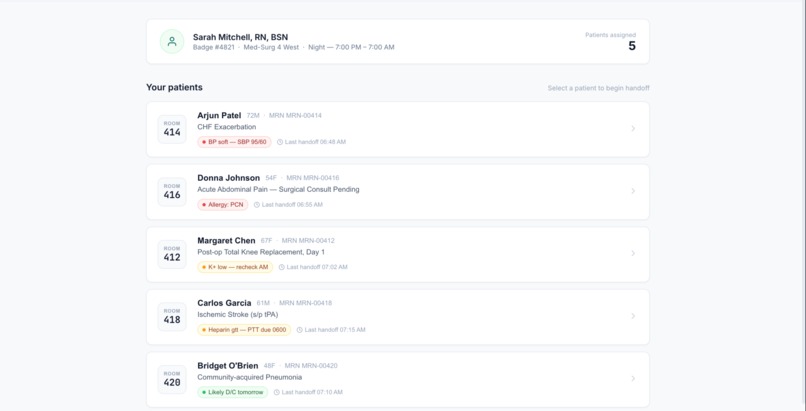
main screen
Inspiration
My mom has been a nurse for more than 20 years. Growing up, I watched her come home from 12-hour shifts still mentally running through her patients, wondering if she had told the next nurse everything that mattered. That moment—the shift handoff—is something she has done thousands of times with little more than a scrap of paper or a long typed note. When we read that communication failures during handoffs are one of the most studied contributors to preventable harm in hospitals, we stopped looking for a generic hackathon idea and started building Relay.
What it does
Relay is a documentation assistant for shift handoff. A nurse can dictate (or type) the way they already talk at the nurses’ station: one patient at a time, out of order, with shorthand and half-finished thoughts. Relay sends that audio-derived text to the backend, which uses a clinical, safety-bounded system prompt so the model structures what was actually said—without acting as a diagnostic system. The app turns the dictation into a structured handoff view: SBAR-style summary, flags, open loops for the incoming nurse, and optional abbreviation callouts, next to the live transcript so nothing is hidden and the nurse can correct before handoff. For continuity, the same stack can persist handoffs and surface prior notes by room so the next shift sees context, not a blank slate.
How we built it
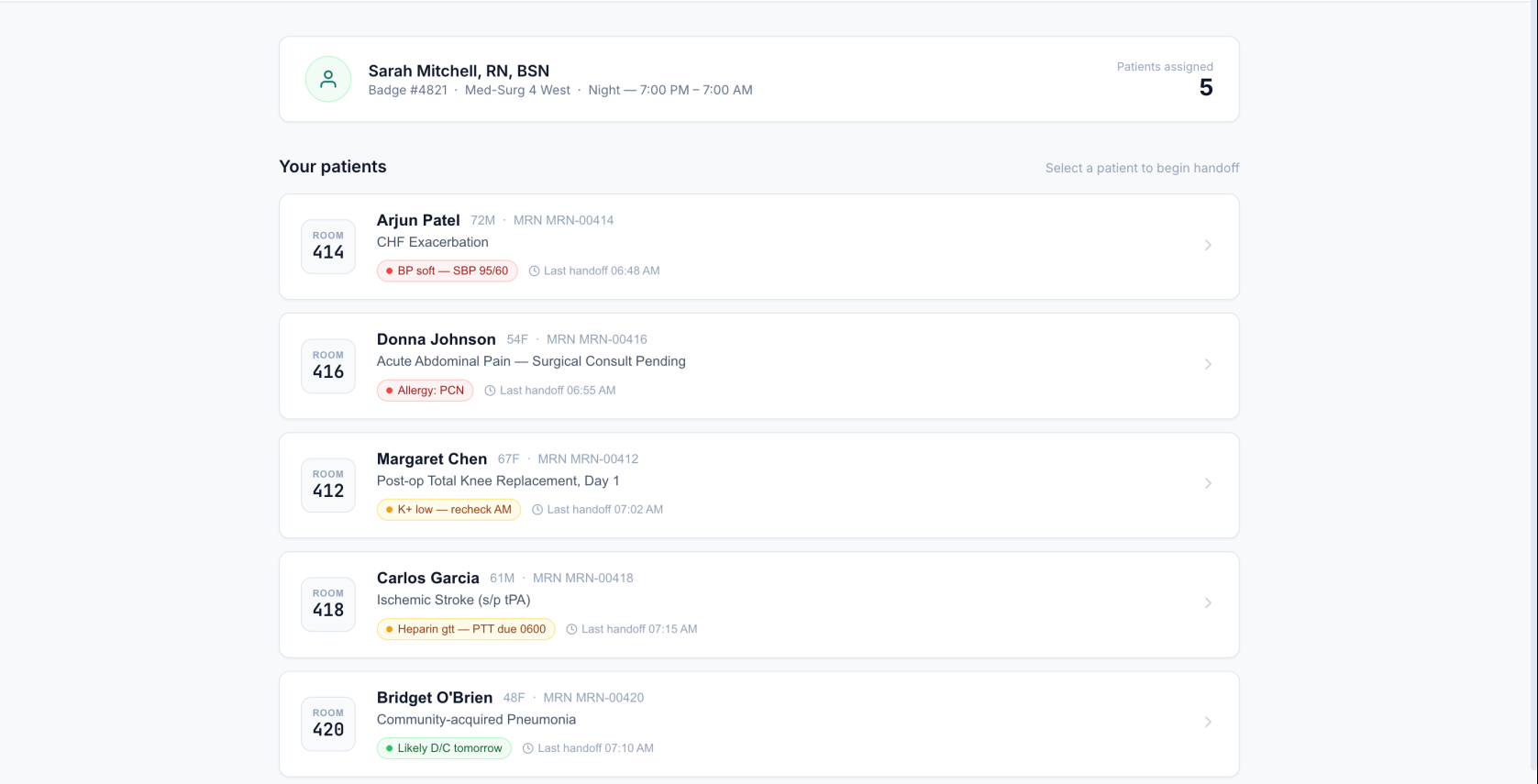
Frontend — A single-page experience built with React and Babel in the browser (no bundler in the loop for the demo), served as static files. The Web Speech API handles dictation in Chrome; nurses can also paste or type. The UI walks through: patient list → recording / transcript → review and edit structured output → a patient summary screen with session history that can call the API for room-based history when the backend is running. Backend — FastAPI on Python. It calls NVIDIA’s hosted Nemotron (via the integrate API) with a prompt tuned to return consistent JSON (patients, SBAR fields, flags, open loops, etc.). We persist to Postgres on Supabase with asyncpg—handoffs, per-patient rows, and a verify path so “approved” state can be stored. CORS is set up for local dev and hosted frontends. Environment config stays on the server: no model keys in the browser.
Challenges we ran into
The hardest work was prompt and schema design: real nurse speech is fragmentary, implicit, and full of abbreviations. Getting the model to return valid, parseable JSON and to avoid inventing clinical details that were not in the audio took many iterations. We also had to keep the product story honest—Relay is for handoff documentation and communication, not diagnosis or treatment decisions—and reflect that in prompts and copy. Infrastructure mattered too: reliable database connectivity (including SSL and, on some networks, Supabase’s connection pooler for IPv4), and making failures visible in the UI so demo debugging didn’t default silently to mock data.
Accomplishments that we're proud of
We’re proud the core loop works: speak or type → structured note → review. We’re especially proud of pairing the structured output with the full transcript—it makes the system auditable and directly addresses the trust question that comes up whenever AI meets clinical workflow. We’re also proud of persistence and continuity by room: enough of a real data path to show that handoff isn’t just a one-off summary, it can carry forward for the same patient on the next round.
What we learned
The limiter usually isn’t “more model” per se—it’s clear scope and schema. Every feature we deferred made the handoff story clearer. We also saw that a simple, end-to-end demo—a nurse talking naturally and seeing a structured note in seconds—beats a pile of half-finished features for both judges and clinicians.
What's next for Relay
Near term: a true multi-patient / multi-turn session in one flow—dictate across the full assignment in one sitting and batch structured notes. Next: a stronger incoming nurse view—a concise briefing built from the outgoing handoff. Longer term: EHR-facing integration (e.g. Epic/Cerner) and identity-aware deployment so Relay is not only the last tool a nurse uses before sign-out, but something the next nurse can trust from the first minute of the shift.
Built With
- html
- javascript
- python
- react
- sql
- supabase


Log in or sign up for Devpost to join the conversation.