-
-
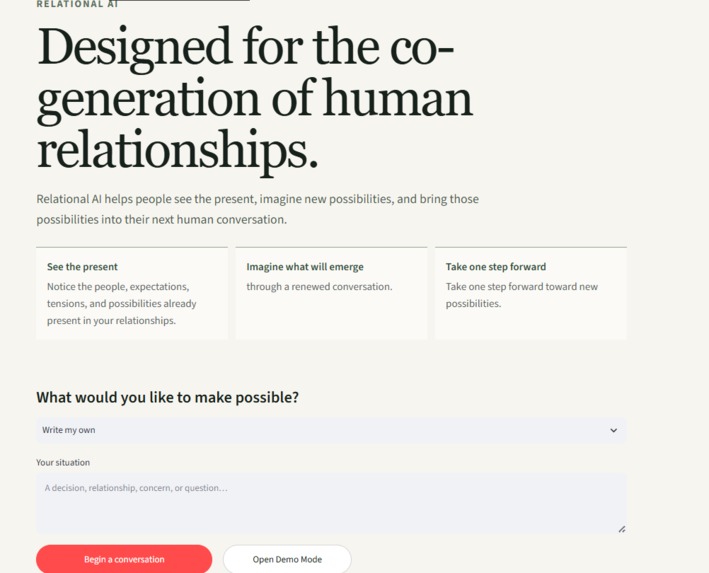
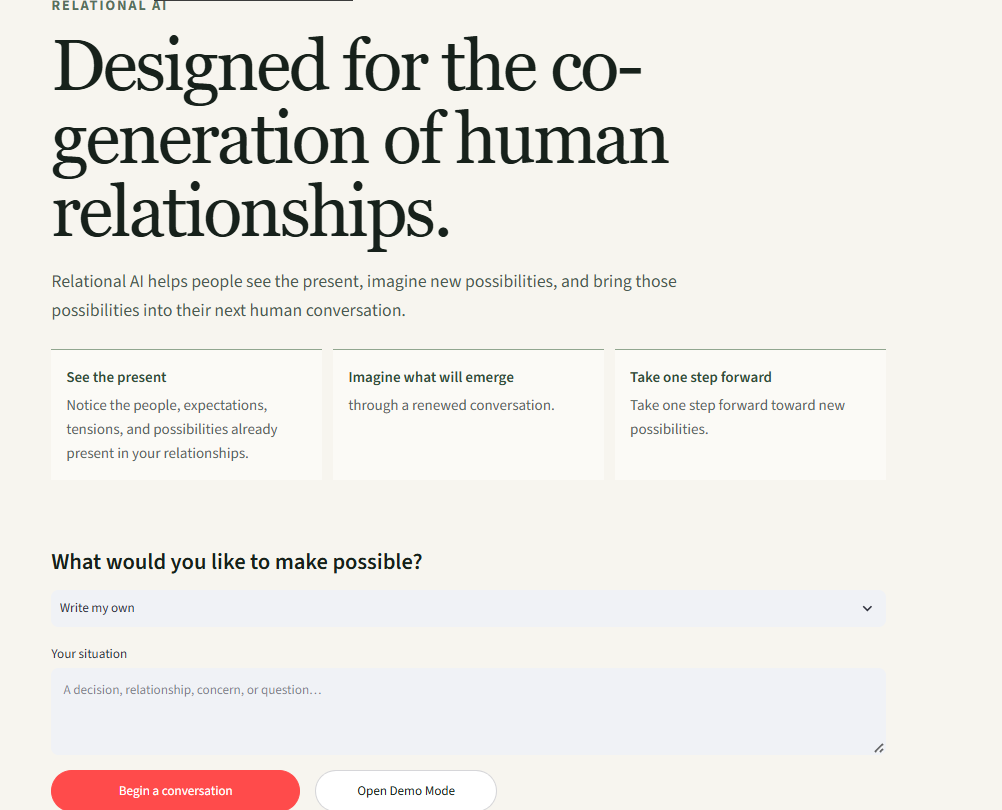
The opening screen of Relational AI, introducing a finite conversational experience designed for life beyond AI.
Inspiration
As AI becomes increasingly capable of holding long and meaningful conversations, we began asking a different question.
Rather than asking how AI could keep people engaged for longer, we asked:
How can AI help people become more capable of participating in the relationships that continue beyond AI?
This project explores a different design direction for conversational AI.
Instead of maximizing engagement, retention, or emotional dependence, Relational AI is intentionally designed as a finite conversational experience. Its purpose is not to become the user's primary relationship, but to help people notice emerging relational qualities and carry them into life beyond AI.
This idea builds on our broader research into relational architecture, participation, and human agency. For Build Week, we focused on turning that broader vision into one concrete, executable experience that people can explore today.
What it does
Relational AI invites the user to bring one unresolved relationship or relational situation into a structured conversation.
During the conversation, the system gradually builds a Participation Map, highlighting people, communities, responsibilities, contexts, and possible next participation that emerge through dialogue.
When sufficient movement has developed, the experience generates a Participation Review and an editable Participation Card grounded entirely in the user's own language.
Rather than offering advice or trying to prolong the conversation, the experience intentionally reaches a stopping point and returns attention to life beyond AI.
How we built it
The MVP was built with Streamlit and the OpenAI Responses API.
The application combines structured prompting, grounded response validation, participation-state tracking, deterministic readiness rules, and optional OpenAI-generated responses.
To ensure the experience remains explorable even without API access, we implemented a deterministic fallback mode that preserves the interaction flow while clearly distinguishing it from live model behavior.
The repository also includes comprehensive unit tests covering conversation flow, participation readiness, response structure, fallback behavior, and safeguards against unsupported interpretations.
Challenges we ran into
The greatest challenge was not technical.
It was designing an AI conversation that intentionally knows when to stop.
Many conversational systems optimize for continued engagement. We explored the opposite question:
Can an AI conversation become more valuable by ending well?
Answering that question required grounding every observation in the user's own words, avoiding unsupported interpretations, resisting dependency, and creating a deliberate transition from reflection with AI into participation beyond it.
Accomplishments that we're proud of
We built a fully executable MVP that demonstrates an alternative direction for conversational AI.
Instead of optimizing for longer conversations, Relational AI intentionally guides users toward a responsible ending while preserving reflection, agency, and openness.
We are particularly proud that the project combines:
- a complete Streamlit experience,
- optional OpenAI-powered structured responses,
- deterministic fallback behavior,
- grounded Participation Reviews,
- editable Participation Cards, and
- a coherent finite interaction design
within a single working prototype.
What we learned
Building this MVP changed the way we think about conversational AI.
We learned that meaningful conversations are not necessarily those that become longer.
Sometimes the most valuable AI interaction is one that leaves people better prepared for the conversations they have with others afterward.
Designing AI for participation rather than engagement opened an entirely different set of product, ethical, and technical questions.
What's next for Relational AI
This MVP demonstrates one executable example of relational interaction design.
Our next goal is to continue developing Relational AI into a broader framework for designing AI systems that strengthen human participation without encouraging dependency.
We hope this project contributes to a wider conversation about how future AI systems can support relationships, communities, and shared worlds that extend beyond AI itself.
We do not see this MVP as a conclusion, but as the beginning of exploring a different future for conversational AI—one in which success is measured not by how long people stay with AI, but by how fully they participate in the world beyond it.

Log in or sign up for Devpost to join the conversation.