-
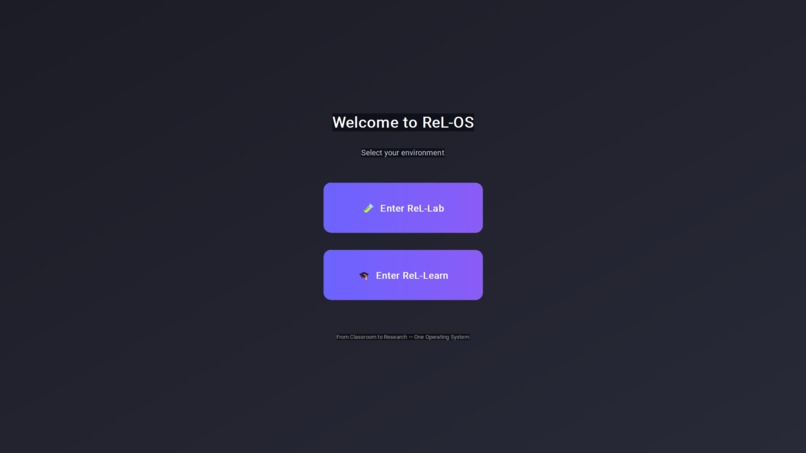
Eco System Interface
-
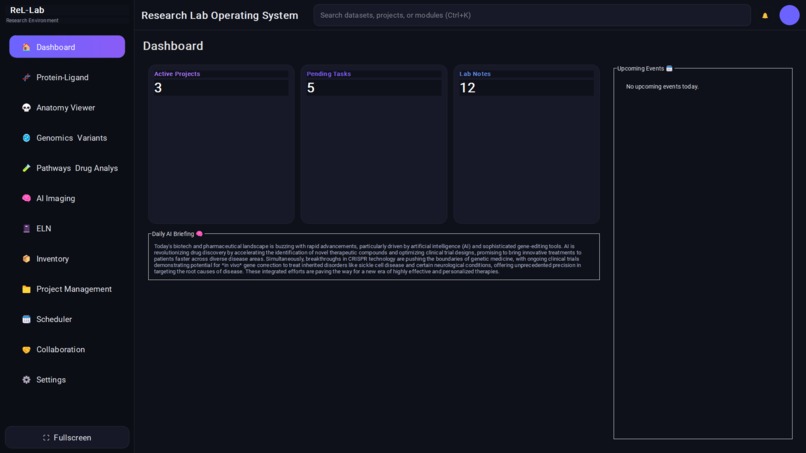
Home Dashboard
-
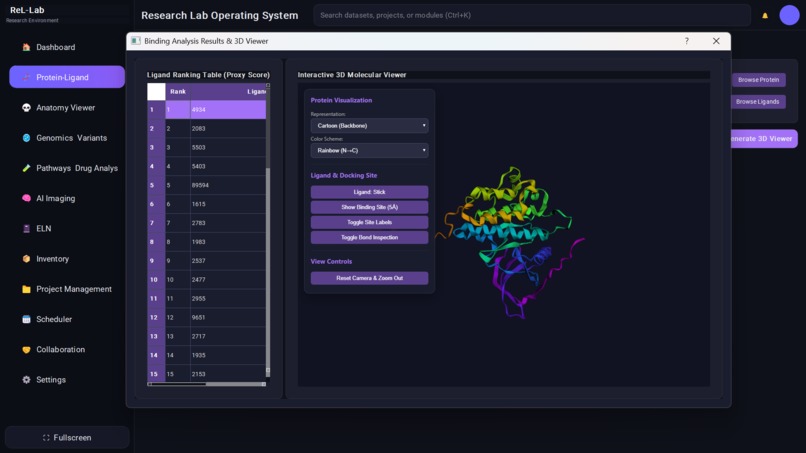
*Novel* Protien-Ligand Scoring and Docking System
-
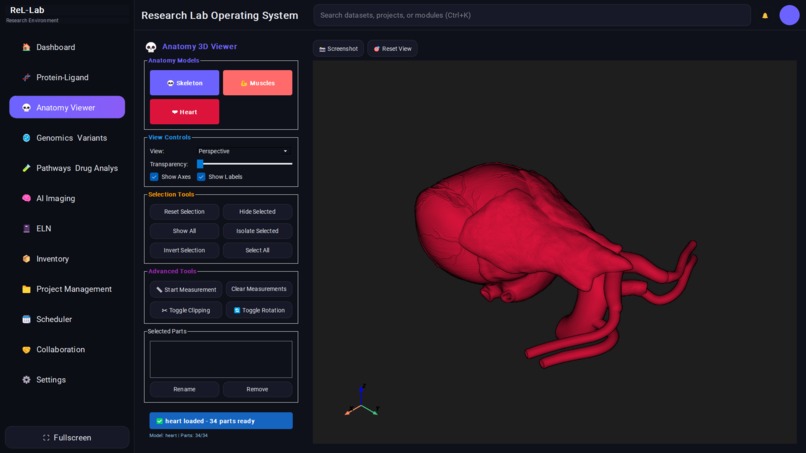
Human Anatomy 3-D Viewer
-
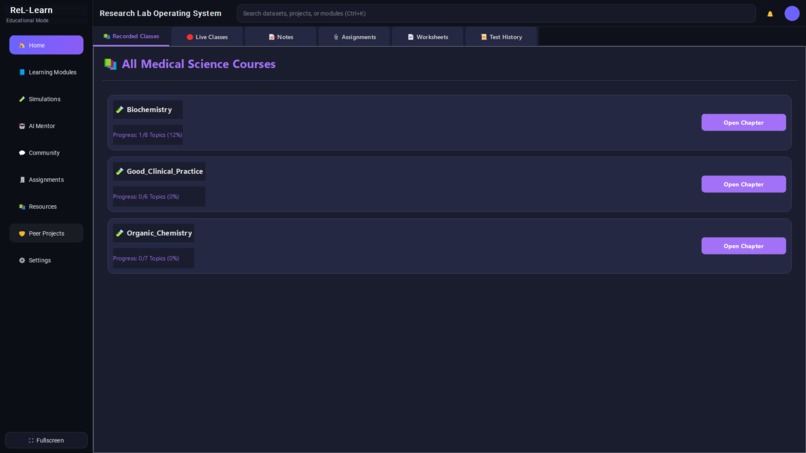
ReL-Learn Page


🌟 Inspiration
We started ReL-OS after feeling the same pain across classrooms and labs: brilliant people blocked by fragmented tools and disconnected data. Imaging sat in one silo, genomics in another, simulations in a third—none speaking the same language. We wanted one AI-powered, cloud platform where students, researchers, and institutions could actually work together, in real time, on the same truth. That’s the spark behind ReL-OS.
💡 What It Does
ReL-OS (Research Lab Operating System) is an AI-powered ecosystem that unites biomedical research, education, and collaboration in one connected platform. It’s built around two tightly integrated environments:
🧬 ReL-Lab — The Research Core
ReL-Lab is where real-world biomedical discovery happens. It brings together advanced tools that scientists and clinicians use daily:
Protein–Ligand Studio: Simulates how drugs bind to target proteins, accelerating drug-discovery pipelines.
Genomics Explorer: Analyzes DNA sequences and identifies disease-causing genetic variations.
AI Imaging Lab: Uses deep learning to interpret MRI, CT, and X-ray scans, spotting patterns faster and more accurately.
Pathways & Drug Analysis Suite: Maps biochemical pathways and predicts how different treatments interact.
Electronic Lab Notebook (ELN): A secure, digital workspace for recording experiments and results.
Inventory & Scheduler: Tracks reagents, materials, and experiment timelines.
Collaboration Hub: Enables cross-team projects, remote discussions, and research sharing in real time.
ReL-Lab functions as a cloud-based digital laboratory, allowing researchers to run simulations, manage data, and collaborate without switching platforms.
🎓 ReL-Learning — The Education Core
ReL-Learning transforms medical and scientific education into an interactive, research-connected experience. It allows students and educators to learn through doing — not memorizing — by integrating real data and simulations:
Learning Sandbox: A hands-on virtual lab to practice molecular docking, genomics, and imaging workflows.
AI Mentor: An intelligent tutor that explains concepts, guides experiments, and answers questions interactively.
Simulations: Virtual experiments replicating biological reactions and lab conditions.
3D Human Atlas Viewer: Explore anatomy with integrated protein and gene mapping in full 3D.
Assignments & Progress Tracker: Lets teachers monitor learning outcomes and student understanding.
Community Forum & Peer Projects: Encourages collaboration, creativity, and teamwork.
Resource Library & Assessment Dashboard: Offers curated learning materials and real-time analytics to track growth.
ReL-Learning bridges classroom theory and professional research, empowering students to experience real-lab scenarios through the same ecosystem used by scientists.
🧠 How We Built It
We designed a modular architecture with two synchronized environments:
ReL-Lab — focused on advanced analytics and biomedical tools.
ReL-Learning — offering interactive education, simulations, and AI mentoring.
Built with Python, Flask, PyQt, and 3Dmol.js, the platform integrates research-grade libraries like RDKit and Biopython. Each module communicates through a shared data layer, creating seamless interconnectivity — results from one tool automatically enhance another.
⚙️ Challenges We Ran Into
Integrating high-performance AI tools without slowing down the interface.
Designing a modern SaaS-grade UI for both scientists and students.
Managing large datasets and molecular models efficiently in the cloud.
Building interoperability so data flows seamlessly between modules.
🏆 Accomplishments That We’re Proud Of
We showcased our working ReL-OS prototype at a business entrepreneurship competition called Vision Era in Muscat, Oman — and won among several innovative startup teams.
The project received interest from two companies who expressed willingness to adopt and collaborate with ReL-OS in the near future.
We also received an official letter of appreciation from both of the companies, recognizing ReL-OS as a promising innovation in the field of biotechnology and digital transformation.
These achievements validated both the technical potential and market viability of our vision — showing that ReL-OS isn’t just an academic idea, but a real, scalable solution for the future of research and education.
📚 What We Learned
We learned to balance scientific precision with accessibility. From bioinformatics to cloud design, we discovered how to merge research technology with an educational mission—proving that complexity can be made usable and inspiring.
🚀 What’s Next for ReL-OS: One System, Infinite Discovery
We’re expanding ReL-OS globally through AWS/Azure infrastructure, AI-personalized research assistants, and institutional partnerships. A freemium model will make it accessible to schools, universities, and labs worldwide—continuing our mission to make advanced biomedical discovery and learning truly universal.
Built With
- 3dmol.js
- amazon-web-services
- biopython
- css
- docker
- firebase
- flask
- html
- javascript
- mongodb
- numpy
- pandas
- postgresql
- pyqt5
- python
- rdkit
- scikit-learn
- tensorflow
