-
-
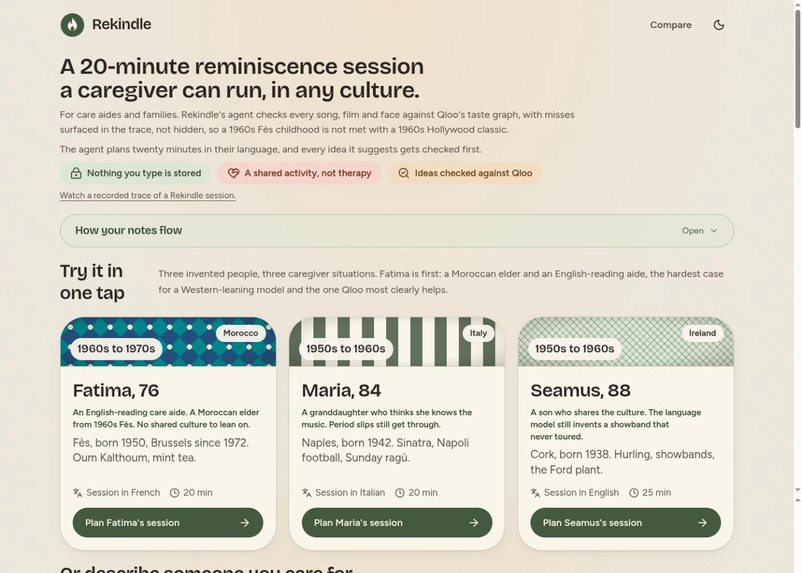
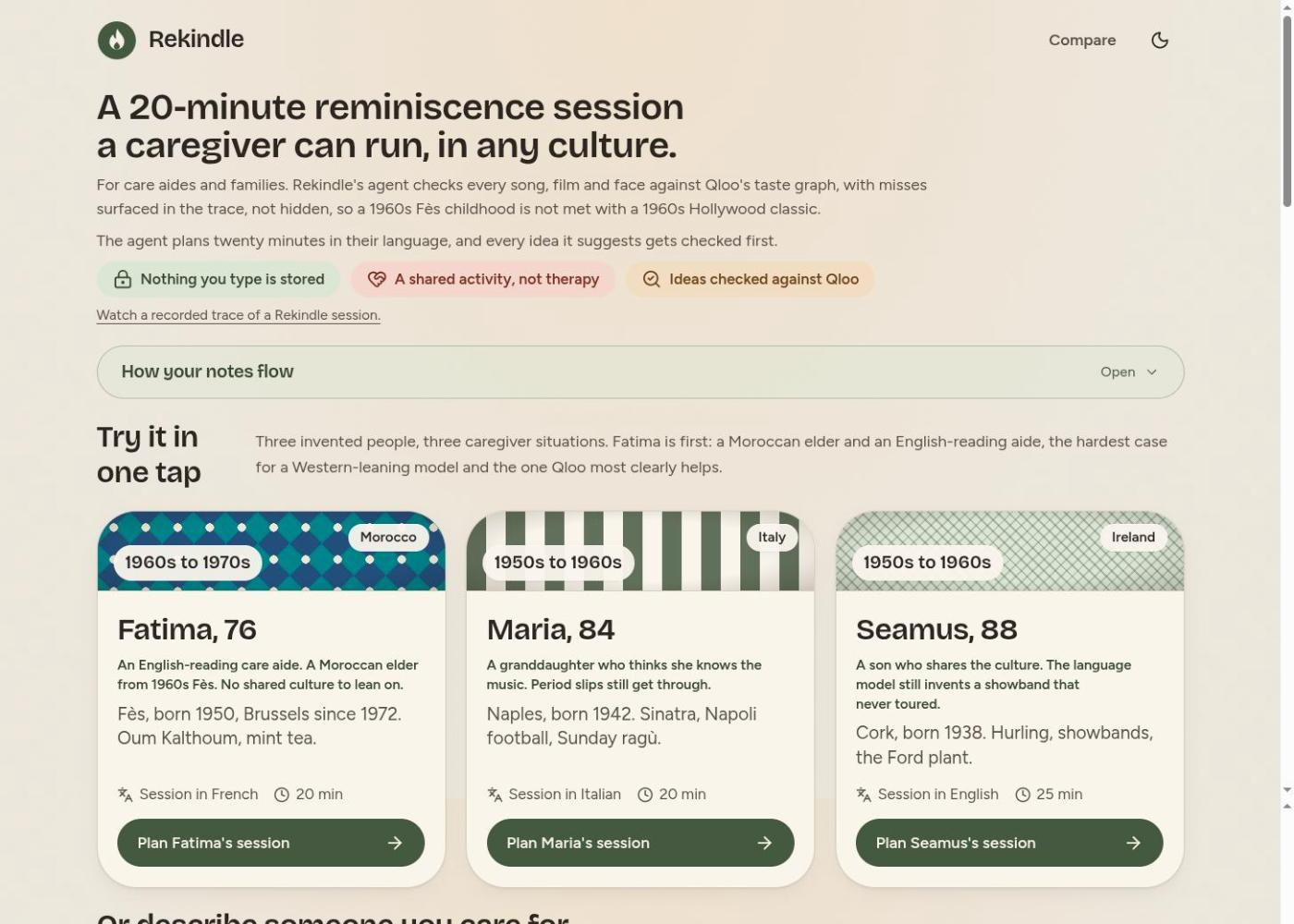
The Rekindle landing page: three personas, each one tap from a recorded run.
-
 GIF
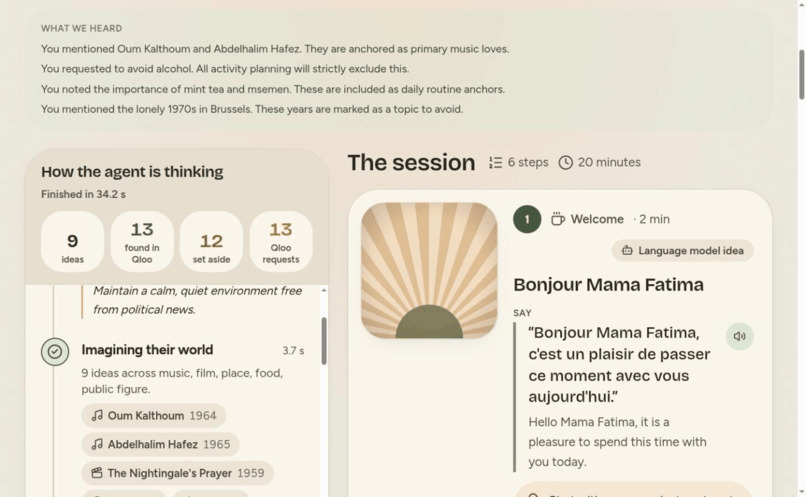
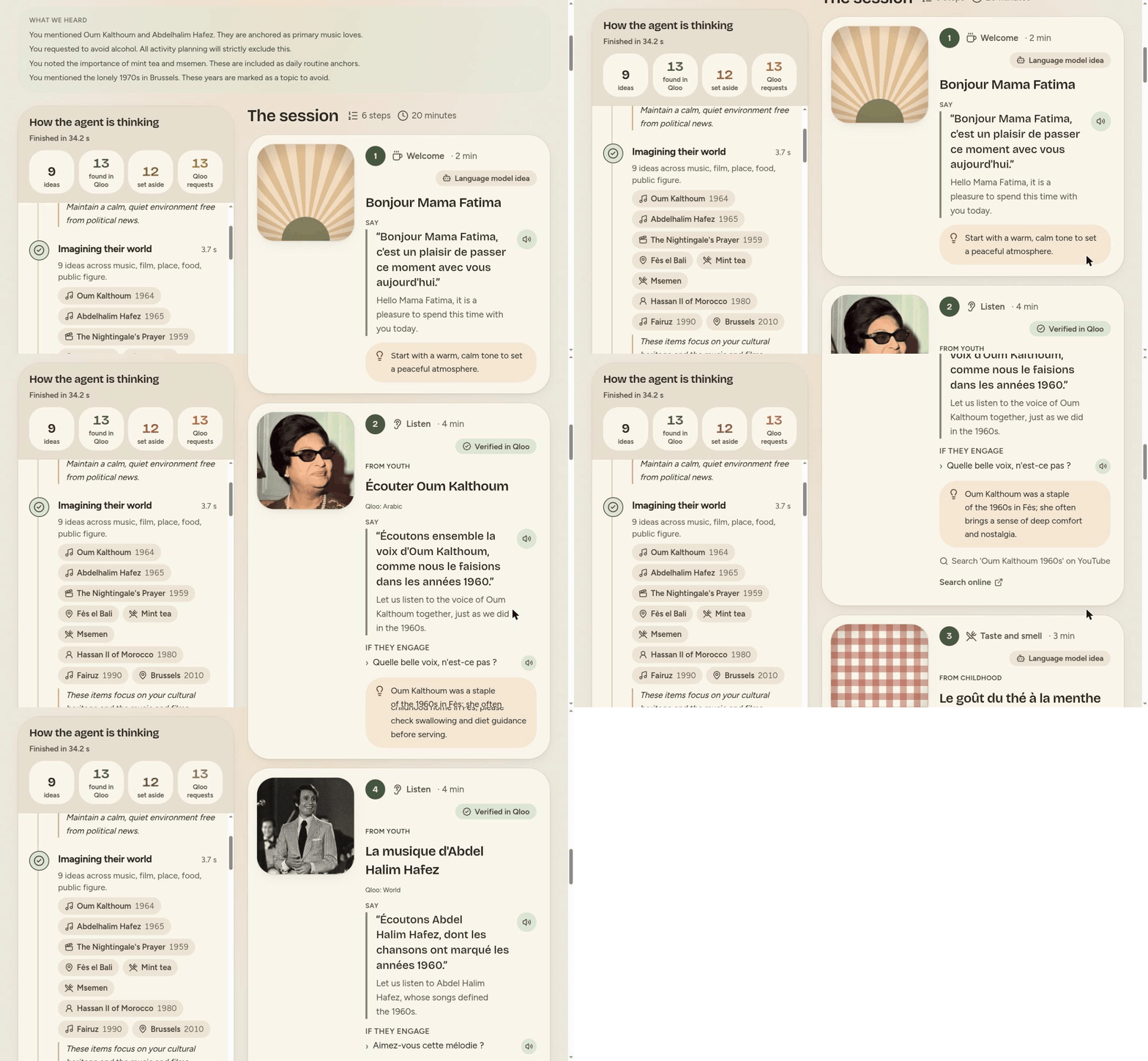
Qloo chips show which seed entities reached each cultural anchor.
-
 GIF
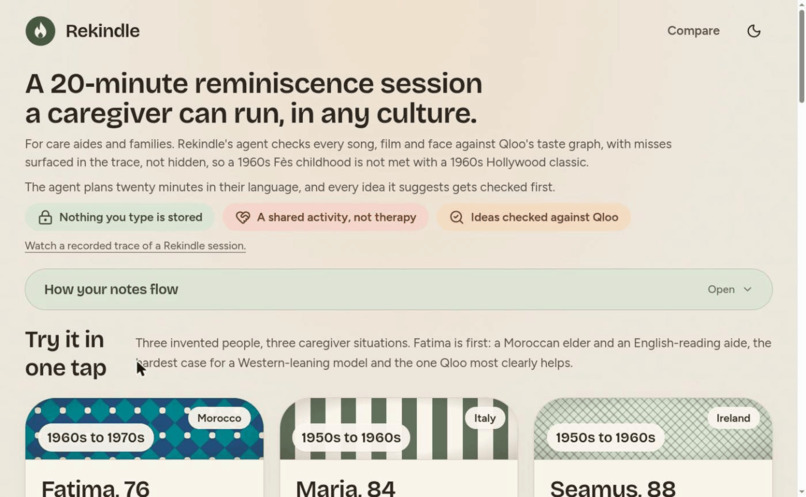
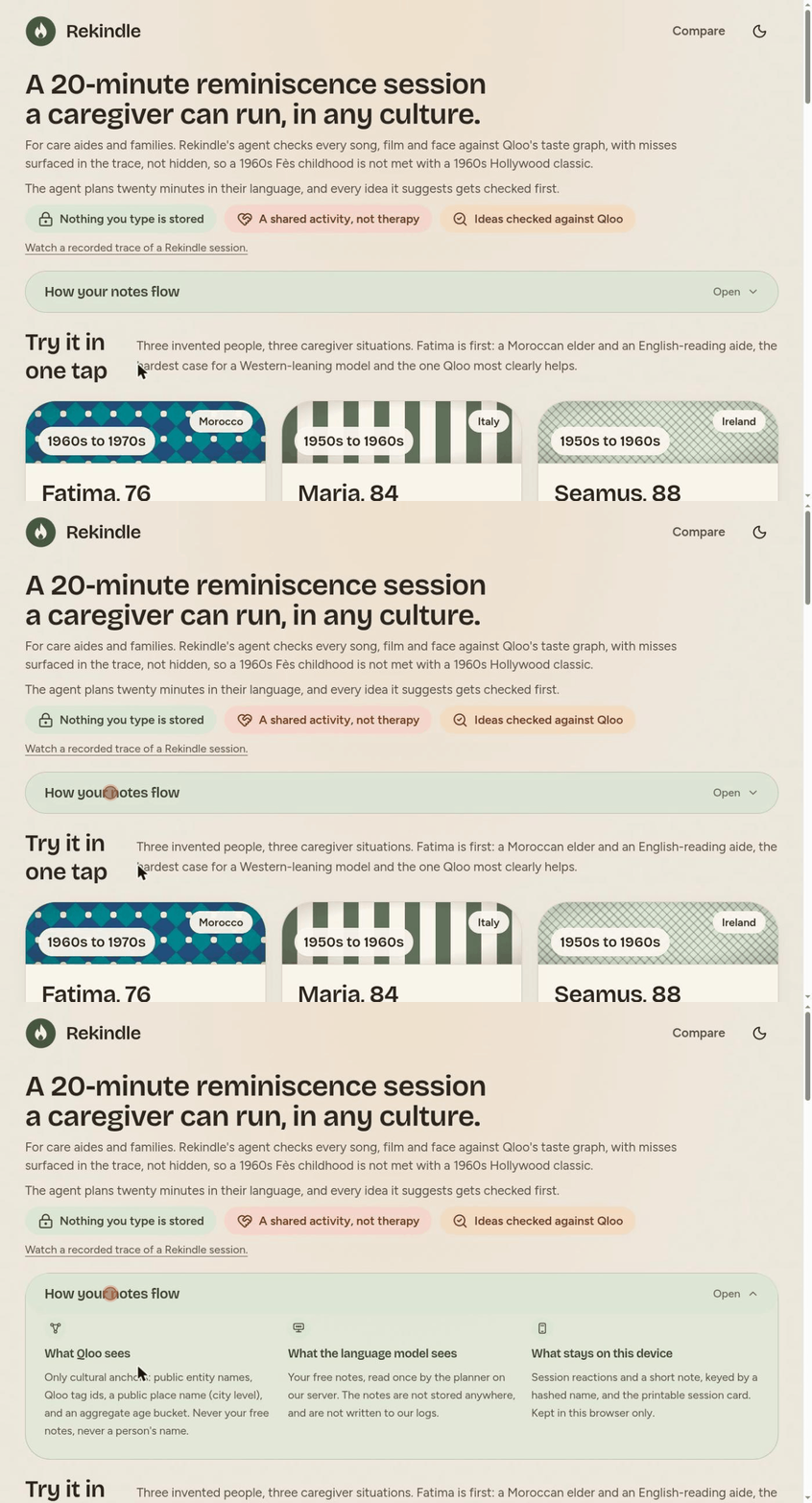
How your notes flow: what Qloo sees, what the model sees, what stays on-device.
-
 GIF
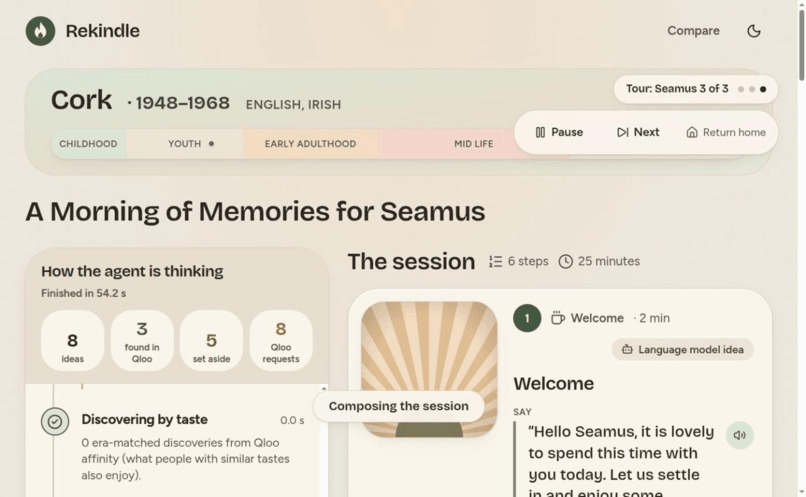
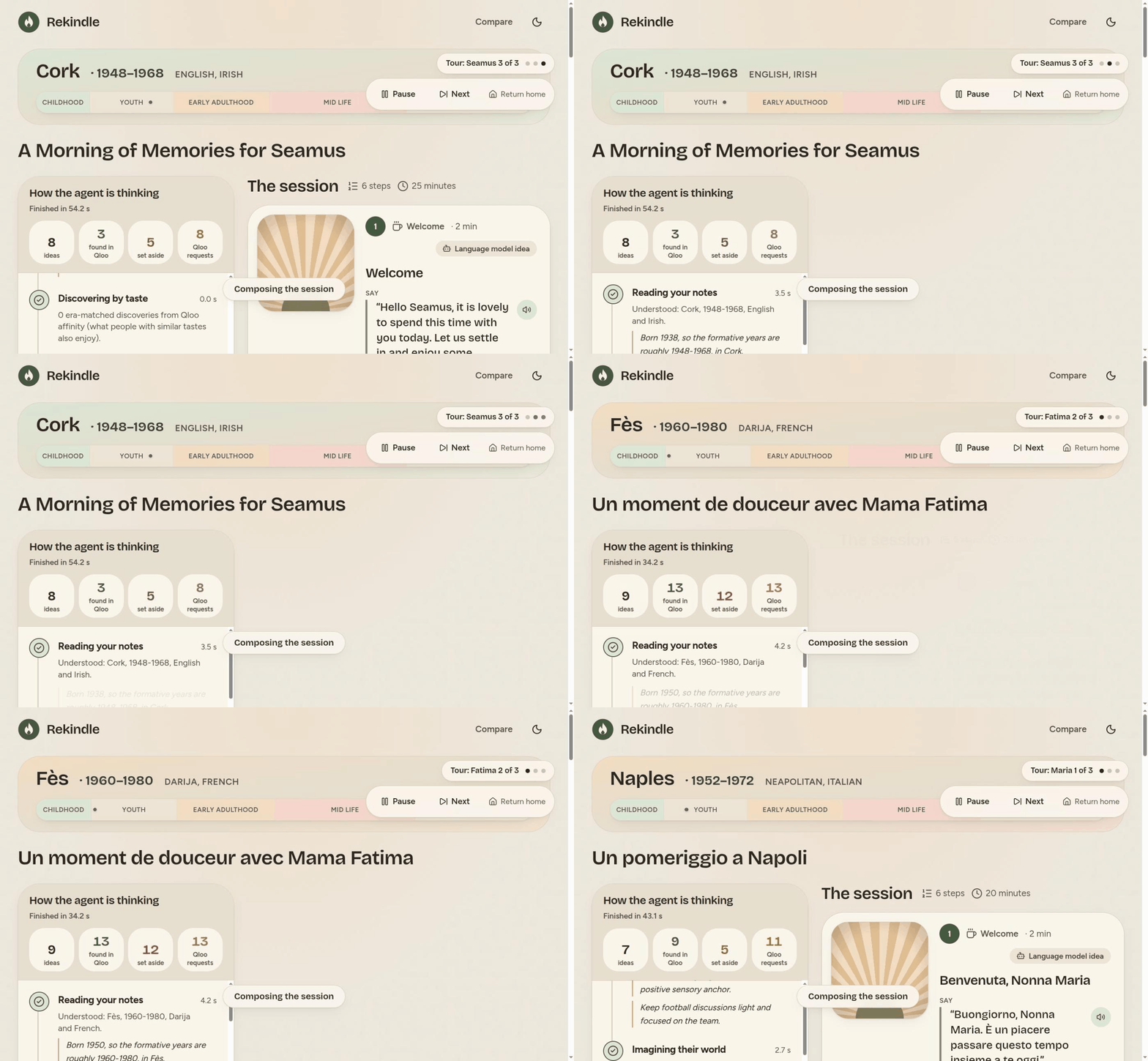
The /tour route replays Maria, Fatima and Seamus with no input and no keys.
-
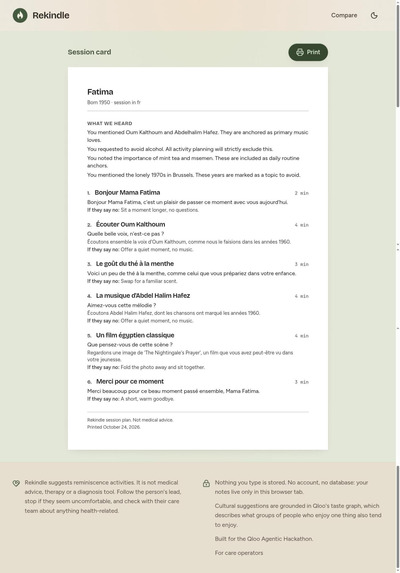
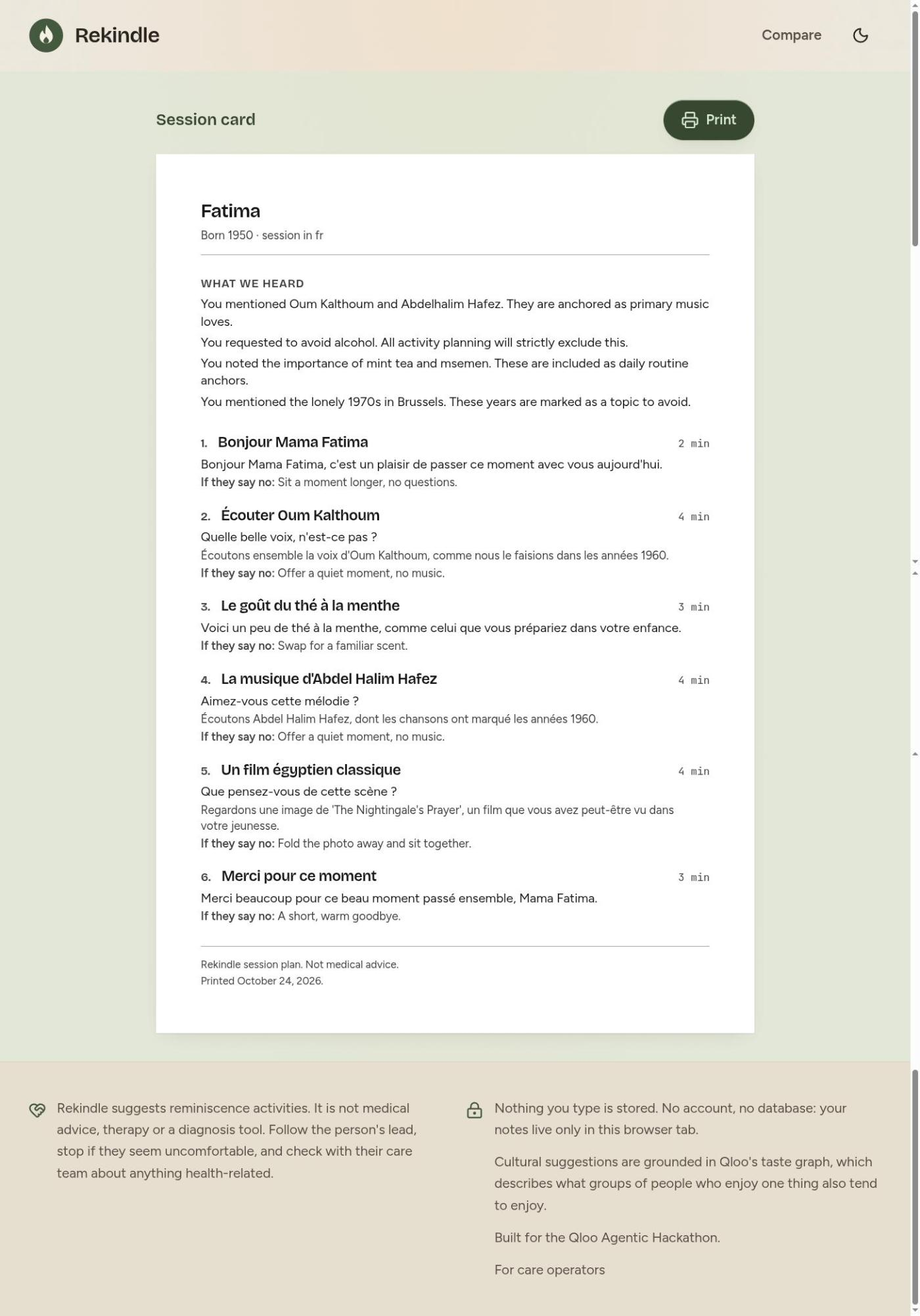
The plan prints to one A4 page, with swap and "If they say no" lines per step.
Inspiration
My grandfather. Fatima, the demo persona you will see in the video and on the live site, is shaped around him: an elder whose era and place sat outside the cultural world of the people caring for him toward the end.
That gap is the common case, not the edge. Most caregivers do not share the cultural world of the person they care for. Reminiscence activities are evidence-backed (Cochrane CD001120, Ueda 2013) and NICE recommends offering them, but a professional care aide planning an afternoon session in fifteen minutes before dinner service does not have the time, or the shared cultural reference, to make them land.
Rekindle is the tool I wish had existed. It plans a culturally grounded reminiscence session for one specific elder in under a minute, every cultural anchor verified against the Qloo taste graph. The caregiver fills in a short This is Me sheet and a six-phase agent returns a twenty-minute session in the elder's own language, with a meaning line in the caregiver's language. It is not therapy. It does not treat, diagnose, or replace care. It plans a shared moment.
What it does
The caregiver enters a few sentences about the person: a name, where they grew up, what settles them, what to avoid. A six-step session comes back: welcome, listen, look together, taste and smell, move, talk, close. Each cultural step is anchored to a public entity Qloo has confirmed exists, with its year and metadata. Prompts are in the person's language; the meaning line and tip are in the caregiver's language. Every prompt has a Listen button.
Above the first step, "What we heard" quotes the caregiver's own notes and says what the planner did with each line. The two singers kept as music anchors. Alcohol excluded. Mint tea kept as routine. The 1970s in Brussels marked as a topic to avoid.
After the session, three one-tap reactions per step (Sparked, Did not land, Walked away) and a short note save on the device. Next time the aide types the same name, "Last time with Mama Fatima" is prepended to the sheet and the planner reads it.
The whole plan prints to one A4 page with a swap alternative and an "If they say no" line per step, so a night shift can run it with no device.
How we built it
Six phases on one agent loop, each narrated to the caregiver in plain language:
- Reading your notes. Gemini turns the sheet into structured anchors through a schema-validated prompt.
- Imagining their world. Gemini proposes era-and-place candidates per domain (music, film, places, routines) with Qloo type hints.
- Checking with Qloo. Each candidate is searched in Qloo's graph. Hits become verified entities with ids, years, tags, and images. Misses are set aside with a reason, visibly.
- Discovering by taste. Qloo
/v2/insightscalls withfeature.explainability=truereach cultural neighbours a model would not name from the notes alone. Every result is labelled aggregate: "people who enjoy X also tend to enjoy Y", never "Fatima will like Y". - Double-checking. One batched critique pass sweeps for wrong era, wrong place, cultural mismatch, and emotional risk.
- Composing the session. A timed session is assembled. A deterministic top-up swaps flexible steps for unused verified entities when a stage minimum is missed; only when no verified entity remains does the plan report an honest coverage gap.
Everything streams as NDJSON. The caregiver watches the trace build.
Technical: Next.js 16, React 19, Tailwind v4, shadcn on Base UI, Vercel AI SDK v7 with Gemini. Ports-and-adapters (TastePort, LlmPort, CachePort); the agent in src/lib/agent/ depends only on ports and domain types, enforced by ESLint. Determinism via pinned model ids, versioned prompt modules, and sha256 input-keyed caching. All meaning (parse, classify, critique) goes through structured output; deterministic code only reshapes already-structured data.
Challenges we ran into
Keeping personal data out of Qloo. Qloo queries carry only public entity names, Qloo ids, tag ids, years, and an aggregate age bucket. A withPersonalDataGuard wrapper refuses any payload containing a personal term; it runs on every Qloo call.
Non-medical framing discipline. The UI never says therapy, treatment, diagnosis, or patient. A prompt-level and ESLint-level sweep enforces it. Every plan and printable card carries the non-medical disclaimer.
Gemini is not byte-deterministic at temperature zero. We committed NDJSON trace fixtures for three personas (Maria, Fatima, Seamus) so judges can replay the full six-phase run with no key, in under fifteen seconds. The committed fixture is the demo artefact.
Coverage gaps are honest. Fatima's mid-stage recorded run reports music 2 of 3, because every extra music candidate had been set aside by the critique pass as era-wrong or culturally off. The plan says so rather than inventing.
Making the agent's reasoning visible. The trace panel is useful but a judge may not open it. We added "Why this anchor" chips on the plan card (feature.explainability=true from Qloo) and a "How your notes flow" collapsible panel on the landing page showing what Qloo sees, what the model sees, and what stays on the device.
Accomplishments that we're proud of
- A live Qloo integration that uses the taste graph as the verification layer, not just as a one-shot recommender. Fatima's recorded run made 13 Qloo requests, confirmed 13 entities (5 proposed by Gemini and verified, 8 discovered by taste), set aside 12, and composed 6 steps.
- A side-by-side test shows that across our three personas, Qloo's taste expansion surfaced 27 verified cultural neighbours the single-call baseline did not name (10 for Maria, 7 for Fatima, 10 for Seamus). Includes Nass El Ghiwane, Faten Hamama, Warda, Mohammed V, Jack Lynch, Maureen O'Hara, Omar Sivori.
- A
/tourjudge path that replays all three personas with no input, no Qloo key, no Gemini key. Survives any outage. - Localization in English, French and Italian, with gender-neutral French and Italian strings.
- A printable A4 card so a night shift can run the session with no device.
- Privacy posture: no login, no database, notes live only in the browser tab, Qloo receives no personal data by construction.
- A reaction loop that feeds the next plan without ever leaving the device.
What we learned
Qloo's taste graph is strongest exactly where a plain language model is weakest: when the caregiver shares none of the person's culture. Where the notes are rich and the culture is well covered by the model, Qloo adds less, and the compare page shows that honestly.
Caregiver realism matters more than model cleverness. The hardest decisions were about what not to show: not mentioning Brussels because the notes said to avoid the 1970s, not suggesting a Korean film to a Moroccan grandmother, not inventing music out of thin air when the critique pass set everything aside.
A twenty-minute shared activity is a different product than a recommender. The plan has to flow from greeting to closing, with pacing that fits a care home afternoon.
Determinism is a feature, not a nice-to-have. Pinned models, versioned prompts, sha256 input-keyed caching, and committed fixtures turn a flaky LLM pipeline into something a judge can click.
What's next for Rekindle
- More domains. Qloo is thinner on food than on music and film; taste steps there are often model-only. We would like to lean harder on
/v2/insightschained across domains. - Stage-aware prompts. Late stage today only lowers the music minimum. It should also remove verbal questions and default to a quieter sensory plan.
- Studies with care partners. The outreach draft list targets five dementia-care researchers and clinicians. If any respond with a willingness to test with a real care team, the next milestone is a small observational pilot focused on caregiver reaction, not elder outcomes.
- Deeper feedback aggregation. Three personas have shown that the Sparked / Did not land / Walked away loop works per session. The next step is surfacing patterns across sessions for the same person without leaving the device.
Credits
- Qloo taste graph for cross-domain verification and the neighbours a single model call does not name.
- Google Gemini via the Vercel AI SDK v7 as the language model.
- Next.js 16, React 19, Tailwind v4, shadcn on Base UI, zod 4, pino, vitest, Playwright.
- Music in the demo video: "There is Romance" by Kevin MacLeod (incompetech.com), licensed under CC BY 4.0.
Not medical advice. Rekindle plans a shared activity. It does not treat, diagnose, or replace care.
Built With
- gemini
- next.js
- playwright
- qloo
- react
- tailwind-css
- typescript
- vercel-ai-sdk
- vitest
- zod
