-
-
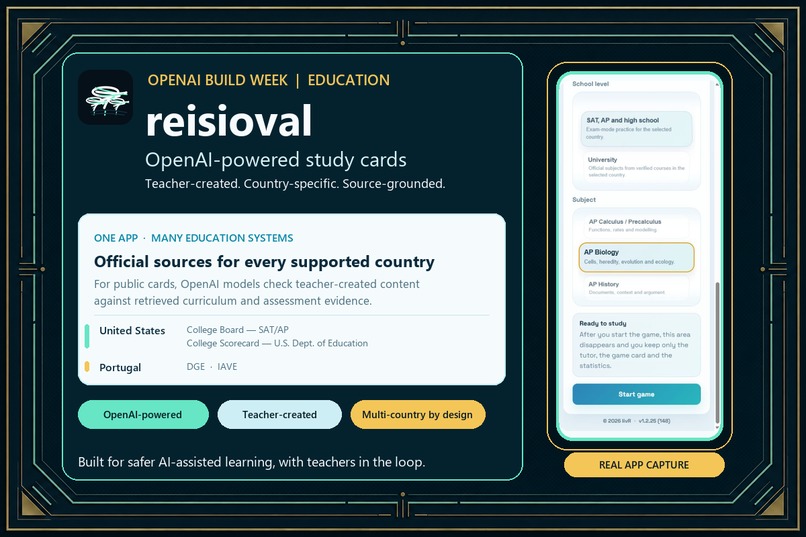
reisioval: OpenAI-powered study cards grounded in country-specific official education sources
-
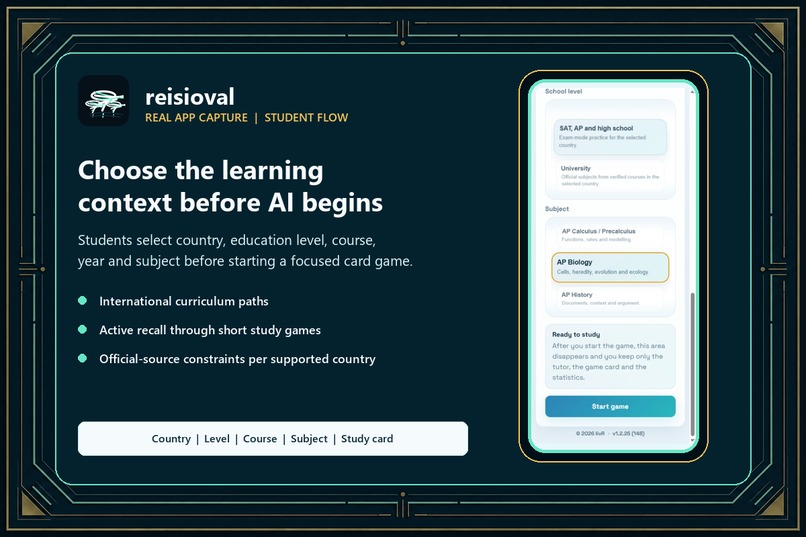
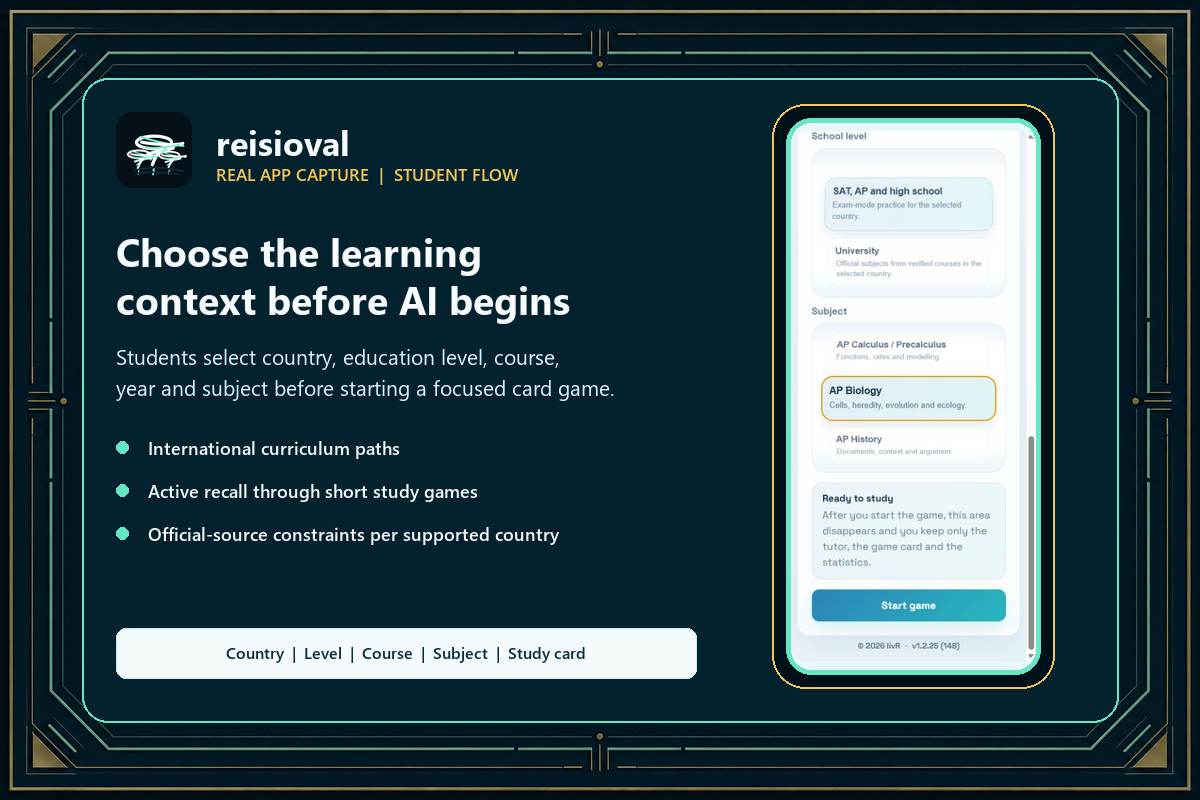
Students choose their country, education level and subject before starting a focused study card game.
-
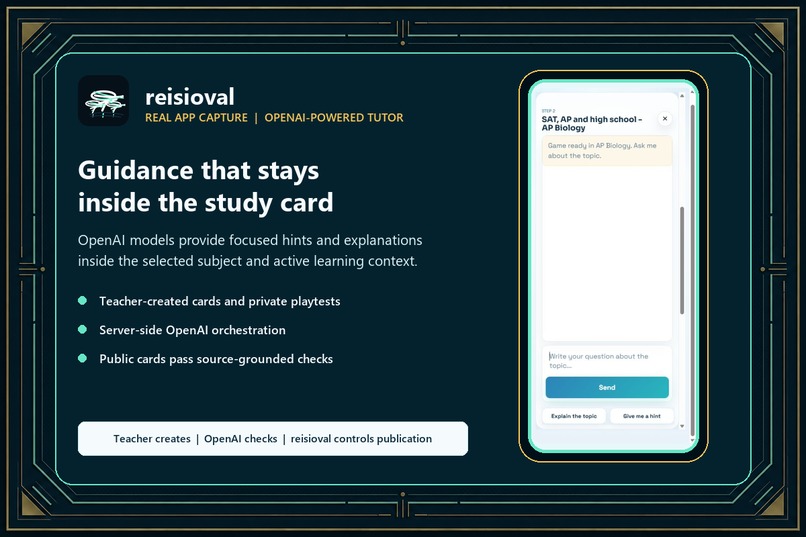
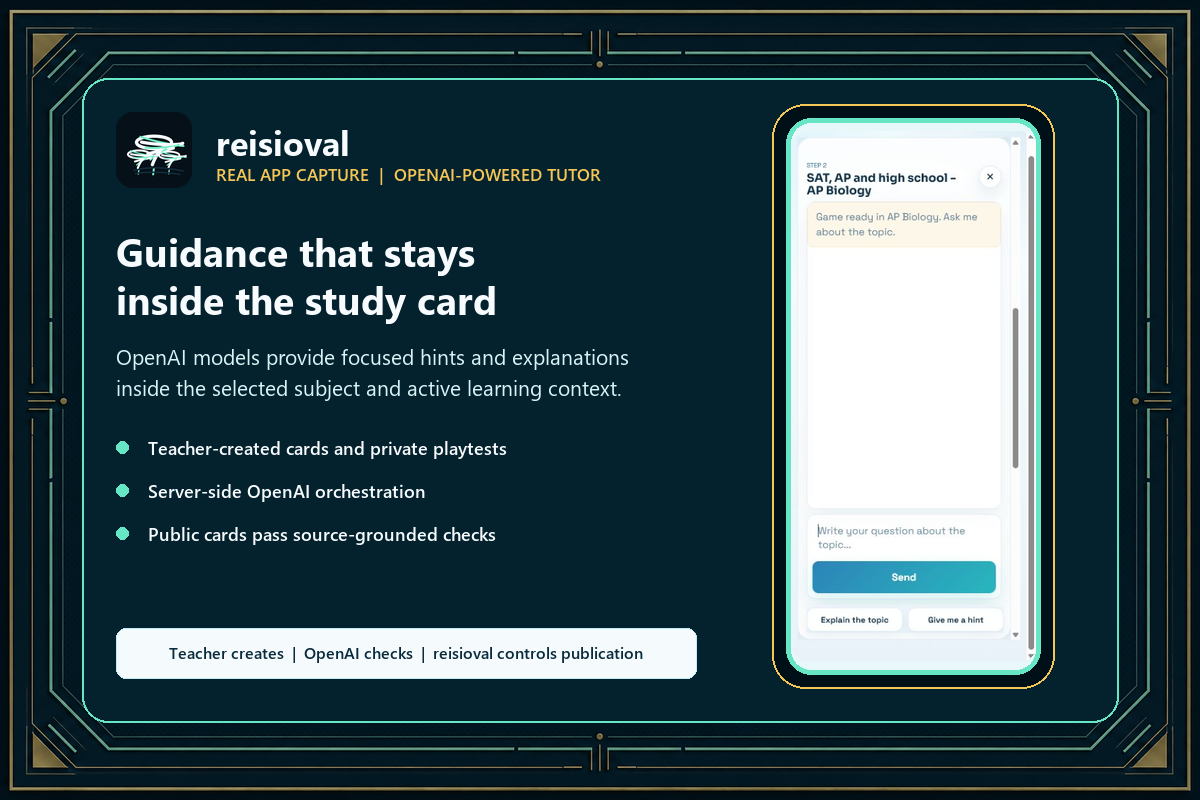
The OpenAI-powered tutor provides hints and explanations inside the selected subject and active study card.
-
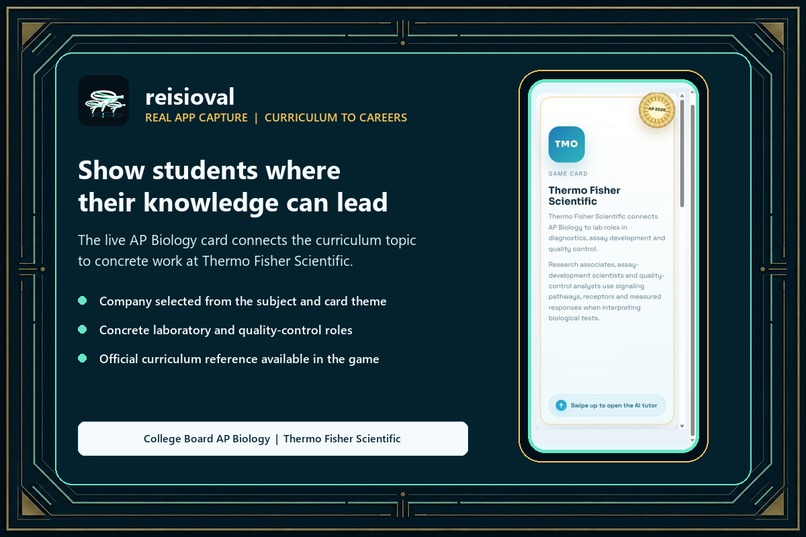
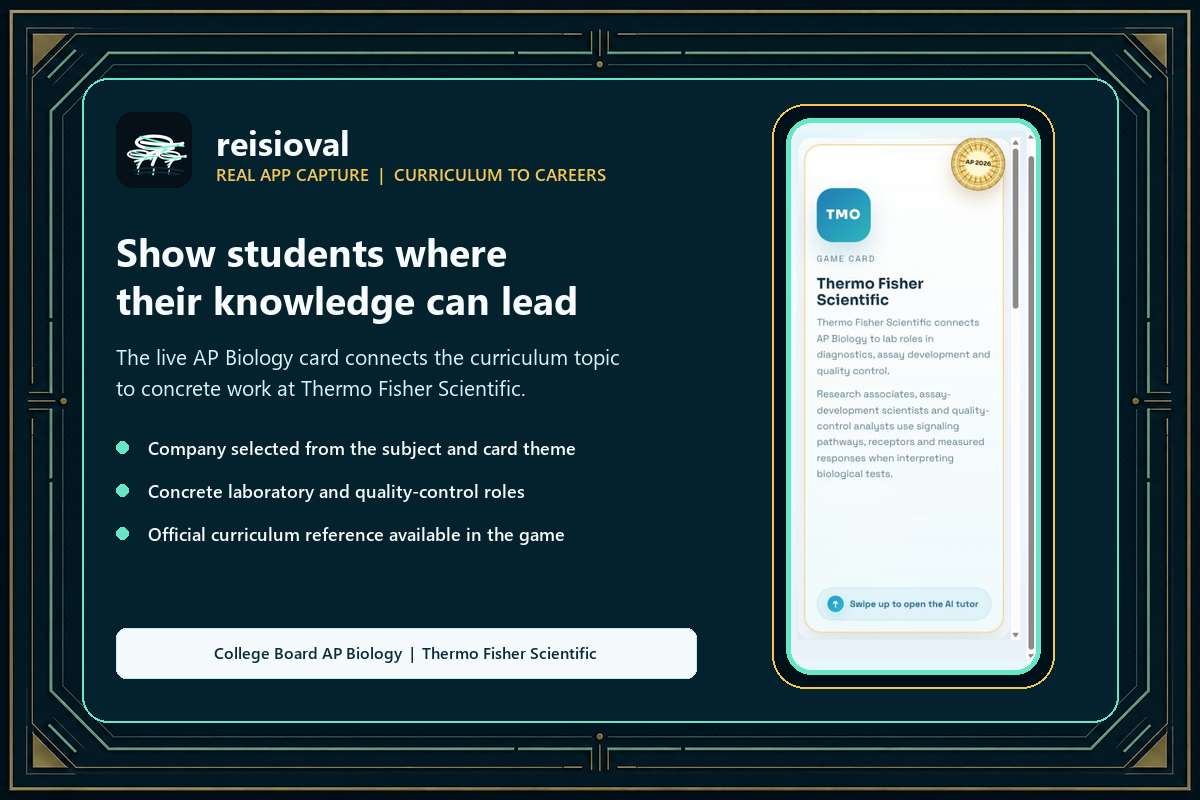
A live AP Biology card connects curriculum to laboratory careers at Thermo Fisher Scientific.
Inspiration
AI can help students reason, but a general-purpose chatbot can drift away from the curriculum, provide answers without building understanding, and leave teachers outside the learning process. We built reisioval to make AI-supported study more focused, traceable and useful inside real education systems.
reisioval is the new identity for the technology currently implemented as livR. The product is designed to expand country by country, using the appropriate curriculum, assessment and institutional sources for every supported education system.
Important point, i'm not a programmer, I studied Nutrition but my dream is help people, and this is my way to do it.
What it does
reisioval turns study into short conversational card games. Before a session begins, the student selects a country, language, education level, course, year and subject. The OpenAI-powered tutor then provides hints, explanations and guided reasoning inside that selected context and active study card.
Every public card also connects curriculum to the student's future. A company is selected because its real work relates to the card's subject and skills, not simply because it is a familiar brand. The card presents concrete roles and explains how the knowledge being studied is used in those jobs. This helps students understand that today's lesson can become a capability used in a future workplace.
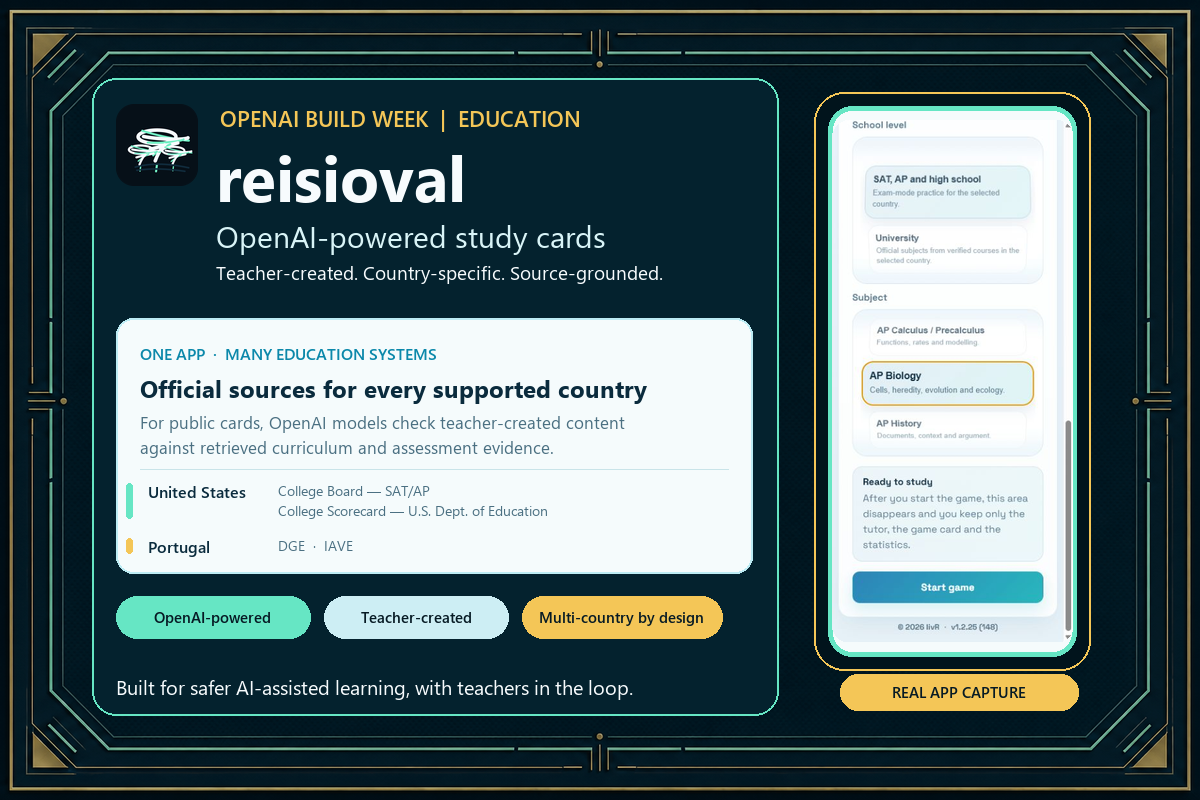
Teachers can create and playtest private cards. Teacher authorship, however, does not automatically place a card in the public student pool. For public cards, the backend retrieves verifiable content from configured official sources and an OpenAI validation model checks the card against its country, stage, subject and source evidence. The founder does not manually validate each card. A submitted URL alone is never treated as curricular evidence: if the source cannot be read, the evidence is insufficient or the model rejects the card, it does not enter the public pool.
This is a validation method created and controlled by reisioval, with OpenAI models acting as the validation engine. reisioval configures the sources and rules, supplies the retrieved evidence and applies the model's structured result. It is not presented as institutional certification or commercial approval by OpenAI.
The source architecture is country-specific. For example, the United States path uses College Board frameworks for SAT/AP study. The U.S. Department of Education College Scorecard is used separately for higher-education discovery. Portugal uses DGE curriculum references and IAVE assessment sources. Other supported markets follow their own official curriculum, examination or institutional authorities.
How we built it
The production system uses Firebase Hosting, Cloud Functions v2, Firestore and Firebase Authentication. OpenAI orchestration runs exclusively on the server, so no OpenAI API key is exposed in the frontend. Firestore client access is closed by default, and student and teacher workflows are separated through authenticated roles and controlled teacher provisioning.
The mobile experience uses HTML, CSS and vanilla JavaScript inside Capacitor workflows for Android and iOS. Students receive a focused game experience, while teachers have separate tools for private card creation and playtesting.
How we used Codex and GPT-5.6
Codex and GPT-5.6 were used throughout Build Week as engineering and product collaborators. They helped us inspect the existing system, implement and test workflows, strengthen source-validation contracts, review security boundaries, prepare mobile release checks, improve documentation and assemble the final submission package.
Codex was especially useful for working across the complete product rather than a single isolated demo: backend functions, frontend behaviour, validation rules, test scripts, operational documentation and public presentation materials.
Challenges we faced
Education systems are not globally uniform. Countries use different authorities, languages, school structures, examinations and levels of public data availability. We therefore could not treat one country's curriculum as a template for every other country.
The second major challenge was distinguishing a source link from real evidence. The validation workflow must retrieve readable content, verify that it matches the selected educational context and retain only the necessary evidence metadata. If the source is unavailable or cannot provide verifiable text, the card must not enter the public pool.
We also had to design for students who may be minors. That led to server-side AI calls, restricted Firestore access, data minimisation, controlled teacher accounts and clear separation between private teacher content and public student content.
Accomplishments we are proud of
- A working mobile-first study game with server-side OpenAI tutoring.
- Country, language, level, course, year and subject constraints before a game starts.
- Teacher-created private cards and controlled playtests.
- A public-card gate based on retrieved official-source evidence.
- A professional bridge on each public card connecting curriculum, companies and concrete jobs.
- International curriculum and higher-education source architecture.
- Firebase authentication, closed-by-default data access and privacy-aware analytics.
- Android and iOS delivery workflows based on the same product experience.
What we learned
Responsible AI in education is not only a model-selection problem. It is a product-contract problem: what context the model receives, which sources are accepted, who can create content, who decides what becomes public and what happens when reliable evidence is unavailable.
We also learned that teachers should remain visible in the workflow. AI can help check, explain and adapt, but the product is stronger when teachers can create, test and guide learning material instead of being replaced by an unrestricted chat interface.
Students are also more likely to understand the purpose of a difficult topic when the product shows where that knowledge is used. The company and job connection must therefore be specific and educational, rather than decorative advertising.
What's next for reisioval
Next, we will complete the reisioval brand transition, expand validated country-specific paths, run structured pilots with teachers, schools and universities, and improve the evidence-review interface.
We also plan a responsible sponsorship model in which companies can fund access to learning cards and educational programmes without controlling curriculum validation, pedagogy or student data. The long-term goal is to help education institutions and public bodies adopt AI as a safer tool for stronger connections between teachers and students.


Log in or sign up for Devpost to join the conversation.