-
-
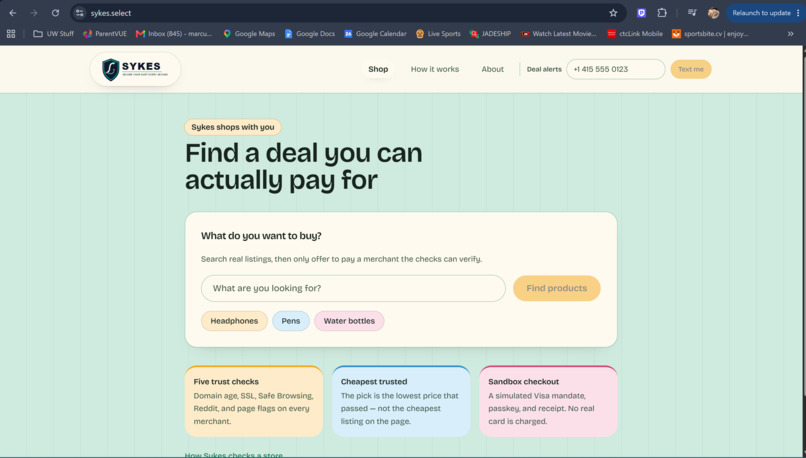
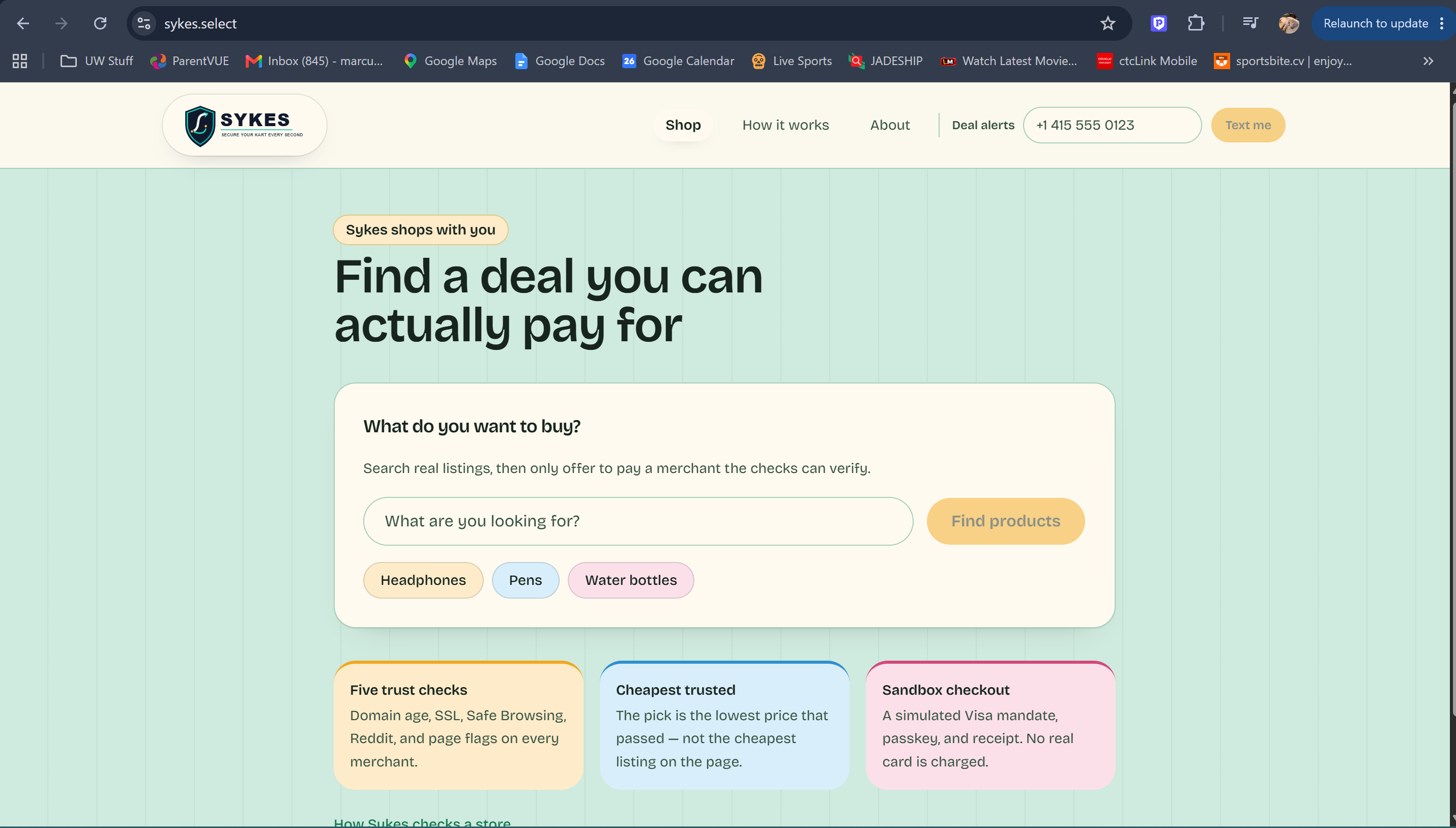
Sykes homepage, prompting user for item to shop for
-
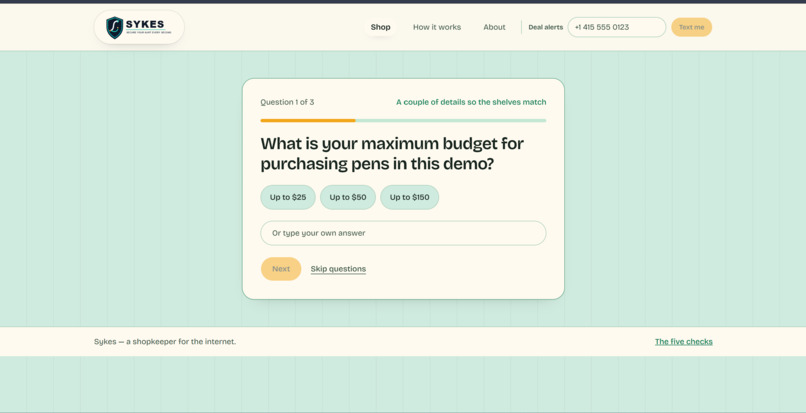
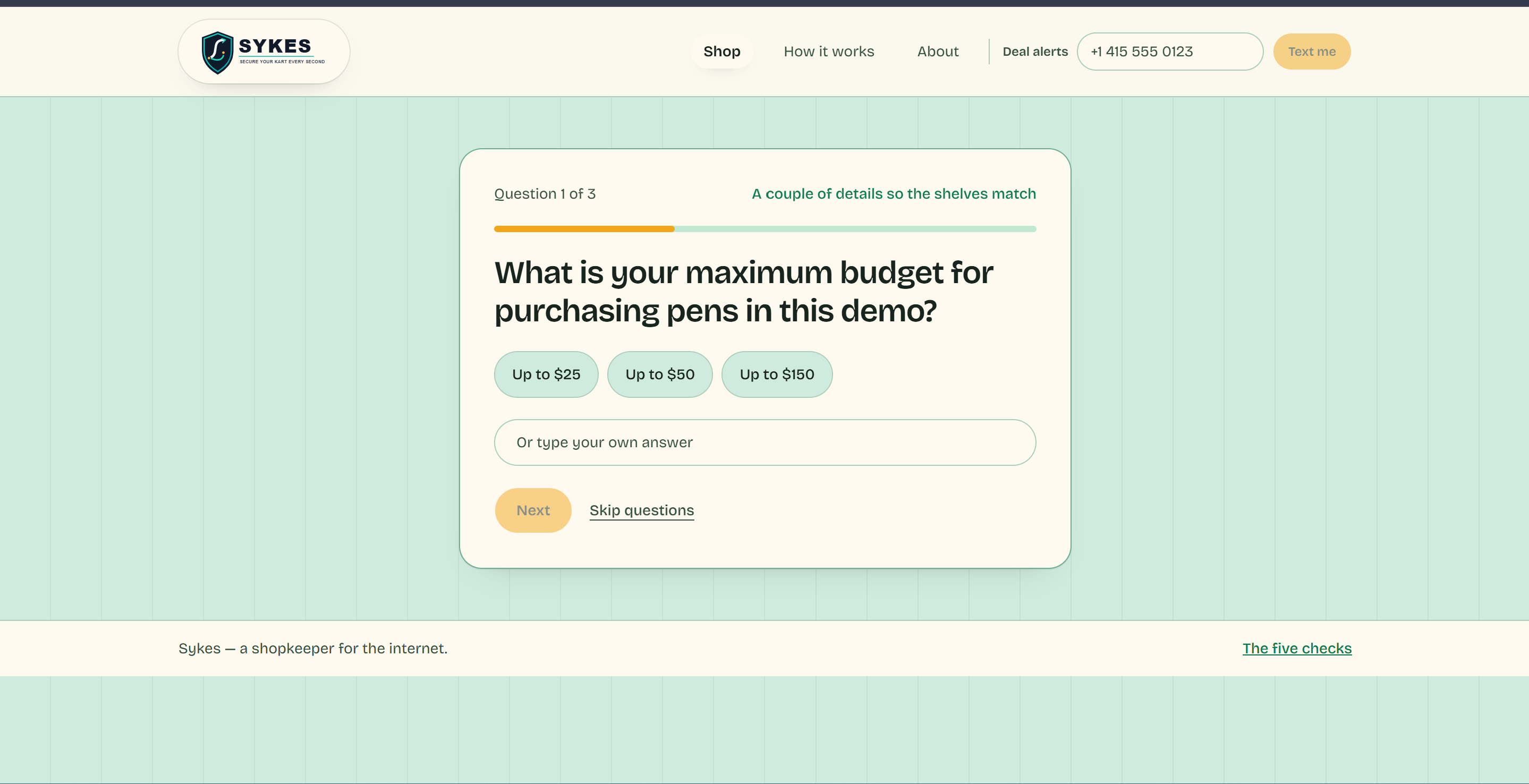
First question prompt
-
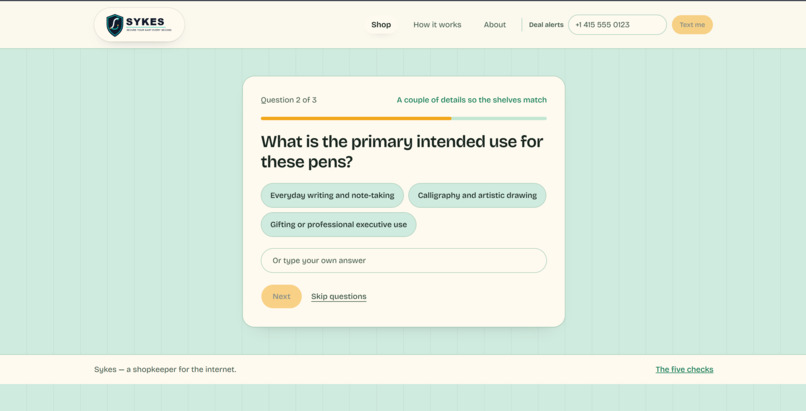
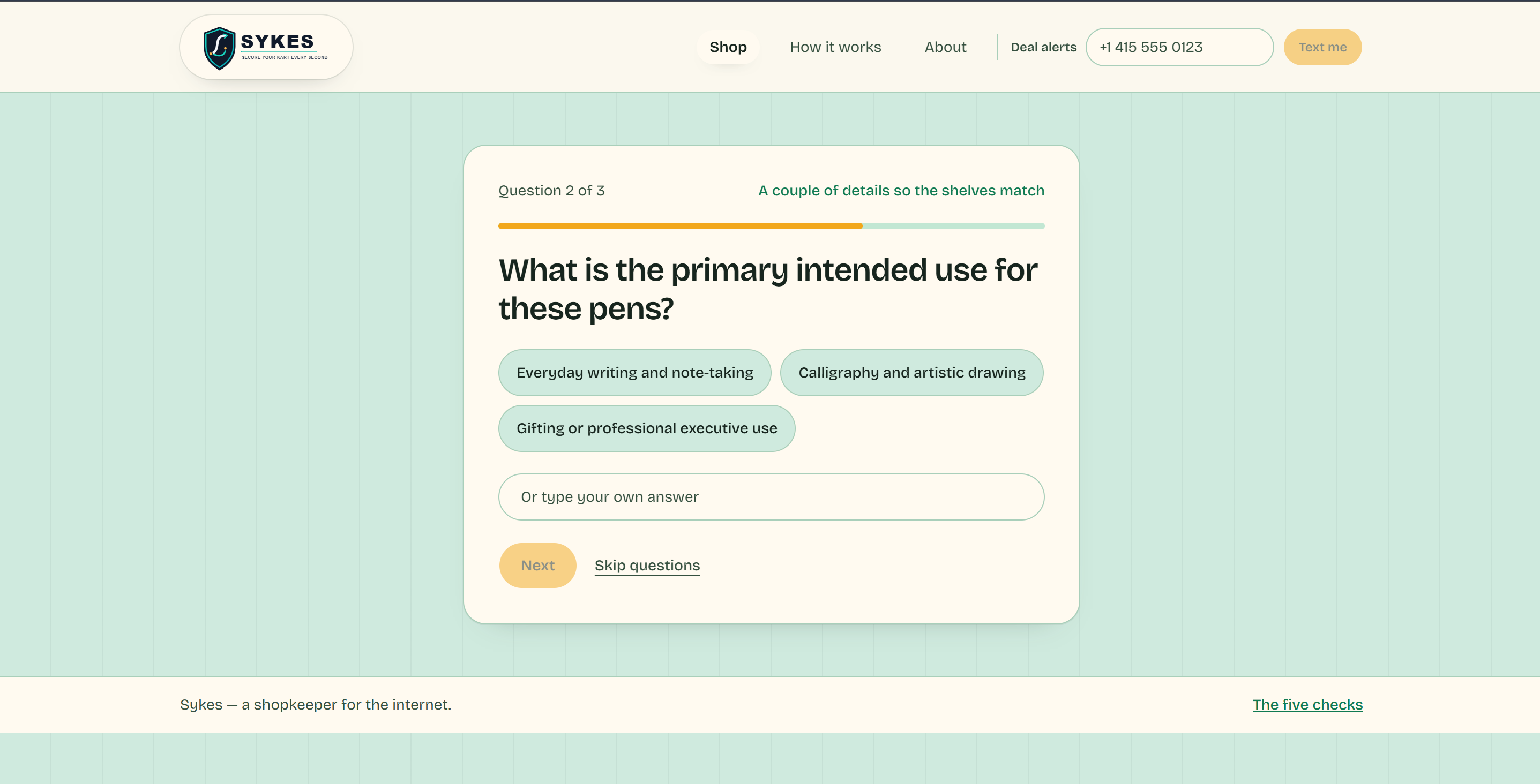
Second question prompt
-
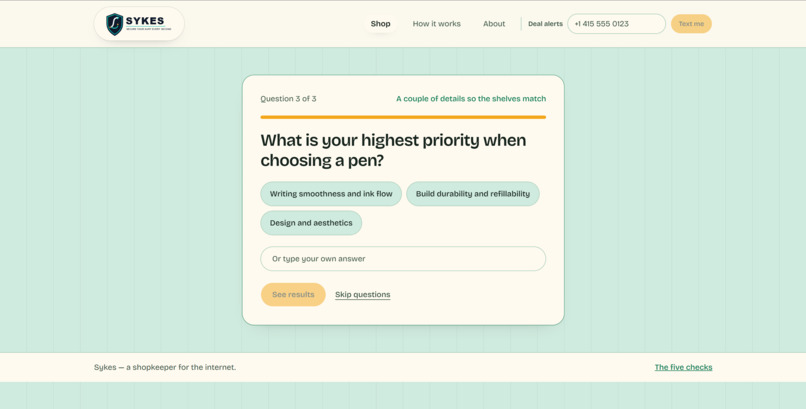
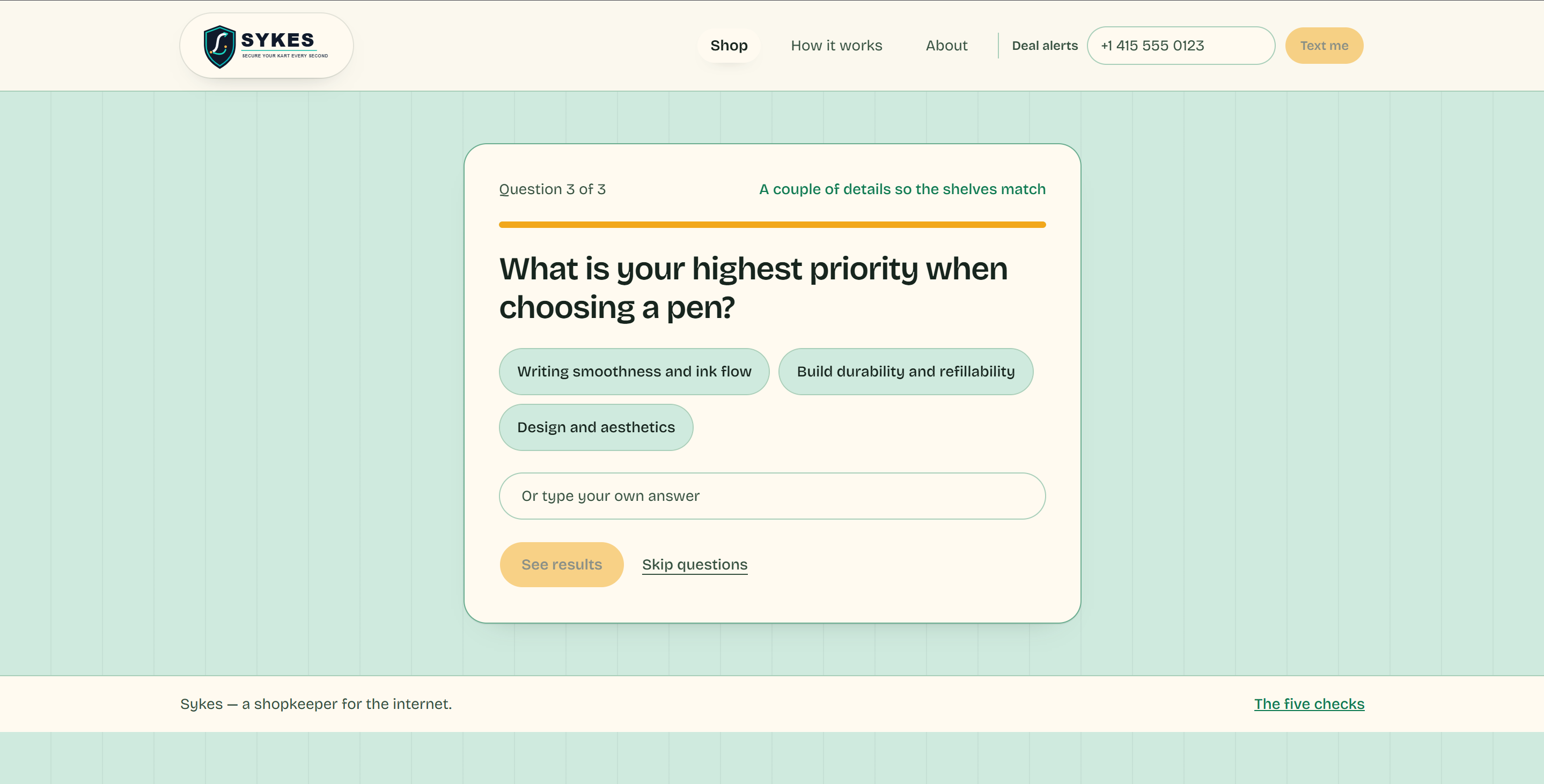
Third question prompt
-
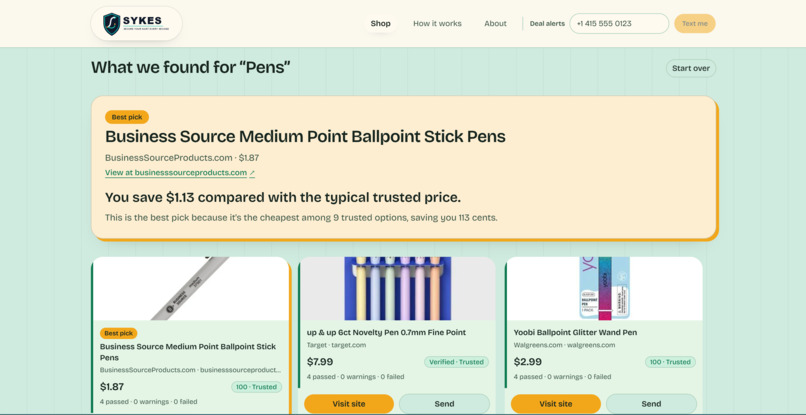
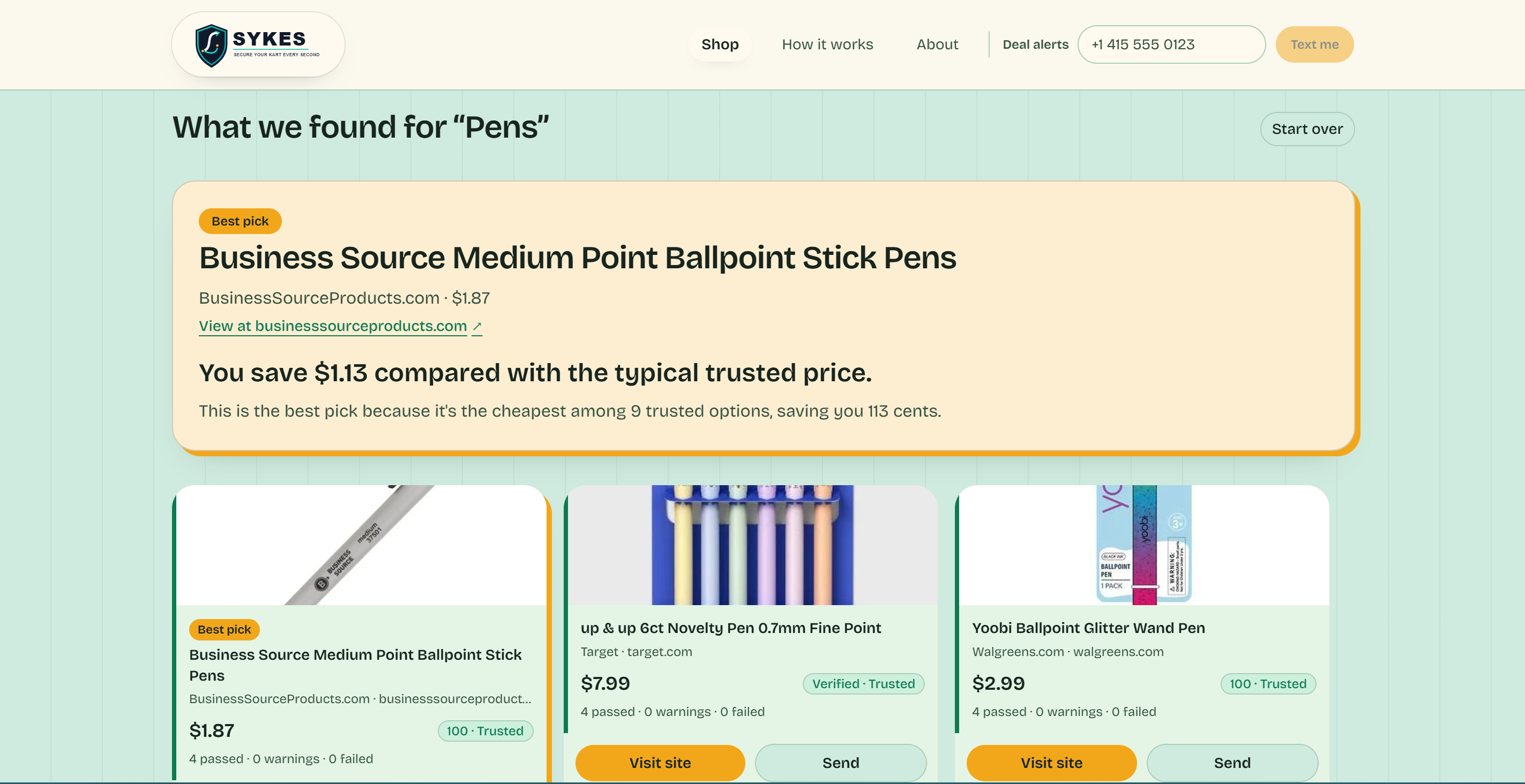
Results page for shopping items after all filters are applied
-
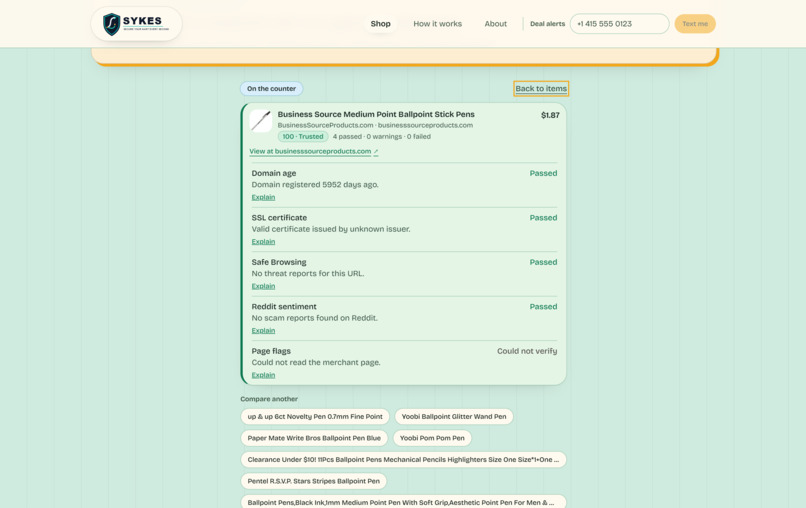
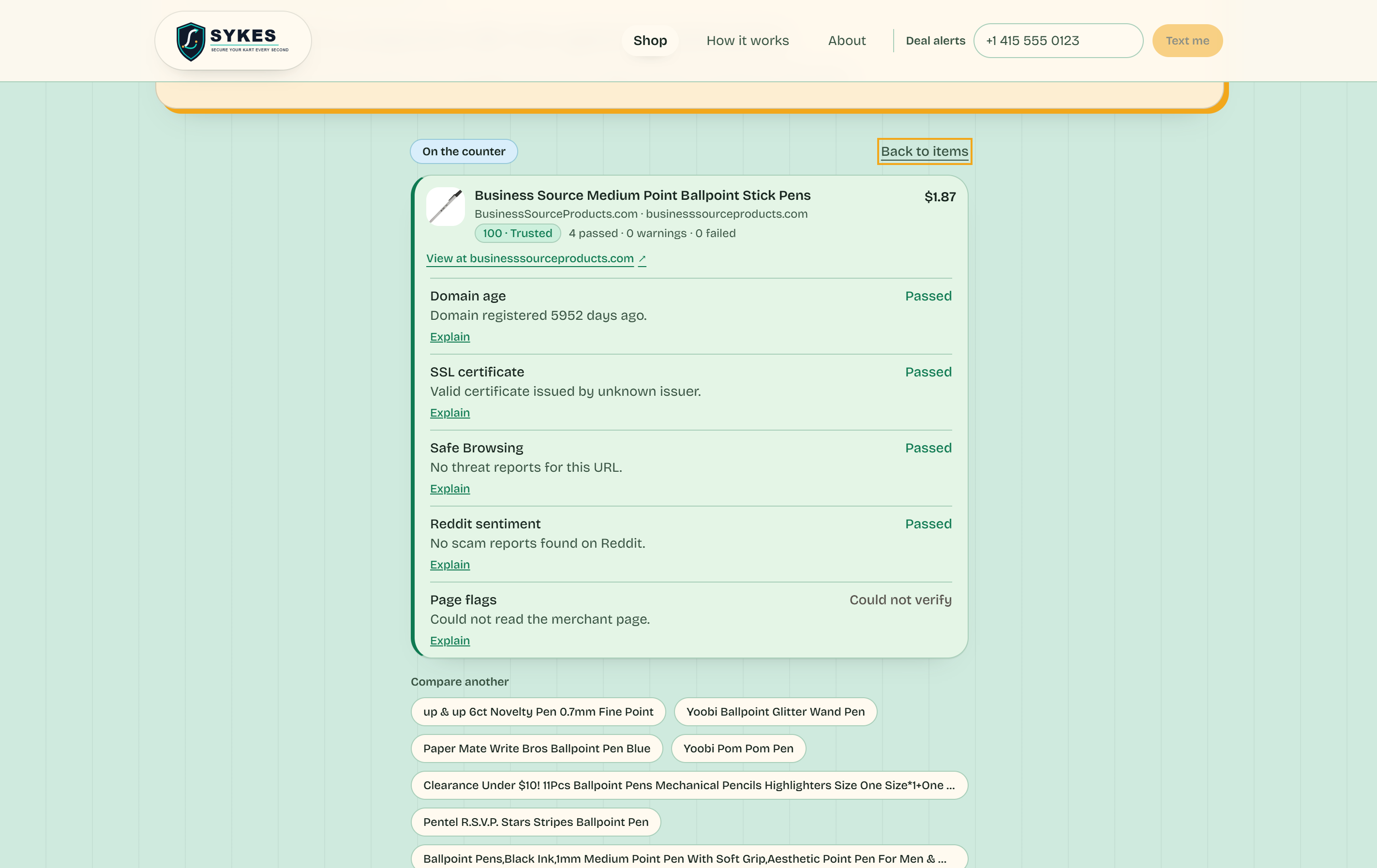
Results for each test for specific item
-
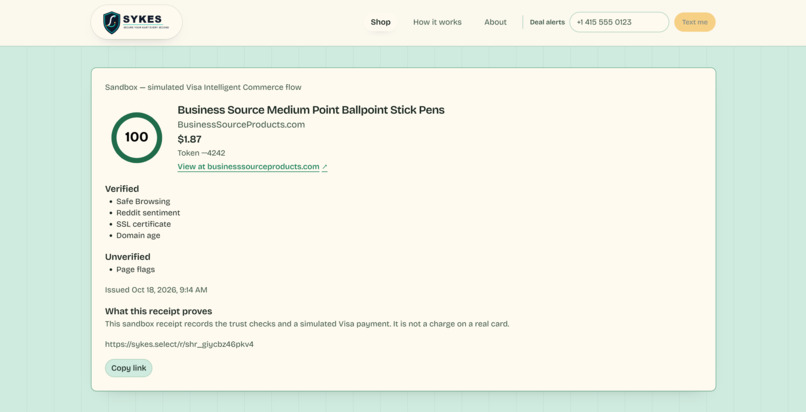
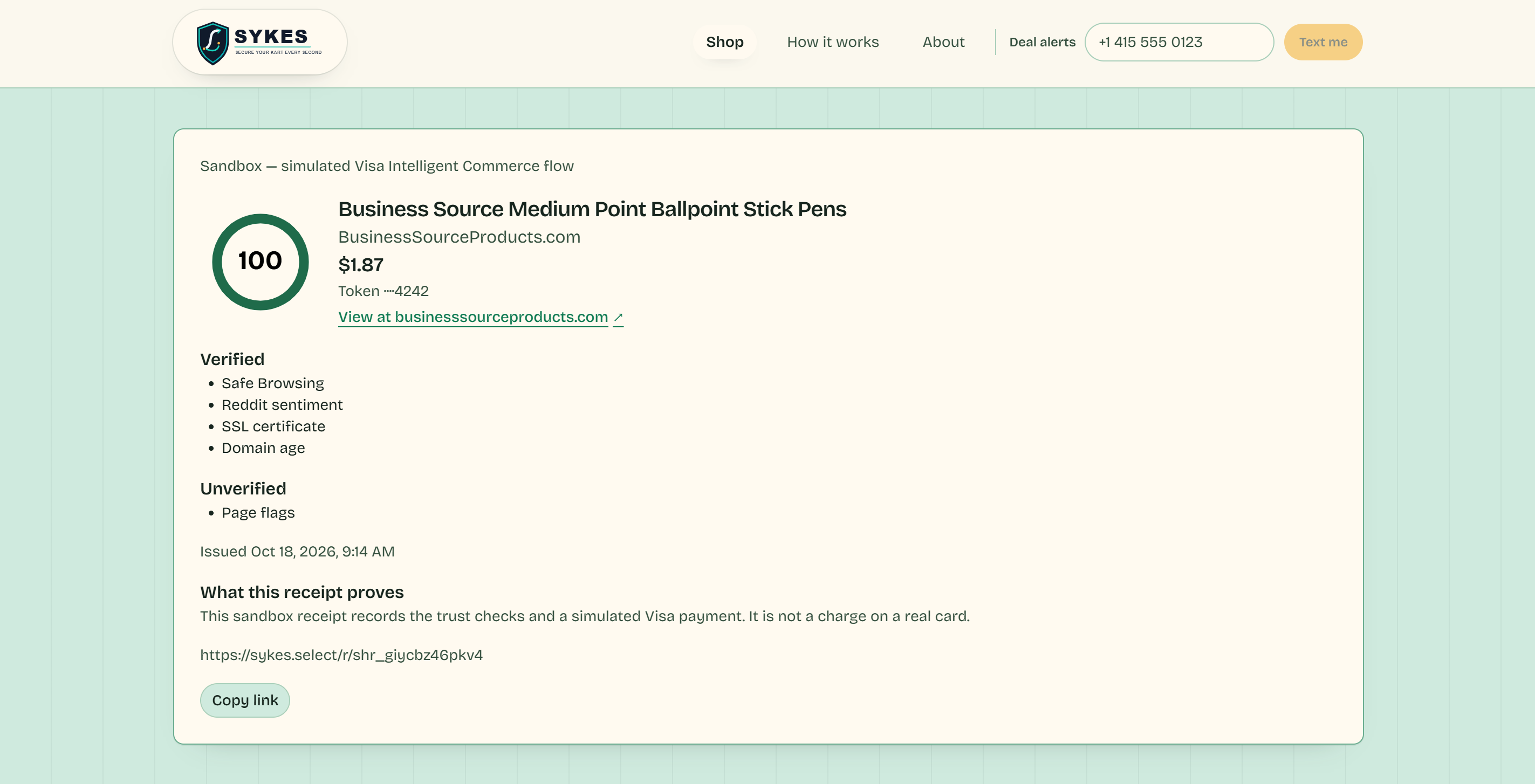
Sandbox payment method
-
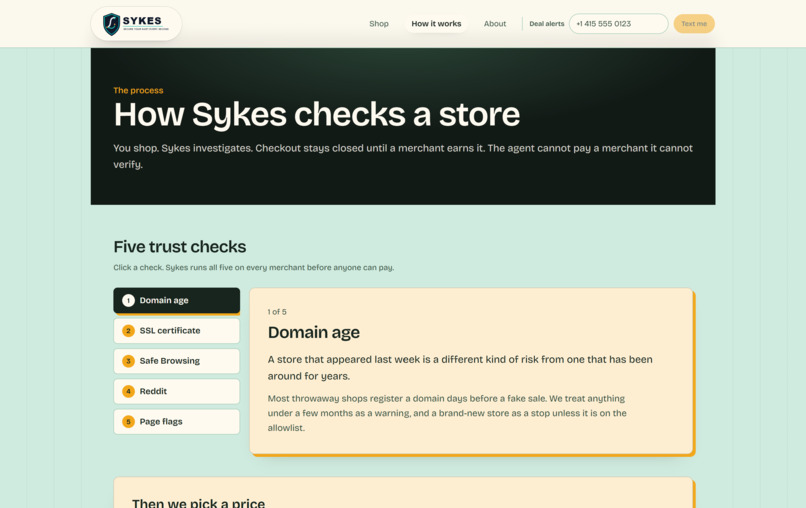
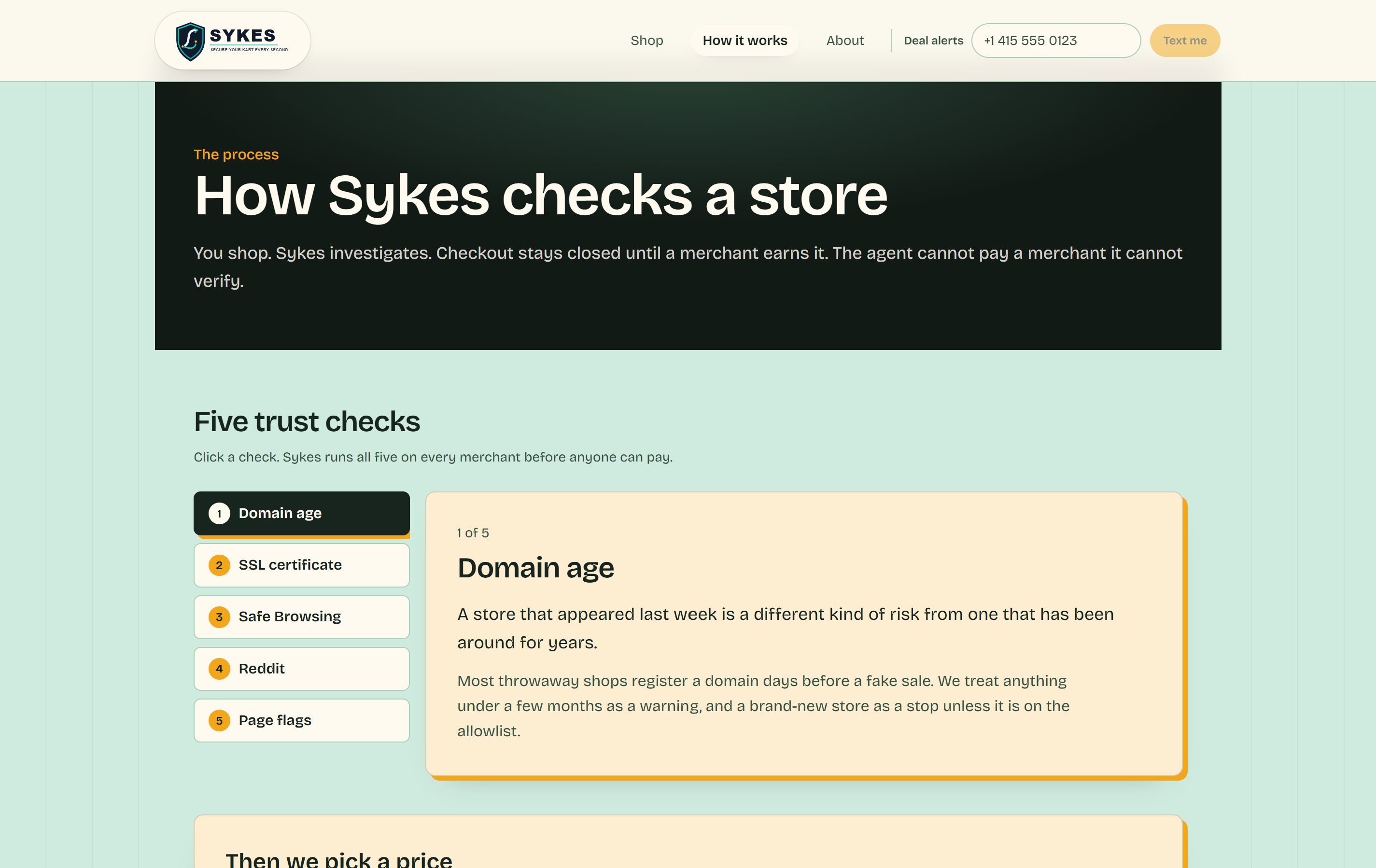
How it works page detailing each of the 5 processes
-
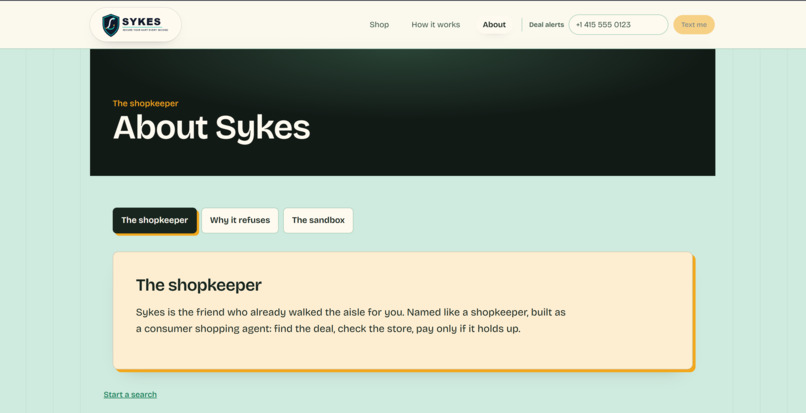
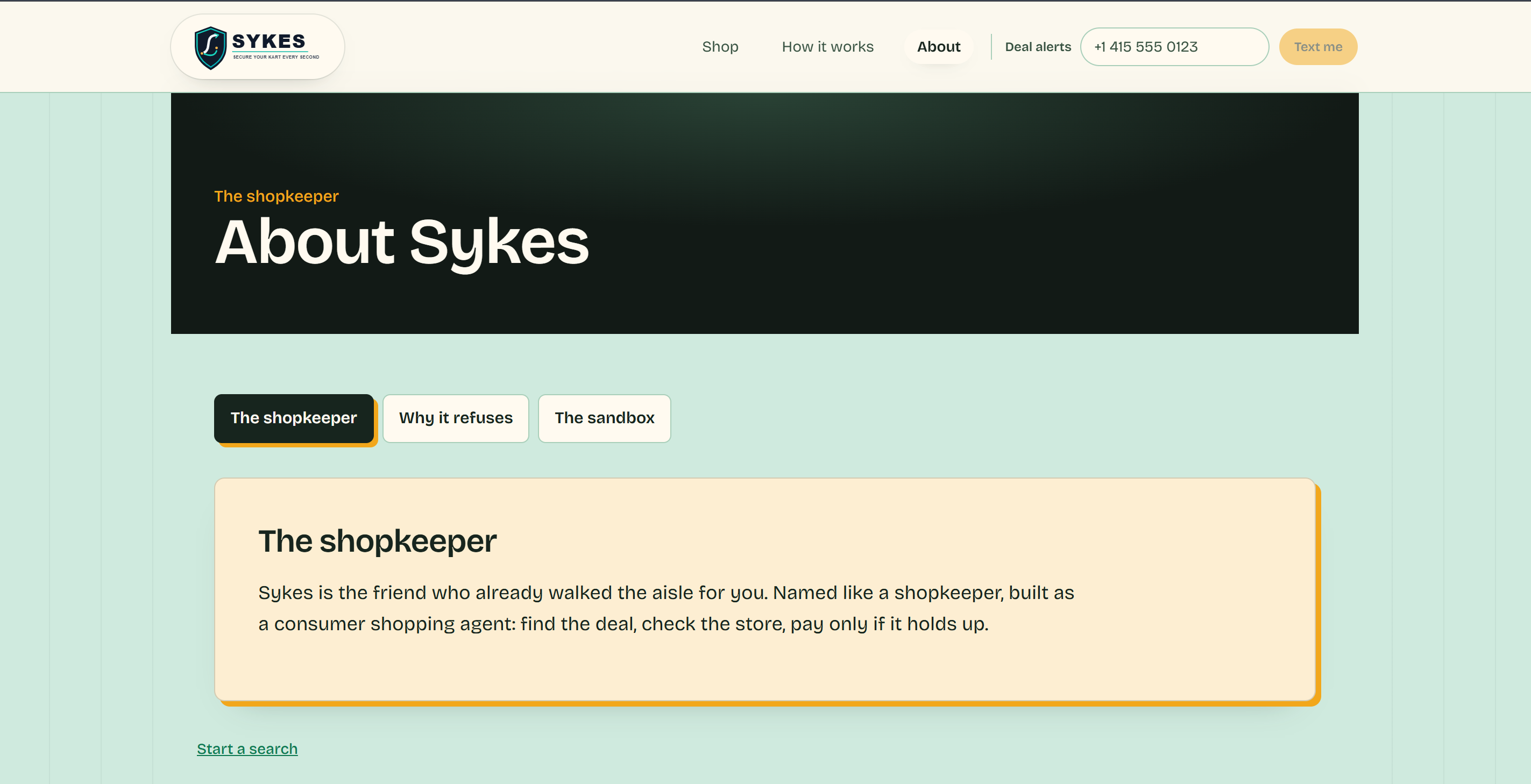
Sykes about page
Inspiration
Online shopping fraud is massive and invisible. Shoppers cannot check WHOIS records or threat databases; they guess from a photo and a price. Agentic commerce makes the problem worse, not better: an AI can now spend your money, and it has no concept of trust.
Every shopping agent demo we had seen optimised for finding the product. None of them answered the question a payment actually requires: should this agent be allowed to pay this merchant at all?
What it does
- Guided discovery. Three questions (budget, use, priority) become a structured search.
- Multi-listing search. Nine listings across eight merchants, including one deliberately hostile store.
- Five parallel fraud checks per listing, streamed live. Domain age via RDAP/WHOIS, TLS certificate validity, threat-list reputation, community sentiment, and scam-pattern page analysis.
- A 0–100 trust score and a
trusted/caution/dangerverdict, computed by observable arithmetic — not a model. - The cheapest trusted recommendation, with the median trusted price and the saving so the user can see the trade-off.
- A Visa checkout with a human-readable spending mandate, a passkey confirmation, a one-time token, and a signed receipt.
- A shareable trust receipt at
/r/{share_id}that carries the score, the checks, and what could not be verified.
The closing beat: the agent reaches for the cheapest listing, refuses it, and explains why. In the demo, the villain is $30 cheaper than the pick and is disqualified on four independent signals.
How we built it
Frontend — React 19 + TypeScript + Vite, Tailwind, shadcn-style components, Zustand for session state, and a native EventSource client with sequence-number dedupe and snapshot fallback. The checkout sheet is a four-step flow (review → mandate → passkey → receipt).
Backend — FastAPI + Pydantic v2, one Uvicorn worker (SSE forbids more), one SSE stream per session with monotonic seq and Last-Event-ID replay.
The checks are ordinary Python with hard timeouts and bounded concurrency (8 at a time, 14-second budget per session):
| Check | Implementation |
|---|---|
| Domain age | RDAP first, WHOIS fallback; a 12-day domain is a fatal signal |
| SSL | Live TLS handshake, hostname match, issuer, expiry |
| Safe Browsing | Google Safe Browsing when a key exists; a static denylist otherwise, always labelled unavailable when it is the static list |
| Reddit sentiment | Public JSON, classified into scam report / neutral / positive |
| Page flags | Server-side fetch, parsed for urgency copy, crypto-only payment, missing return policy, and countdown language |
The scoring is arithmetic, deliberately.
score = 100 − Σ penalties
  failed  → round(severity × 40)
  warning → round(severity × 15)
trusted ≥ 70 · caution ≥ 40 · danger < 40
fewer than 3 completed checks → score capped at 69
The score is deterministic, and a model never decides anything. Gemini Flash Lite writes the clarifying questions, the recommendation narration, and on-demand check explanations — each call capped at 2.5 seconds and falling back to a template. It never scores, never selects checks, and never sees a verdict it can change. Scoring, checks, payability, and checkout are Python-only, and a build test fails if any trust, check, or payment module imports the LLM. This was a deliberate trade: a trust score you cannot re-derive from evidence is not a trust score, and judges — like users — should be able to check the math.
The payment is a sandboxed Visa Intelligent Commerce flow. Mandate → passkey → token → transaction → receipt, with the same state machine and idempotency a real integration needs, and visible honesty about what is simulated.
The trust gate (the core of the product)
Checkout is refused server-side — not just disabled in the UI — unless the listing is trusted, scores ≥ 70, has at least three completed checks, matches the mandate's merchant, stays under the cap, and has an investigation less than 30 minutes old. Every refusal carries a machine-readable code and a human reason.
The client sends only a session id, a listing id, and a cap. It never sends a verdict, a score, or a price. The server re-derives all of them.
Challenges
- Making five network-dependent checks fast and reliable in 21 hours. The answer was per-check timeouts, bounded concurrency, and a rule that a check that cannot run is
skipped, neverpassed. - Keeping skipped from looking safe. The UI renders
skippedas "Could not verify", and missing checks cap the score below the payability floor. Insufficient evidence is not trust. - A deterministic score with honest explanation. We dropped the LLM from the scoring path entirely and wrote the reasons from the evidence the checks emitted.
- A payment flow that feels real without production access. We mocked the network and kept the controls: mandates, idempotency, single-use tokens, signed receipts, and a visible sandbox label on every surface.
- A demo that cannot drift. A replay script runs the whole session in-process with no server and no network and exits non-zero if the numbers change.
Accomplishments
- A live investigation the user watches happen, rather than a loading spinner.
- A score anyone can audit: every deduction names the check and the evidence.
- A payment moment that puts the human in the loop with a passkey.
- A receipt that turns a private checkout into a public trust signal.
- A test suite that treats the demo script as a contract: 187 backend and 34 frontend tests, plus an offline replay that must reproduce the live numbers exactly.
What we learned
- Trust is a UX problem, not only a security problem. The valuable output is not "score 0" — it is "here is the four-item reason, and here is what we could not check."
- Deterministic scoring plus evidence beats a model that sounds confident. Judges and users both asked "how do you know?" — and we could show them.
- The demo needs a villain and a hero. One scam store and one safe pick turn an abstract trust system into a story with a decision in it.
- Skipped is the hard case. Most trust products quietly treat missing data as neutral. Ours refuses to.
What's next
- Real Visa Intelligent Commerce integration against the Token Service and Payment Passkey APIs.
- A browser extension that scores the page you are already on.
- A merchant verification dashboard for the allowlist.
- More signals: seller history, price history, counterfeit detection, and a persisted audit trail.
Built With
- beautifulsoup4
- fastapi
- gemini
- httpx
- mongodb
- pydantic
- pytest
- python
- python-whois
- react
- tailwindcss
- typescript
- uvicorn
- vite
- vitest
- zustand

Log in or sign up for Devpost to join the conversation.