-
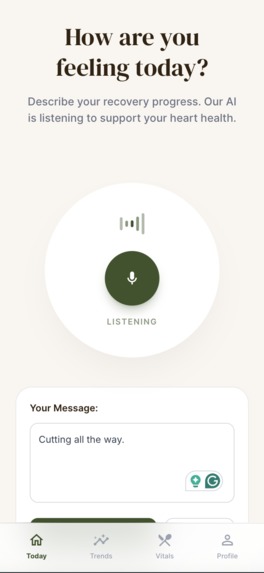
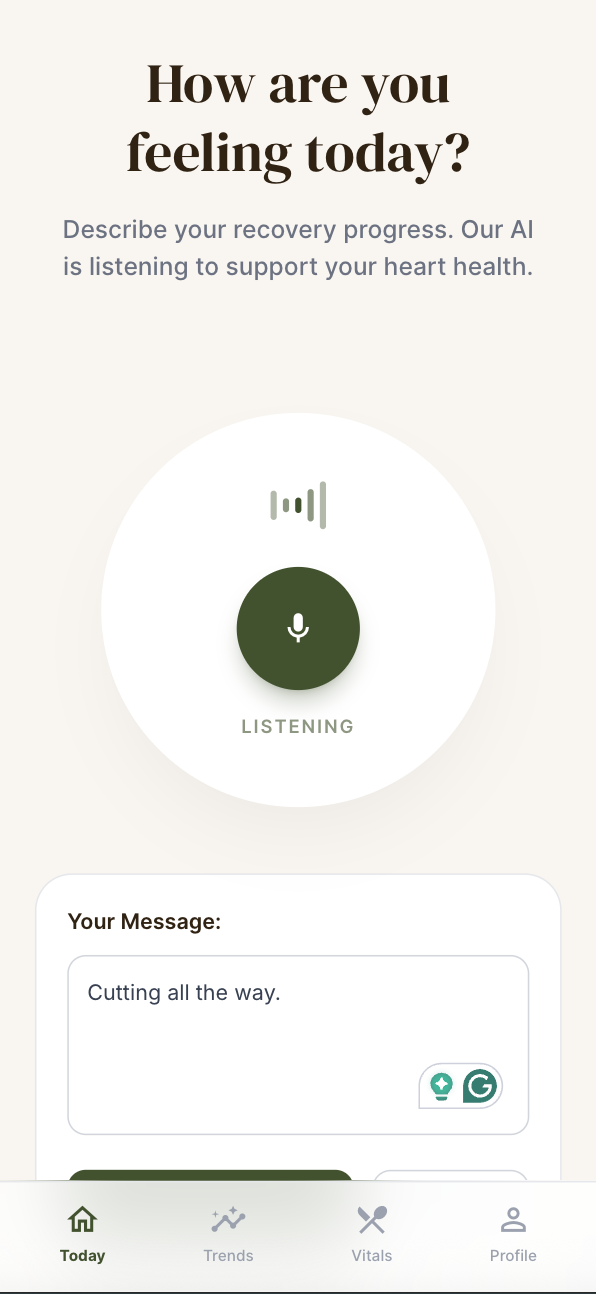
Check-in page
-
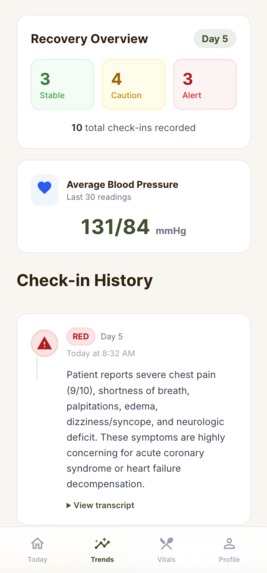
Health Trends
-
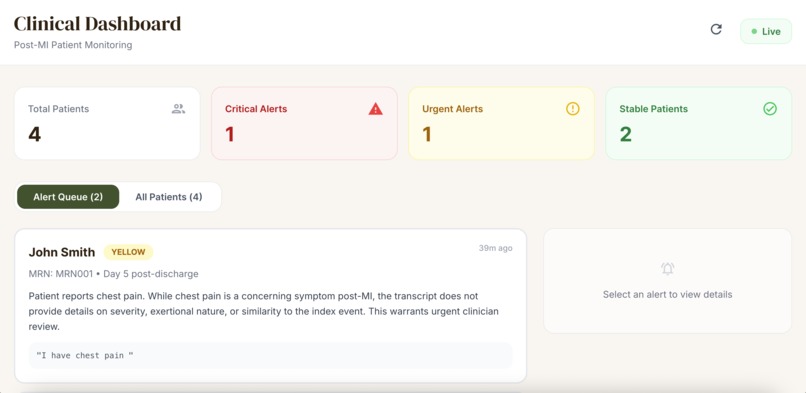
Nurse Dashboard View
Inspiration
Every year, nearly 1 in 4 heart attack survivors is readmitted within 30 days — often due to missed warning signs, medication errors, or delayed follow-up. The most dangerous period isn’t during hospitalization — it’s the silent gap after discharge.
We were inspired by a simple question: What if every heart attack survivor had an AI copilot watching over their recovery at home?
ReHeart exists to close that dangerous 30-day gap.
What it does
ReHeart is an AI-powered cardiac recovery copilot that monitors patients in the critical 30 days after heart attack discharge.
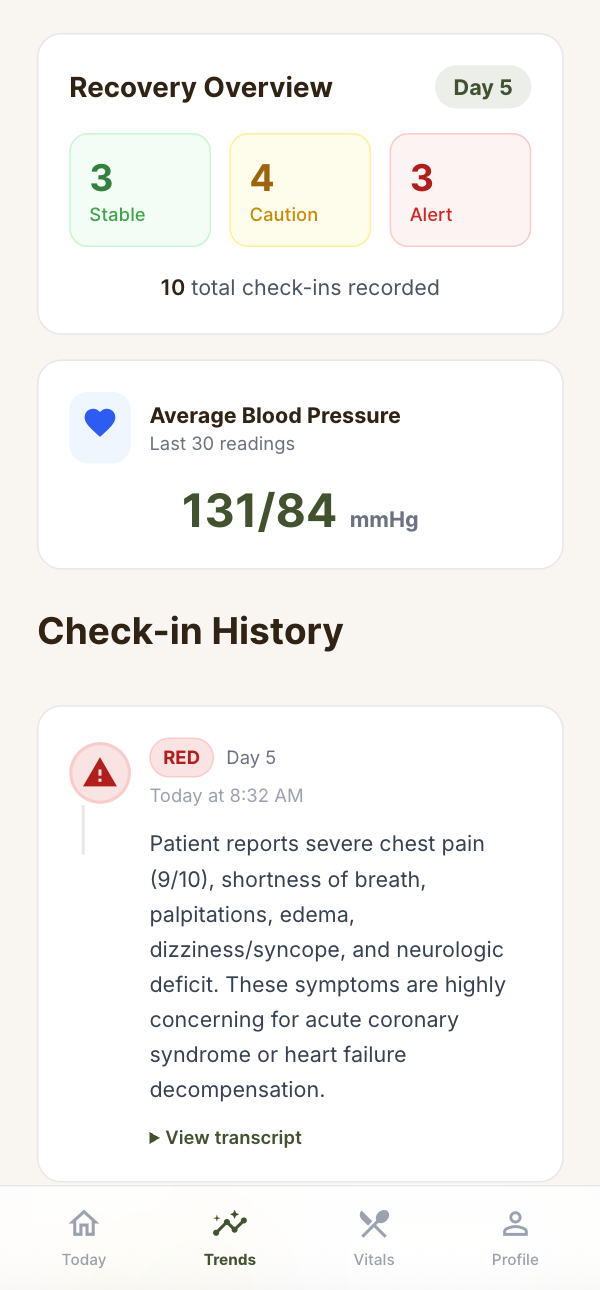
Patients complete daily voice check-ins describing how they feel. ReHeart:
- Extracts cardiac-relevant symptoms (chest pain, dyspnea, edema, palpitations)
- Applies structured post-MI risk stratification
- Maps symptoms to potential clinical deterioration
- Generates guideline-aligned recommended actions
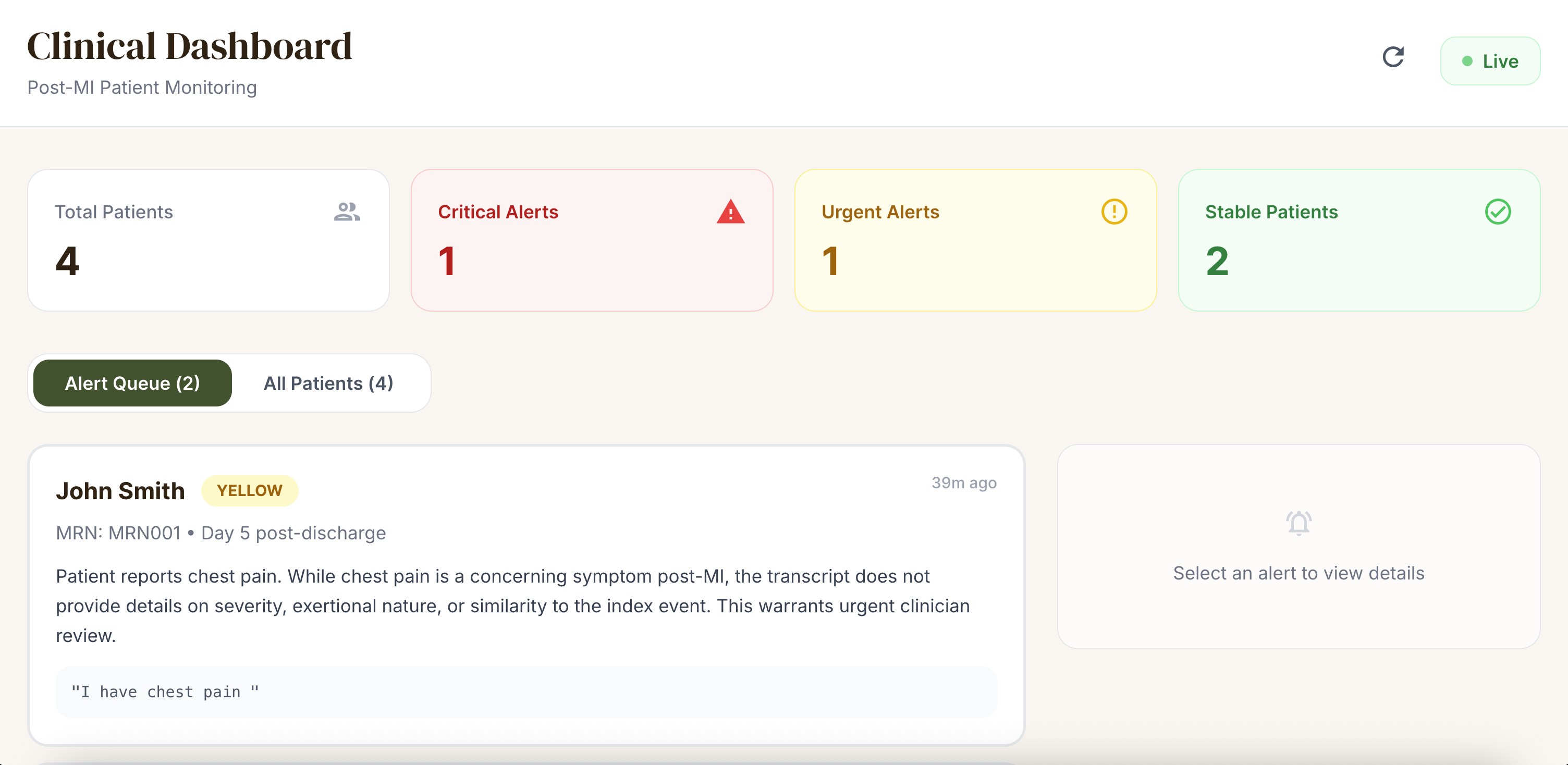
- Escalates RED or YELLOW cases to a care team dashboard
Instead of reactive care, ReHeart provides continuous, AI-driven post-discharge monitoring.
How we built it
We built ReHeart as a multi-layer clinical reasoning pipeline:
Step 1 - Voice Input
- Web-based voice recording
- Transcription using Whisper
Step 2 - Clinical Intelligence
- MedGemma deployed on Modal
- Structured symptom extraction into strict JSON
- Risk stratification (GREEN / YELLOW / RED)
- Condition inference (e.g., recurrent ischemia, heart failure decompensation)
- Guideline-aligned action recommendation
Step 3 - Safety Guardrails
- Conservative escalation rules
- Higher-risk default when uncertain
- Human-in-the-loop alerting
Step 4 - Care Team Dashboard
- Patient list with risk badges
- Alert queue
- Structured clinical summaries
- Trend visualization
The system is designed as an executable clinical decision engine.
Challenges we ran into
1. Reliable clinical reasoning Getting structured, consistent medical JSON output required tight schema constraints and prompt tuning.
2. Balancing safety vs over-alerting Too sensitive → constant RED flags. Too lax → unsafe system. We had to encode conservative but practical escalation logic.
3. Demo fragility Voice AI, multimodal inputs, and real-time reasoning introduce many failure points. We built fallback pathways and seeded demo data to ensure reliability.
Accomplishments that we're proud of
- Built an end-to-end AI clinical reasoning pipeline in 18 hours.
- Transformed cardiology guidelines into executable decision logic.
- Created structured escalation outputs instead of vague chatbot responses.
- Demonstrated a realistic Day 5 crisis detection scenario.
- Designed the system to prioritize safety and human oversight.
Most importantly, we built something that feels like it could truly prevent a readmission.
What's next for ReHeart
Short-term:
- Add longitudinal recovery modeling
- Improve condition inference confidence scoring
- Pilot with cardiology practices
Mid-term:
- Expand to heart failure, post-CABG surgery, and arrhythmias
- Integrate with EHR systems
- Add real-time escalation capabilities
Long-term vision: ReHeart becomes the AI copilot for every cardiac patient’s recovery journey — continuously monitoring, guiding, and preventing avoidable deterioration at scale.
Our goal is simple - make surviving a heart attack safer than ever before.
Built With
- fastapi
- medgemma
- modal
- next.js
- python
- react.js
- supabase

Log in or sign up for Devpost to join the conversation.