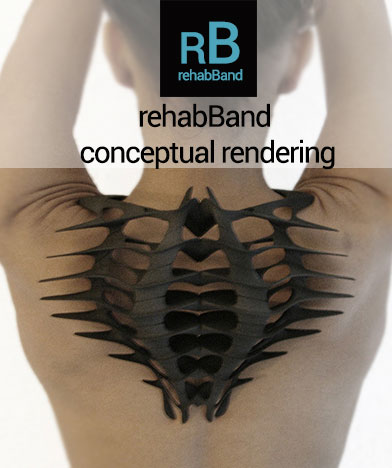
The rehabBand is an innovative concept using new sensor and e-technology to help patients relearn basic muscle contraction sequencing.
Applied Technology Used to stimulate muscle contraction and/or give feedback to help patients relearn basic muscle contraction sequencing would be valuable in many situations/populations: Critical illness where out of bed may not be possible, a wearable that allowed for muscle activation may counteract many of the untoward complications of prolonged bed rest - ie/ dvt, muscle deconditioning/atrophy, nervous system instability May be used in basic ambulation sequencing - helping to decrease the manpower to do these tasks and may improve on safety for the therapist and patient alike. Applied stimulation and data will be readily available to the owner of the band as well as the medical provider. Low power and safe to use this band is also available in 3D printed e-textile form. Data is transmitted via 4.0 Bluetooth and or wifi enabled API. End user interface via mobil device by patient or heal care provider
We are in concept prototype phase and are ready for proof of concept. AIP and hardware are in development and have had proof of concept. Electronics are all certified.
Please read our founders story below or follow the link to read.
A compelling story of our founders survival, stroke recovery and new found passion of life born from the concept of technology, innovation and life improvement. I am proud to have founded this business and developed this progressive business model during my recovery. By using a new business canvas we will using minimum viable products, pivoting and agile development to rapidly improve population health and wellness. Many of our product concepts are marketable, scaleable and show potential for rapid vertical growth.
360techWear Founders Story at: (http://360techwear.com/index.php/our-story)
Founders Story
In February of 2013, I suffered two massive strokes cutting off blood flow to my entire right cerebellum and a large part of my left cerebellum. Some of the obvious immediate complications from my strokes included moderate aphasia, and problems with important vital functions. There was also damage to other lobes of the brain, which affected my vision and caused a visual field cut. My strokes were labeled “cryptogenic”, meaning of unknown origin – the doctors didn’t know what caused my strokes and they couldn’t say it wouldn’t happen again. Scary right?
After 10 days in the Jefferson University Hospital for Neuroscience Intensive Care Unit in Philadelphia I knew my life was changed forever - my new goal, stay alive and rehabilitate. Could I ever get back to the way I was before my strokes? I’ll never forget the doctors saying, “Probably not, but it will take at least two years to fully understand the effect on the brain and what will be permanent and what may not be permanent.” That’s not going to stop me, I thought to myself. The doctor’s long-term diagnosis still drives me to see just how much I can recover after this life-changing event, now two years past. Once I was home and able, I searched and explored resources for any product or information that could help with my concerns.
As a former tennis professional, I recognized the importance both health and fitness would play in my mission to stay alive and remain as healthy as possible. Forced into an early retirement, I spent much of my time doing rehabilitation in the form of vision, speech, cognitive, psychological, occupational and physical therapies. At first I was barely able to walk let alone stand, ride a bike and driving was out of the question. I was now home bound. Were there any products out there that I could find and use, which would assist me in my recovery? Were there more modern tools to monitor my vitals at home or elsewhere? I hoped to find a solution for my problem.
While I was still first hospitalized, my cardiologist placed a “looper” into my chest to monitor my heart rate and rhythm. Cool, I thought, until I realized I had to transmit data using a dial up modem. In the summer after my strokes, I had a mild cardiac event and immediately transmitted the data. Days later my results were phoned into me. This was way too long in my opinion. It was six months since my strokes, I felt alone, disconnected and worried about how to communicate important information to my providers.
Over the next months I ended up with several wearable devices which all worked independently of each other. Each device had different hardware and software, which communicated intermittently with my mobile devices. My iPhone and iPads were now loaded with almost a dozen new apps. Confusing for someone even without brain damage! Some devices I wore 24/7, while others for only a minute or two. I quickly realized that the technology was not dependable, not user friendly, spread across a broad spectrum and too many platforms. With all of these separate devices and apps it was just too expensive and at time very confusing which led to frustration.
In recovery my thoughts turned to my family; they deserved to monitor their health too, I spent hundred and hundreds of dollars for devices and apps for them wanting to share the experience with them. My family used the devices for a while, but then they were put aside. Placed in the bedside table or packed away, apps were deleted, all of their benefits only to be forgotten.
Why did they not use them? Why did they not wear them? Why are there so many different devices for all of these different yet related functions? Are there devices out there that do it all? Is there a synergistic app with cross functionality and integrated capabilities that go beyond a one and done solution? How about a social component to connect others with me so I could share, learn and associate? Why couldn’t I use this device to communicate information to my doctors and therapists in real time? What if I had an event like I did and it was critical in nature and a band and app saved my life?
I kept thinking “What if?” I thought technology should be ready for this answer. Two important questions I asked myself, why is the industry not looking at the motivational factors that continue to keep the devices being consumed and are they listening to the consumer? My primary question was, why does this cost so much money?
This was the beginning of my recovery, my journey to find a solution that I could share with other people to better lives and motivate them to a healthier lifestyle.
Mark Townsend Founder, CEO


Log in or sign up for Devpost to join the conversation.