-
-
Logo
-
Medical Report
-
UI Screen
Inspiration
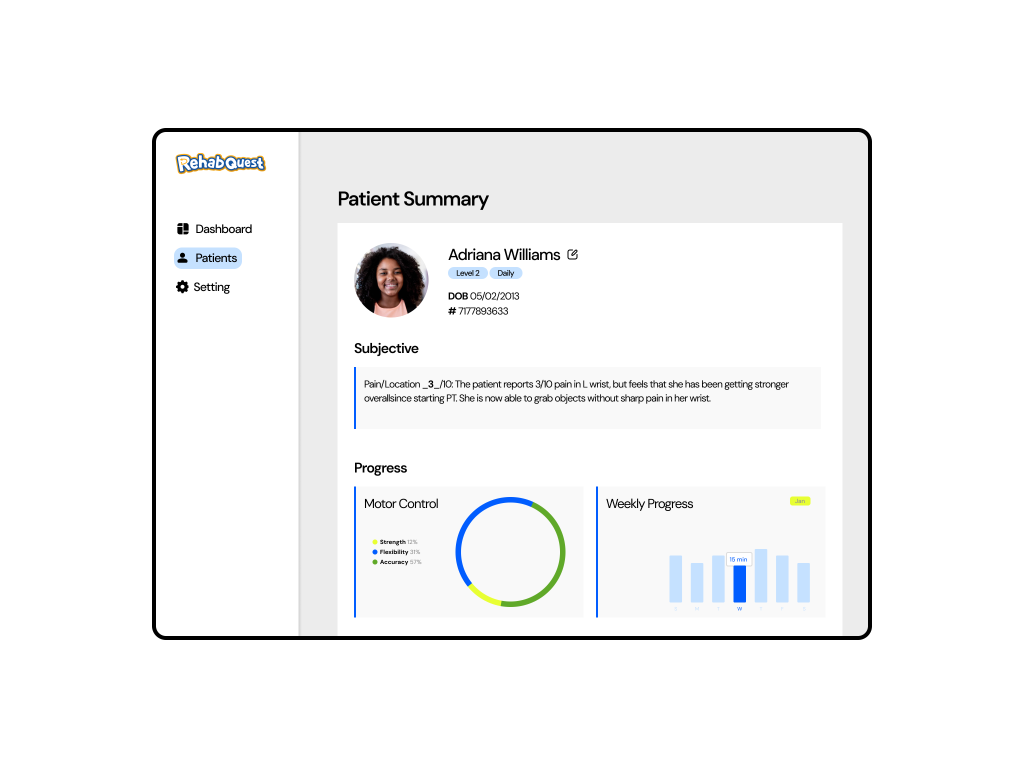
The idea came to mind when one of our friend's younger sisters had to do physical therapy after an arm injury and hated it. So we thought, how can we make physical therapy fun and engaging for kids, especially in the age range of 10 - 13. During our research, we found that one of the main problems physical therapists face these days is patient retention and the stigma that after attending a few in-person sessions, we are magically healed. However, that is not the case. The continuation of the exercises taught during a physical therapy session at home is crucial to a patient's treatment plan and not meeting those goals at home can lead to a delay in healing or even permanent damage in some cases. Today, there are 3.5 million more kids who feel the same frustration and lack of motivation when faced with an injury involving physical therapy, making recovery feel even harder.
What it does
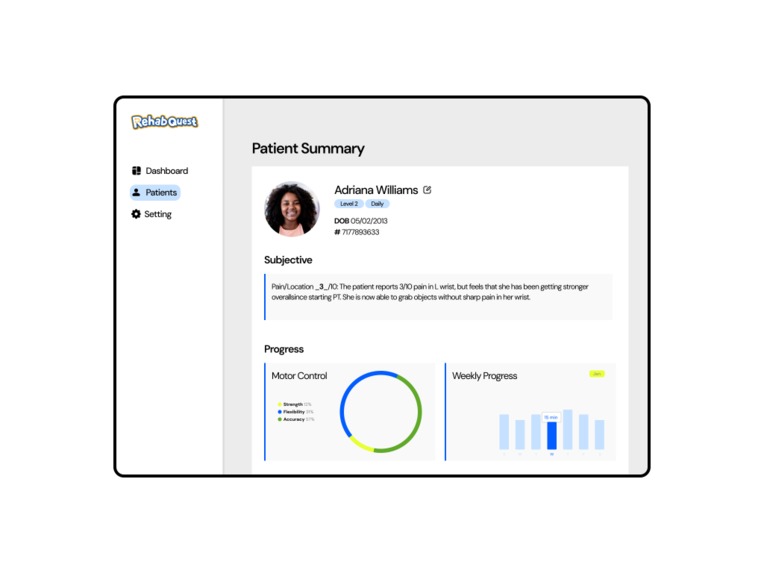
Our project is an MR (Mixed Reality) rehabilitation system that combines real-world physical therapy with immersive carnival games, utilizing Meta Quest's passthrough technology and hand-tracking capabilities. This mixed reality approach allows patients to remain aware of their actual surroundings while engaging with virtual therapeutic elements.
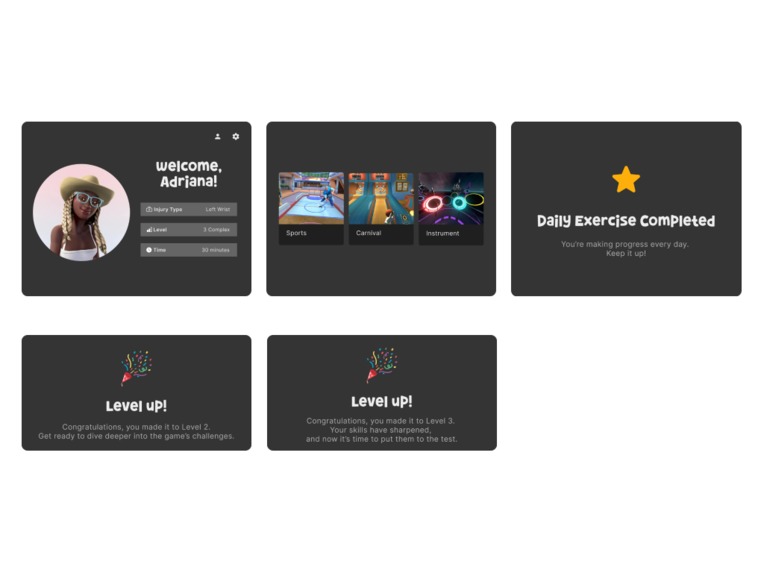
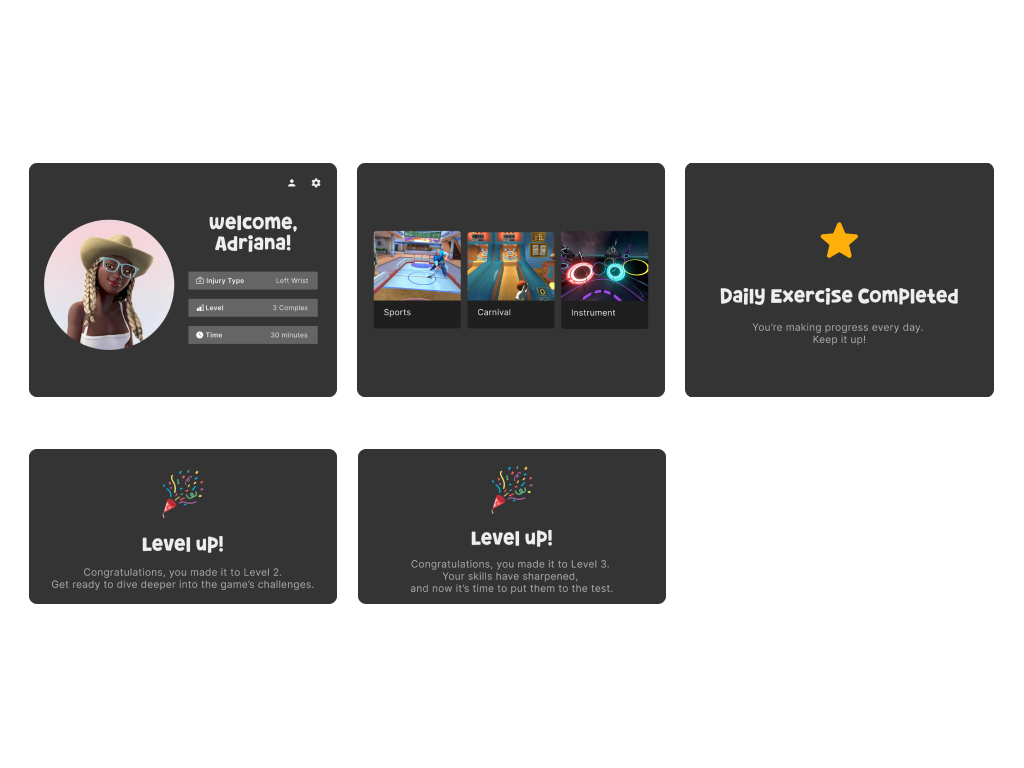
The application features three carnival-themed rehabilitation games in mixed reality: The system seamlessly blends the physical therapy environment with virtual elements through an intuitive mixed-reality interface. This allows therapists to monitor patients' actual movements while patients engage with the virtual rehabilitation games. The passthrough technology ensures patients can maintain awareness of their surroundings while participating in their therapeutic exercises, creating a safe and effective rehabilitation experience.
How we built it
We developed a rehabilitation content system using Unity (version 2022.4.37) and C#, integrating the Meta Interaction SDK for hand tracking capabilities. 3D assets were created by our designers using Blender. The project consists of multiple stages: a start screen, three game levels, and an ending sequence.
Our interface utilizes poke interactions for buttons with hover feedback, providing visual depth indication when pressed. The system starts with a 5-second logo screen followed by a patient interface that offers three entertainment categories: Instrument, Sport, and Carnival. Each category contains three difficulty levels, though for this project, we fully implemented the Carnival category. The Carnival category includes: Level 1: Skee-ball Level 2: Ring Toss Level 3: Darts
For Level 1 (Skee-ball), we implemented grabbable ball physics with automatic respawning when balls fall out of bounds. A reset button allows players to respawn balls at will.
Level 2 (Ring Toss) features three rings with carefully designed cube colliders to ensure accurate throwing mechanics. Like the Skee-ball game, rings respawn when dropped or when the reset button is pressed.
Level 3 (Darts) represents our most challenging rehabilitation exercise. We implemented a sophisticated throwing mechanism that calculates the dart's trajectory based on the vector between the furthest negative and positive z-coordinates when held. The throwing force is determined by multiplying this directional vector with the holding duration before release. When darts hit the target, they stick in place through collider interaction.
The system includes an end button that returns users to the start screen for level selection, and upon completion, players see a congratulatory interface in the ending scene.
Challenges we ran into
The Meta Quest 3 device, while advanced, has limitations in its motion-tracking capabilities. This constraint forced our team to narrow our focus to pediatric patients with upper body restrictions. The device’s current technology primarily tracks head and hand movements, which restricted our ability to address a wider range of physical disabilities.
To overcome these limitations and expand our target audience, we’ve identified potential solutions: Integration of additional tracking devices for lower body movements, Exploration of full-body tracking technologies compatible with MR environments, and Collaboration with hardware manufacturers to develop specialized tracking solutions for rehabilitation purposes
Additionally, ensuring the application’s effectiveness as a rehabilitation tool requires extensive clinical testing and validation, which is time-consuming and resource-intensive.
By addressing these challenges, we aim to create a more comprehensive and inclusive MR rehabilitation platform for pediatric patients. Future iterations of the project will focus on overcoming these limitations to expand the range of disabilities we can effectively address through our gamified rehabilitation approach.
Development Challenges: During development, we encountered several significant challenges:
Hardware-related issues with passthrough occasionally showing black screens Hand tracking reliability problems in crowded environments, which sometimes caused: Colliders to remain attached unexpectedly Difficulties in releasing objects like balls and rings properly
Dart throwing mechanics proved challenging due to: Users naturally attempting downward throwing motions, resulting in unexpected trajectories The need to accommodate various throwing styles while maintaining accuracy
The lack of comprehensive hand tracking tutorials made implementation more difficult than anticipated, requiring significant trial and error to achieve desired functionality.
Developing on a Macbook for one of our developers significantly delayed development progress and failed to utilize Meta XR SDK Simulator, which appeared as a black screen in Unity. We resorted to building and deploying builds to the headset for development, which again, slowed the progress of development. Headset Limitations: The Meta Quest 3 device, while advanced, has limitations in its motion-tracking capabilities. This constraint forced our team to narrow our focus to pediatric patients with upper body restrictions. The device’s current technology primarily tracks head and hand movements, which restricted our ability to address a wider range of physical disabilities.
To overcome these limitations and expand our target audience, we’ve identified potential solutions: • Integration of additional tracking devices for lower body movements • Exploration of full-body tracking technologies compatible with MR environments • Collaboration with hardware manufacturers to develop specialized tracking solutions for rehabilitation purposes
Additionally, ensuring the application’s effectiveness as a rehabilitation tool requires extensive clinical testing and validation, which is time-consuming and resource-intensive.
By addressing these challenges, we aim to create a more comprehensive and inclusive MR rehabilitation platform for pediatric patients. Future iterations of the project will focus on overcoming these limitations to expand the range of disabilities we can effectively address through our gamified rehabilitation approach.
Accomplishments that we're proud of
Our team has demonstrated strong execution by incorporating critical feedback from the Founder Lab board meeting, significantly improving our finalist potential. The carnival demo for children aged 10-14 with wrist injuries has resonated well as a focused beachhead market strategy. We've received positive validation on our business model, particularly our dual subscription approach ($10/headset/month and $20/user/month) and our clear growth trajectory from pediatric physical therapy to broader rehabilitation services. Our comprehensive market analysis showing a $496.8M serviceable obtainable market for our initial demographic has strengthened our position as a viable venture.
What we learned
As a part of the founder's lab track, we were able to gain helpful feedback from advisors and mentors throughout the hackathon journey. In terms of business, we were asked to provide a more unique value proposition to set ourselves different from other competitors in the market. As a project with the potential to become a new business, we've learned to develop the project sustainable and attractive for users to continuously use the product in terms of both marketing and technology.
What's next for Rehab Quest
Our expansion strategy focuses on three key areas beyond physical therapy: phantom limb therapy through MR gaming, cognitive behavioral therapy for fear management, and mental wellness exercises. By integrating AI, we'll provide real-time feedback and personalized recovery plans, while continuously adapting difficulty levels based on patient performance. The roadmap includes rehabilitating additional body areas, developing tactile experiences for understanding anatomy, and creating new rehabilitation games based on AI-driven patient assessments. As we grow, we'll expand from our initial focus on children's gamification to serve broader age categories and needs, while maintaining user engagement through AI-suggested features tailored to individual progress and requirements.


Log in or sign up for Devpost to join the conversation.