-
-
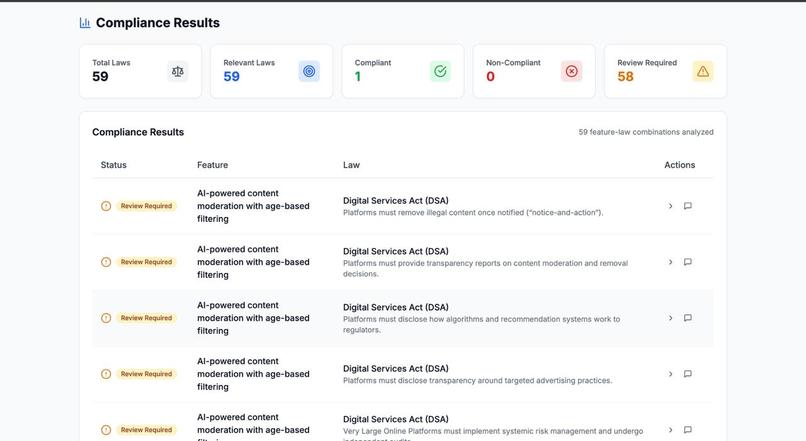
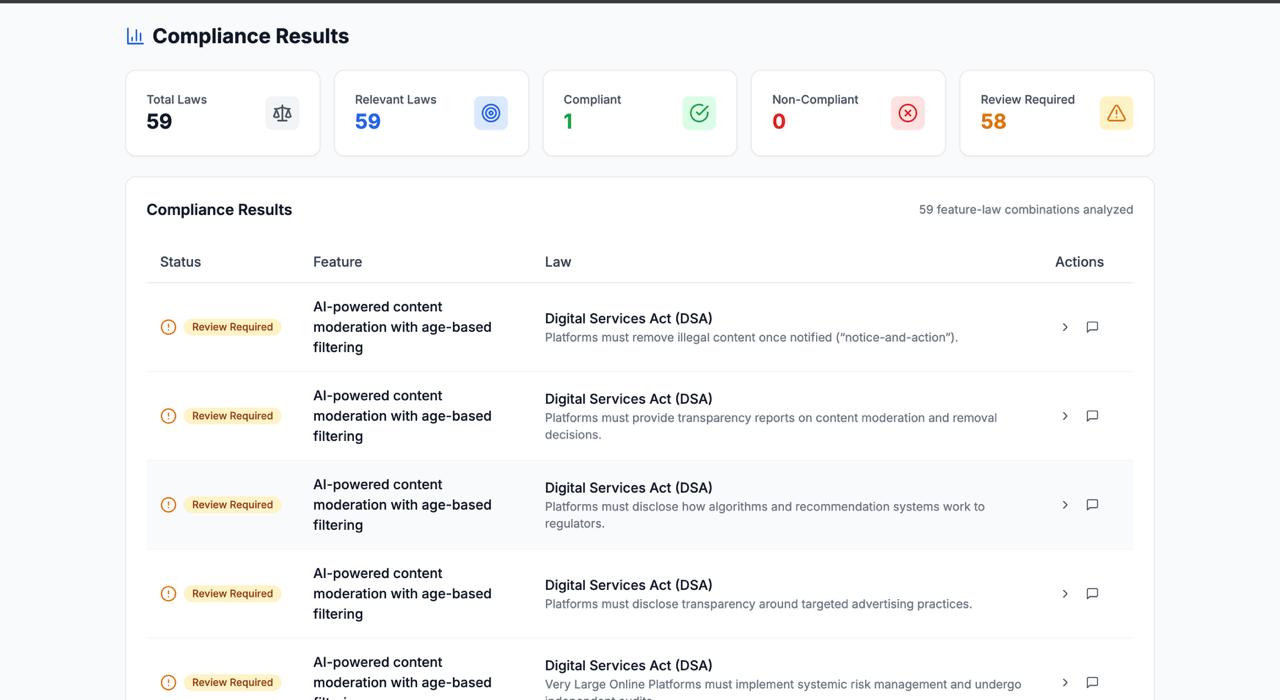
Comprehensive summary
-
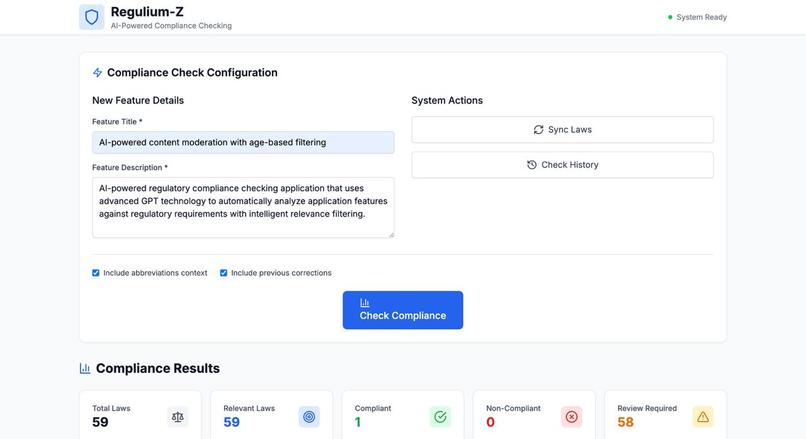
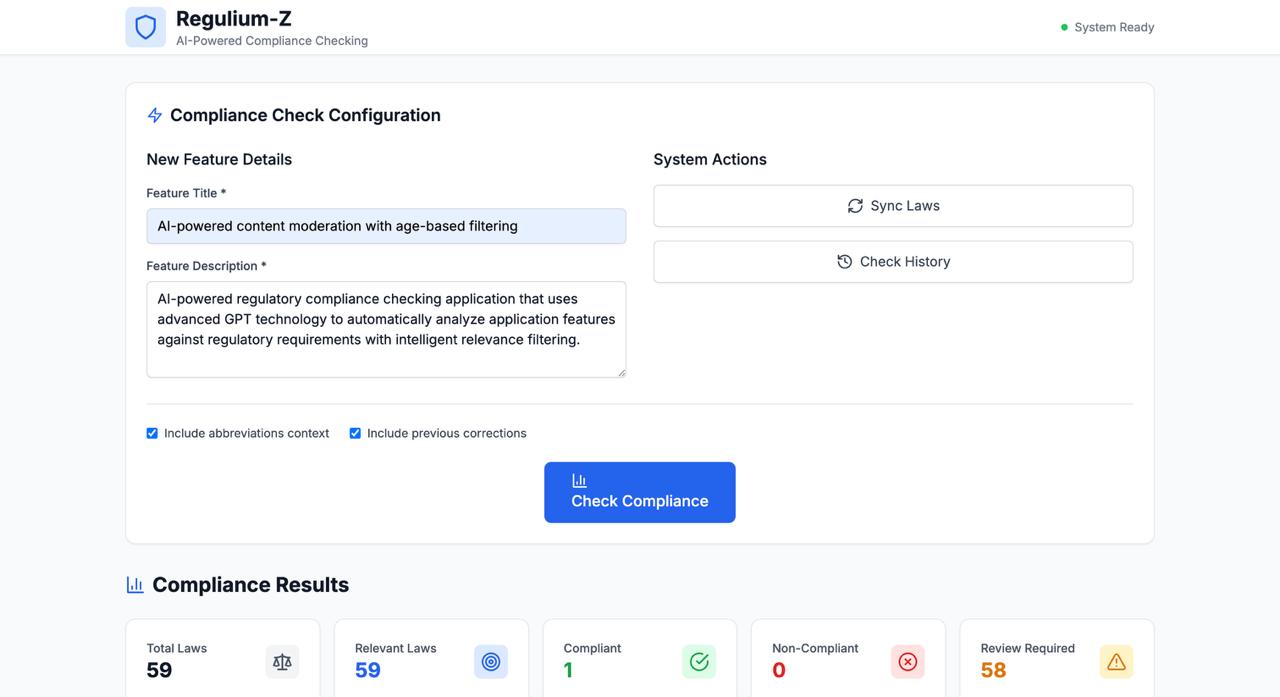
Initial page
-
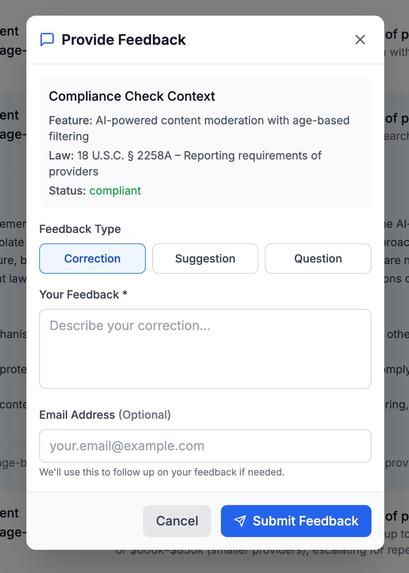
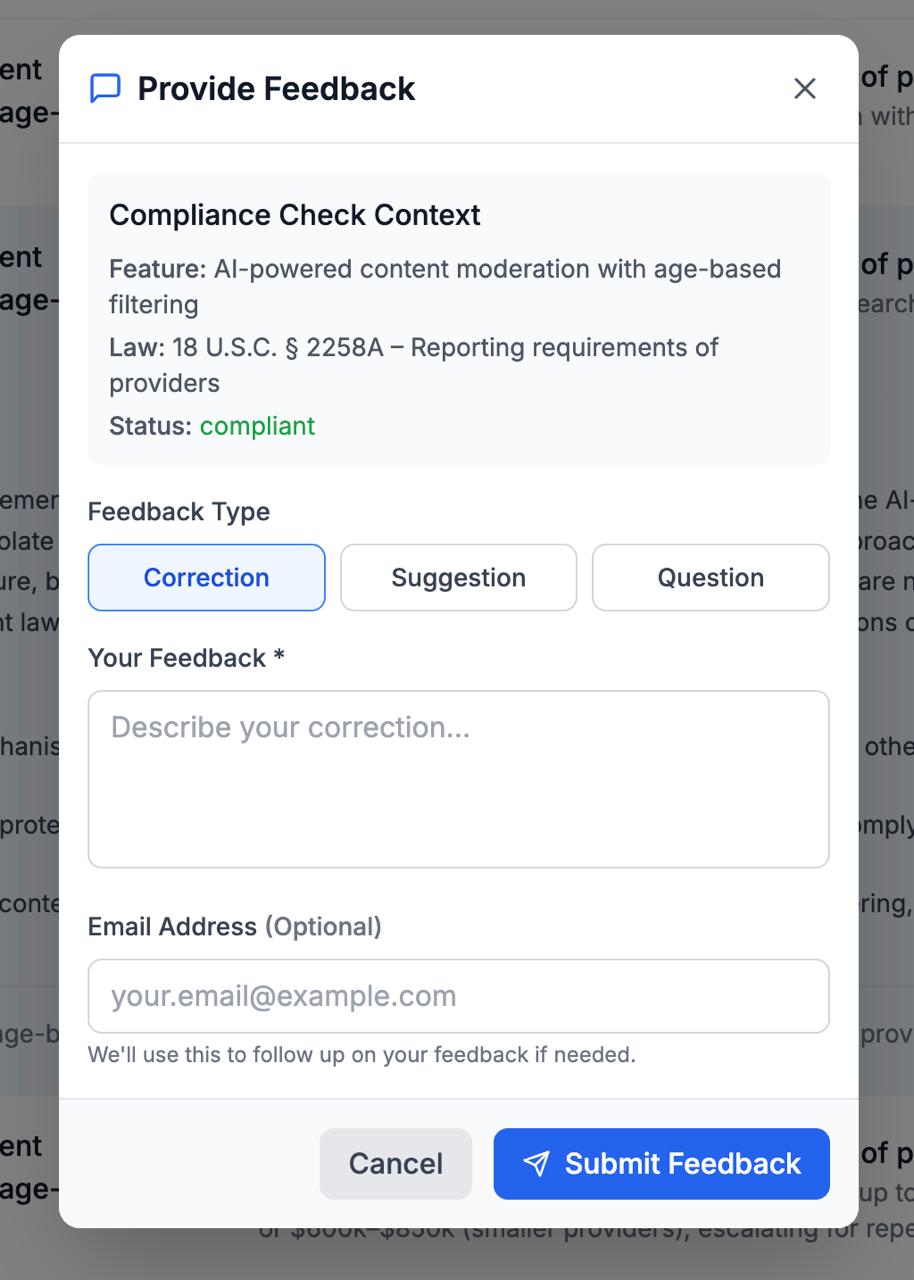
User feedback on results
-
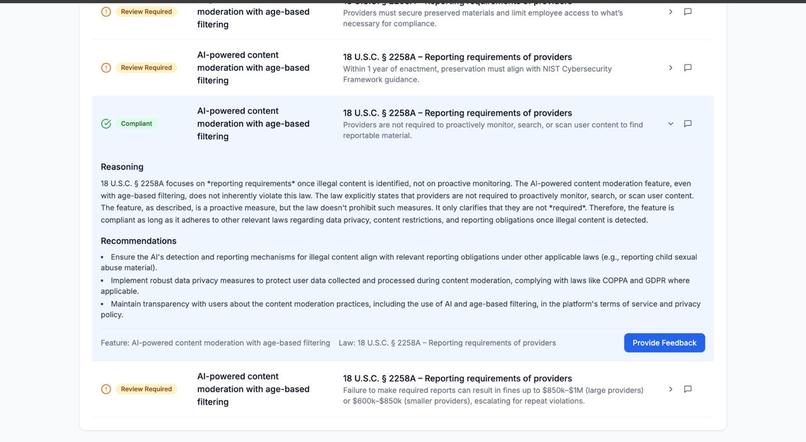
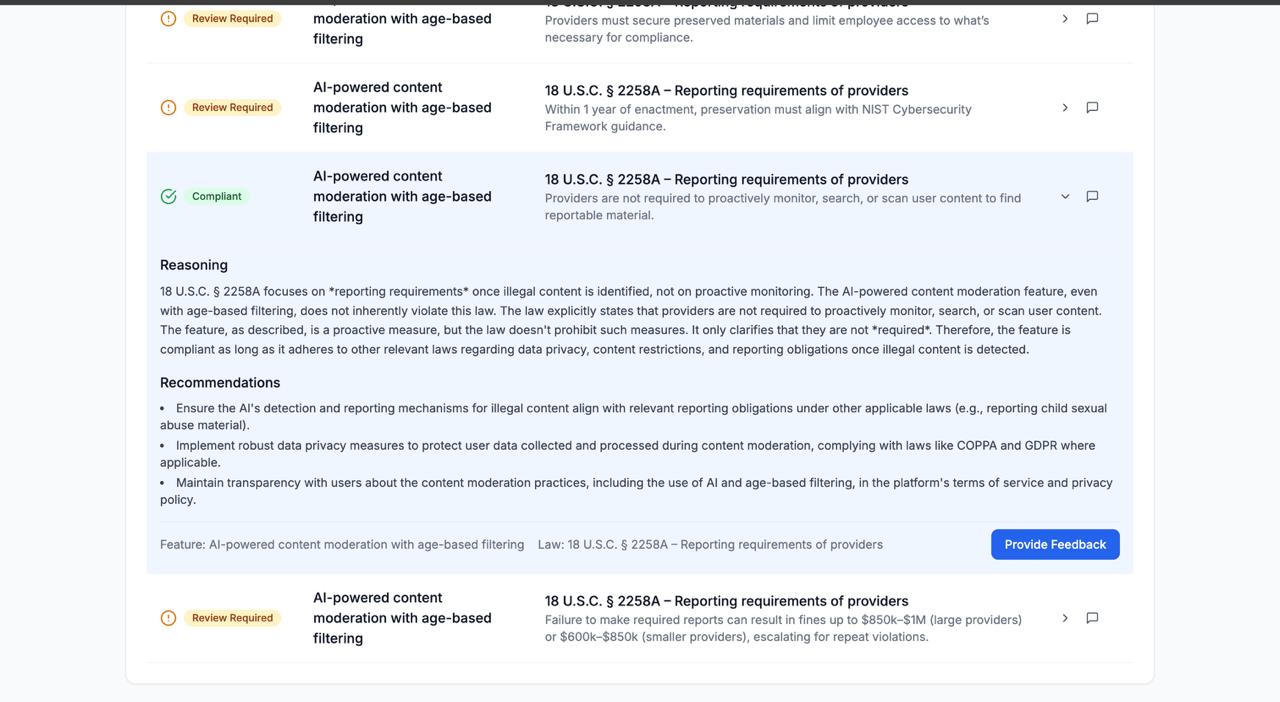
Review details and suggestions
Regulium-Z: AI-Powered Regulatory Compliance Detection
Inspiration
The inspiration for Regulium-Z came from the critical challenge faced by global tech companies like TikTok in navigating complex regulatory landscapes. As platforms operate across dozens of countries, each with unique legal requirements, the manual process of identifying compliance needs has become unsustainable and error-prone, often requiring a lot of manual work.
Tech giants like TikTok constantly face significant business risks from compliance blind spots. Undetected gaps can lead to serious legal exposure and force teams into a constant, reactive struggle to address inquiries from auditors or regulators. This manual approach creates massive overhead, making it incredibly difficult and time-consuming to scale global feature rollouts. Our product directly tackles these challenges by automating compliance checks, mitigating risk, and enabling companies to innovate and expand with confidence.
Additionally, our product can be very useful for several other reasons. It can help protect brand reputation, as a single compliance misstep can lead to public scrutiny and loss of user trust. It can also accelerate the pace of innovation by allowing development teams to move faster without the constant fear of non-compliance. Instead of spending weeks or months on manual checks, teams can get immediate feedback, which speeds up the entire product development lifecycle. Lastly, it can provide a consistent and auditable record of compliance checks, simplifying reporting and demonstrating due diligence to stakeholders and governing bodies.
The core insight was that while LLMs have revolutionized many domains, they haven't been effectively applied to the specific challenge of regulatory compliance detection. We saw an opportunity to create a system that could transform regulatory detection from a blind spot into a traceable, auditable output.
Our vision was to build a prototype that could:
- Proactively flag features requiring geo-specific compliance logic
- Generate auditable evidence proving features were screened for regional compliance needs
- Enable confident responses to regulatory inquiries with automated traceability
What it does
Regulium-Z is an AI-powered compliance detection system that automatically analyzes feature artifacts against regulatory requirements to identify potential compliance gaps. The system serves as a proactive compliance screening tool that transforms regulatory detection from a manual, error-prone process into an automated, auditable workflow.
Core Functionality
Automated Compliance Analysis: The system takes feature descriptions (titles, descriptions, related documents) and analyzes them against a comprehensive database of regulatory laws from multiple jurisdictions
Intelligent Context Awareness: The system leverages:
- Abbreviations Context: Handles internal jargon and codenames (like "ASL", "GH", "CDS", "PF") to avoid misclassification
- Previous Corrections: Learns from human feedback to improve accuracy over time
- Regional Relevance Screening: Automatically filters laws based on feature relevance
Comprehensive Output: For each feature-law combination, the system provides:
- Compliance Status: Compliant, Non-compliant, or Requires Review
- Detailed Reasoning: Clear explanation of the assessment
- Specific Recommendations: Actionable steps to achieve compliance
Interactive Feedback System: Users can provide corrections and suggestions that improve future analyses, creating a self-evolving system that learns from human expertise.
How we built it
Architecture Overview
We built Regulium-Z as a full-stack web application with a modern, scalable architecture:
Frontend (React + TypeScript) ←→ Backend (Node.js + Express) ←→ LLM API
Backend Development
Technology Stack:
- Node.js + TypeScript: For type safety and modern JavaScript features
- Express.js: Fast, unopinionated web framework for API development
- OpenAI/OpenRouter: Integration with GPT models for compliance analysis
- CSV Processing: Efficient data handling for laws and features
- JSON Storage: Lightweight storage for abbreviations and corrections
Key Components:
- ComplianceChecker Service: Core AI integration using GPT-4/Gemini for analysis
- DataHandler Service: CSV processing and data management
- FeedbackHandler Service: User feedback storage and retrieval
- API Routes: RESTful endpoints for all operations
LLM Integration Strategy:
- Used OpenRouter API for access to multiple LLM providers
- Implemented structured prompting to ensure consistent JSON responses
- Added fallback parsing for robust error handling
- Integrated context from abbreviations and previous corrections
Frontend Development
Technology Stack:
- React 18: Latest React features with hooks
- TypeScript: Type-safe component development
- Tailwind CSS: Utility-first CSS framework
- Vite: Fast build tool and development server
- Lucide React: Modern icon library
Key Components:
- ComplianceTable: Interactive results display with expandable details
- FeedbackChatbox: Modal interface for user corrections
- Main Dashboard: Feature input and configuration interface
UI/UX Design:
- Modern, Clean Interface: Professional design suitable for enterprise use
- Responsive Design: Mobile-first approach with modern UI patterns
- Real-time Feedback: Loading states, error handling, and success indicators
- Accessibility: Proper ARIA labels and keyboard navigation
Data Management
Regulatory Database:
- Comprehensive CSV database of 59 regulatory requirements
- Covers EU DSA, US federal laws, and state-specific regulations
- Structured format with law titles, descriptions, and regional applicability
Feature Artifacts:
- Sample dataset of 30+ feature descriptions
- Includes internal codenames and technical jargon
- Real-world examples from social media platform features
Context Enhancement:
- Abbreviations mapping for internal terminology
- Corrections storage for continuous learning
- Regional relevance screening to reduce noise
Development Process
- Rapid Prototyping: Started with a simple GPT integration to validate the concept
- Iterative Development: Built features incrementally with continuous testing
- User Feedback Integration: Implemented feedback system early to improve accuracy
- Performance Optimization: Added caching and efficient data processing
- Error Handling: Robust error handling and fallback mechanisms
Challenges we ran into
Technical Challenges
LLM Response Parsing: One of our biggest challenges was ensuring consistent, parseable responses from the LLM. Initially, the AI would sometimes return malformed JSON or include additional text that broke our parsing logic.
Solution: We implemented a robust parsing system with multiple fallback strategies:
- JSON extraction using regex patterns
- Markdown code block detection and removal
- Validation of required fields with sensible defaults
- Comprehensive error logging for debugging
Context Window Limitations: The regulatory database is extensive, and we needed to provide sufficient context while staying within token limits.
Solution: We developed a relevance screening system that:
- Pre-filters laws based on feature relevance
- Uses intelligent prompting to focus on applicable regulations
- Implements context-aware abbreviation expansion
API Rate Limiting: During development, we hit rate limits with the LLM APIs, especially during bulk testing.
Solution: Implemented:
- Request queuing and throttling
- Efficient batch processing
- Caching of similar requests
- Graceful degradation when APIs are unavailable
Data Challenges
Regulatory Complexity: Different jurisdictions have overlapping but distinct requirements, making it difficult to create clear mappings.
Solution: We structured our data with:
- Clear regional tags for each regulation
- Detailed descriptions that capture nuances
- Cross-referencing between related laws
Internal Jargon: The sample features contained extensive internal codenames (ASL, GH, CDS, PF, etc.) that could confuse the AI.
Solution: Created an abbreviations mapping system that:
- Translates internal terms to clear descriptions
- Provides context for technical implementations
- Learns from user corrections over time
Integration Challenges
Frontend-Backend Communication: Ensuring smooth data flow between the React frontend and Node.js backend required careful API design.
Solution:
- Comprehensive TypeScript interfaces for type safety
- RESTful API design with clear error responses
- Real-time loading states and error handling
State Management: Managing complex application state with multiple async operations was challenging.
Solution: Used React hooks effectively:
- Custom hooks for API calls
- Local state management for UI interactions
- Proper error boundaries and loading states
Accomplishments that we're proud of
Technical Achievements
Robust LLM Integration: Successfully built a production-ready LLM integration that handles:
- Multiple AI model providers through OpenRouter
- Structured JSON responses with fallback parsing
- Context-aware prompting with abbreviations and corrections
- Error handling and graceful degradation
Intelligent Relevance Screening: Developed an innovative system that:
- Pre-filters regulatory requirements based on feature relevance
- Reduces noise and improves accuracy
- Scales efficiently with large regulatory databases
- Provides clear reasoning for relevance decisions
Self-Learning System: Implemented a feedback loop that:
- Stores user corrections and suggestions
- Improves future analyses based on human expertise
- Maintains audit trails of all changes
- Enables continuous system improvement
User Experience Achievements
Professional Interface: Created a modern, enterprise-ready UI that:
- Provides clear, actionable compliance insights
- Supports detailed drill-down into specific requirements
- Offers intuitive feedback mechanisms
- Maintains professional appearance suitable for legal teams
Comprehensive Reporting: Built a results system that delivers:
- Clear compliance status indicators
- Detailed reasoning for each assessment
- Specific, actionable recommendations
- Risk scoring and summary statistics
Accessibility and Usability: Ensured the system is accessible and user-friendly:
- Proper keyboard navigation
- Screen reader compatibility
- Clear error messages and loading states
- Responsive design for all devices
Innovation Achievements
Novel Application of LLMs: Successfully applied large language models to a previously unexplored domain:
- Regulatory compliance detection
- Legal requirement analysis
- Automated audit trail generation
Domain-Specific Optimization: Developed techniques for:
- Handling legal and technical jargon
- Managing complex regulatory relationships
- Providing explainable AI outputs for legal contexts
Scalable Architecture: Built a system that can:
- Handle multiple jurisdictions and regulatory frameworks
- Process large volumes of feature artifacts
- Integrate with existing compliance workflows
- Scale from prototype to production deployment
What we learned
Technical Insights
LLM Prompt Engineering: We discovered the critical importance of structured prompting for consistent results. The key was balancing specificity with flexibility, ensuring the AI understood the domain while maintaining the ability to handle edge cases.
Context Management: Managing context windows effectively requires careful planning. We learned to prioritize the most relevant information and use intelligent filtering to stay within token limits while maintaining accuracy.
Error Handling: Robust error handling is essential when working with external APIs. We developed comprehensive fallback strategies and learned to design systems that gracefully degrade when external services are unavailable.
Data Quality: The quality of training data significantly impacts AI performance. We learned that well-structured, comprehensive regulatory databases are crucial for accurate compliance detection.
Domain Knowledge
Regulatory Complexity: We gained deep appreciation for the complexity of global regulatory frameworks. Different jurisdictions have overlapping but distinct requirements, and understanding these nuances is crucial for accurate compliance detection.
Legal-Technical Translation: We learned to bridge the gap between legal requirements and technical implementations. This requires understanding both the legal intent and the practical implications for software systems.
Compliance Workflows: We discovered that compliance processes are highly collaborative and iterative. Our system needed to support human oversight while providing automated assistance.
Development Process
Iterative Development: We learned the value of building incrementally and getting early feedback. The feedback system we implemented early in development proved invaluable for improving accuracy.
User-Centered Design: Understanding the needs of compliance teams was crucial. We learned to design interfaces that support existing workflows while providing new capabilities.
Testing Strategy: Testing AI systems requires different approaches than traditional software. We developed strategies for validating AI outputs and ensuring consistent behavior.
What's next for Regulium-Z
Immediate Enhancements
Advanced Compliance Scoring: Implement more sophisticated risk assessment algorithms that consider:
- Severity of potential violations
- Historical compliance patterns
- Regional enforcement trends
- Industry-specific risk factors
Multi-Language Support: Extend the system to handle regulatory requirements in multiple languages, enabling global deployment and compliance with local language requirements.
Integration Capabilities: Develop APIs and webhooks for integration with:
- Existing compliance management systems
- Project management tools
- Legal document repositories
- Audit and reporting platforms
Medium-Term Roadmap
Machine Learning Enhancement: Implement fine-tuning and custom model training:
- Train specialized models on compliance-specific data
- Improve accuracy through domain-specific optimization
- Reduce dependency on external LLM APIs
- Enable offline compliance checking capabilities
Advanced Analytics: Build comprehensive reporting and analytics features:
- Compliance trend analysis
- Risk prediction models
- Regulatory change impact assessment
- Automated compliance monitoring
Workflow Automation: Develop automated compliance workflows:
- Integration with CI/CD pipelines
- Automated compliance checks on feature proposals
- Real-time compliance monitoring
- Automated report generation
Long-Term Vision
Global Regulatory Database: Expand the regulatory database to cover:
- All major jurisdictions worldwide
- Industry-specific regulations
- Emerging regulatory frameworks
- Historical compliance data
AI-Powered Compliance Assistant: Evolve into a comprehensive compliance assistant that:
- Provides real-time compliance guidance
- Suggests compliance strategies
- Predicts regulatory changes
- Automates compliance reporting
Enterprise Platform: Scale to enterprise-level deployment with:
- Multi-tenant architecture
- Advanced security features
- Custom regulatory frameworks
- Integration with enterprise systems
Innovation Opportunities
Predictive Compliance: Develop predictive models for:
- Emerging regulatory trends
- Compliance risk forecasting
- Proactive compliance recommendations
Collaborative Compliance: Build collaborative features for:
- Cross-organization compliance sharing
- Industry-wide compliance standards
- Regulatory feedback and advocacy
Regulium-Z represents a significant step forward in automated compliance detection, but we see this as just the beginning. The potential for AI-powered compliance systems to transform how organizations manage regulatory requirements is enormous, and we're excited to continue pushing the boundaries of what's possible in this space, with the hands of TikTok.
Built With
- csv
- express.js
- gemini2.0flash
- javascript
- json
- node.js
- openrouter-api
- python
- react
- tailwind
- typescript
- vite


Log in or sign up for Devpost to join the conversation.