🧬 CliniRepGen AI
Agentic, Distributed Intelligence for Clinical Study Report Compliance
🌍 Problem Statement
Clinical Study Reports (CSRs) are among the most complex documents in regulated science.
A single report must simultaneously comply with:
- Health Canada (HC)
- EMEA / EMA — ICH E3, E6(R3), E9(R1)
- North America — FDA, 21 CFR, CDISC
Each authority enforces strict requirements on:
- Document structure and completeness
- Statistical validity and transparency
- End-to-end traceability from protocol to conclusions
- Consistency across text, tables, figures, and appendices
Today, compliance review is:
- Manual and expert-driven
- Slow (weeks to months)
- Error-prone and expensive
A single missing estimand definition or inconsistent endpoint can delay approval by quarters.
🚀 Our Solution
CliniRepGen AI is an agentic, multimodal AI system that ingests Clinical Study Reports and automatically validates them against Canada, EMEA, and North American clinical standards.
The platform performs:
- Deep regulatory research
- Semantic cross-checking
- Statistical integrity validation
- Multiregional compliance harmonization
All in hours instead of weeks.
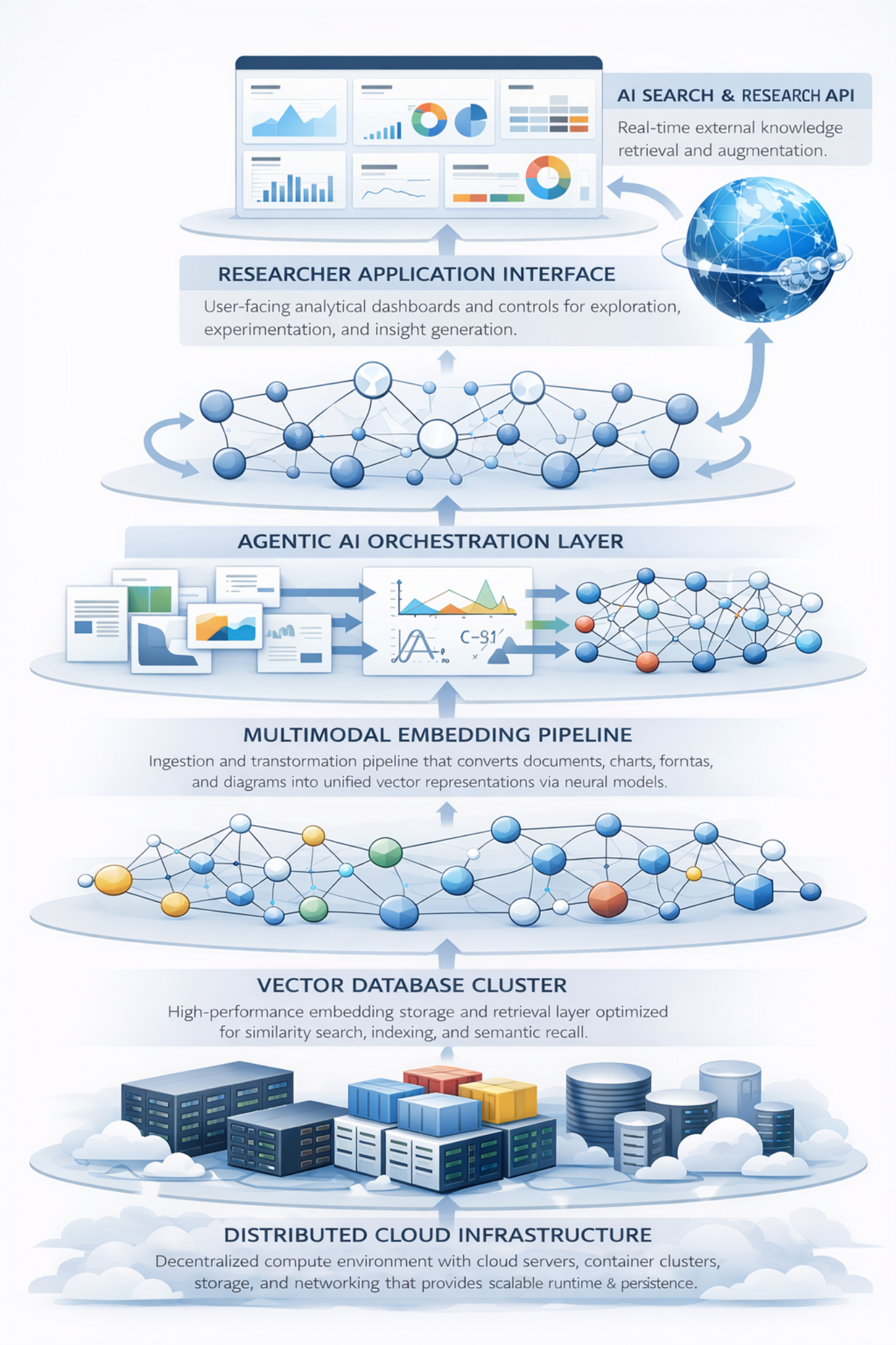
🏗️ Architecture Overview
(Referenced from the attached layered architecture diagram)
CliniRepGen AI follows a layered enterprise AI architecture, optimized for:
- Distributed compute
- Semantic embeddings
- Multimodal reasoning
- Agent-based decision-making
⚙️ Architecture Breakdown (Bottom → Top)
1. Distributed Cloud Infrastructure — Akash Network
The foundation of the system runs on Akash Network, providing:
- Decentralized GPU/CPU compute
- Containerized microservices
- Cost-efficient scaling for large CSRs
- Flexible, regulation-friendly deployment
This layer executes:
- Embedding generation
- Vector search workloads
- Agent inference
- Large-scale document parsing
2. Vector Database Cluster
All clinical artifacts are embedded and indexed in a distributed vector database.
Embedded assets include:
- CSR sections (aligned to ICH E3)
- Study protocols and amendments
- Statistical Analysis Plans (SAPs)
- Tables, Listings, and Figures (TLFs)
- Regulatory guidance (HC, EMA, FDA)
Semantic similarity is computed via cosine similarity:
[ \text{Similarity}(x, y) = \frac{x \cdot y}{|x||y|} ]
This enables:
- Guideline-to-section traceability
- Detection of missing or weak compliance evidence
- Cross-document consistency validation
3. Multimodal Embedding Pipeline
Clinical studies are inherently multimodal.
The pipeline processes:
- 📄 Narrative sections (methods, results, discussion)
- 📊 Statistical tables
- 📈 Figures (e.g., Kaplan–Meier plots)
- 📐 Mathematical expressions (hazard ratios, p-values, confidence intervals)
All modalities are projected into a shared embedding space, enabling reasoning such as:
Does the primary endpoint described in Section 10 match the statistical test defined in Section 9 and reported in Table 14.2.1?
4. Agentic AI Orchestration Layer
This layer represents the cognitive engine of CliniRepGen AI.
Specialized AI agents collaborate through decision graphs and feedback loops.
Key Agents
Regulatory Mapping Agent
Maps CSR content to ICH E3, HC, EMA, and FDA requirementsStatistical Integrity Agent
Validates endpoints, estimands, multiplicity control, and confidence intervalsSafety & Pharmacovigilance Agent
Verifies SAE completeness, MedDRA coding consistency, and exposure-adjusted incidence ratesCross-Region Harmonization Agent
Identifies regulatory divergences across Canada, EMEA, and North America
One agent integrates with the You.com AI Research API, enabling:
- Live regulatory research
- Interpretation of ambiguous guidance
- Retrieval of updated compliance expectations
5. Researcher Application Interface
The top layer provides a user-facing analytical interface.
Key capabilities:
- ✅ Compliance heatmaps by region
- 📍 Missing or non-compliant sections highlighted
- 🔎 Traceability: guideline → evidence → CSR paragraph
- 📊 Statistical validity alerts
Instead of reading hundreds of pages, reviewers receive decision-ready insights.
🧪 Clinical Intelligence (Technical Depth)
ClinicaGraph AI understands advanced clinical research concepts, including:
- Estimands Framework (ICH E9(R1))
[ \text{Estimand} = (Population, Variable, Intercurrent\ Events, Summary\ Measure) ]
- Multiplicity control (Bonferroni, Hochberg, gatekeeping strategies)
- Interim analyses and alpha-spending functions
- Intent-to-Treat vs Per-Protocol populations
- Survival analysis assumptions (log-rank, Cox proportional hazards)
- CDISC SDTM → ADaM → TLF traceability
- Safety signal coherence across narratives and tables
The system flags scientific and regulatory risk, not just formatting issues.
⚡ Hackathon Impact
- ⏱️ Weeks → Hours for compliance validation
- 📉 Reduced regulatory rejection risk
- 🌍 Unified multi-region compliance workflow
- 🧠 Expert-level reasoning without expert scarcity
- 💰 Lower cost through decentralized compute (Akash Network)
🌟 Why This Matters
Clinical innovation is slowed not by science — but by compliance friction.
By combining:
- Decentralized infrastructure (Akash Network)
- High-dimensional semantic embeddings
- Agentic AI reasoning
- Live regulatory research via You.com API
ClinicaGraph AI transforms compliance from a bottleneck into an accelerator.
🏁 Closing Thought
What if regulatory compliance felt less like an audit — and more like an intelligent co-pilot?
That is the future ClinicaGraph AI is building.


Log in or sign up for Devpost to join the conversation.