-
-
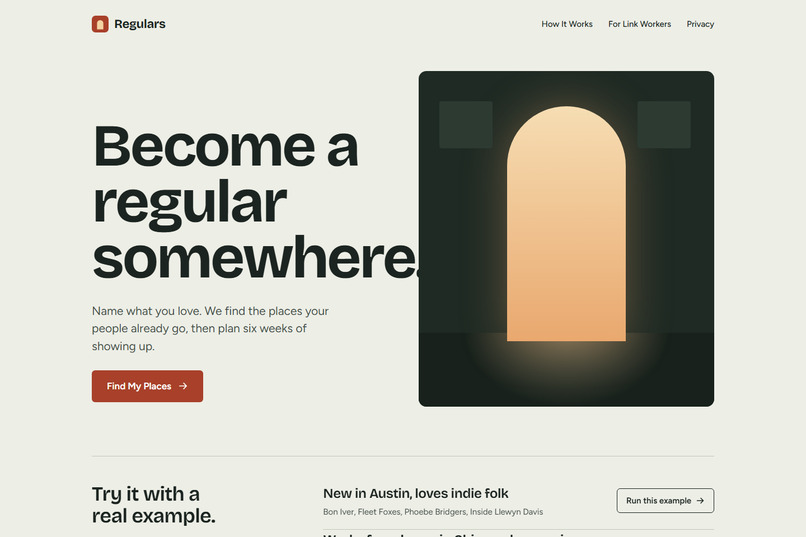
Become a regular somewhere: name what you love, get real places near you
-
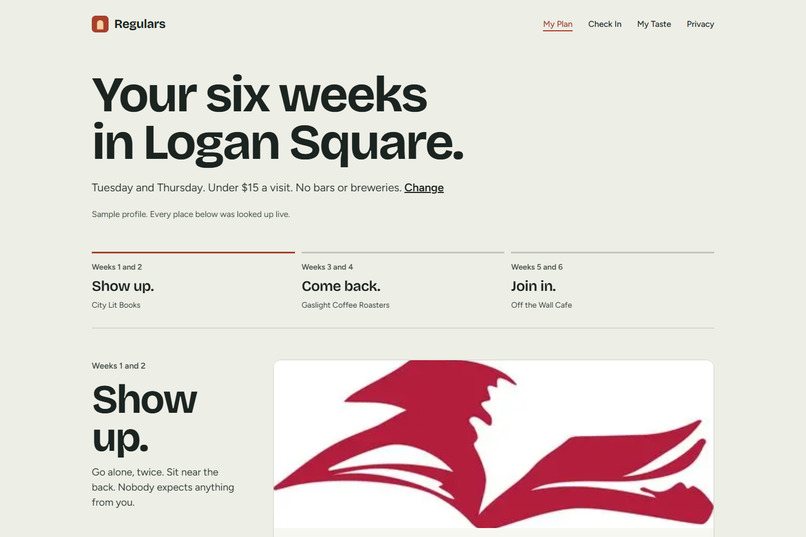
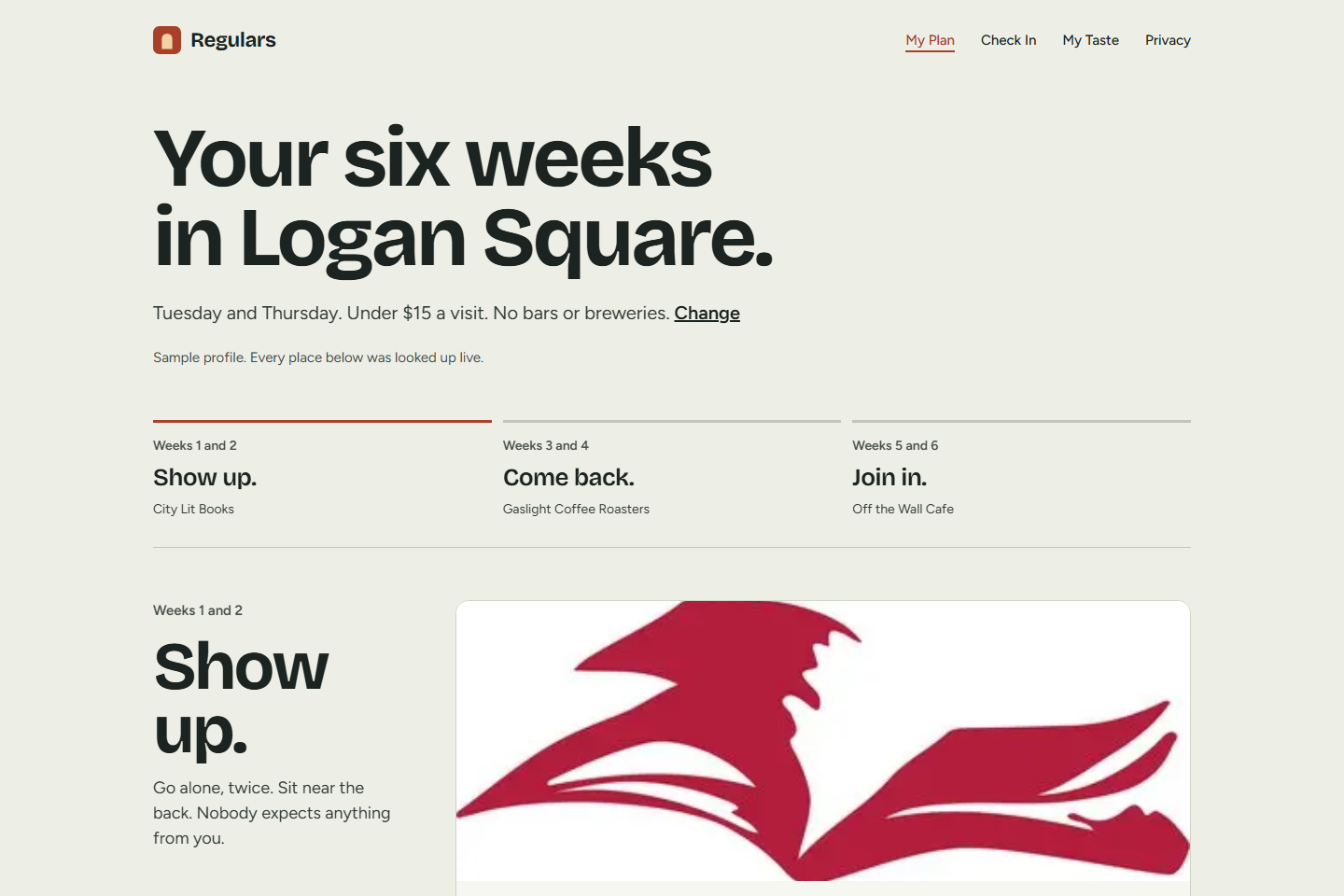
A six week Connection Plan for Logan Square, Chicago, built live from Qloo
-
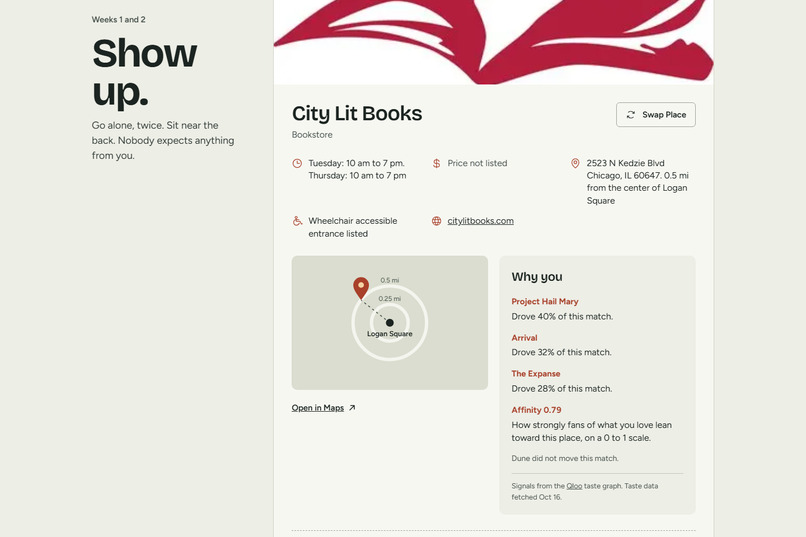
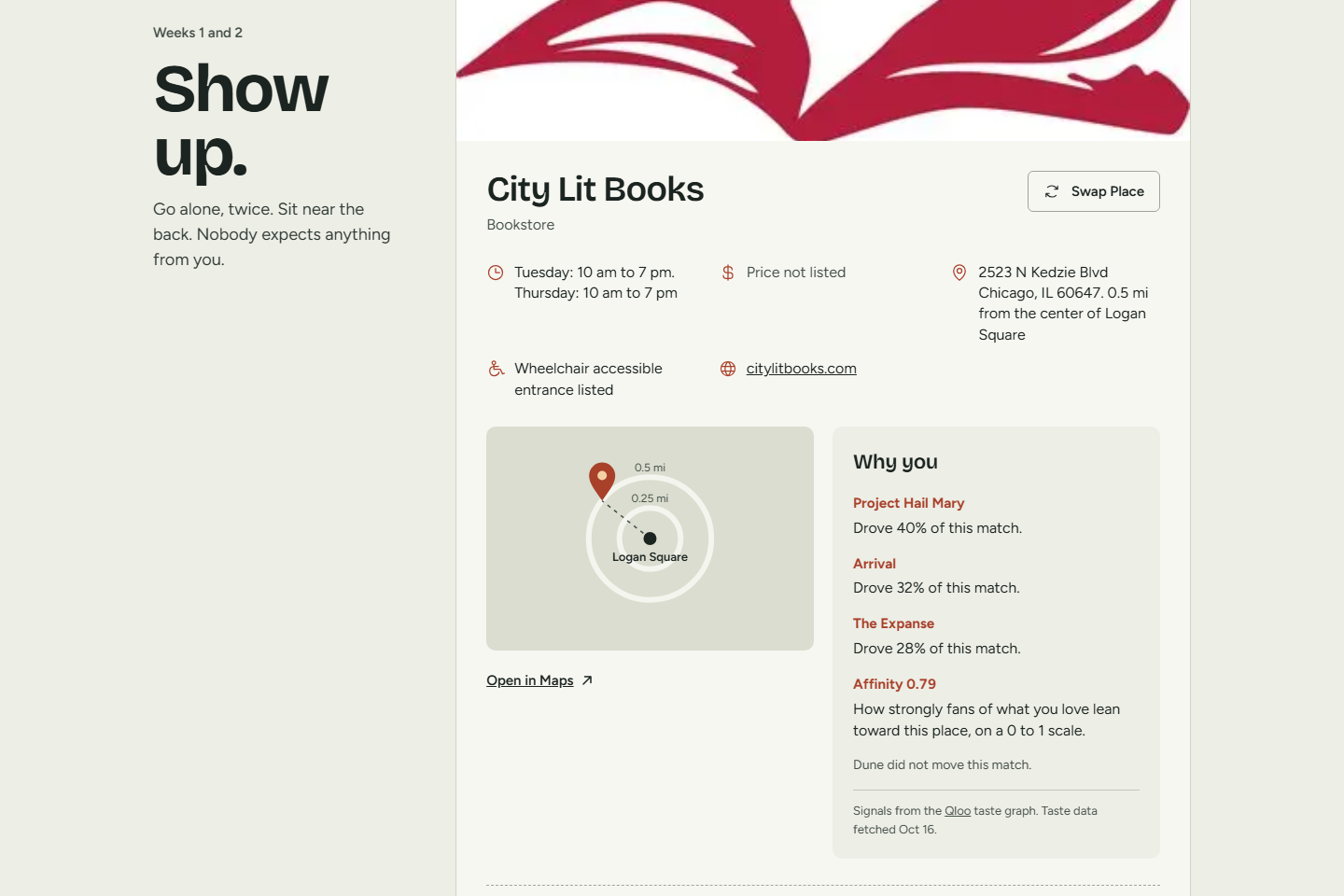
Each card shows only Qloo fields. Why you comes from Qloo explainability.
-
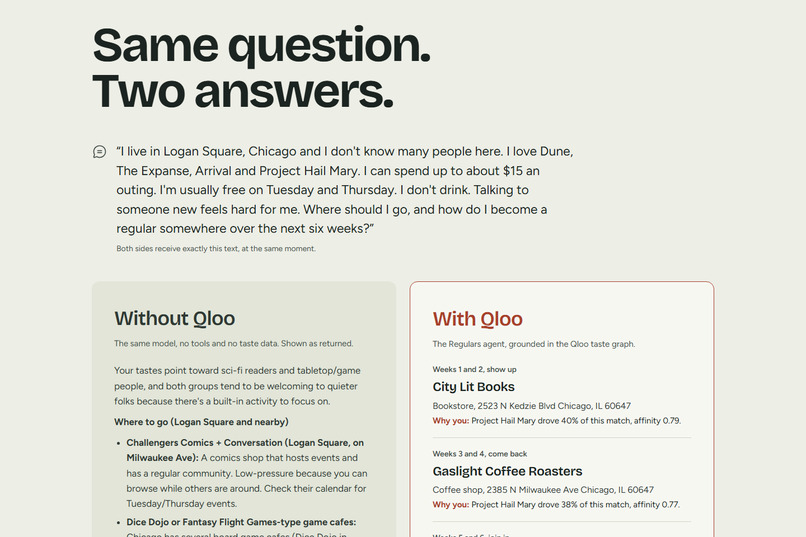
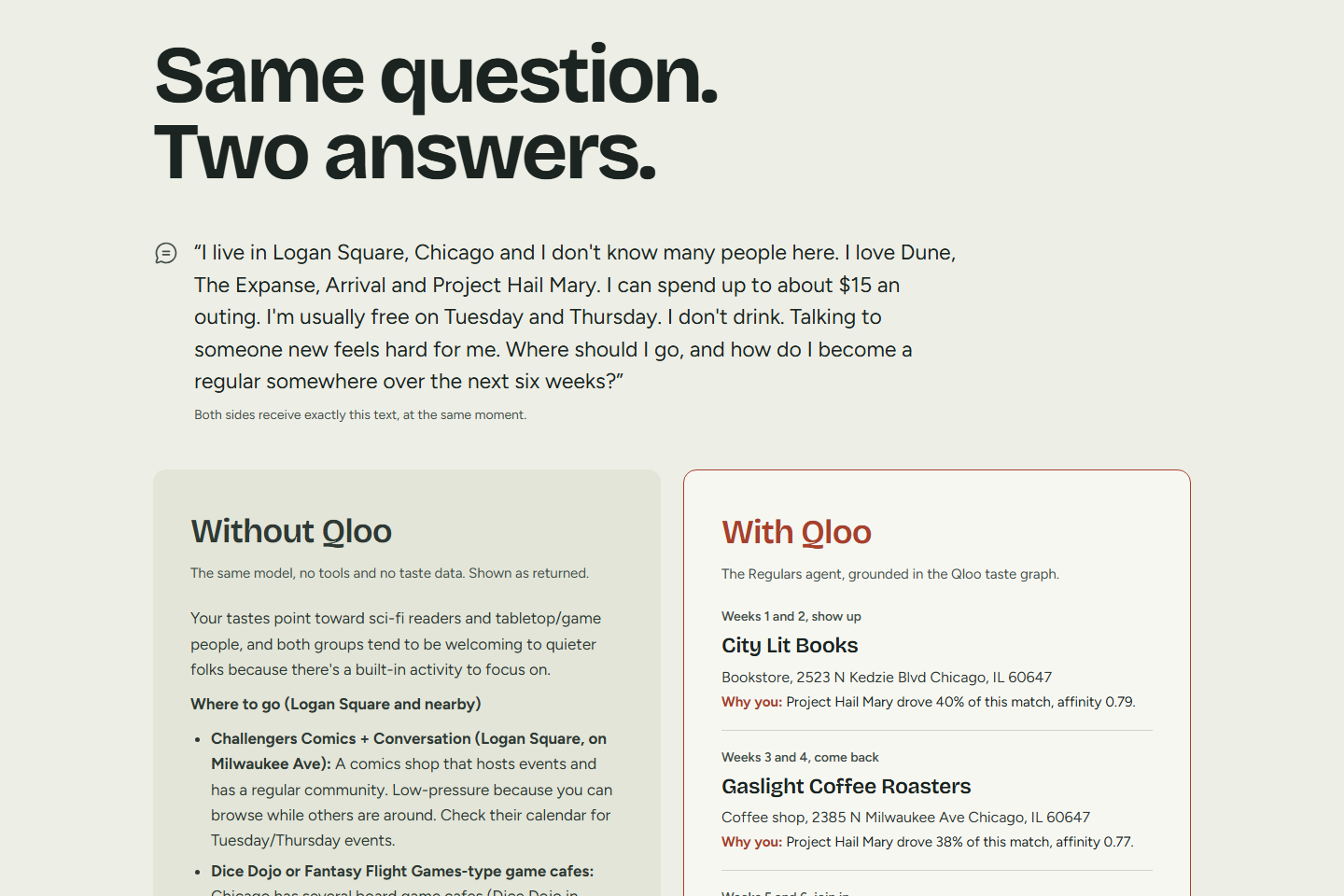
Same request, live: general advice without Qloo, real places with evidence with Qloo
-
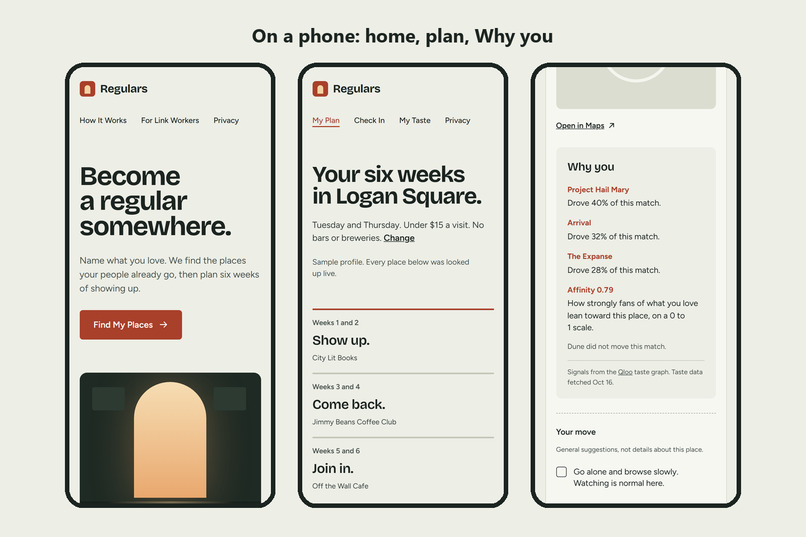
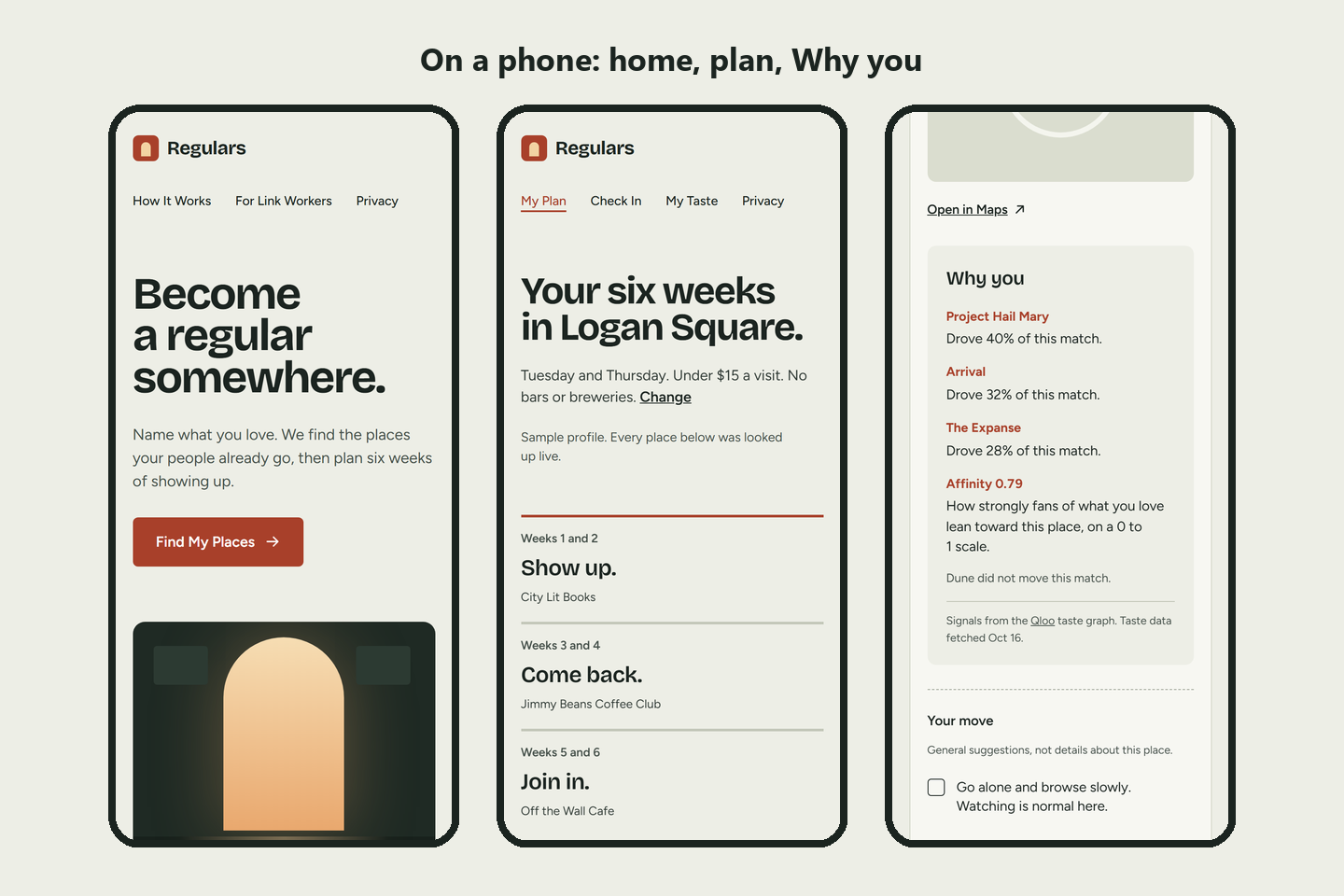
On a phone: home, plan and Why you
-
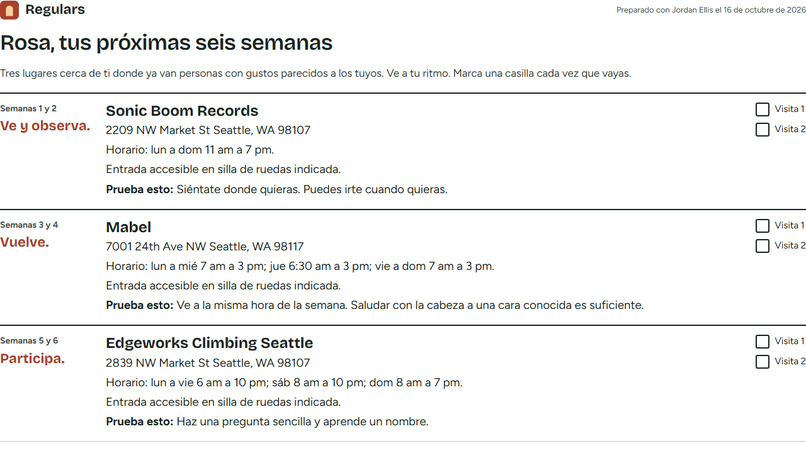
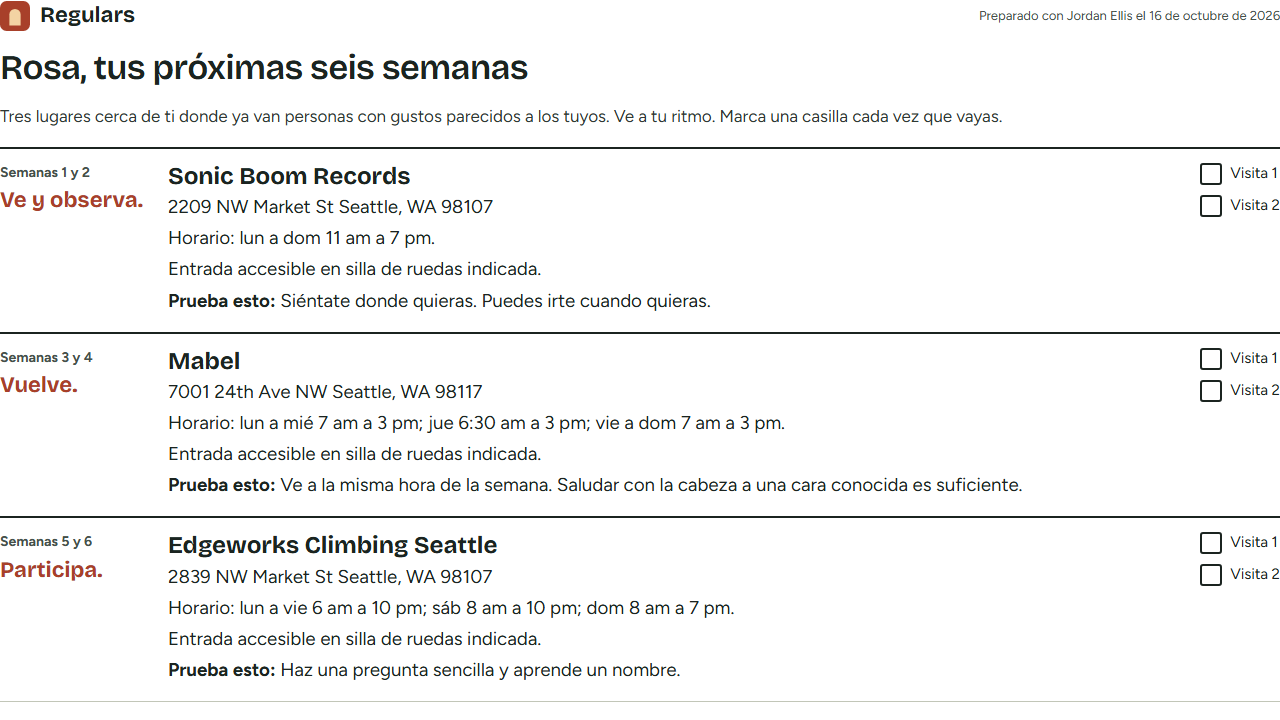
Link worker mode: a large print sheet in Spanish, ready to hand over
-
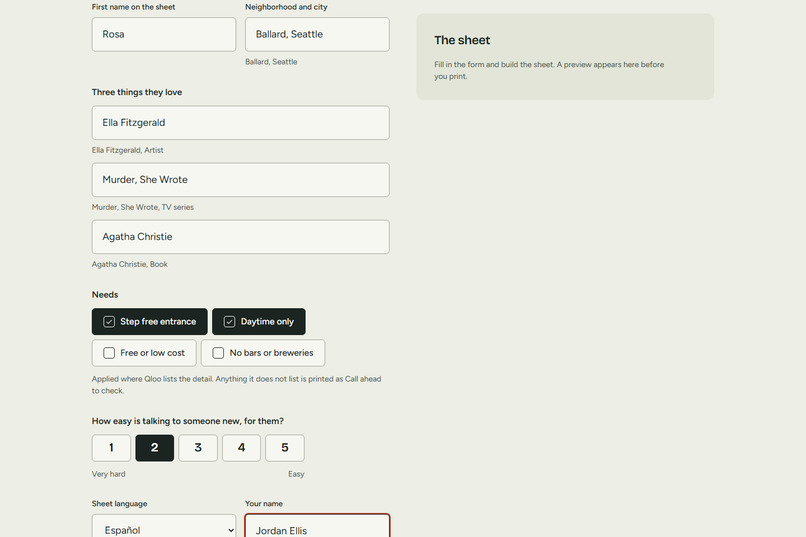
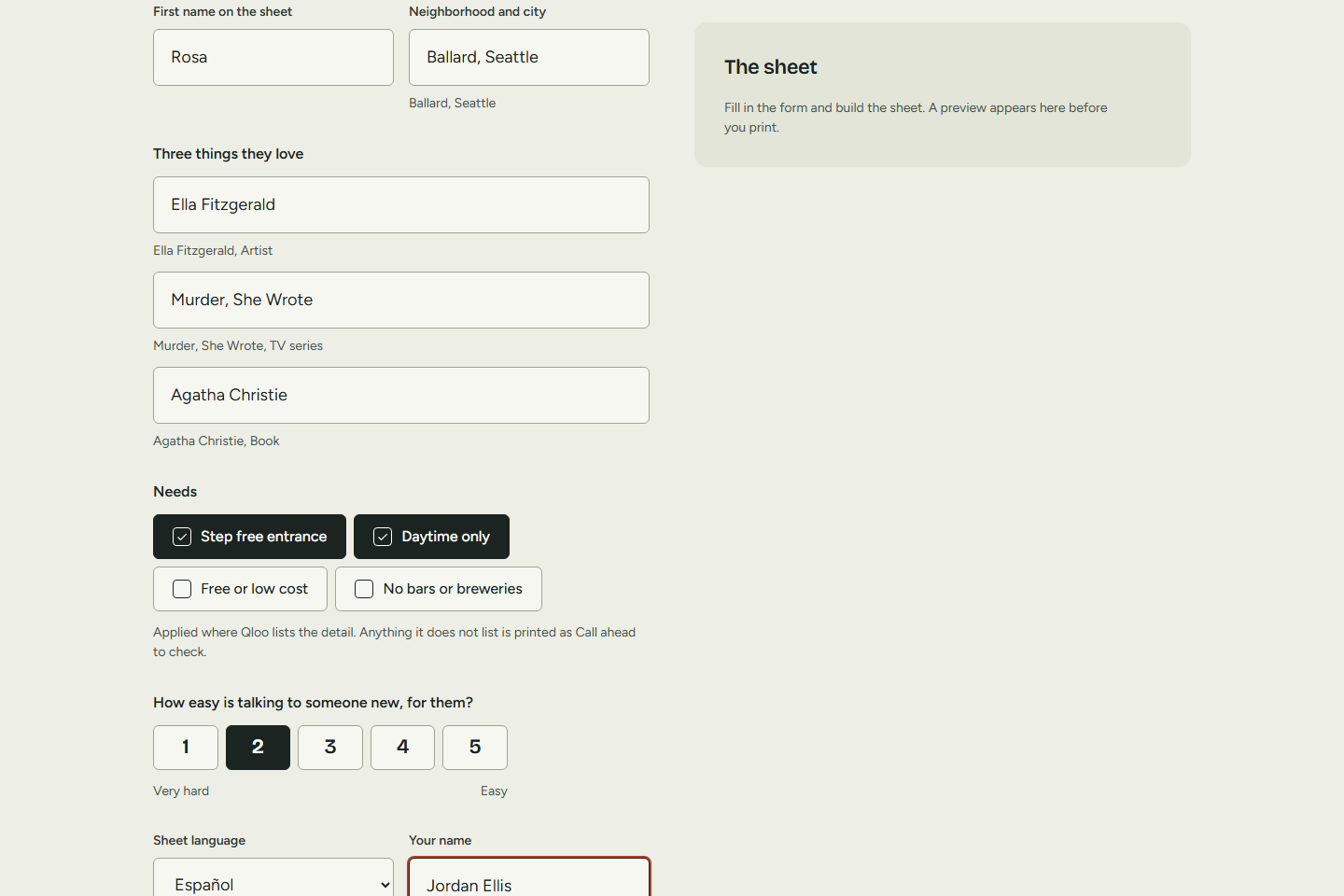
Link worker form: needs like a step free entrance or daytime only, and the sheet language
-
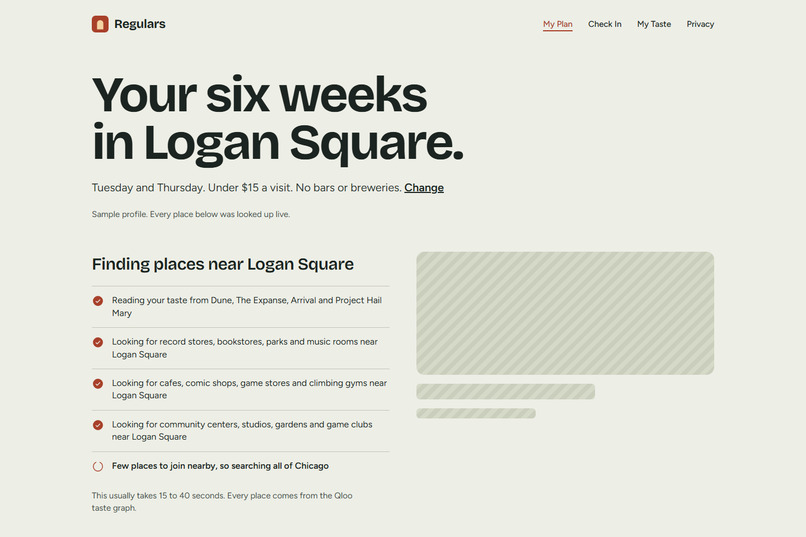
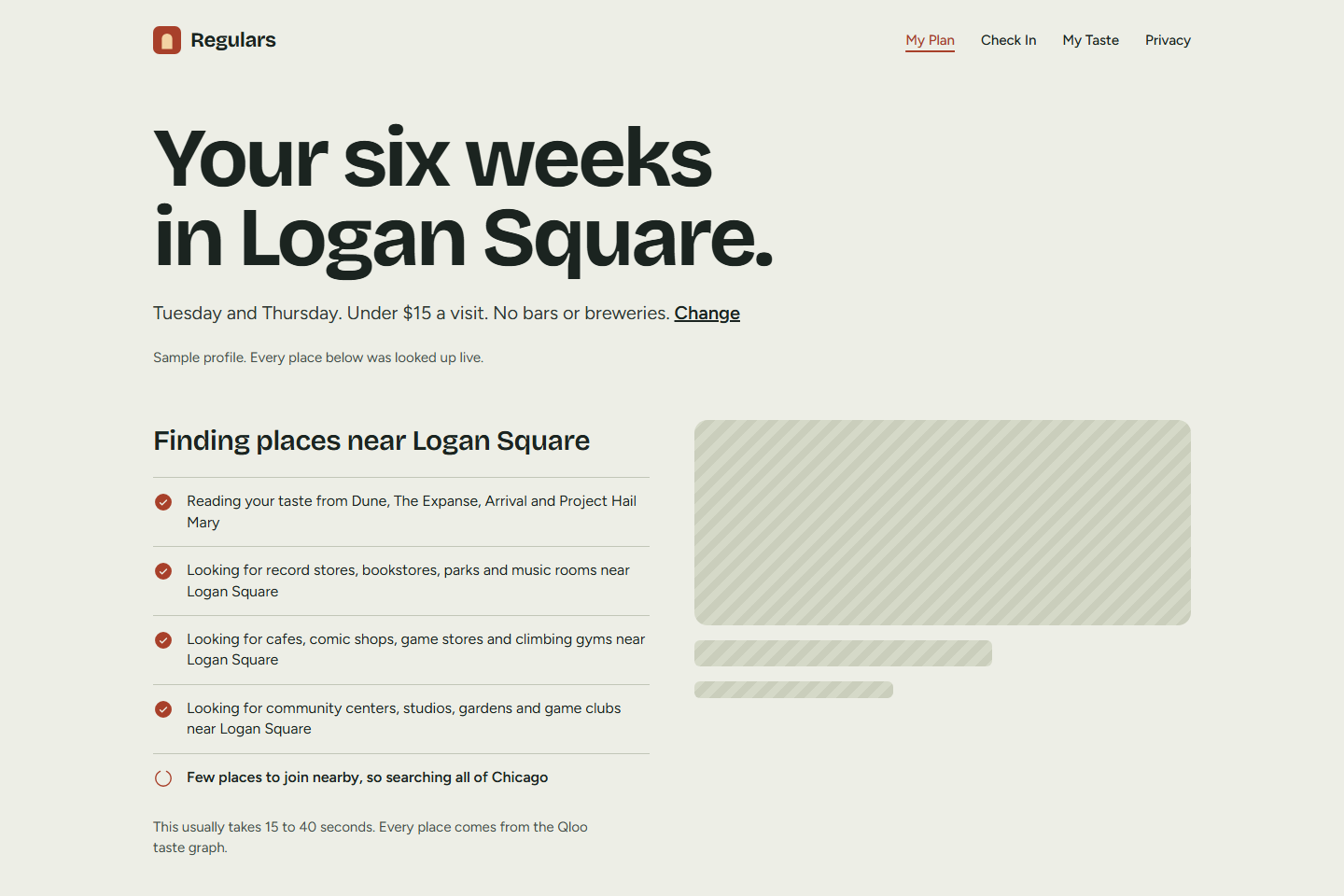
The planner streams each Qloo step to the page
-
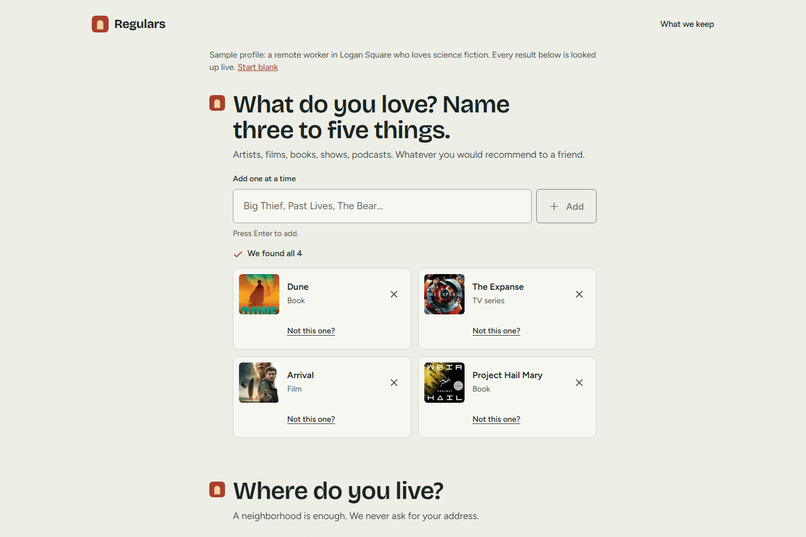
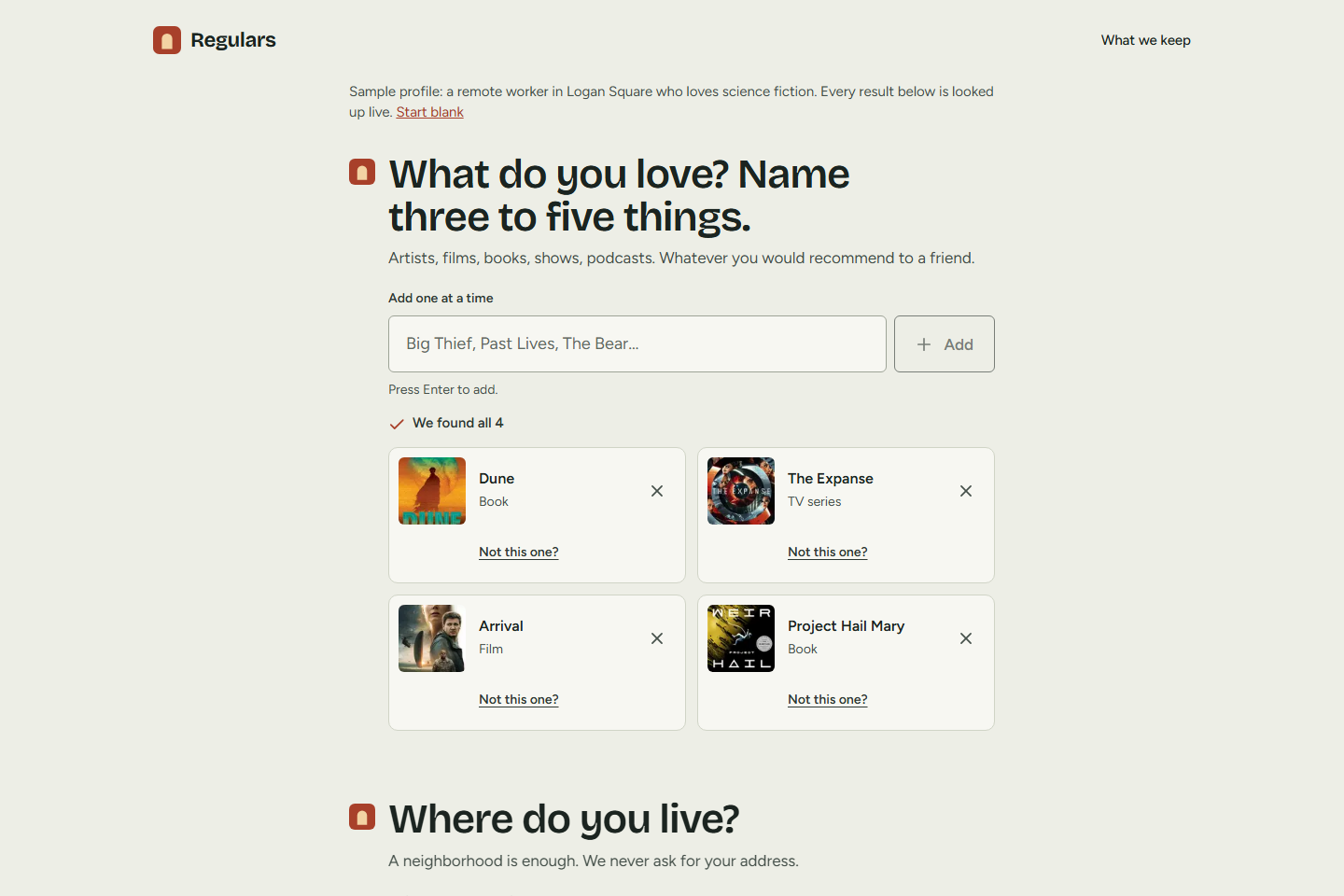
Intake: each love becomes a real Qloo entity
-
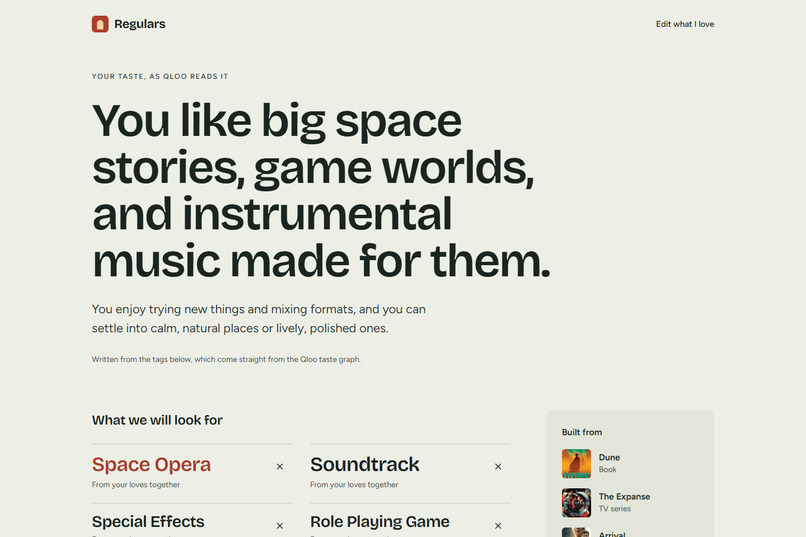
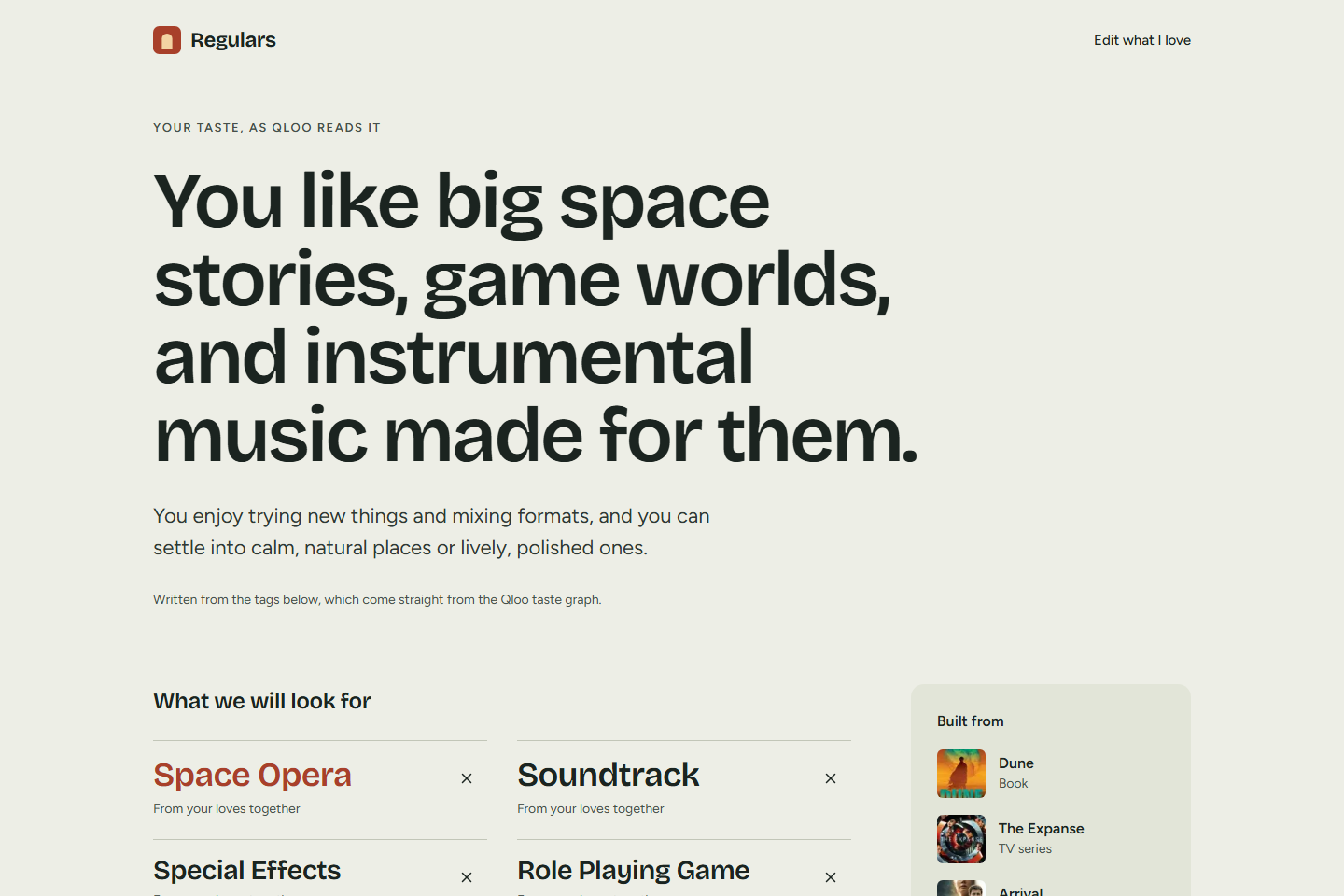
Taste portrait written from Qloo tags
-
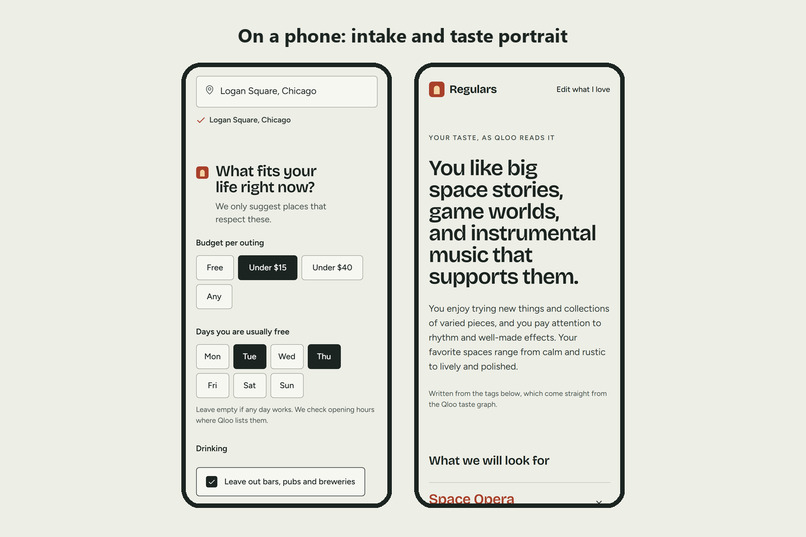
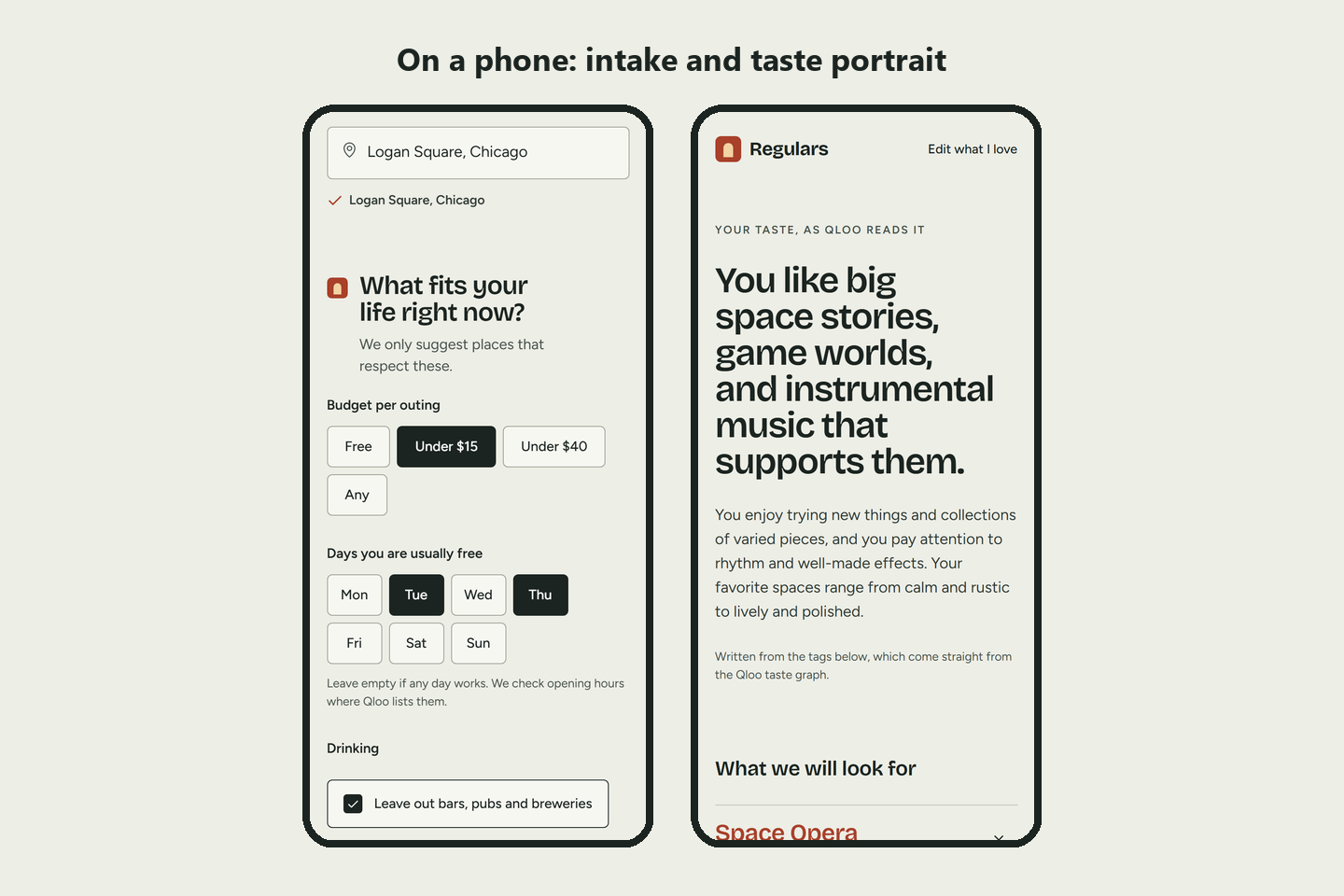
On a phone: intake and taste portrait
-
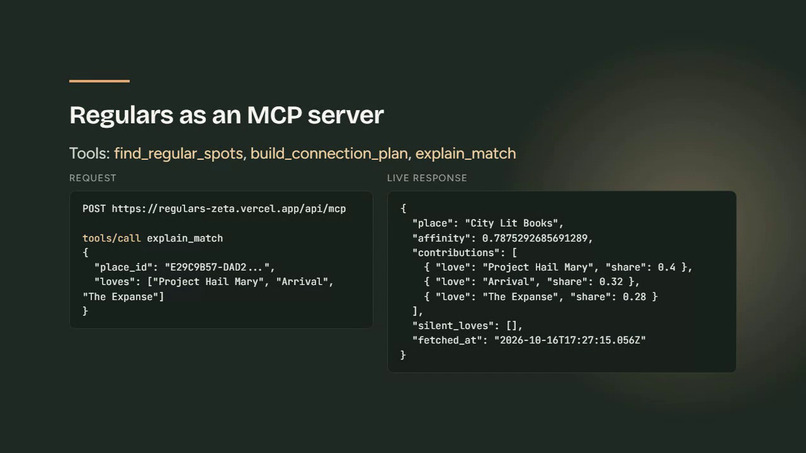
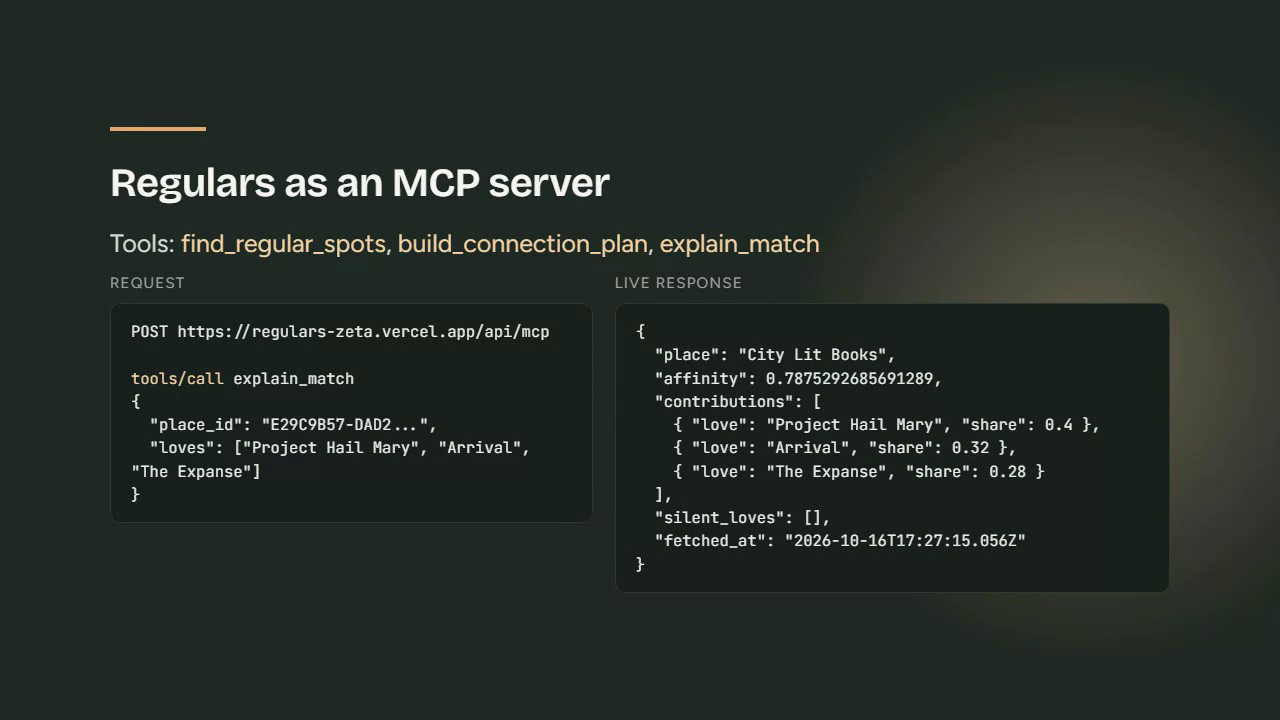
MCP endpoint: a live explain_match call
-
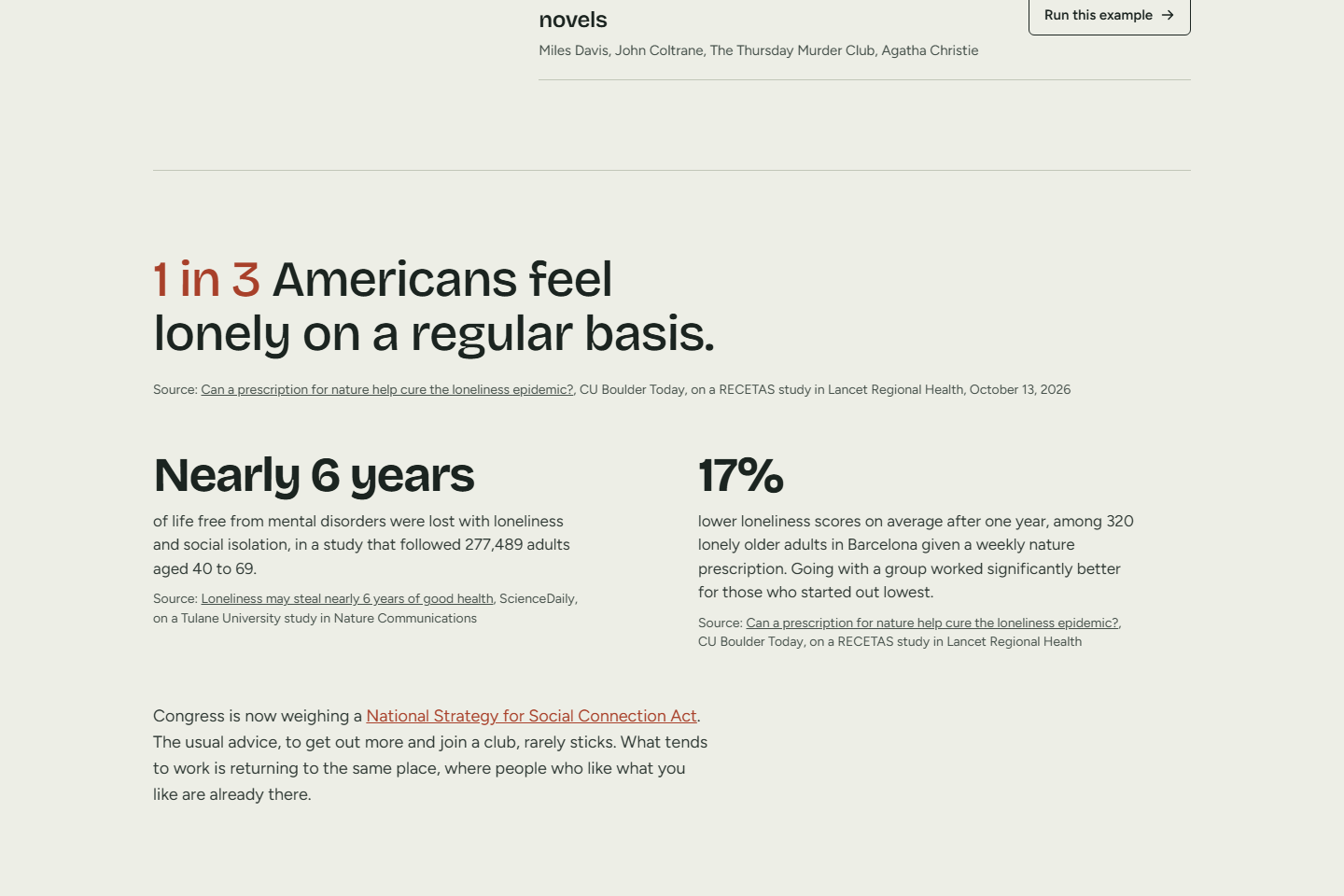
Why it matters, with sources
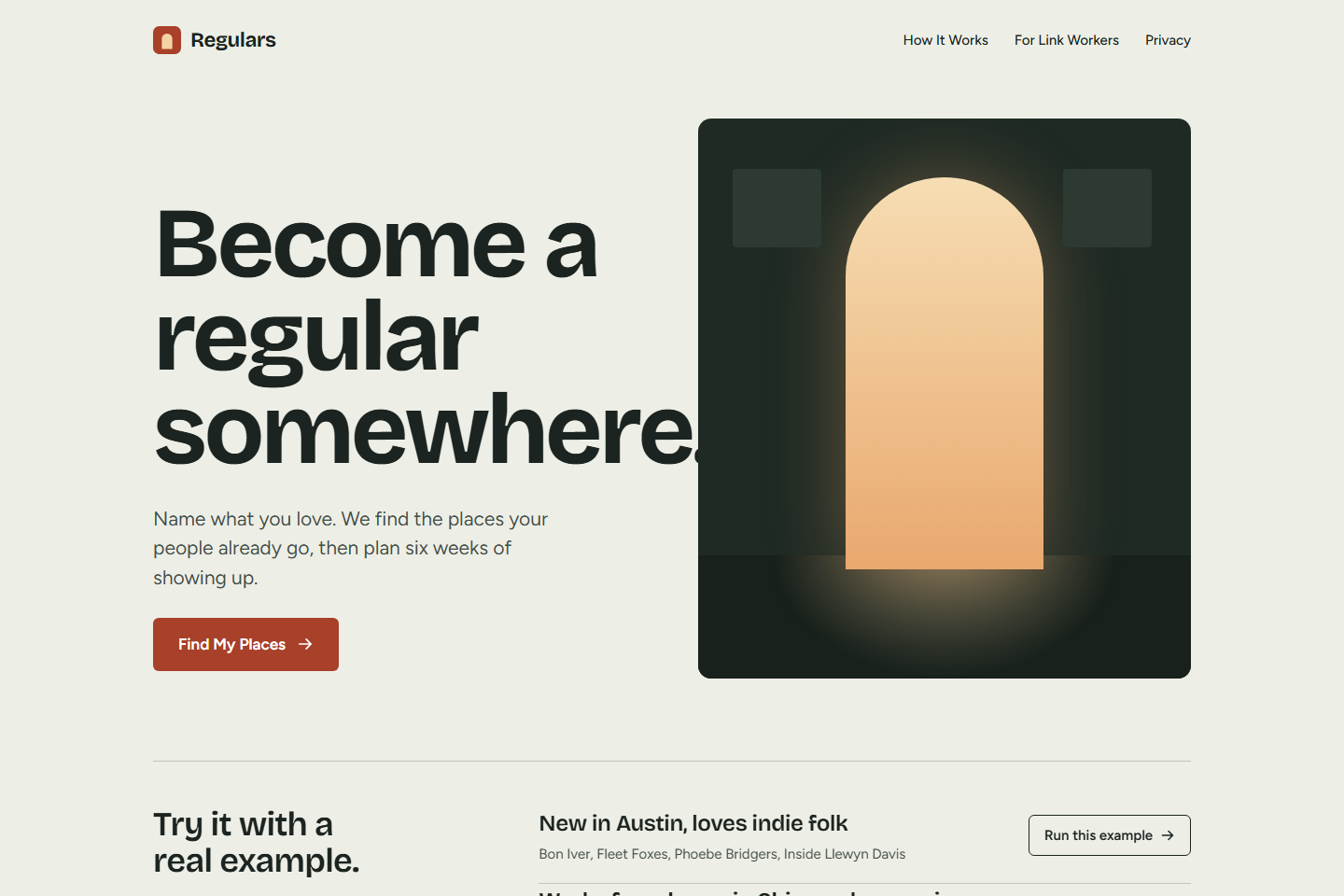
Become a regular somewhere. Name what you love. Regulars finds the places your people already go, then plans six weeks of showing up.
Live demo: https://regulars-zeta.vercel.app · Code: https://github.com/Chinorab/regulars · License: MIT
Try it
- Open https://regulars-zeta.vercel.app and pick an example under "Try it with a real example" (Austin, Chicago or Seattle). No account, no typing.
- Click See My Taste Profile, then Build My Plan. Places are looked up live, usually in 15 to 40 seconds.
- Open Check In and choose "I'd go back" to see the later steps refresh around that place.
- Open See the Difference (/compare) for the same request answered without and with Qloo.
- Open Link Worker Mode (/link-worker) to build a printable sheet in English or Spanish.
- MCP: add https://regulars-zeta.vercel.app/api/mcp as a custom connector in Claude Desktop (Streamable HTTP).
Inspiration
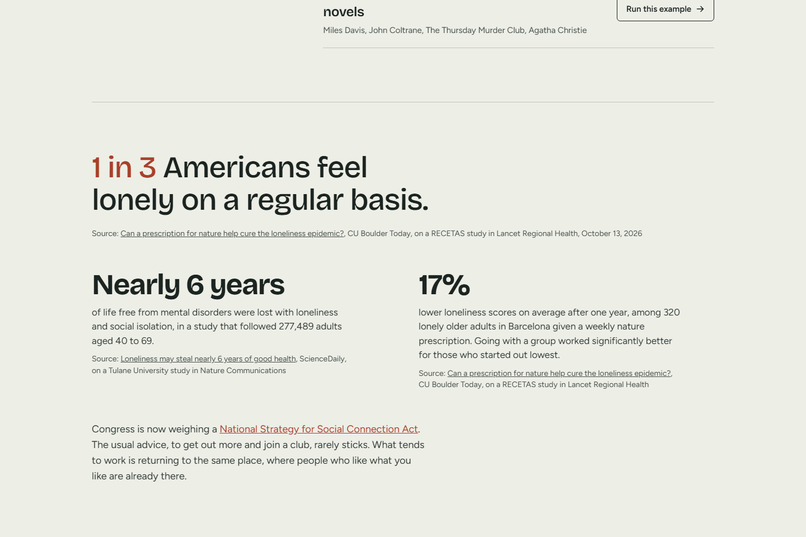
About one in three Americans feel lonely on a regular basis (CU Boulder Today, Oct 2026). A study of 277,489 adults linked loneliness and isolation to the loss of nearly six years of life free from mental disorders (ScienceDaily, Nature Communications, Oct 2026), and Congress is weighing a National Strategy for Social Connection Act.
The advice people get is generic: get out more, join a club. It rarely sticks. Friendships tend to form where you keep seeing the same faces, in a place full of people who like what you like. A recent trial of nature prescriptions found that doing the activity with a group worked significantly better for the loneliest people (Lancet Regional Health, via CU Boulder). The missing piece is knowing which place. That is a taste question, and it is local. Qloo's taste graph answers exactly that.
What it does
- Intake. You name a few artists, films, shows, books or podcasts and your neighborhood. Each name becomes a real entity card with its image. You set a budget, free days, whether to leave out bars, and how easy talking to strangers feels.
- Taste portrait. Real Qloo tags, balanced across genres, keywords and the kind of rooms these fans prefer. Each one is removable.
- A six week Connection Plan in three steps: Show up (go alone, no pressure), Come back (same place, same time, faces repeat), Join in (take one small part). Each step has one real place and two backups.
- Why you, with evidence. Every card shows only what Qloo returned: hours on your free days, address, price level, accessibility, distance from your neighborhood center. A Why you block comes straight from Qloo explainability: "Project Hail Mary drove 40% of this match", the affinity score, what visitors mention, and which of your loves did not move it.
- Check ins that change the plan. "Not for me" swaps the place for the next match. "I'd go back" makes that place a new taste signal: in our Chicago test, after a check in at City Lit Books the next steps were re-ranked and the bookstore drove 34% of the new matches.
- Without Qloo / With Qloo. The same request goes live to the same model with no tools and to the grounded agent, side by side. On its own the model invented "Dice Dojo-type places" and cover charges; the grounded side can only name places Qloo returned.
- Link worker mode. Social prescribers and care teams can plan with a patient and print a large print, letter size sheet in English or Spanish. Nothing is stored; the form wipes itself after printing.
- An MCP endpoint exposing
find_regular_spots,build_connection_planandexplain_match, so Claude Desktop or any agent can use Regulars as a tool.
No account. Plans stay in the browser.
How we built it
- Spec first. GitHub Spec Kit: a constitution (truth from Qloo only, every claim sourced, privacy by default), a spec, clarifications, a plan, 58 tasks and a cross artifact analysis that caught three critical issues before any code was written.
- Probe first. Before writing the agent we called the live API with three cities and three taste profiles, about 130 calls, and wrote down what we learned (see Challenges).
- Agent. A Claude tool use loop on
claude-sonnet-5-5, with three tools:read_taste,find_placesandsubmit_plan. Each tool call streams to the page as a step ("Looking for record stores, bookstores, parks and music rooms near Logan Square"). - Evidence registry. Every Qloo record fetched during a run goes into a registry. The model only ever hands back place ids; the server renders every field from the registry, and
validatePlandrops any id Qloo did not return for that step. Tips are filtered so they cannot carry venue facts. - Stack. Next.js 16 App Router and TypeScript on Vercel, plain CSS with tokens extracted from our Claude Design mockups, Upstash Redis for a 24 hour cache and per visitor limits (keys and IPs are hashed),
mcp-handlerfor the MCP endpoint. - Verification. 23 unit tests, a copy lint (no em dashes, no emoji), a secret scan of the source and client bundle, and seven browser journeys with playwright-cli at 1440 px and 360 px, all run against the live APIs.
Qloo integration
/searchwith atypeslist: Resolve each love to an entity with image and tags, one call per name./v2/insights,filter.type=urn:tag,filter.tag.types,diversify.by=subtype: Taste portrait balanced across music genres, Qloo genres and keywords./v2/insights,filter.tag.types=urn:tag:ambience:qloo: The rooms these fans prefer./v2/insights,filter.type=urn:entity:place,filter.location.query,filter.tags(place categories per step),filter.exclude.tags,filter.exclude.entities,feature.explainability: Real places per step with affinity and per love contributions; bars excluded on request; swapped or rejected places excluded./v2/insightswith a liked place insignal.interests.entities: Check ins re-rank the later steps around a place you want to return to./v2/insights,filter.results.entities:explain_match: score one place for a set of loves.- Locality resolution from
filter.location.query: Validate the neighborhood and compute distance from its center.
We also use what Qloo returns beyond the ranking: opening hours (to respect free days), wheelchair accessible entrance and time of day tags (for link worker needs like step free or daytime only), review keywords ("Visitors mention"), images and coordinates.
Challenges we ran into
- The quota is real. The hackathon key allows 5 requests per second and 10,000 a month. We budgeted about ten calls per plan, cached every answer for 24 hours, added a monthly guard and per visitor limits, and learned that a 429 on
/searchlooks like "no match" if you do not check it. - Typos travel far. An unknown or misspelled place name in
filter.location.querydoes not fail: "Logn Sqare, Chicgo" resolved to a district of Besançon, France. Regulars accepts only a US locality that matches the stated city and asks the person to check the spelling otherwise. - Books do not move places. Explainability showed that books barely affect place affinity, while artists, films and shows do. Instead of hiding that, the Why you block says so ("Dune did not move this match") and books still shape the taste portrait through tags.
- Unfiltered tags are noisy. Plain tag insights returned credit card types and seafood chowder for jazz fans.
filter.tag.typesplusdiversify.by=subtypegave a portrait people recognize. - Participatory places are sparse. "Join in" categories return few places at neighborhood scale, so the agent widens to the whole city when fewer than three qualify, and the card says so.
- Keeping the model honest. The mockups had friendly details like "Tuesdays at 7 pm, songwriter night". Qloo does not know about events, so the design changed: only Qloo fields appear, and the general advice is visibly separate from the evidence.
Accomplishments that we're proud of
- Every venue fact on screen can be traced to a Qloo response from that request.
- A check in measurably changes the next recommendations, and the card shows by how much.
- A paper sheet that a link worker can hand to someone without a phone.
What we learned
The most useful thing an agent can do with a taste graph is to stay inside it. The best moments in the demo come from Qloo data the model could not have known: which love actually drove a match, a store's hours on your free day, the bookstore that changes your next coffee shop.
What's next
- Pilot link worker mode with a social prescribing team and measure return visits, not clicks.
- Optional reminders before each visit, still without an account.
- Events and recurring formats when a reliable source exists, shown only when verified.
- More languages for the printed sheet.
Built with
Next.js · React · TypeScript · Claude API · Qloo Taste AI · Model Context Protocol · Upstash Redis · Vercel · GitHub Spec Kit · Playwright
Built With
- claude
- github-spec-kit
- model-context-protocol
- next.js
- playwright
- qloo
- react
- redis
- typescript
- upstash
- vercel

Log in or sign up for Devpost to join the conversation.