-
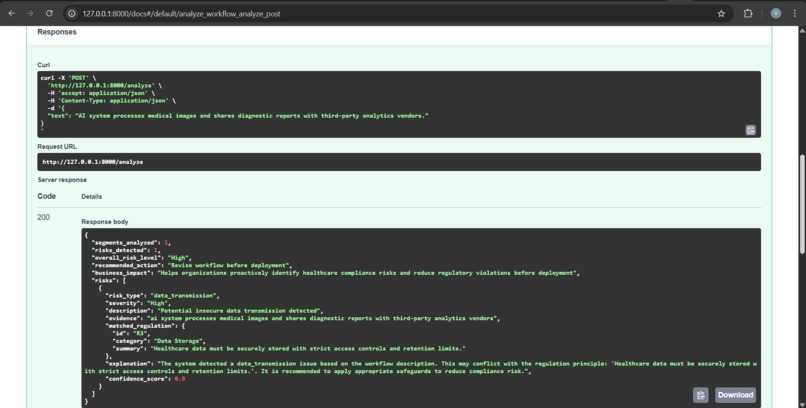
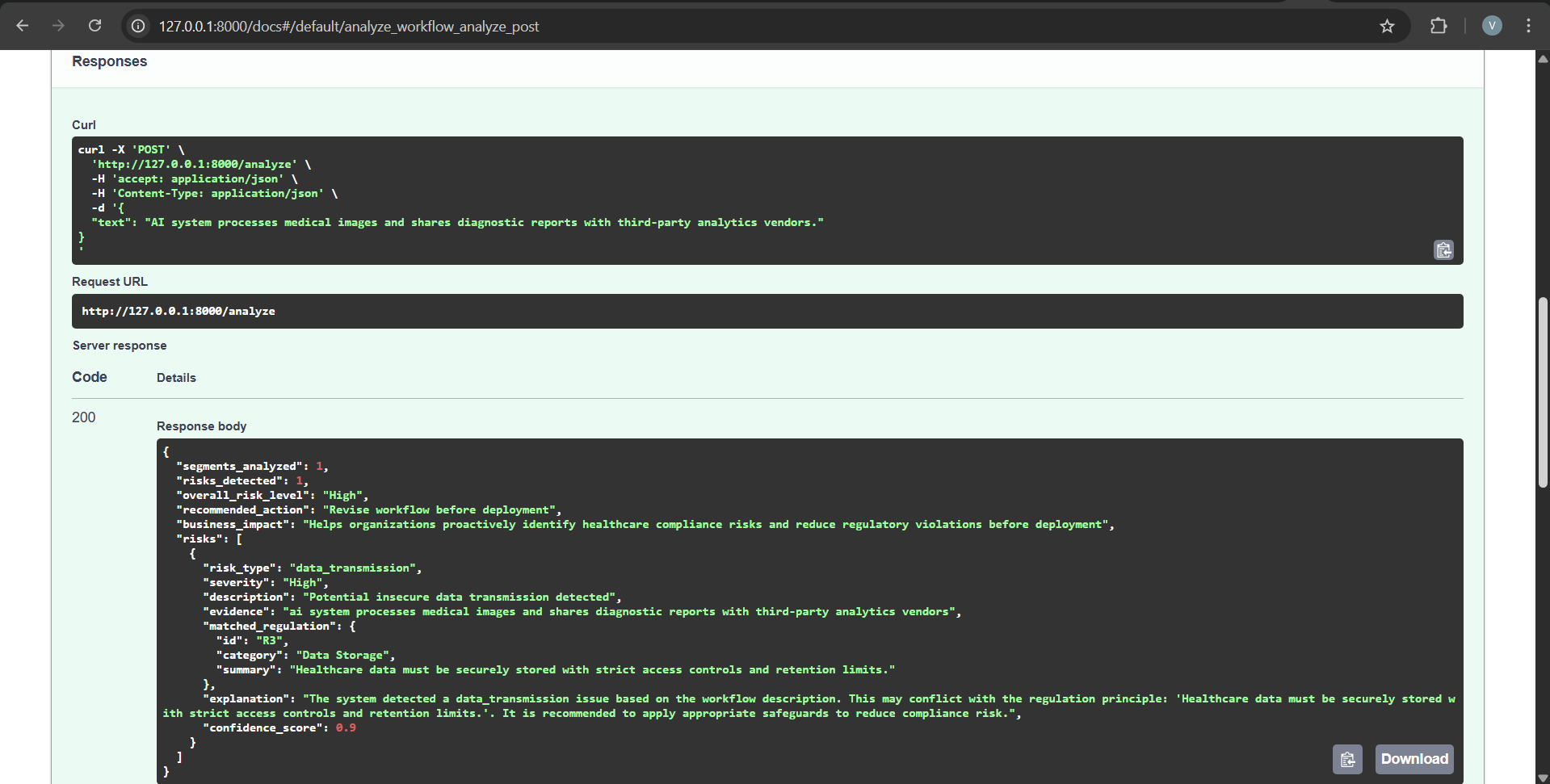
api-response
-
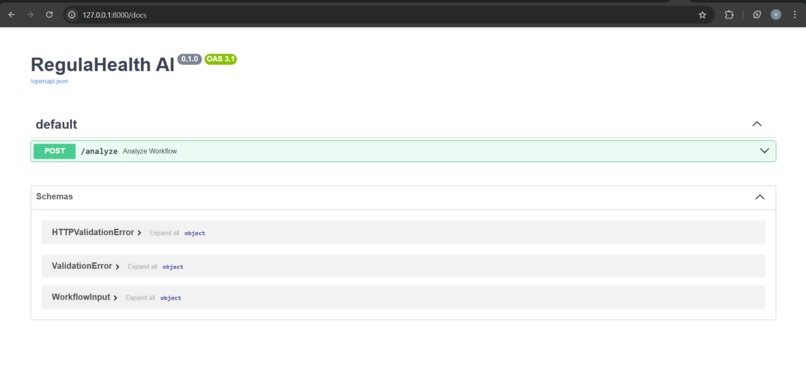
swagger-api
-
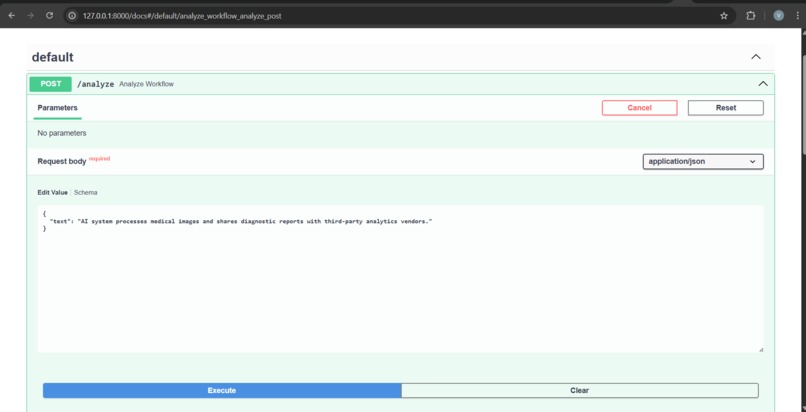
api-request
Abstract
RegulaHealth AI is an explainable AI governance system designed to identify regulatory and compliance risks in healthcare and other regulated AI workflows. By analyzing how sensitive data is collected, stored, and shared, the system flags potential violations and maps them to relevant regulatory principles with clear, human-readable explanations.
Unlike black-box compliance tools, RegulaHealth AI emphasizes transparency, explainability, and decision support. It enables teams to assess AI workflows before deployment, reducing legal exposure and promoting responsible AI practices across health, law, and data-driven systems.
Inspiration
As AI systems are increasingly deployed in regulated environments such as healthcare, law, and public services, compliance failures can result in serious legal, ethical, and financial consequences. However, most teams discover these risks too late—after deployment or during audits.
This project was inspired by the growing gap between rapid AI innovation and the slower pace of regulatory compliance. I wanted to explore how AI itself could be used to support responsible AI development by making regulatory risks understandable, explainable, and actionable at the design stage.
What It Does
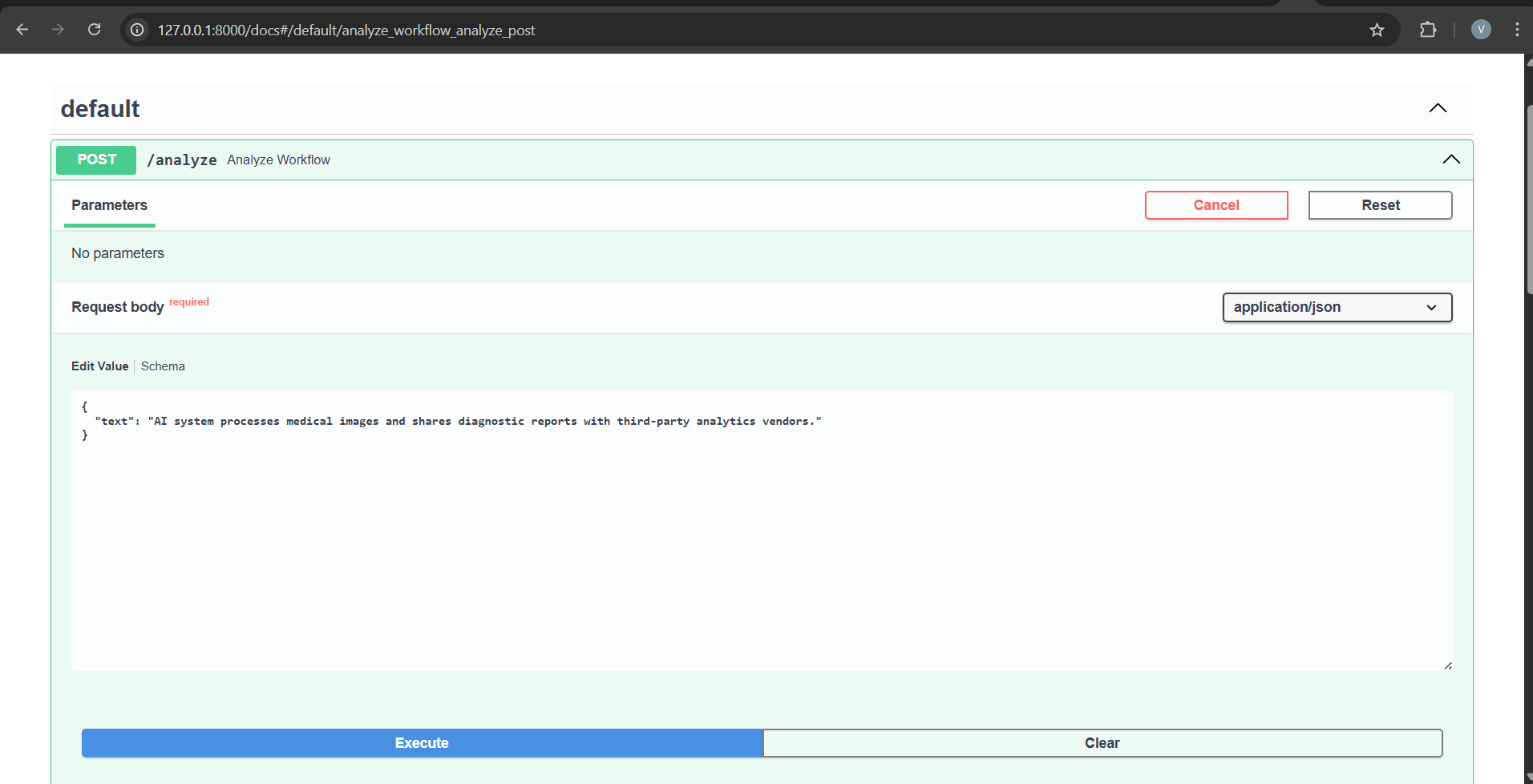
RegulaHealth AI analyzes textual descriptions of AI or healthcare workflows and:
Detects potential compliance risks related to data storage, transmission, and sensitive data handling
Matches detected risks to relevant regulatory principles
Generates human-readable explanations for each risk
Produces an overall risk assessment with actionable recommendations
The system is designed as a decision-support tool, not a legal replacement, helping teams proactively identify and mitigate compliance issues.
How I Built It
The system follows a modular architecture:
Workflow Parser Uses NLP-based segmentation to break complex workflow descriptions into analyzable steps.
Risk Detection Engine Applies rule-based and pattern-driven logic to identify potential compliance risks.
Regulation Matching Engine Matches detected risks to a structured regulatory knowledge base.
Explainability Layer Generates natural-language explanations linking risks to regulatory principles.
Decision Layer Assigns severity levels, confidence scores, and an overall risk verdict.
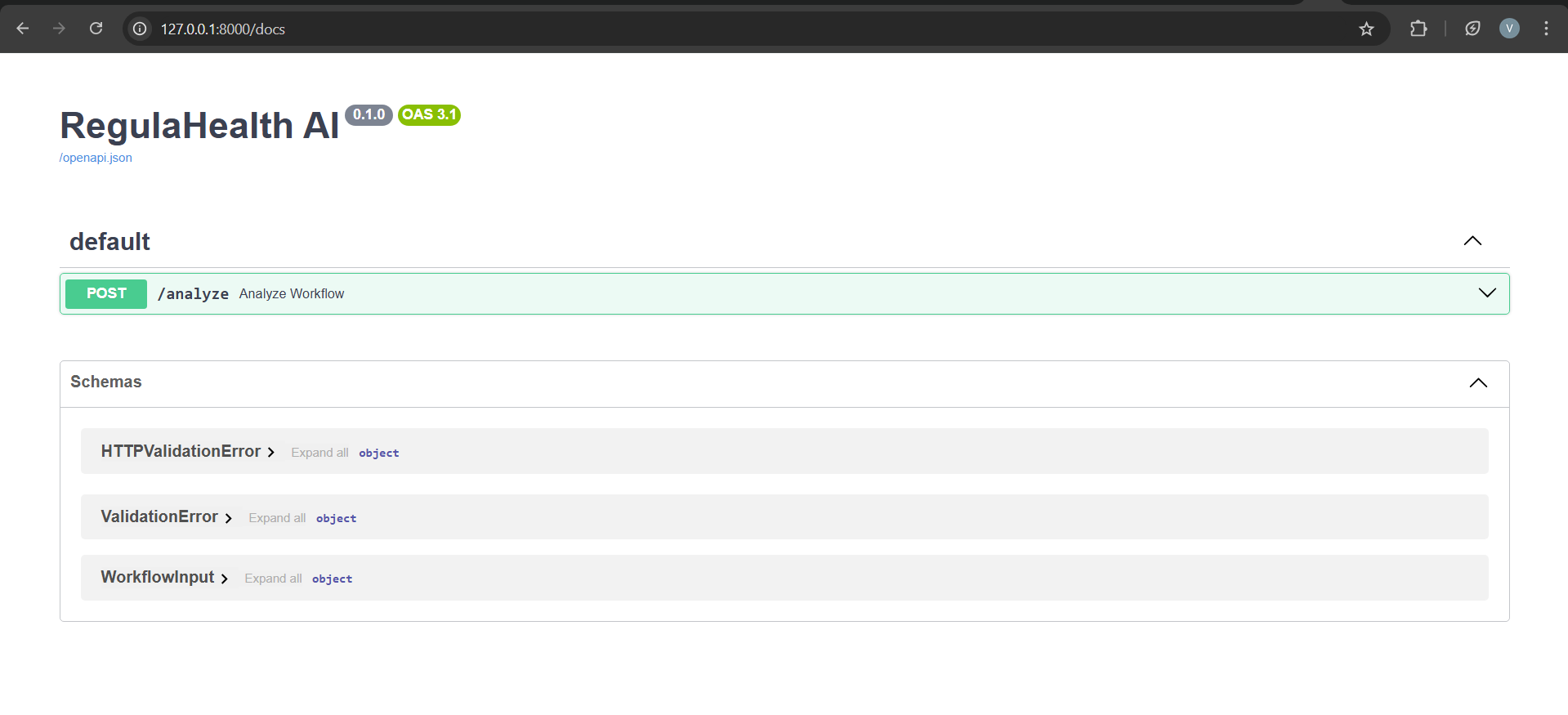
The backend is implemented using FastAPI, allowing the system to be easily integrated into real-world pipelines.
Challenges I Faced
Translating legal and regulatory language into machine-interpretable rules
Avoiding black-box predictions while still providing meaningful AI reasoning
Designing explanations that are understandable to both technical and non-technical users
Balancing simplicity with real-world applicability under hackathon time constraints
What I Learned
The importance of explainable AI in regulated domains
How AI governance differs from traditional ML problem-solving
System design thinking for compliance-oriented AI tools
Building decision-support systems instead of prediction-only models
Future Scope
Replace rule-based regulation matching with semantic embeddings for higher accuracy
Support additional regulatory frameworks beyond healthcare
Add workflow visualization and risk heatmaps
Integrate with CI/CD pipelines for automated compliance checks
Built With
- explainable-ai-(xai)-principles
- fastapi
- natural-language-processing
- openapi
- pydantic
- python
- rule-based-ai-systems
- swagger


Log in or sign up for Devpost to join the conversation.