-
-
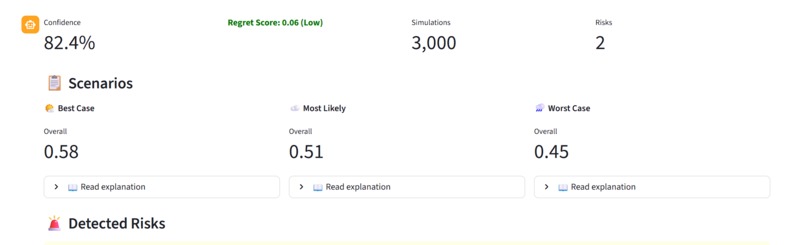
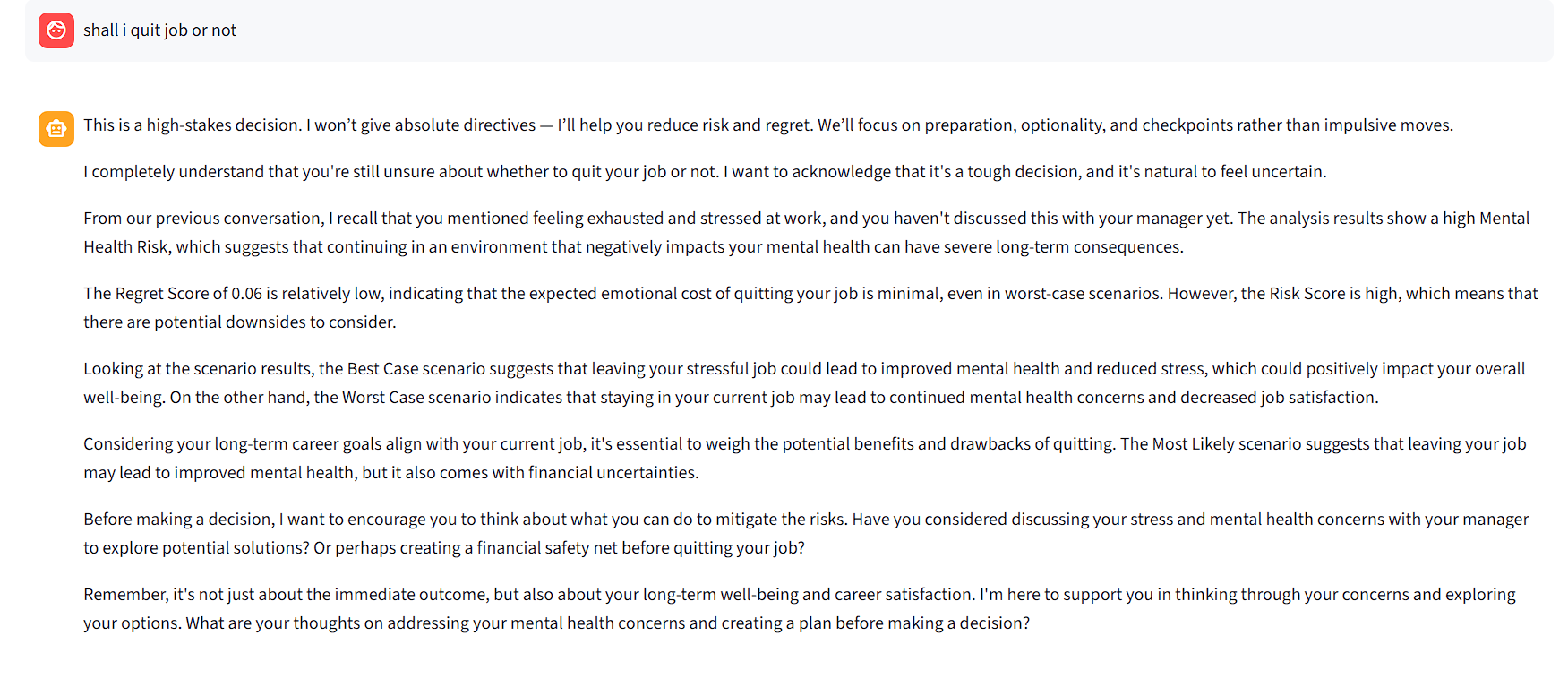
final prediction
-
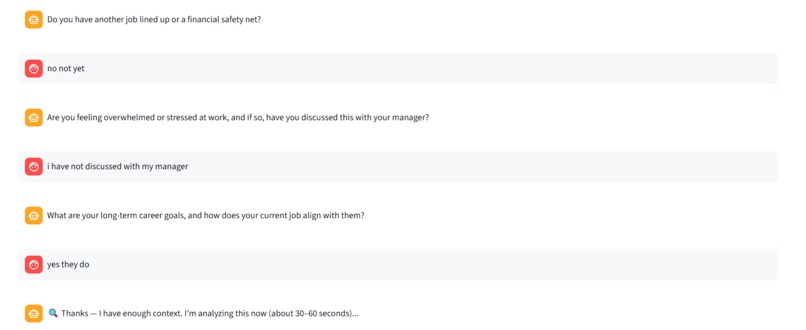
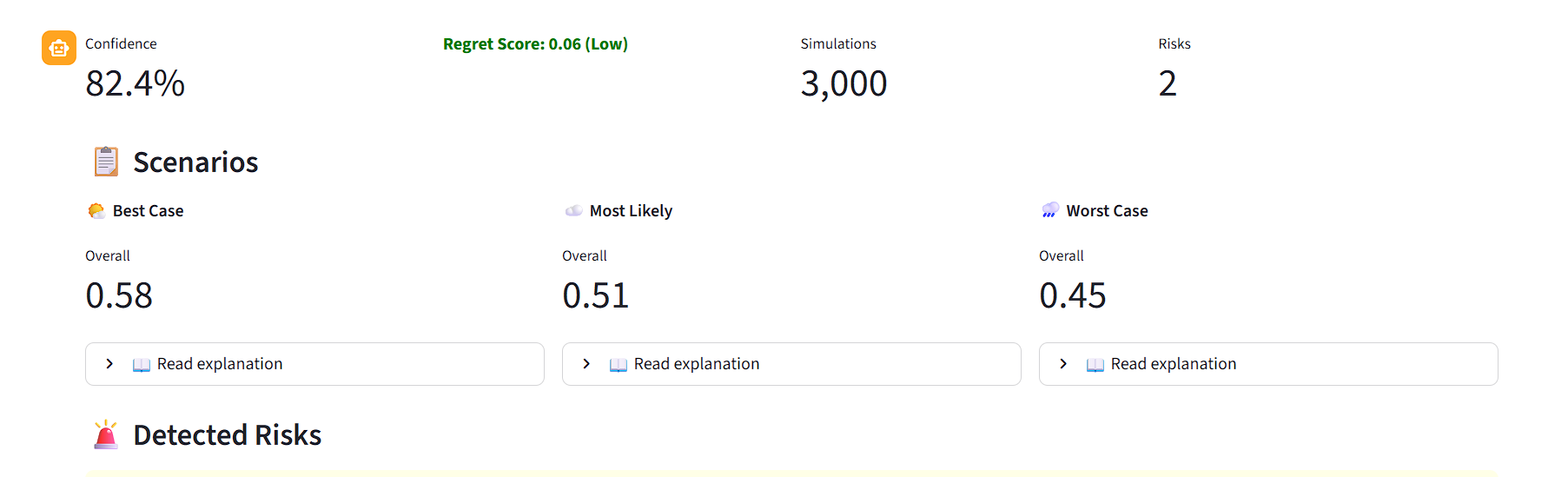
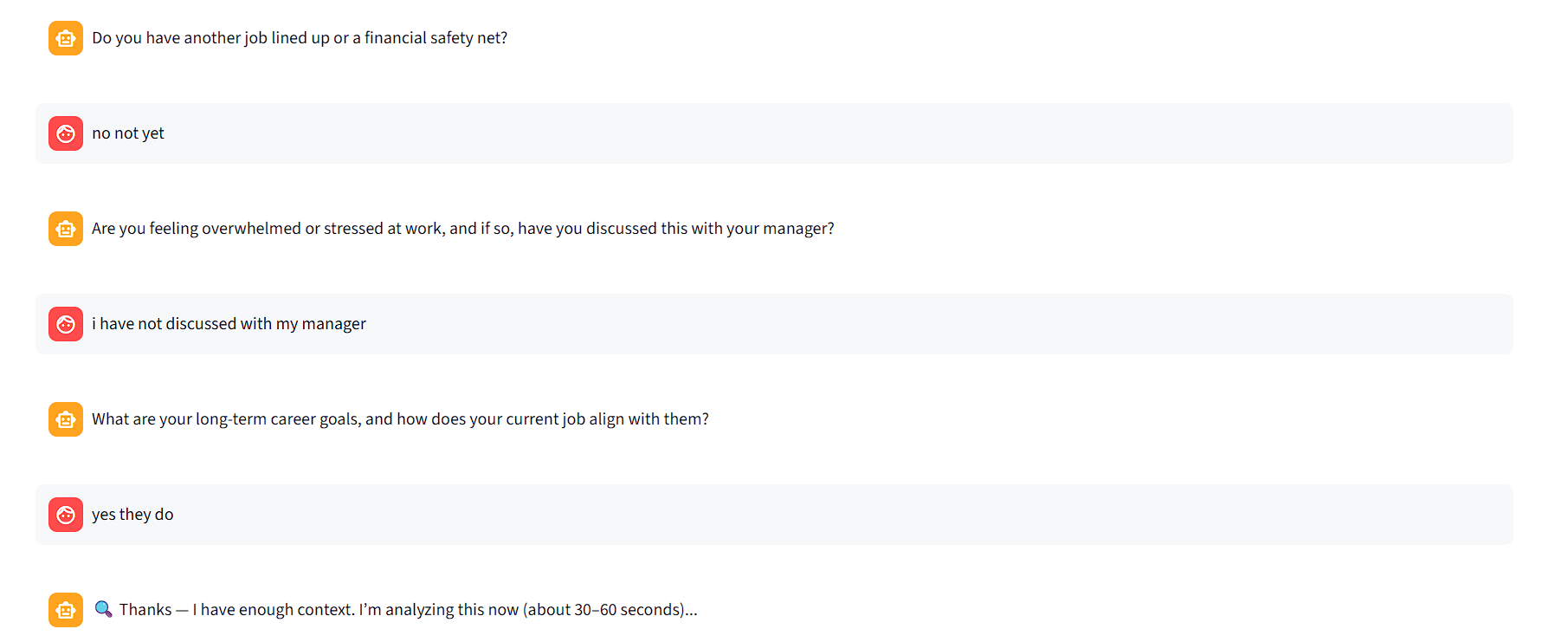
ask questions for clarity before prediction
-
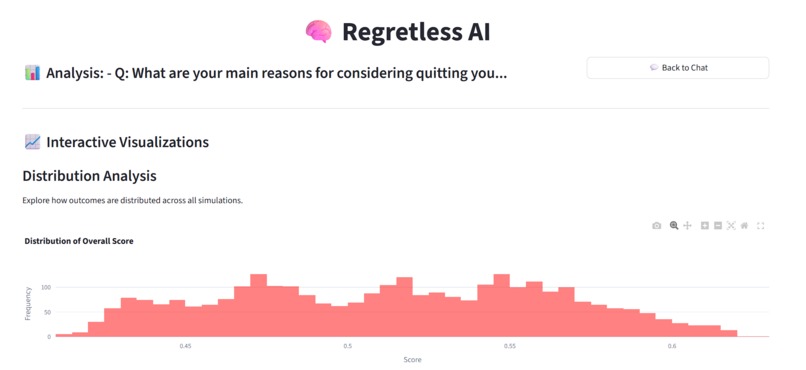
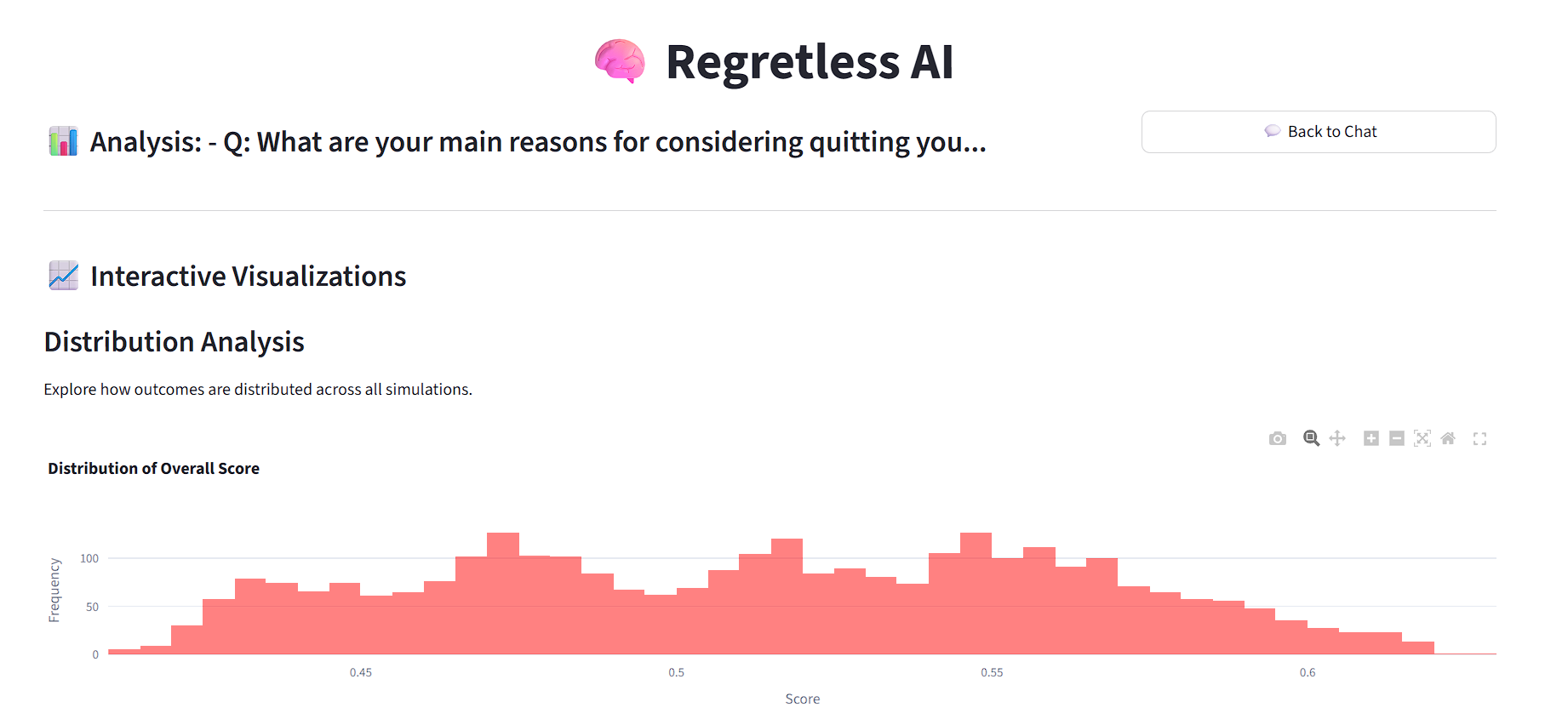
visualization of simluation
-
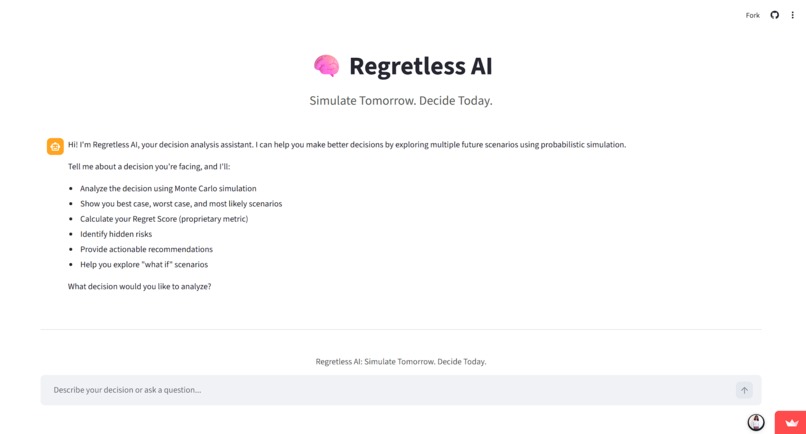
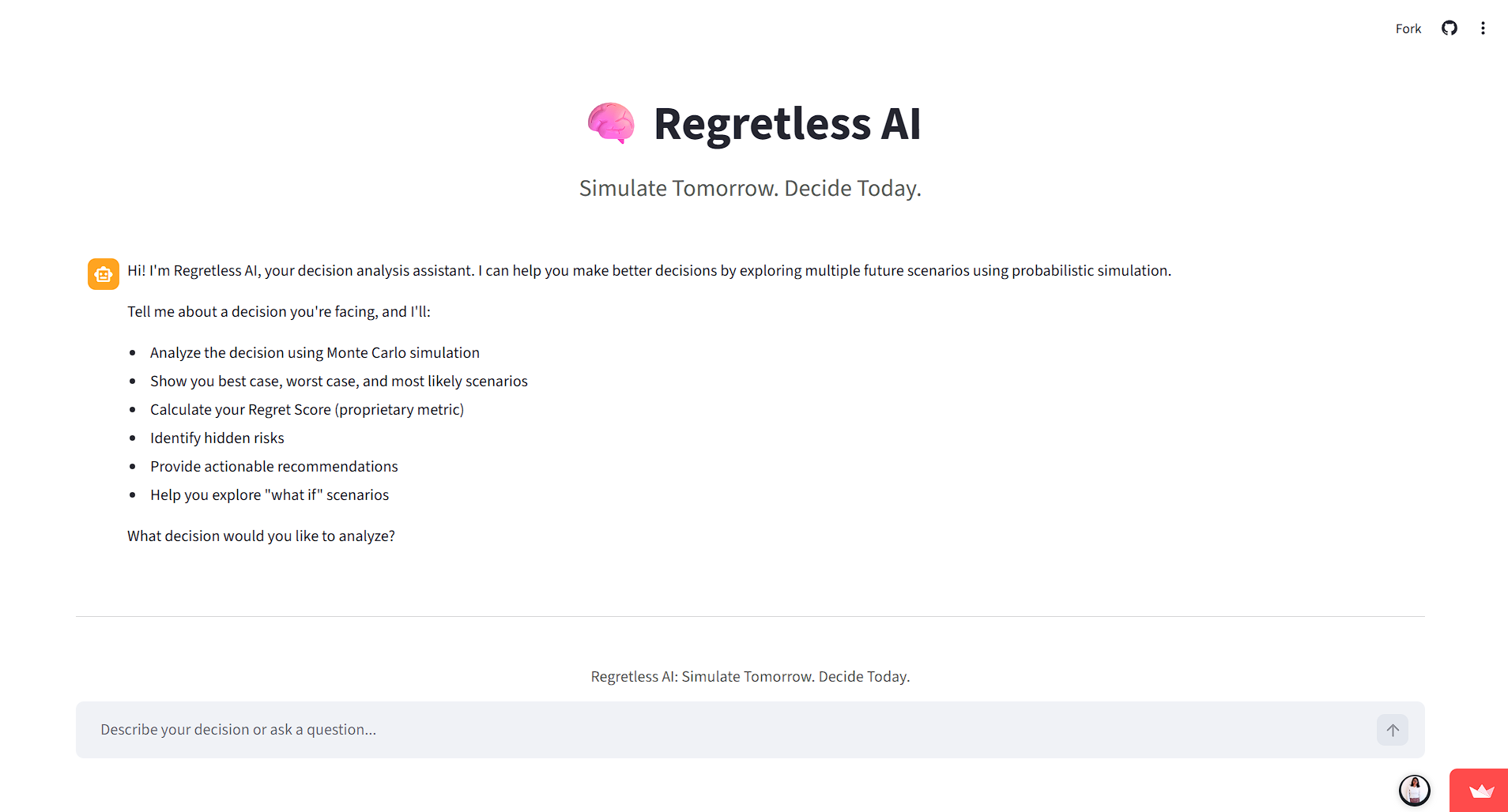
Home page
-
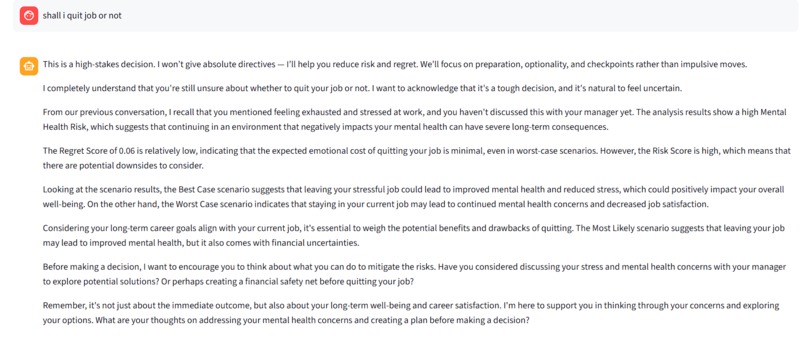
description of final results
Inspiration
Many of the most important decisions in life—education, career moves, finances—are made under uncertainty. Existing tools either overwhelm users with abstract numbers or offer confident AI advice that hides uncertainty and risks regret. We wanted to build a system that helps people think clearly about the future without pretending to predict it. Regretless AI was inspired by the idea that better decisions come from understanding trade-offs, not from being told what to do.
What it does
Regretless AI is a decision intelligence platform that explores thousands of plausible futures for a decision using Monte Carlo simulation. Instead of giving a single prediction, it shows best-case, worst-case, and most-likely scenarios, highlights hidden risks, and explains where regret comes from. An LLM acts as an interpreter—translating probabilistic results into clear narratives, regret paths, and safer next steps—without ever generating or altering probabilities.
How we built it
We designed Regretless AI around a strict role split. A NumPy-based Monte Carlo engine generates all probabilities, scenario distributions, risk metrics, and regret scores. The LLM (via Groq) is used only for meaning: asking clarifying questions, interpreting results, explaining trade-offs, and framing regret using counterfactual reasoning. Deterministic code converts qualitative inputs into distributions, while guardrails ensure the LLM cannot invent numbers or override simulation results. The interface is built with Streamlit, interactive charts use Plotly, and results can be exported as a professional PDF.
Challenges we ran into
The hardest challenge was preventing “AI overconfidence.” Early versions felt authoritative but vague. We solved this by enforcing that only simulations produce numbers and by validating LLM outputs to block invented statistics. Another challenge was making uncertainty understandable without oversimplifying it. This led us to develop scenario stories, human-readable metrics, and regret framing instead of raw scores.
Accomplishments that we're proud of
- Built a production-quality decision intelligence system, not just a chatbot
- Designed a clean separation between probabilistic reasoning and language interpretation
- Implemented anti-hallucination guardrails that enforce “no invented numbers.”
- Introduced an explainable Regret Score grounded in probability and loss
- Added ethical safety gates for high-risk decisions
- Delivered interactive exploration, counterfactuals, and PDF reporting
What we learned
We learned that responsible AI is as much about what not to automate as what to automate. LLMs are powerful interpreters but unreliable predictors. By combining deterministic simulations with human-centered explanations, we were able to build a system that is more trustworthy, understandable, and useful than either approach alone.
What's next for Regretless AI
Next, we plan to add domain-specific structuring heuristics (education, career, health), multi-horizon “Future You” simulations, hard constraints (must-have / must-avoid), and automated evaluation to continuously verify anti-hallucination guarantees. Our long-term goal is to make regret-aware decision intelligence accessible for everyday high-stakes choices.


Log in or sign up for Devpost to join the conversation.